How much do you take home in Australia after tax and the Medicare levy?
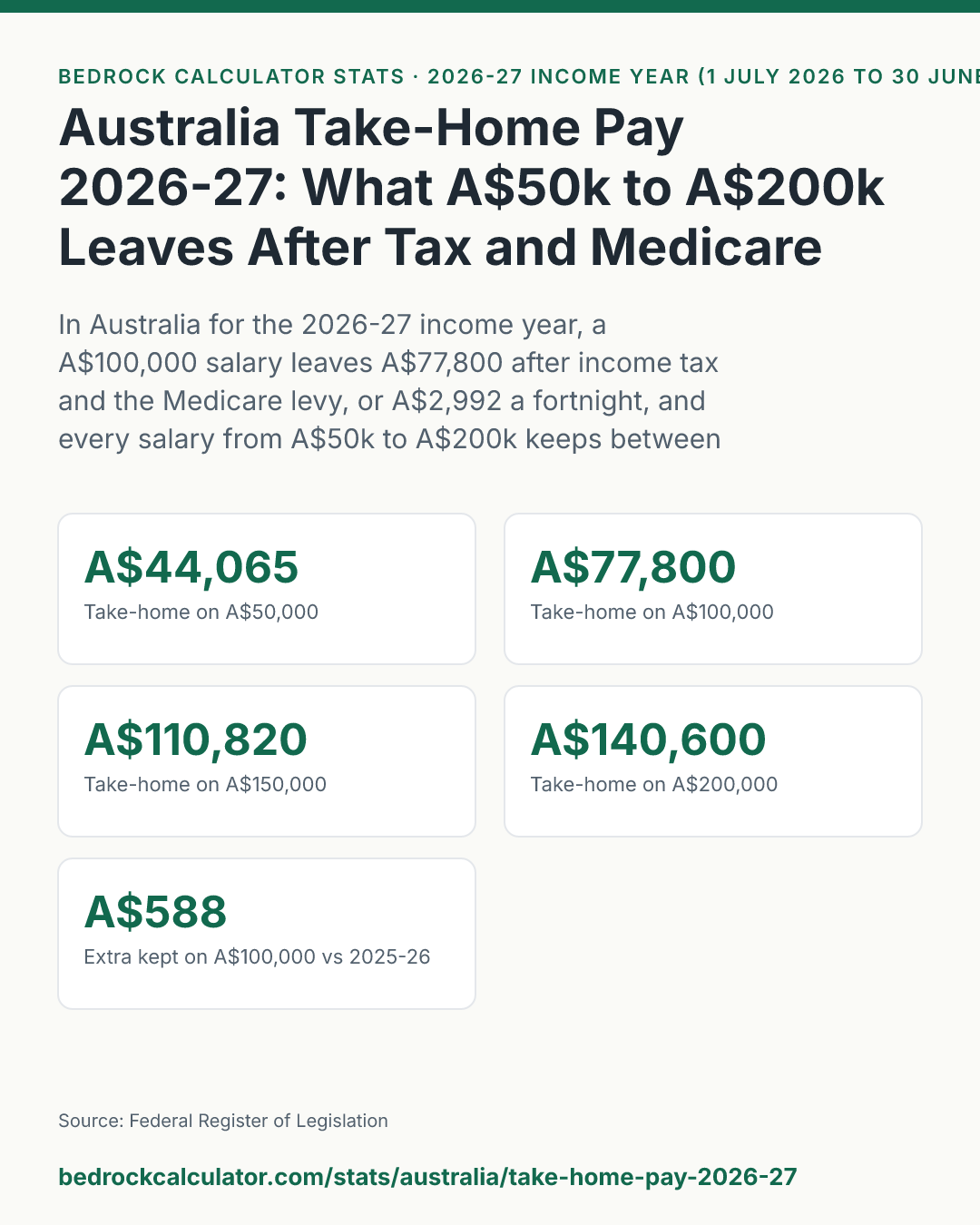
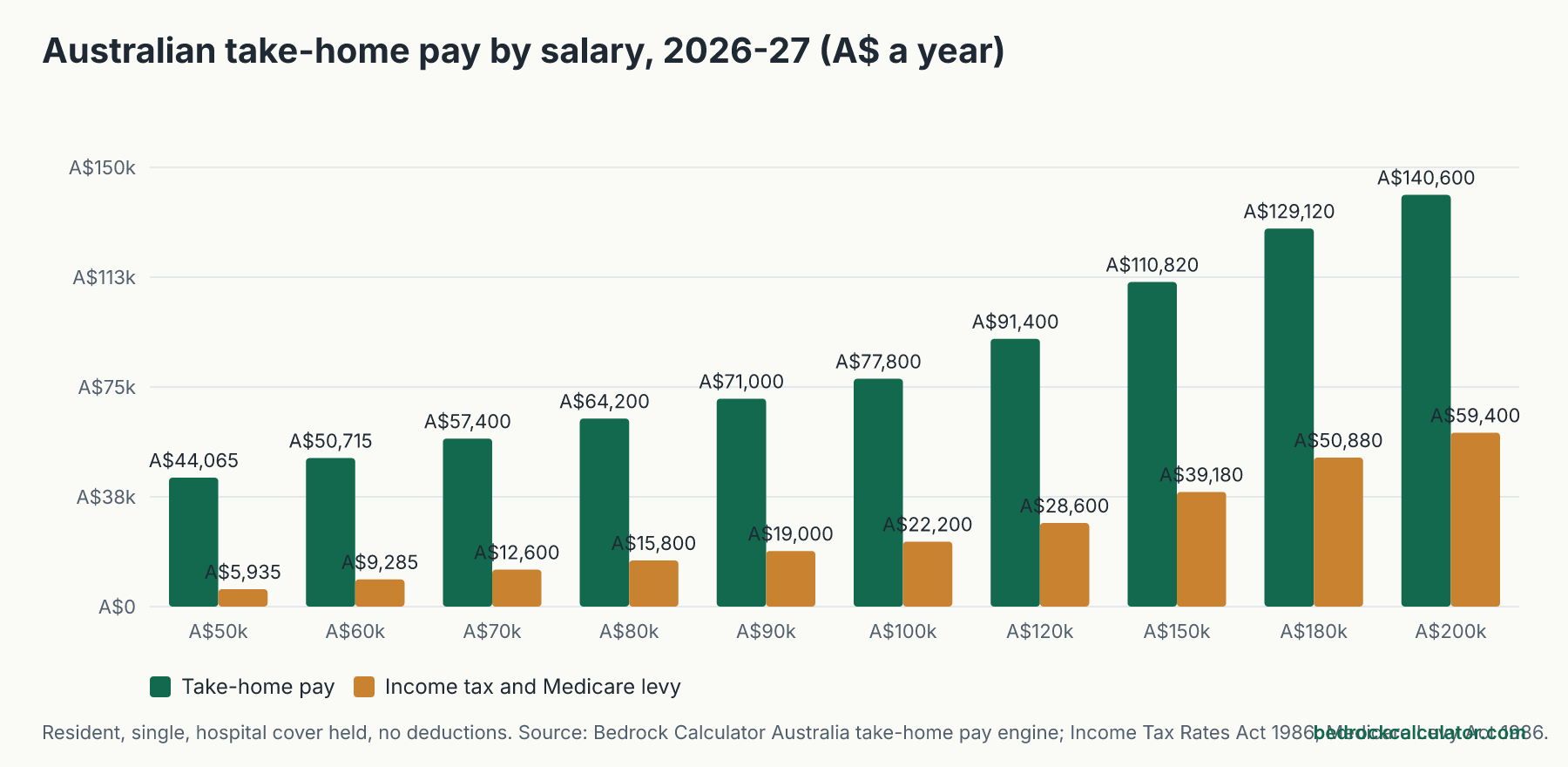
On a A$100,000 salary in Australia, you keep A$77,800 in the 2026-27 income year after income tax and the Medicare levy. That's A$2,992.31 a fortnight, or 77.8% of what you earn. At A$50,000 you keep A$44,065, and at A$200,000 you keep A$140,600.
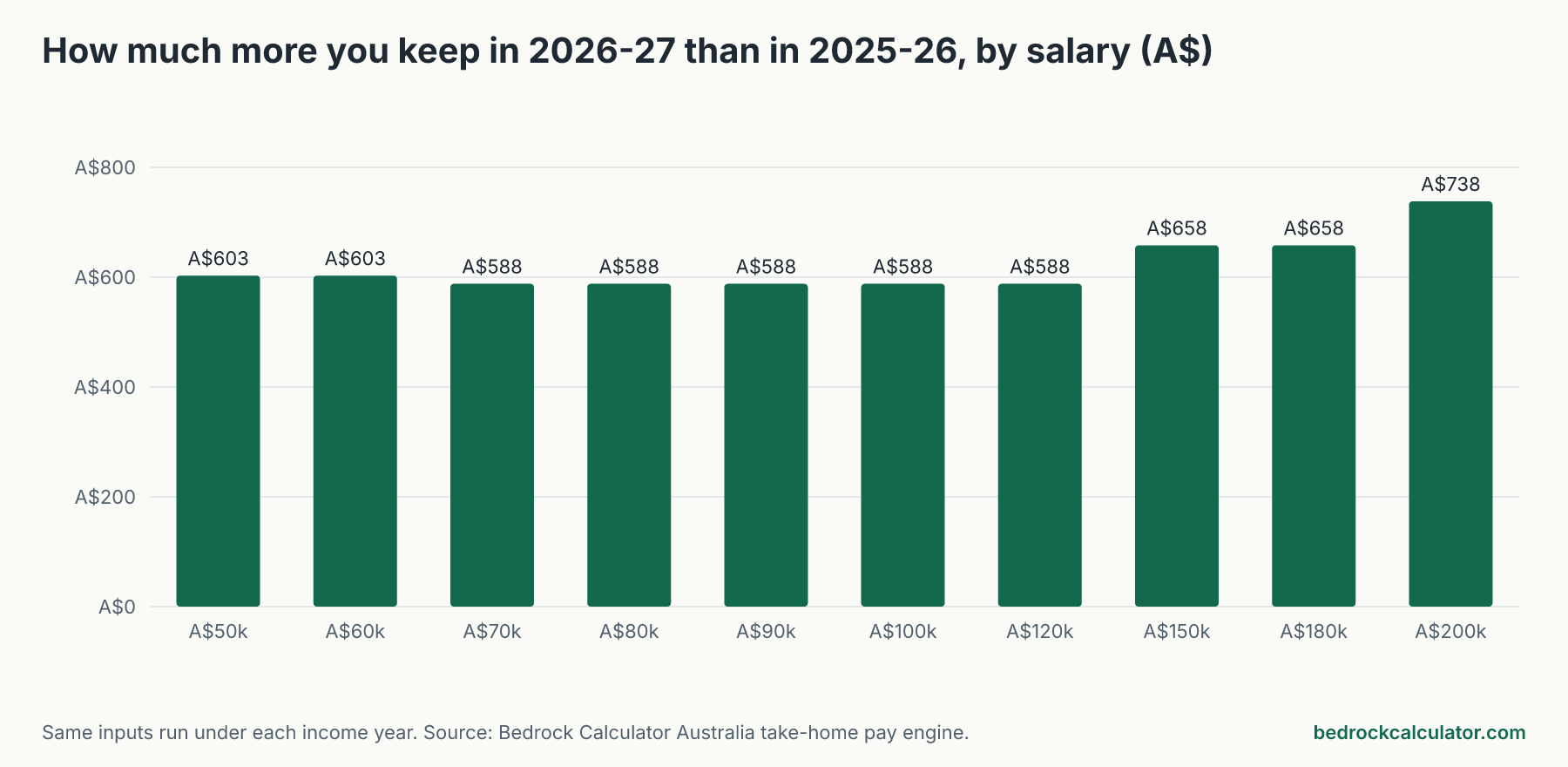
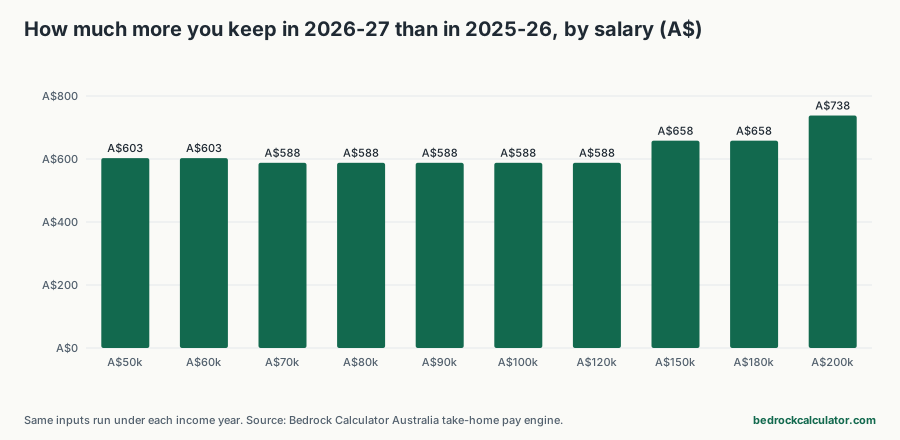
Everyone in that range also keeps a little more than last year. The gain is between A$588 and A$738 a year, thanks to a lower first tax rate and a new standard deduction that both started on 1 July 2026.
How we worked out these numbers
We ran the Australia take-home pay calculator on this site at ten salaries from A$50,000 to A$200,000 and recorded what it returned. Nothing here is an estimate or a survey figure. Each run uses the same setup, so salary is the only thing that changes:
- An Australian resident for tax purposes, single, with no dependants
- Paid fortnightly, salary only
- No work-related deductions claimed, so the new A$1,000 standard deduction applies in full
- No salary sacrifice into super
- Private hospital cover held, so there's no Medicare levy surcharge
The calculator applies the 2026-27 resident tax rates, the low income tax offset (LITO), the standard deduction and the 2% Medicare levy with its low-income phase-in. It works out the tax you'd be assessed for the whole year and divides it by 26, which is how we get the fortnightly figure.
What it leaves out matters. HECS-HELP and other study loan repayments aren't deducted. Neither is anything you put into super yourself. The fortnightly figure is your share of the annual assessment, not what your employer withholds under the ATO's PAYG schedules, so your payslip can differ and the difference is settled when you lodge your return. And the salary is before compulsory employer super, which is paid on top.
Take-home pay on every salary from A$50,000 to A$200,000
Click a column heading to sort. The last column is how much more the same salary leaves you in 2026-27 than it did in 2025-26.
Australia take-home pay by salary, 2026-27 income year (A$)
Download CSVAustralian resident, single, no dependants, private hospital cover held, no work-related deductions claimed so the A$1,000 standard deduction applies, no salary sacrifice. Income tax after the low income tax offset, plus the 2% Medicare levy. Excludes HECS-HELP repayments.
| A$50,000 | A$4,955 | A$980 | A$44,065 | A$1,694.81 | 88.1% | A$603 |
| A$60,000 | A$8,105 | A$1,180 | A$50,715 | A$1,950.58 | 84.5% | A$603 |
| A$70,000 | A$11,220 | A$1,380 | A$57,400 | A$2,207.69 | 82.0% | A$588 |
| A$80,000 | A$14,220 | A$1,580 | A$64,200 | A$2,469.23 | 80.3% | A$588 |
| A$90,000 | A$17,220 | A$1,780 | A$71,000 | A$2,730.77 | 78.9% | A$588 |
| A$100,000 | A$20,220 | A$1,980 | A$77,800 | A$2,992.31 | 77.8% | A$588 |
| A$120,000 | A$26,220 | A$2,380 | A$91,400 | A$3,515.38 | 76.2% | A$588 |
| A$150,000 | A$36,200 | A$2,980 | A$110,820 | A$4,262.31 | 73.9% | A$658 |
| A$180,000 | A$47,300 | A$3,580 | A$129,120 | A$4,966.15 | 71.7% | A$658 |
| A$200,000 | A$55,420 | A$3,980 | A$140,600 | A$5,407.69 | 70.3% | A$738 |
How much is A$100,000 after tax in Australia?
A$77,800 a year. Income tax is A$20,220 and the Medicare levy is A$1,980, so A$22,200 goes to the ATO in total, an average rate of 22.2%.
Notice that taxable income is A$99,000, not the full salary. That's the standard deduction at work. From 2026-27 every resident earning salary or wages gets a deduction of up to A$1,000 for work-related expenses without needing receipts. If you already claim that much or more in actual expenses, it adds nothing; if you claim less, it tops you up to A$1,000.
Your marginal rate at A$100,000 is 30.00% plus the 2% levy. That's the rate on your next dollar, which is why a pay rise from A$100,000 to A$150,000 adds A$33,020 to take-home pay rather than the full increase. The next step, from A$150,000 to A$200,000, adds A$29,780, because more of it falls in the 37.00% bracket and then the 45.00% bracket above it.
Why you keep a smaller share as pay rises
Australia's tax scale is progressive. The first A$18,200 is tax-free for residents, and each band above it is taxed at a higher rate. So the share you keep falls from 88.1% at A$50,000 to 77.8% at A$100,000 and 70.3% at A$200,000.
At the lower end, LITO softens things a little. It's worth A$265 at A$50,000 and runs out entirely before A$70,000, which is one reason the gap between salaries looks uneven at the bottom of the table.
What changed from 2025-26
Two things, both from 1 July 2026. The first tax rate, on income between the tax-free threshold and the next band, fell from 16% to 15%. And the A$1,000 standard deduction started.
The chart above shows what that adds up to. At A$50,000 you keep A$603 more. Across the middle of the range the gain is A$588. At A$200,000 it's A$738, because the standard deduction saves tax at your top marginal rate, and that rate is higher for bigger salaries. The rate cut itself is worth the same to anyone earning above the first band.
None of this is a big change on its own, but it's permanent, and the first rate is legislated to drop again in 2027-28.
Turning this into your own number
These figures are a clean comparison, not a prediction of your payslip. Your own take-home will be lower if you're repaying HECS-HELP, if you don't hold hospital cover and earn enough to pay the Medicare levy surcharge, or if you salary sacrifice into super. It will be higher if you claim more than A$1,000 in work expenses.
To see your own figure, open the Australia take-home pay calculator and enter your salary, pay cycle and deductions. If you want to see the tax side in more detail, the Australia income tax calculator breaks down each bracket, the Medicare levy calculator shows the low-income phase-in, and the HECS-HELP calculator shows what a study loan would take from each pay. For more on study loans, see our HECS-HELP repayments for 2026-27, and for a cross-country view, take-home pay by country.