How much does a novated lease really save in Australia?
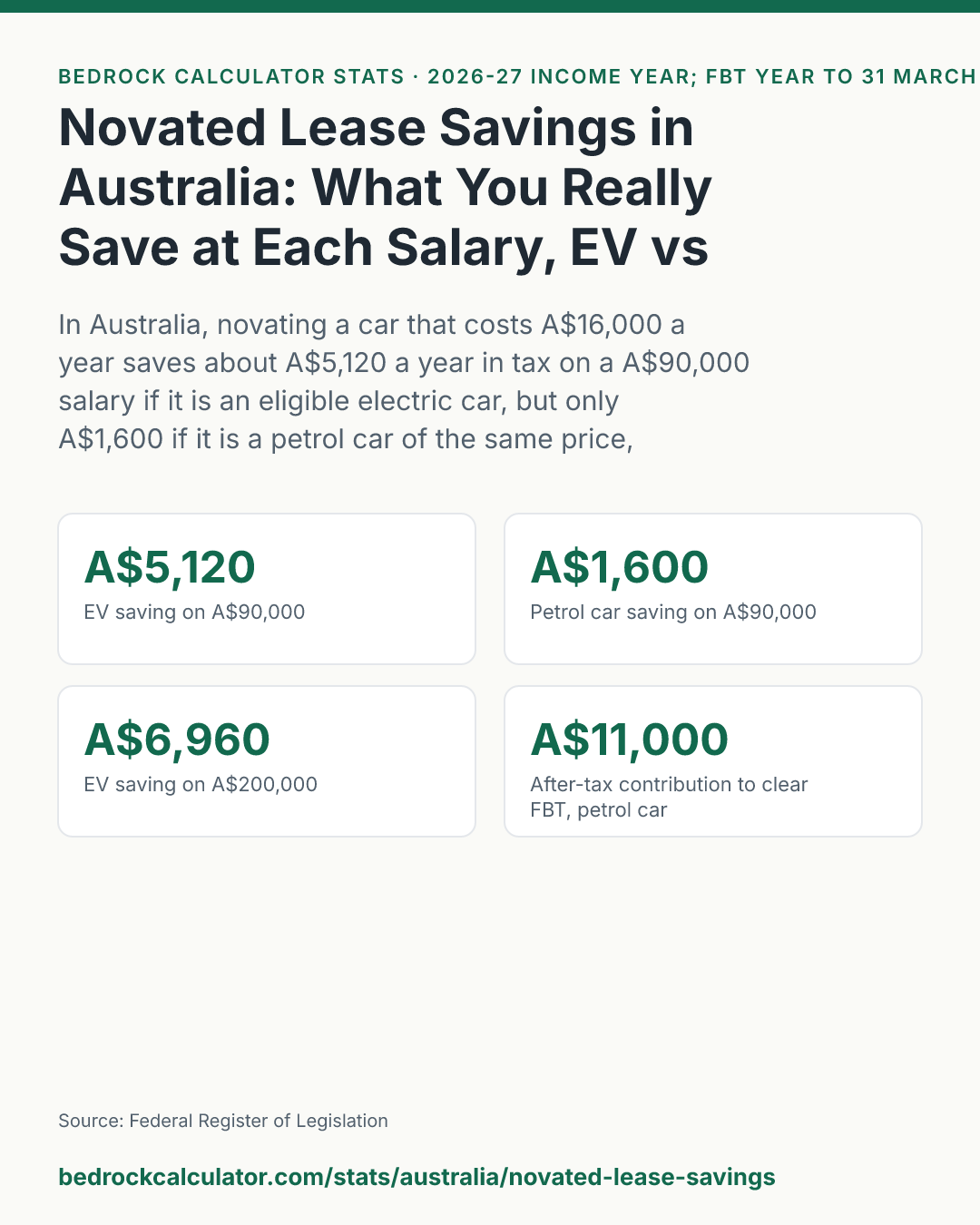
A novated lease saves real money in Australia, but how much depends almost entirely on whether the car is an eligible electric vehicle. For a A$55,000 car costing A$16,000 a year to lease and run, someone on A$90,000 saves about A$5,120 a year in income tax and Medicare levy with an electric car.
With a petrol car of the same price and the same running costs, the saving is A$1,600.
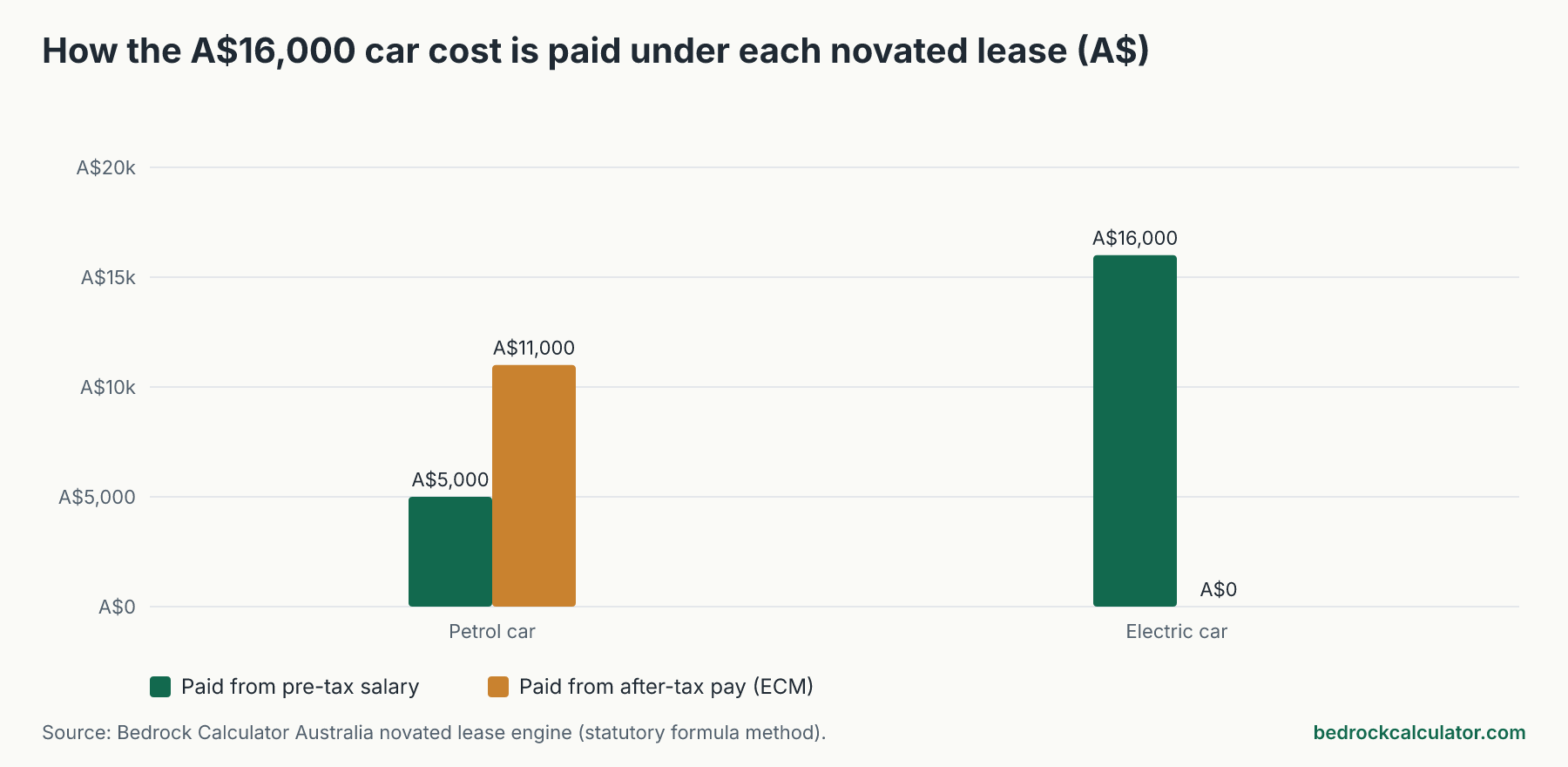
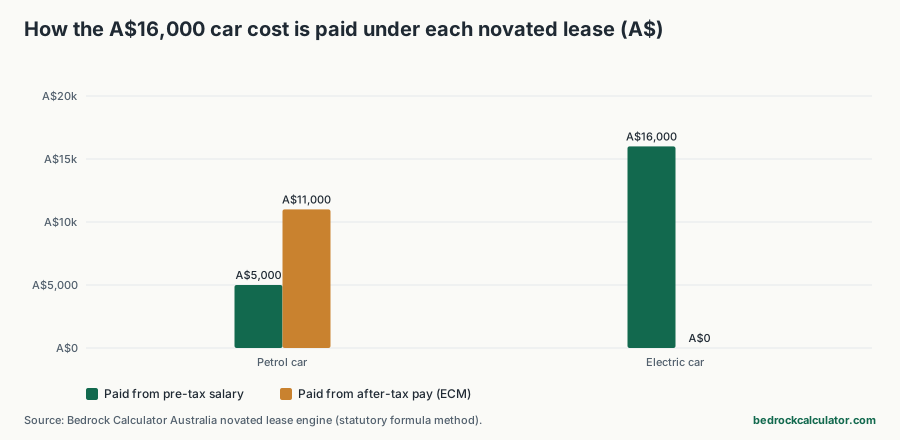
The difference, A$3,520 a year at that salary, comes from fringe benefits tax. An eligible EV is exempt. A petrol car isn't, and the usual way to avoid the FBT bill means paying A$11,000 of the car's cost from after-tax pay.
How we worked out these numbers
A novated lease is a three-way arrangement: you lease a car, and your employer pays the lease and running costs out of your salary before tax. Your taxable income falls, so you pay less income tax. The catch is that a car provided this way is a fringe benefit, and your employer would owe FBT on it unless something removes it.
We used two calculators on this site. The Australia novated lease calculator works out the FBT position using the statutory formula: the taxable value is 20% of the car's price, here A$11,000. With no employee contribution, the FBT bill on a petrol car would be A$9,755. Paying A$11,000 from after-tax pay, the employee contribution method, reduces the taxable value to nil, so no FBT is owed. For an eligible EV the calculator returns no FBT at all.
Then the Australia take-home pay calculator gave take-home pay for 2026-27 on the full salary, and on the salary reduced by the part of the car cost paid before tax. The saving is the difference between paying the whole A$16,000 from after-tax pay and paying it through the lease.
The example car is the same in every run:
- Price for FBT purposes of A$55,000
- A$16,000 a year of lease payments and running costs
- Petrol car: A$5,000 packaged before tax and A$11,000 paid after tax
- Electric car: all A$16,000 packaged before tax
What this leaves out
These figures cover income tax and the Medicare levy only, and it's worth being clear about what that misses.
GST. Your employer can usually claim back GST on the car's purchase price and running costs, and pass that saving on. That can be worth a lot, especially for a petrol car, and isn't counted here. So the petrol car saving shown is likely understated.
Lease costs. We've assumed the lease and running costs are the same A$16,000 whether you novate or pay yourself. In practice a novated lease carries its own interest rate, fees and a residual payment at the end, which can easily outweigh part of the saving. Compare the lease's total cost with buying the car outright on a car loan.
Reportable fringe benefits. Even an FBT-exempt EV counts as a reportable fringe benefit. That's added to your income for the Medicare levy surcharge test, HECS-HELP repayments, family payments and some other income tests, which can cost you elsewhere. The take-home pay figures here assume you hold private hospital cover and have no study loan.
EV eligibility. The FBT exemption covers battery electric and hydrogen fuel cell cars below the luxury car tax threshold for fuel-efficient vehicles. Plug-in hybrids lost the exemption for new arrangements from 1 April 2025.
Novated lease savings at every salary
Click a column heading to sort.
Novated lease savings in Australia by salary, 2026-27: petrol car vs electric car (A$ a year)
Download CSVA$55,000 car, A$16,000 a year of lease and running costs. Petrol car: FBT removed with an employee contribution of A$11,000 from after-tax pay, the rest packaged pre-tax. Eligible EV: FBT-exempt, all A$16,000 packaged pre-tax. Income tax and Medicare levy only; GST savings and lease fees not included.
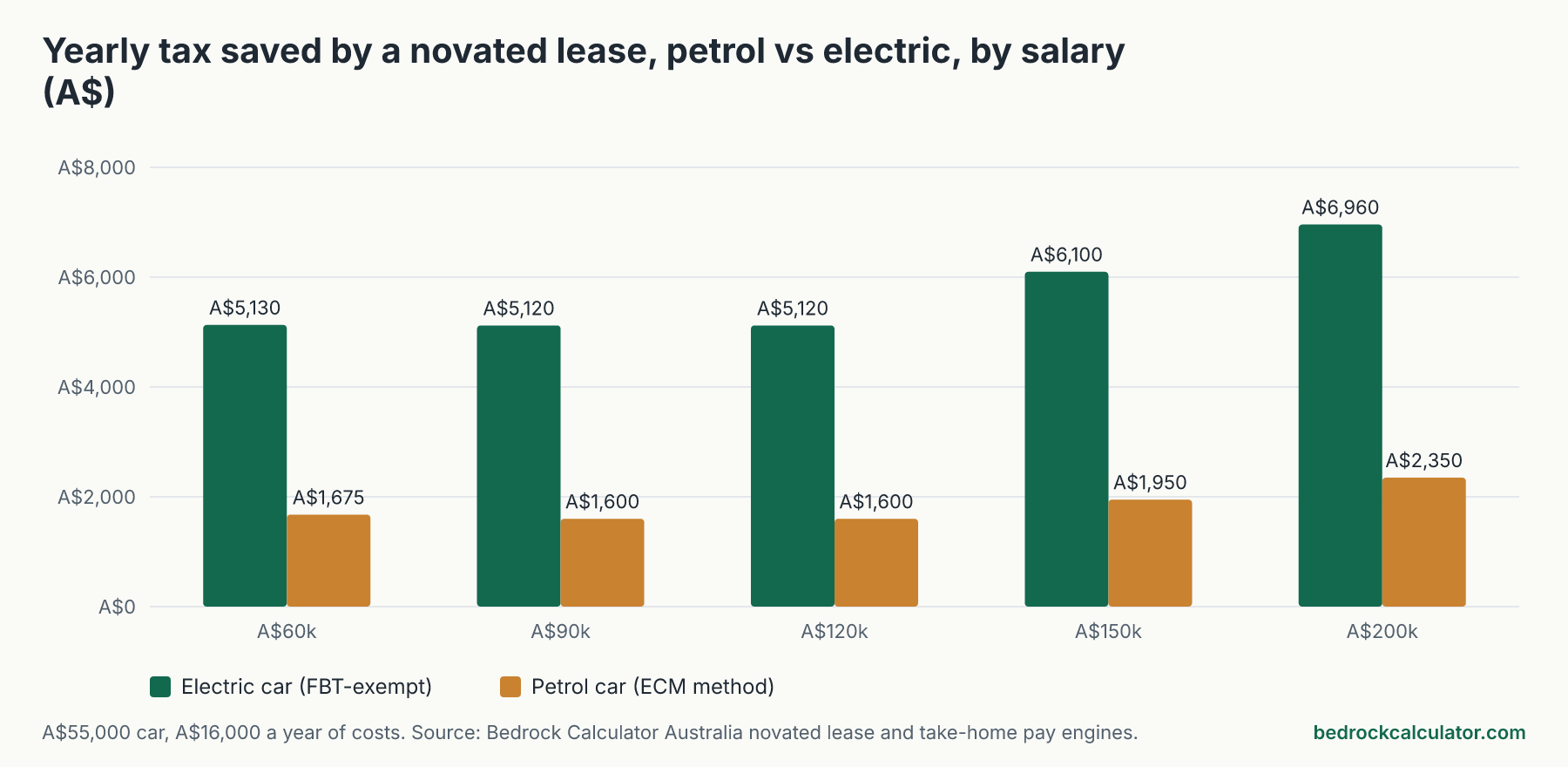
| A$60,000 | A$1,675 | A$5,130 | 32.1% |
| A$90,000 | A$1,600 | A$5,120 | 32.0% |
| A$120,000 | A$1,600 | A$5,120 | 32.0% |
| A$150,000 | A$1,950 | A$6,100 | 38.1% |
| A$200,000 | A$2,350 | A$6,960 | 43.5% |
Why the electric car saves so much more
With the EV, all A$16,000 of the car cost comes out of pre-tax salary, so the whole amount saves tax at your marginal rate plus the Medicare levy. At A$90,000 that's A$5,120, or 32.0% of the car's yearly cost, about A$196.92 a fortnight.
With the petrol car, only A$5,000 is packaged before tax. The other A$11,000 has to come from after-tax pay to clear the FBT, so the saving at A$90,000 is A$1,600, about A$61.54 a fortnight and only 10.0% of the car's cost.
Higher salaries save more
Because the saving comes from a lower marginal rate on the packaged amount, it grows with income. For the EV it rises from A$5,130 at A$60,000 to A$6,100 at A$150,000 and A$6,960 at A$200,000, where it covers 43.5% of the car's yearly cost. Between A$90,000 and A$120,000 the saving stays at A$5,120, because both salaries are in the same tax bracket before and after packaging.
For the petrol car the pattern is the same but much smaller: A$1,675 at A$60,000 and A$2,350 at A$200,000.
Is a novated lease worth it for you?
For an eligible EV, the tax saving is large enough at most salaries that a novated lease is usually worth a close look, as long as the lease itself is competitively priced. For a petrol car, the case rests mostly on GST and on whether the lease is cheaper than financing the car another way.
To run your own numbers, start with the novated lease calculator for the FBT position on your car, then compare your take-home pay with and without the packaged amount in the take-home pay calculator. The FBT calculator covers other fringe benefits. For what your salary leaves before any packaging, see Australian take-home pay for 2026-27.