What super balance does the Super Guarantee alone build by 67?
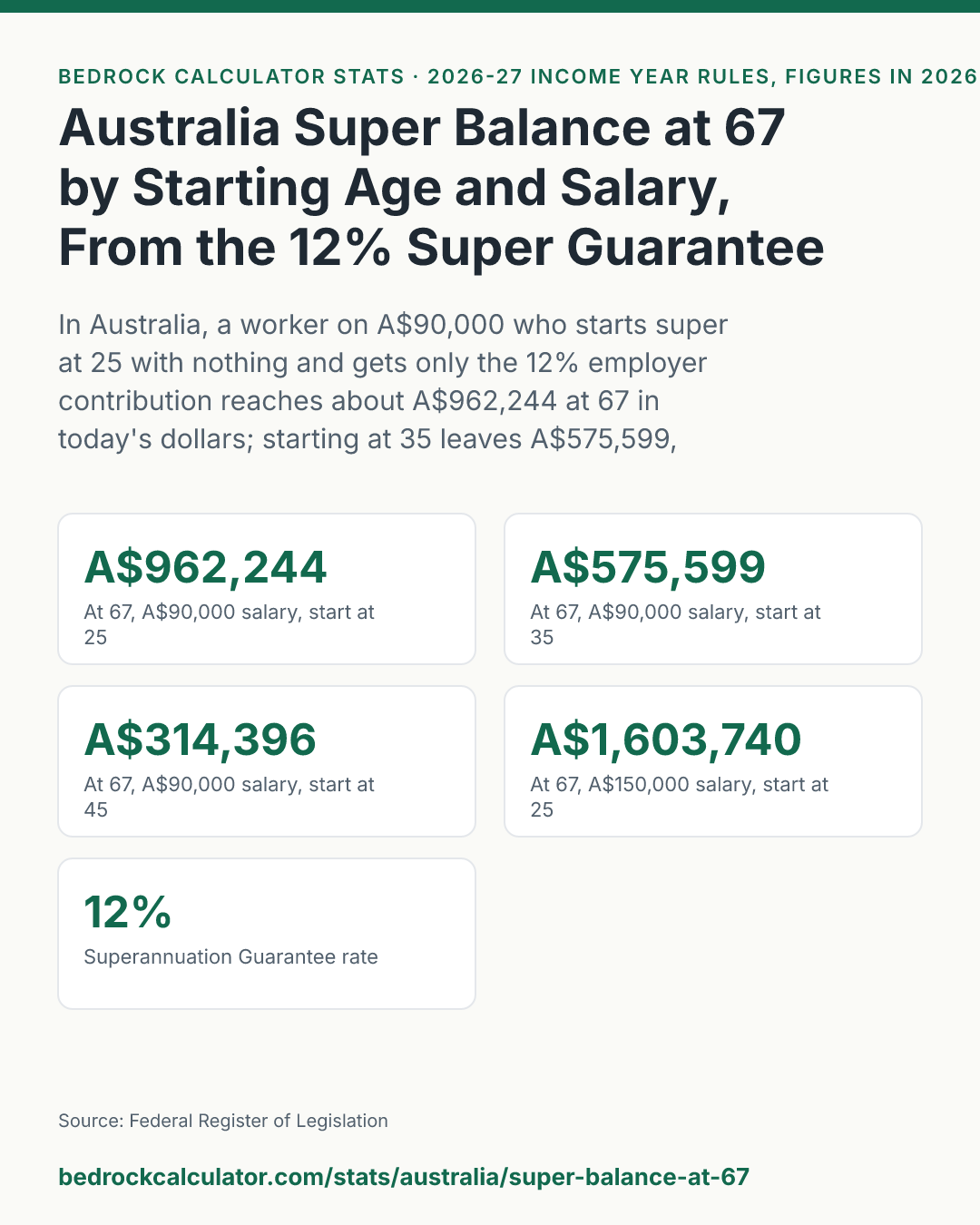
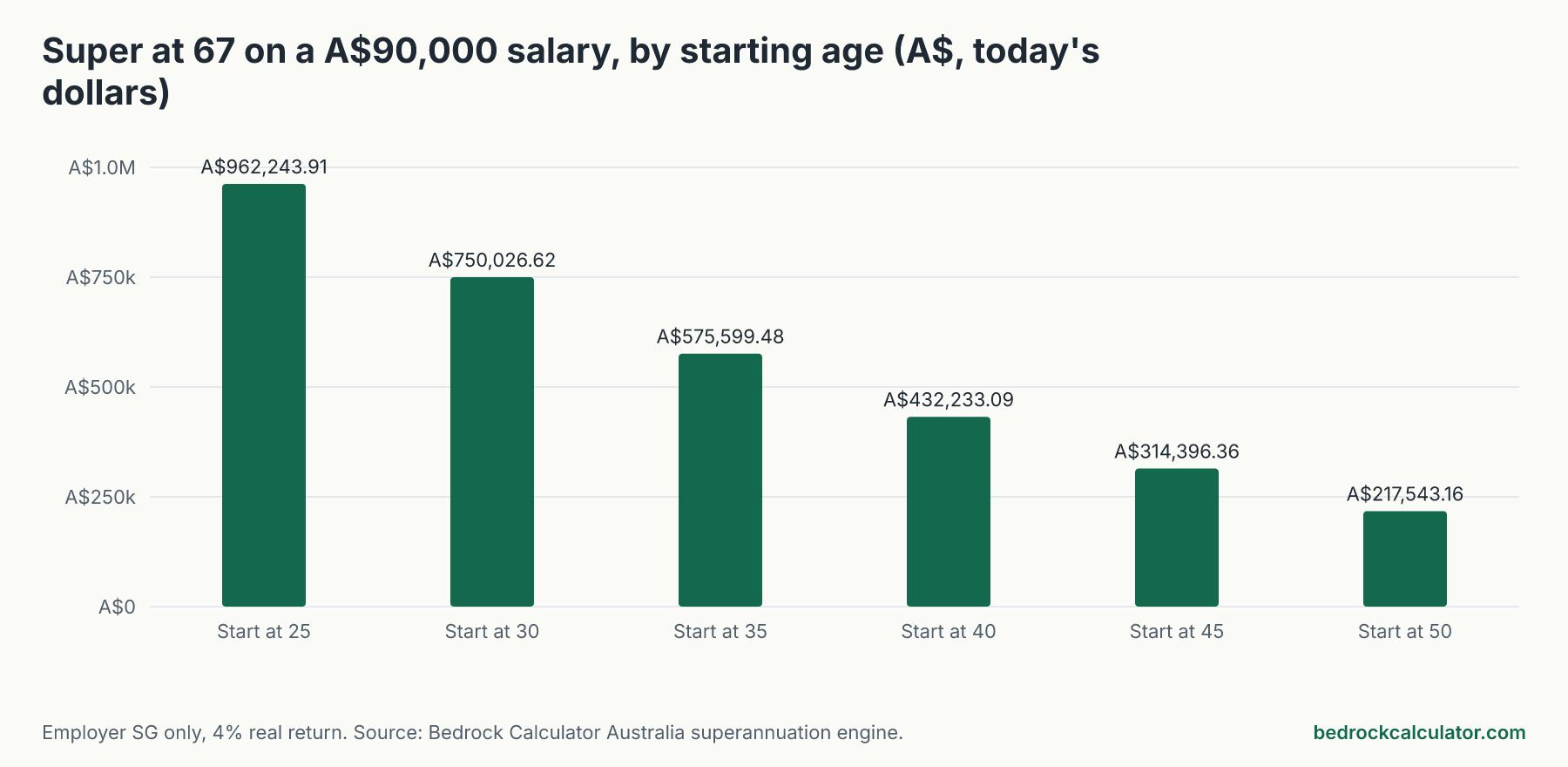
If you earn A$90,000 in Australia, start super at 25 with an empty account and never add a dollar beyond what your employer pays, you'd have about A$962,244 at 67 in today's dollars. Start at 35 and it's A$575,599. Start at 45 and it's A$314,396.
The pattern holds at every salary. The age you start matters more than almost anything else you control, because the earliest contributions have the longest to grow.
How we worked out these numbers
We ran the Australia superannuation calculator on this site for six starting ages, from 25 to 50, and four salaries, from A$60,000 to A$150,000, each time projecting to age 67. Every run uses the same assumptions:
- The account starts at zero on the starting age
- Your employer pays the Superannuation Guarantee of 12% of salary, the rate the calculator holds for 2026-27
- 15% contributions tax comes off each contribution as it goes in
- No salary sacrifice and no after-tax contributions
- Salary stays the same in today's dollars for the whole career
- The fund returns 4% a year after inflation
That last pair of assumptions is deliberate. Holding salary flat and using a return above inflation means every figure reads in 2026 dollars, which is what you need to judge whether a balance is enough. A balance projected in future dollars always looks bigger than it really is.
The 4% is meant to be net of fees and of the tax a fund pays on its earnings. The calculator doesn't charge either separately, so the return you enter has to absorb them. If your fund's fees are high, or you hold a conservative option, a lower figure is more realistic. The second chart below shows how much that matters.
Some things the calculator leaves out. It doesn't model career breaks, part-time years, insurance premiums inside super, the government co-contribution, or Division 293 tax for high earners. It applies the guarantee to the whole salary, which is fine here because every salary we used is below the A$270,830 maximum contribution base for 2026-27, and none of these scenarios goes over the A$32,500 concessional cap.
Super at 67 for every starting age and salary
Read across a row to see what salary does, and down a column to see what starting age does. All figures are in today's dollars.
Australia: super balance at 67 by starting age and salary (A$, today's dollars)
Download CSVStarting from a zero balance. Employer Superannuation Guarantee of 12% only, less 15% contributions tax. Salary held flat in today's dollars; 4% a year return after inflation, fees and earnings tax.
| 25 | A$641,496 | A$962,244 | A$1,282,992 | A$1,603,740 |
| 30 | A$500,018 | A$750,027 | A$1,000,036 | A$1,250,044 |
| 35 | A$383,733 | A$575,599 | A$767,466 | A$959,332 |
| 40 | A$288,155 | A$432,233 | A$576,311 | A$720,388 |
| 45 | A$209,598 | A$314,396 | A$419,195 | A$523,994 |
| 50 | A$145,029 | A$217,543 | A$290,058 | A$362,572 |
How much super will I have at 67?
On these assumptions, a A$60,000 earner who starts at 25 ends up with A$641,496. A A$150,000 earner who starts at the same age ends up with A$1,603,740. Because the guarantee is a flat percentage of salary, the balance scales in proportion: double the salary and you double the balance.
Starting age is a different story. On A$90,000, the balance at 67 falls from A$962,244 if you start at 25 to A$750,027 at 30, A$432,233 at 40 and A$217,543 at 50. Waiting from 25 to 35 costs A$386,644, which is 40.2% of what you'd otherwise have.
Why the first decade does so much work
Your employer puts in A$10,800 a year on a A$90,000 salary. After contributions tax, A$9,180 lands in your account. Over a career starting at 25, that adds up to A$453,600 of contributions before tax, of which A$68,040 goes in contributions tax.
The rest of the final balance, A$576,684, is investment growth. That's 59.9% of the A$962,244 total. For someone starting at 45, growth is only 35.8% of the final balance, because the money has far less time to compound.
What happens if returns are higher or lower
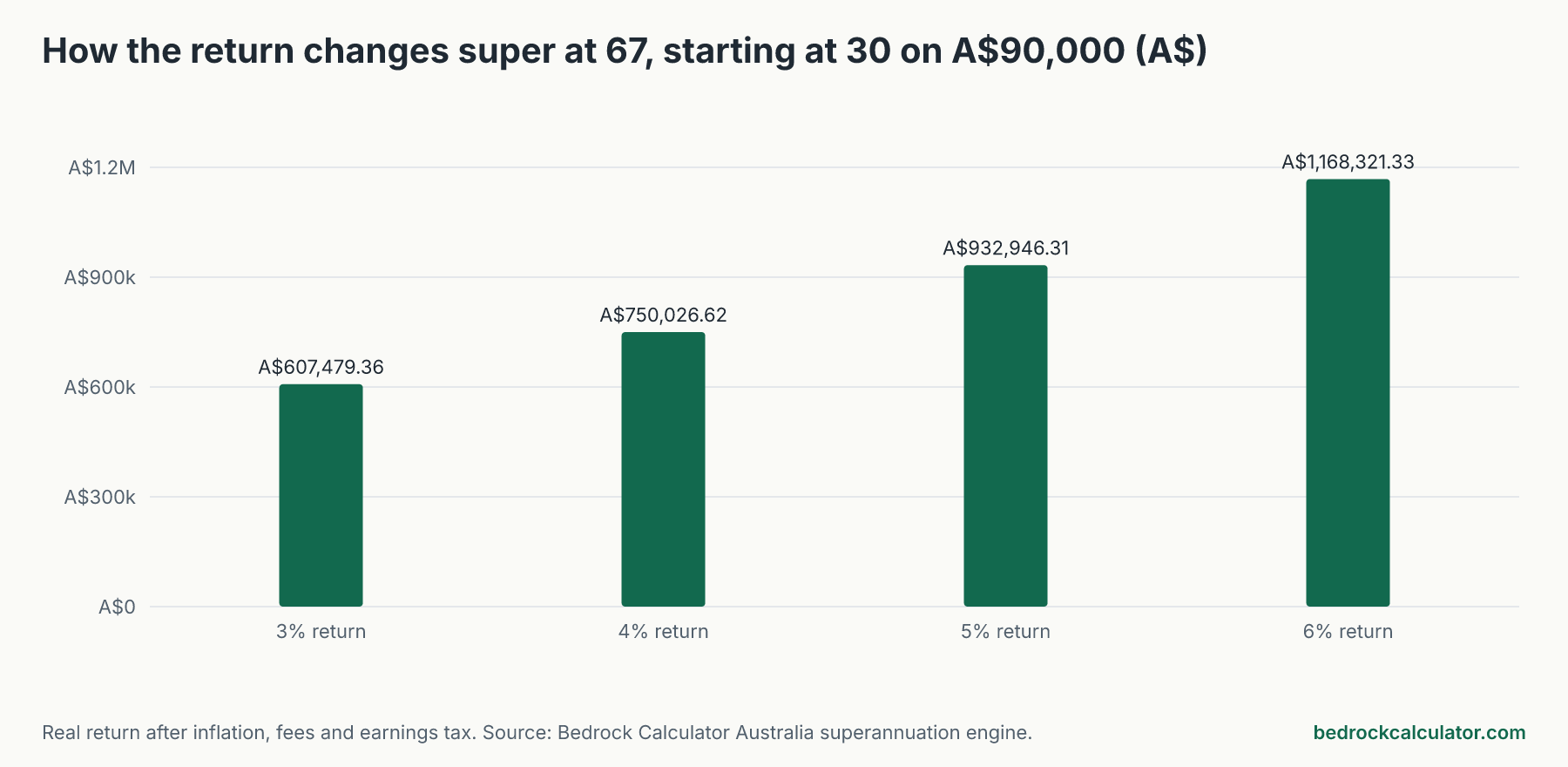
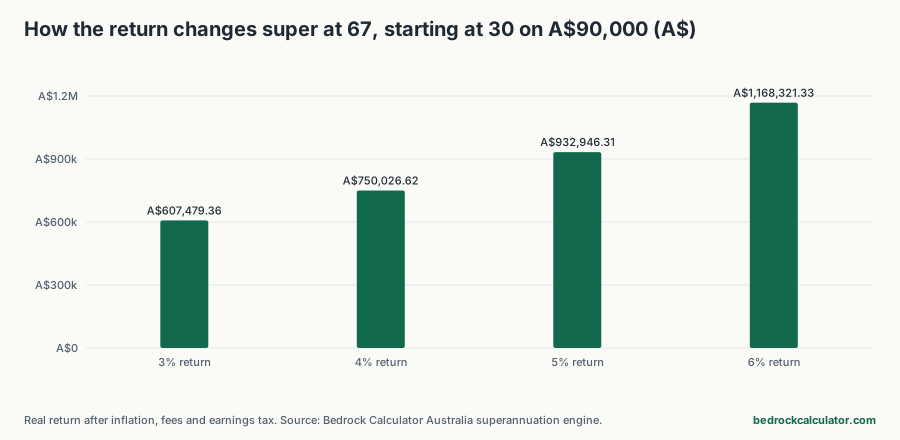
The return assumption moves the answer a lot. For someone starting at 30 on A$90,000, a 4% real return gives A$750,027 at 67. At 3% it would be A$607,479. At 5% it would be A$932,946, and at 6% it would be A$1,168,321.
Nobody knows what returns will be over forty years, so treat any single projection as one possible path. What the chart does show is that fees matter: a fund that costs you an extra percentage point a year pushes you one bar to the left.
Is employer super alone enough?
That depends on what you need in retirement, whether you own your home, and whether you'll get any Age Pension, none of which this page models. What the table does show is that someone who starts late on a modest salary, say A$60,000 from age 50, reaches only A$145,029.
The usual ways to close a gap are salary sacrifice, after-tax contributions, and using unused concessional cap from earlier years, which you can carry forward while your total super balance is below A$500,000. The superannuation calculator lets you add any of those to your own projection.
Running your own super projection
Your real balance will depend on your current balance, your fund's fees and investment option, pay rises above inflation, time out of the workforce and any extra contributions. Enter your own figures in the Australia superannuation calculator. If you earn over the Division 293 threshold, the Division 293 and FHSS calculator shows the extra tax on your contributions, and the transfer balance cap calculator covers how much you can later move into a tax-free retirement pension. For what your salary leaves after tax today, see Australian take-home pay for 2026-27.