How much stamp duty do you pay in NSW, Victoria and Queensland?
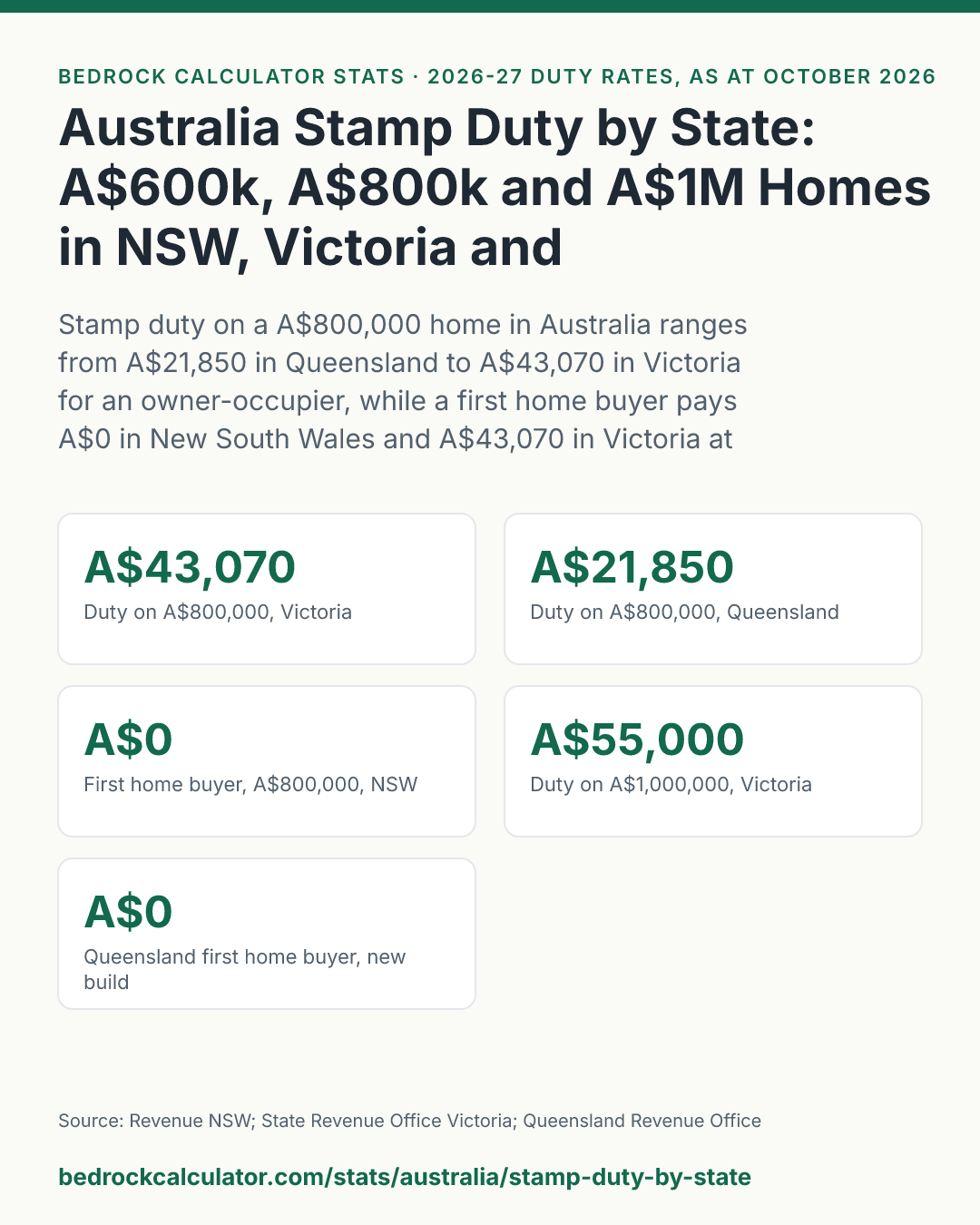
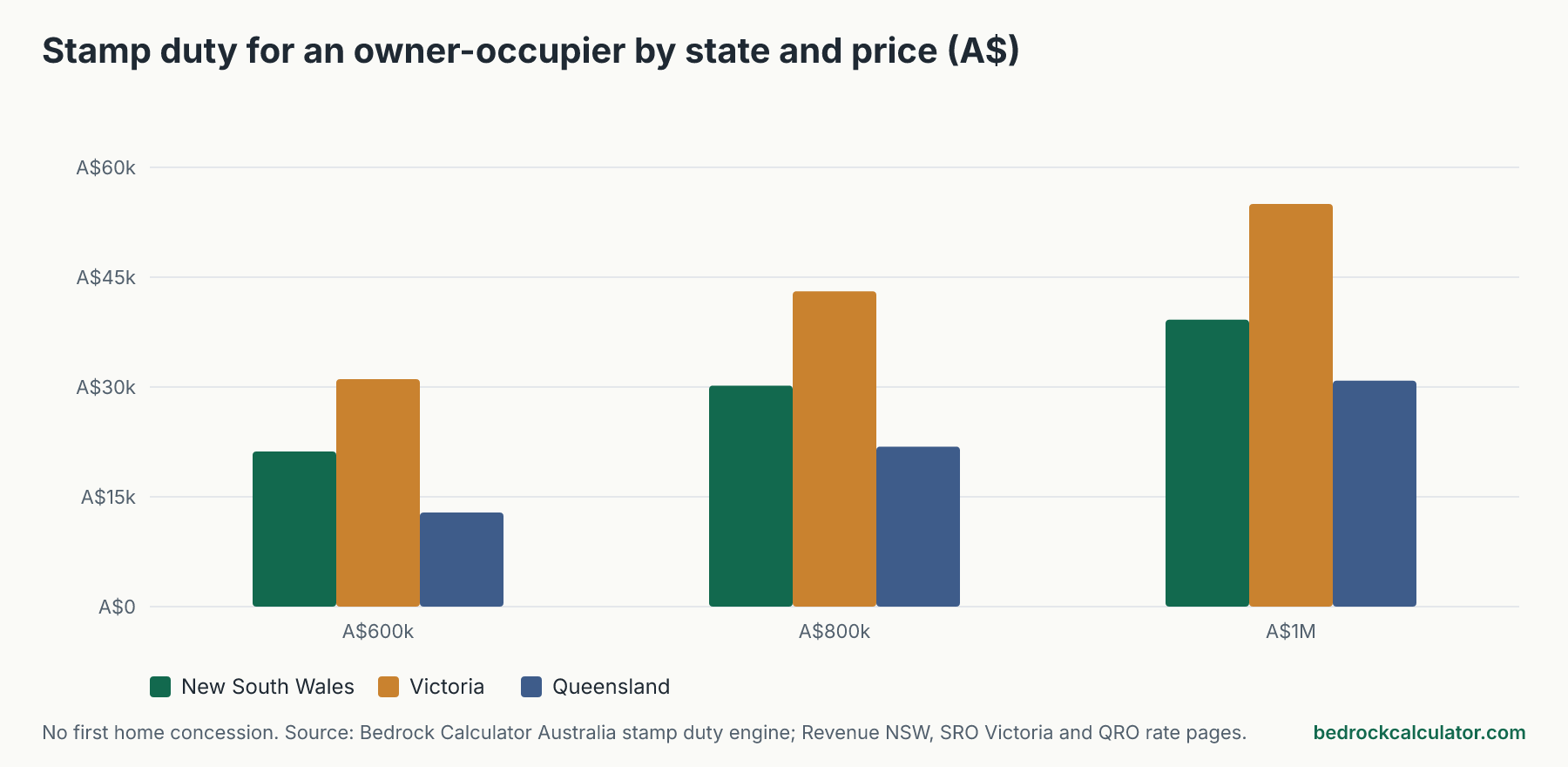
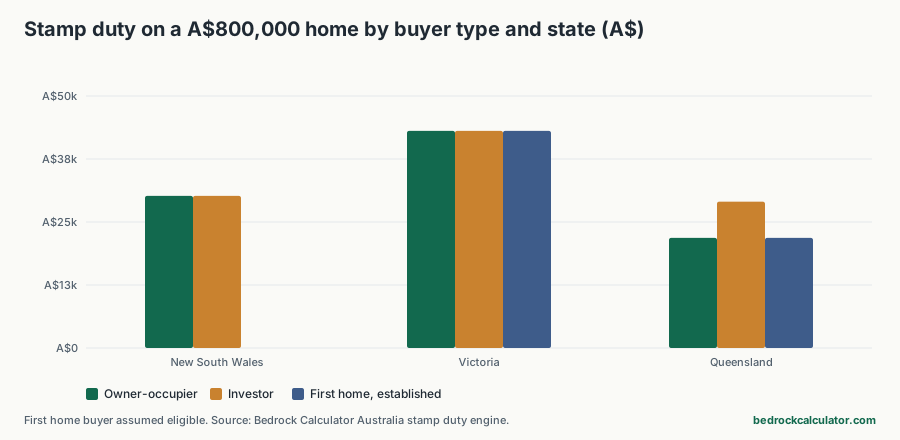
Buy the same A$800,000 home in three Australian states and the stamp duty bill swings by A$21,220. An owner-occupier pays A$21,850 in Queensland, A$30,187 in New South Wales and A$43,070 in Victoria.
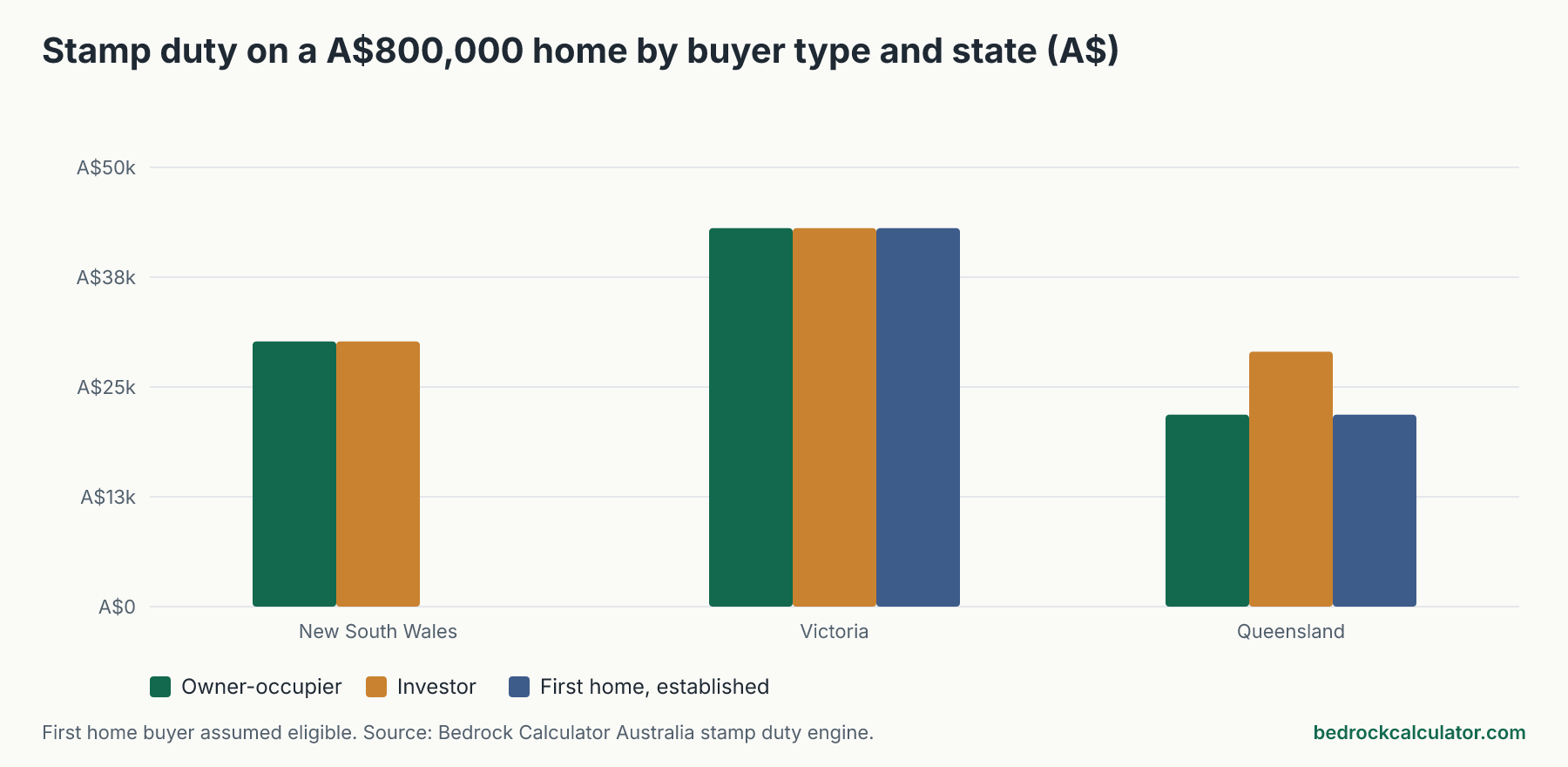
First home buyers change the picture completely. In New South Wales an eligible first home buyer pays A$0 on a A$800,000 home, while in Victoria the first home concession has already run out at that price and the bill stays at A$43,070.
How we worked out these numbers
We ran the Australia stamp duty calculator on this site for three prices, A$600,000, A$800,000 and A$1,000,000, in each of the three states it covers, and for four kinds of buyer:
- An owner-occupier who will live in the home and isn't using a first home concession
- An investor buying the same property to rent out
- A first home buyer of an established home, assumed to meet every eligibility rule
- A first home buyer of a new home, which only Queensland treats separately in the calculator
The calculator works out transfer duty from each state revenue office's current rate schedule and then applies the first home exemption or concession where one is available.
Three limits are worth knowing. First, it only covers New South Wales, Victoria and Queensland. South Australia, Western Australia, Tasmania, the ACT and the Northern Territory have their own schedules that the calculator doesn't hold, so we've left them out rather than guess. Second, it doesn't check first home buyer eligibility; it assumes you qualify. Third, foreign buyer surcharges and off-the-plan concessions aren't modelled.
There's also a subtlety in how the concessions taper. Each state phases its first home concession out over a band of prices, and the calculator approximates that taper with a straight line. We picked prices that sit outside every taper band, and the page checks this before it publishes a number, so every figure here is either full duty or a full exemption, with no approximation involved.
Stamp duty in NSW, Victoria and Queensland at every price
Click a column heading to sort. The last column is the owner-occupier bill as a share of the price.
Stamp duty by state and price, NSW, Victoria and Queensland (A$)
Download CSVTransfer duty on a home or residential property at each price. First home columns assume the buyer meets every eligibility rule. "New home" applies only in Queensland, where the engine models a separate new home concession. Foreign buyer surcharges are excluded.
| Victoria | A$1,000,000 | A$55,000 | A$55,000 | A$55,000 | n/a | 5.50% |
| Victoria | A$800,000 | A$43,070 | A$43,070 | A$43,070 | n/a | 5.38% |
| New South Wales | A$1,000,000 | A$39,187 | A$39,187 | A$39,187 | n/a | 3.92% |
| Victoria | A$600,000 | A$31,070 | A$31,070 | A$0 | n/a | 5.18% |
| Queensland | A$1,000,000 | A$30,850 | A$38,025 | A$30,850 | A$0 | 3.08% |
| New South Wales | A$800,000 | A$30,187 | A$30,187 | A$0 | n/a | 3.77% |
| Queensland | A$800,000 | A$21,850 | A$29,025 | A$21,850 | A$0 | 2.73% |
| New South Wales | A$600,000 | A$21,187 | A$21,187 | A$0 | n/a | 3.53% |
| Queensland | A$600,000 | A$12,850 | A$20,025 | A$0 | A$0 | 2.14% |
n/a means the column does not apply to that row.
Why Victoria charges the most
Victoria has a discounted rate for a principal place of residence, but it only applies to homes up to a fairly low value. Above that, owner-occupiers and investors pay the same general rates, which climb steeply. So on a A$600,000 home, Victoria's A$31,070 is already the highest of the three, and on A$1,000,000 it reaches A$55,000, or 5.50% of the price.
Queensland sits at the other end. Its home concession rates for owner-occupiers produce A$12,850 at A$600,000, A$21,850 at A$800,000 and A$30,850 at A$1,000,000. New South Wales falls between the two at A$21,187, A$30,187 and A$39,187.
Stamp duty for first home buyers in each state
This is where the states really differ.
New South Wales exempts eligible first home buyers on homes up to A$800,000. That's worth A$30,187 at A$800,000 and A$21,187 at A$600,000. At A$1,000,000 the concession is gone and a first home buyer pays the full A$39,187.
Victoria exempts first homes up to a lower ceiling. At A$600,000 the exemption saves A$31,070, the biggest saving of any state at that price, because Victoria's duty is so high to begin with. By A$800,000 it no longer applies.
Queensland has two schemes. On an established home the exemption saves A$12,850 at A$600,000 but runs out by A$800,000. On a new home, or land to build one, Queensland charges A$0 at any price for contracts signed from 1 May 2025. On a A$1,000,000 new build that's a saving of A$30,850.
If you're a first home buyer in Queensland choosing between an established place and a new build above the established-home ceiling, the duty difference is the whole bill. It's worth running both through the calculator before you commit.
Investors pay more in Queensland
New South Wales charges the same duty whoever is buying. Victoria's owner-occupier discount stops below these prices, so it doesn't matter there either. Queensland is the exception: an investor pays A$20,025 on A$600,000, A$29,025 on A$800,000 and A$38,025 on A$1,000,000. At A$800,000 that's A$7,175 more than an owner-occupier pays, because only owner-occupiers get the home concession rates.
Duty is only the first state tax an investor meets. Once you own the property you may also pay annual land tax; the Australia land tax calculator works it out on the published NSW, Victorian and Queensland schedules.
Working out your own stamp duty
These numbers are for a single buyer at round prices. Your own bill can differ if you're buying vacant land, buying off the plan, buying as a foreign person, or if your price sits inside one of the concession taper bands. In a taper band, check the state revenue office's own calculator as well as ours.
To get your figure, open the Australia stamp duty calculator, choose your state and enter the price. If you're buying to rent out, the Australia negative gearing calculator shows the after-tax cost of holding the property, and our article on negative gearing worked out at several incomes shows how that changes with your salary.