How much land tax does an investment property cost each year in Australia?
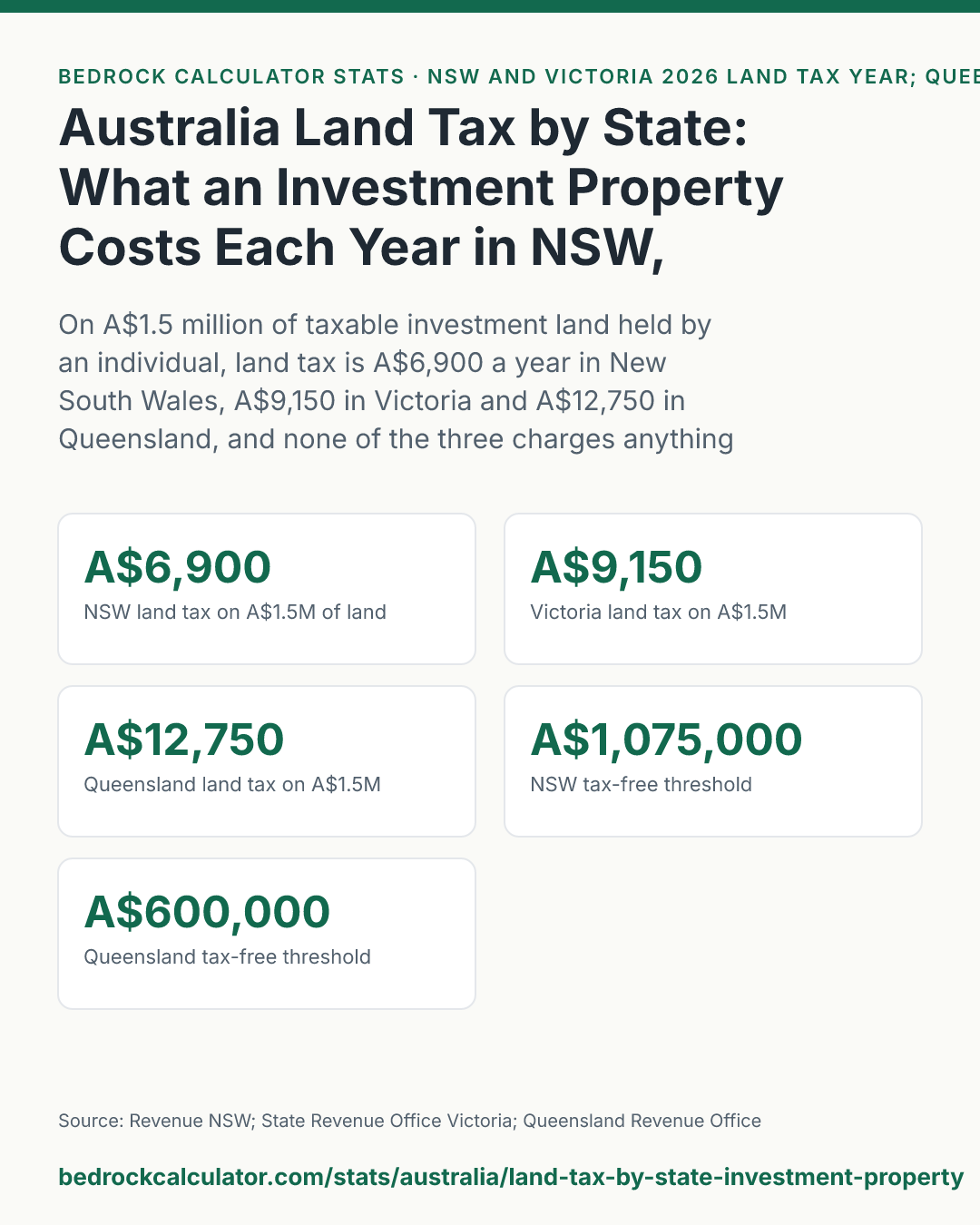
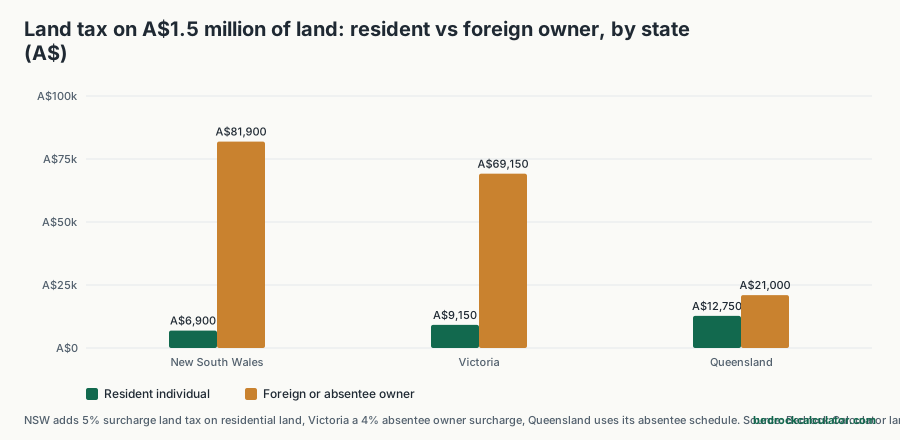
Land tax is the yearly bill that comes with owning an investment property in Australia, and how big it is depends on which state the land is in. On A$1.5 million of taxable land held by an individual, it's A$6,900 a year in New South Wales, A$9,150 in Victoria and A$12,750 in Queensland.
Each state starts charging at a different point. NSW charges nothing until your land passes A$1,075,000, Queensland nothing below A$600,000, and Victoria starts at just A$50,000. So a small investor can owe Victorian land tax and nothing at all in NSW, while a large portfolio can cost more in NSW or Queensland than in Victoria.
Land tax is charged on land value, not property value
This is the part that catches most new investors. Land tax isn't worked out on what you paid for the house or unit, or what it would sell for. It's worked out on the value of the land alone, as set by the state's valuer, and then each state applies its own rules on top.
- New South Wales uses the unimproved land value set by the NSW Valuer General at 1 July each year, then takes a three-year average of those values. Tax is assessed on the land you own at midnight on 31 December and applies to the following year.
- Victoria assesses the land you own at midnight on 31 December of the previous year, using the site value set by the Valuer-General.
- Queensland assesses the land you own at midnight on 30 June. Your taxable value is the lower of the latest statutory land value and a three-year average of it.
In all three states the threshold applies to the total taxable value of all your land in that state, not to each property separately. Two investment properties with A$600,000 of land each are taxed as one holding of twice that. A unit in a large block usually carries only a small share of the land, which is why apartment owners often pay little or no land tax, while a house on a big block in a capital city can carry most of its value in land.
How we worked out these numbers
We ran the Australia land tax calculator on this site for each state at eight taxable land values, from A$500,000 to A$5 million. Every run uses the same setup:
- An individual owner who is an Australian resident, not a company or trust
- No principal place of residence included, so all the land is taxable
- The individual schedule each state publishes: NSW and Victoria for the 2026 land tax year, Queensland for 2026-27
The schedules come from each revenue office's own rate table. We checked all three again in October 2026.
Every value, side by side
Click a column heading to sort.
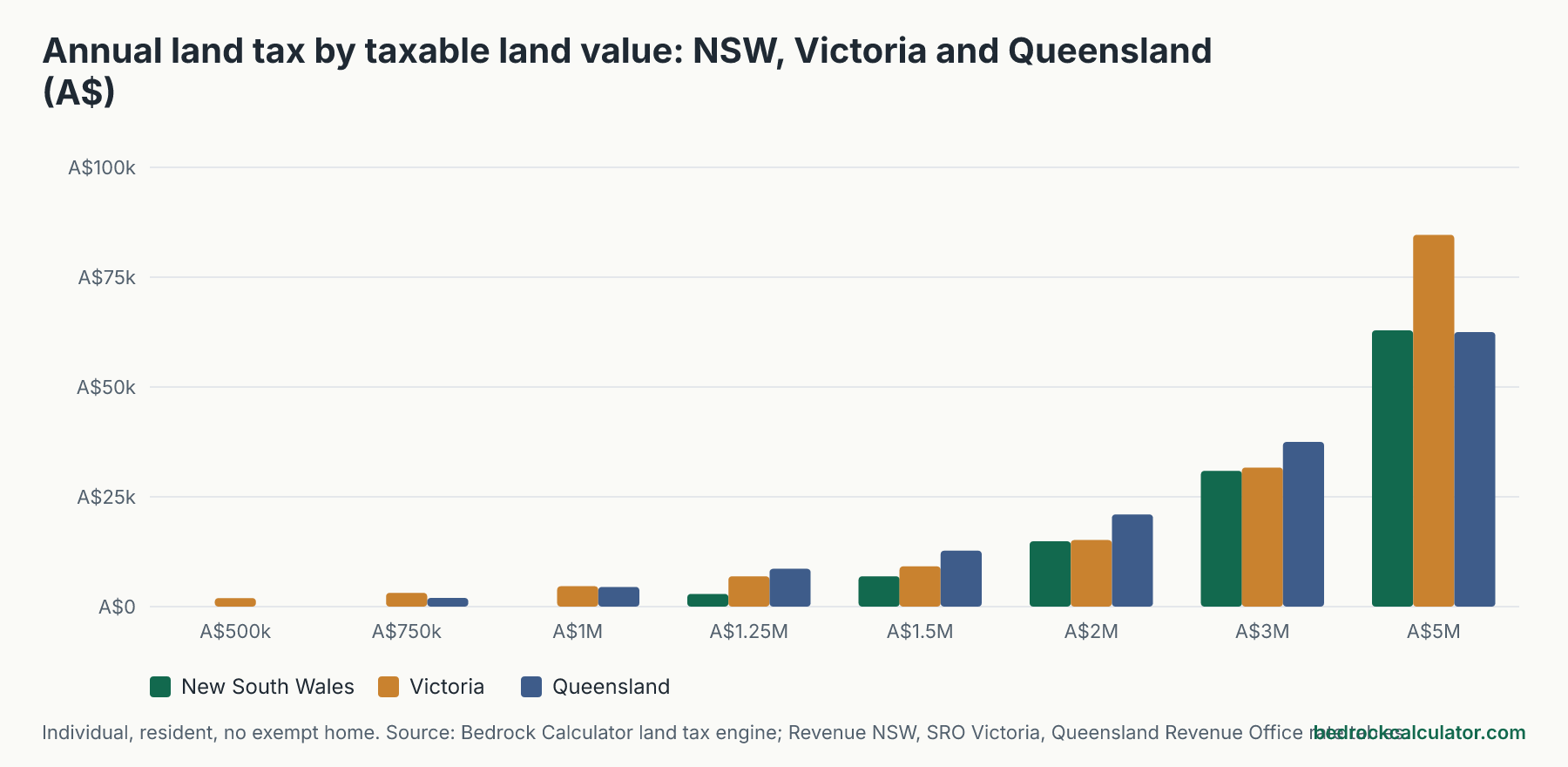
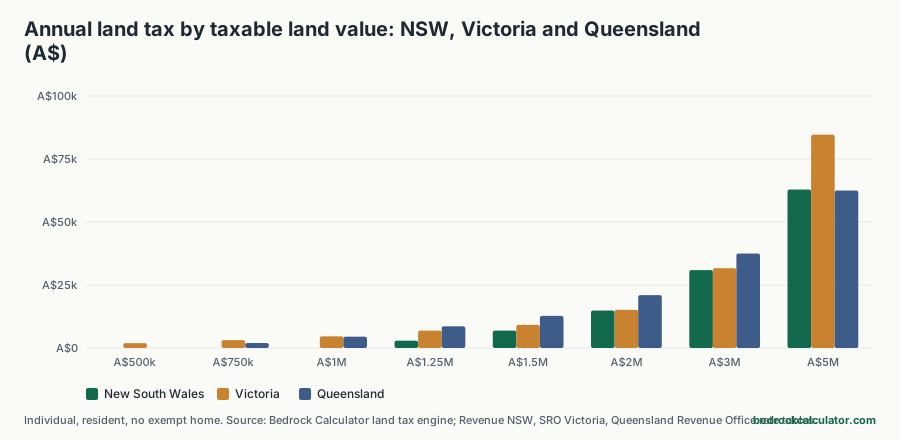
Annual land tax for an individual by taxable land value: NSW, Victoria and Queensland (A$)
Download CSVIndividual owner, Australian resident, no exempt home included. Taxable land value is the total of all your taxable land in that state, on the state's own valuation basis. NSW and Victoria: 2026 land tax year. Queensland: 2026-27.
| A$500,000 | A$0 | A$1,950 | A$0 |
| A$750,000 | A$0 | A$3,150 | A$2,000 |
| A$1,000,000 | A$0 | A$4,650 | A$4,500 |
| A$1,250,000 | A$2,900 | A$6,900 | A$8,625 |
| A$1,500,000 | A$6,900 | A$9,150 | A$12,750 |
| A$2,000,000 | A$14,900 | A$15,150 | A$21,000 |
| A$3,000,000 | A$30,900 | A$31,650 | A$37,500 |
| A$5,000,000 | A$62,900 | A$84,650 | A$62,500 |
The three schedules work quite differently.
New South Wales has one big threshold and then a flat rate. Above A$1,075,000 you pay A$100 plus 1.6% of the excess. Above the premium threshold of A$6,571,000 the rate rises to 2.0%. Revenue NSW lists the same thresholds for every land tax year from 2024 onwards.
Victoria starts low and climbs through several bands. There's a flat A$500 once land reaches A$50,000, and the rate on the top band, above A$3,000,000, is 2.65%. That's why Victoria is the dearest of the three at A$1 million (A$4,650) and at A$5 million (A$84,650).
Queensland charges A$500 plus 1.0% of the excess once land passes A$600,000, then 1.65% from A$1,000,000. Unusually, its rate drops to 1.25% above A$3,000,000. That's why Queensland costs more than NSW at A$2 million (A$21,000 against A$14,900) but less at A$5 million (A$62,500 against A$62,900).
What land tax costs as a share of land value
Effective rates make the pattern easier to see. On A$1.5 million of land the tax is 0.46% of the land value in NSW, 0.61% in Victoria and 0.85% in Queensland.
Land tax as a share of taxable land value, by state (%)
Download CSVAnnual land tax divided by the taxable land value. Same runs as the table above.
| A$500,000 | 0.00% | 0.39% | 0.00% |
| A$750,000 | 0.00% | 0.42% | 0.27% |
| A$1,000,000 | 0.00% | 0.46% | 0.45% |
| A$1,250,000 | 0.23% | 0.55% | 0.69% |
| A$1,500,000 | 0.46% | 0.61% | 0.85% |
| A$2,000,000 | 0.74% | 0.76% | 1.05% |
| A$3,000,000 | 1.03% | 1.05% | 1.25% |
| A$5,000,000 | 1.26% | 1.69% | 1.25% |
For an investor, the useful comparison is with rent. Land tax comes out of rental income every year, and it's a deductible expense against that income, so its real cost depends on your tax rate. The negative gearing calculator shows how deductible costs like land tax change the after-tax result on a rental.
Foreign owners pay much more
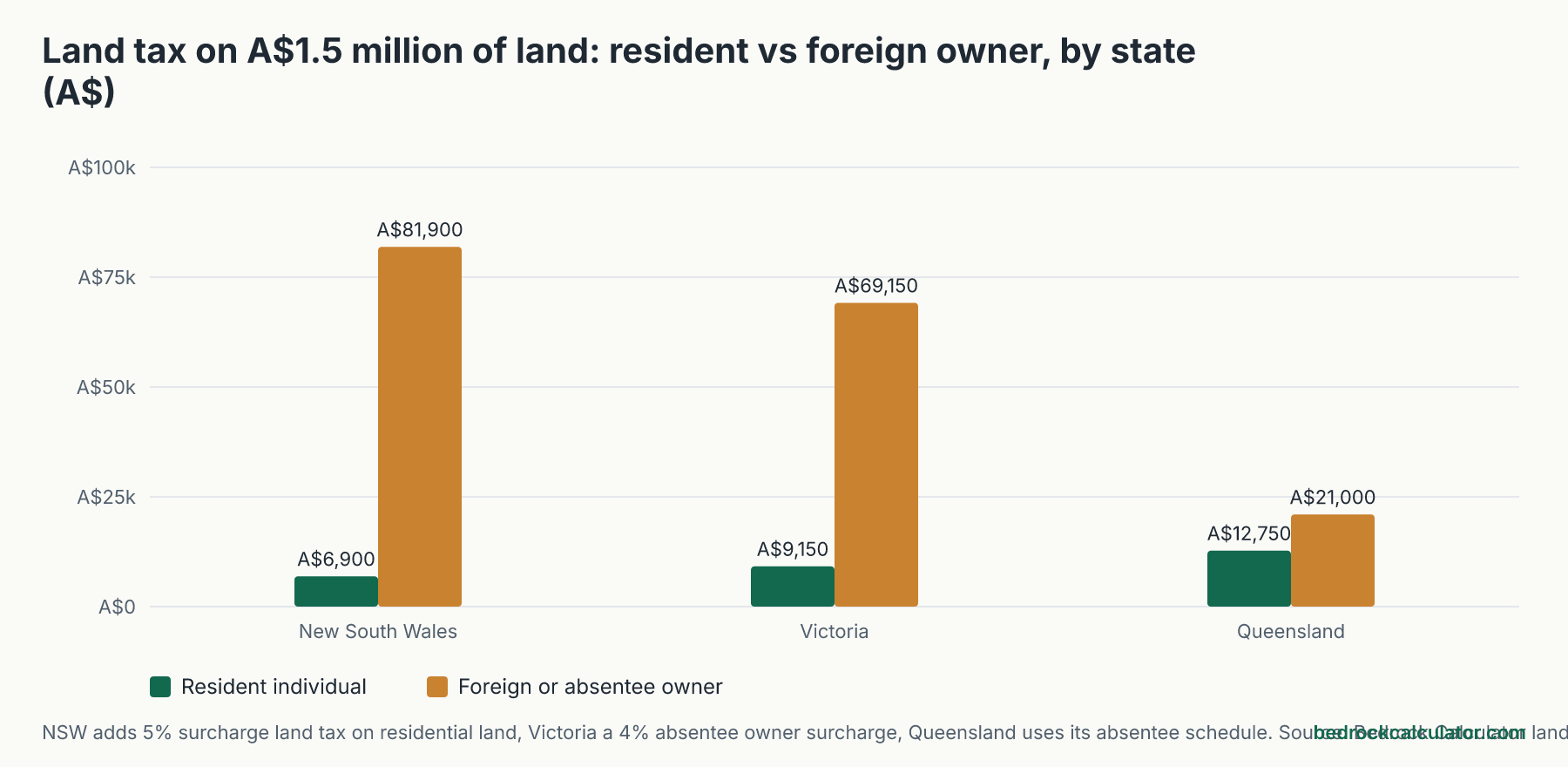
All three states charge foreign or absentee owners extra, and the extra is large.
NSW adds surcharge land tax of 5.0% of the land value, with no threshold, on residential land. Victoria adds an absentee owner surcharge of 4.0% of the taxable value. Queensland moves absentee individuals onto a separate schedule that starts at a lower value and charges more. On A$1.5 million of land that gives A$81,900 in NSW, A$69,150 in Victoria and A$21,000 in Queensland. Even on A$750,000 of residential land, a foreign owner in NSW pays A$37,500 a year, where a resident would pay nothing.
Who counts as a foreign person or absentee is defined differently in each state, and some owners can get the surcharge waived. If that applies to you, check with the revenue office before relying on these figures.
What these numbers leave out
The calculator applies each state's published individual schedule, and some real-world rules are outside it:
- Companies and trusts. Victoria and Queensland tax land held in a trust or company on different schedules. These figures are for individuals only.
- Averaging. Enter the averaged taxable value from your assessment notice, not the latest single valuation. The figures here treat the land value shown as already taxable.
- Partial exemptions. Homes used partly for business or rented in part, land over a certain size, primary production land and other concessions aren't modelled.
- Joint ownership. Co-owned land is grouped and assessed differently in each state.
- Other states. South Australia, Western Australia, Tasmania, the ACT and the Northern Territory aren't covered, because their schedules aren't yet in the calculator.
- Separate charges. Victoria's vacant residential land tax and similar levies are not included.
Run your own numbers
The Australia land tax calculator takes your state, owner type, total taxable land value and any exempt home, and shows the band you fall in. If you're still deciding whether to buy, the stamp duty calculator covers the upfront cost, and the capital gains tax calculator covers what happens when you sell.