When do you start repaying HECS-HELP in 2026-27?
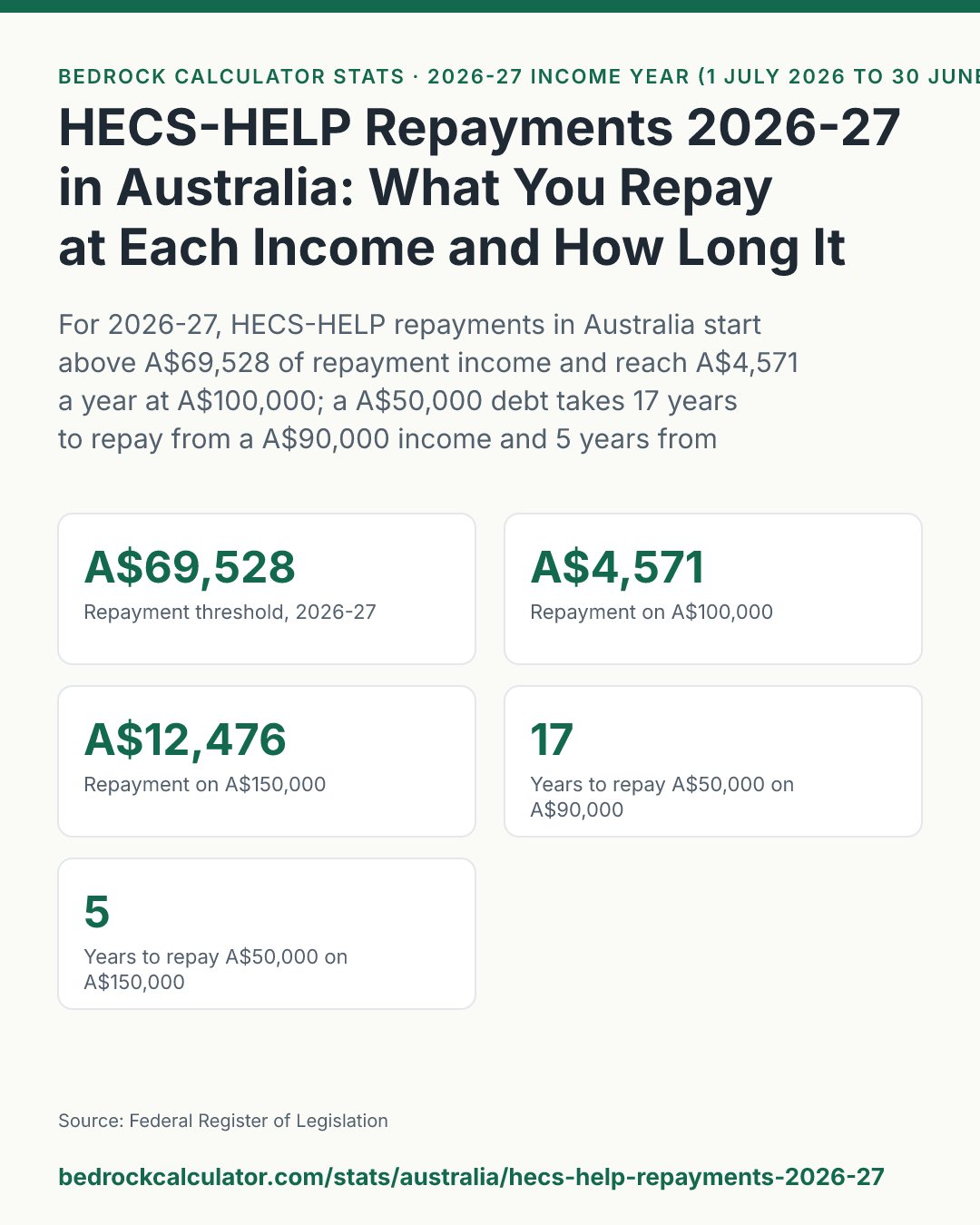
For the 2026-27 income year, you start repaying HECS-HELP once your repayment income passes A$69,528. On A$80,000 the compulsory repayment is A$1,571 a year. On A$100,000 it's A$4,571, and on A$150,000 it's A$12,476.
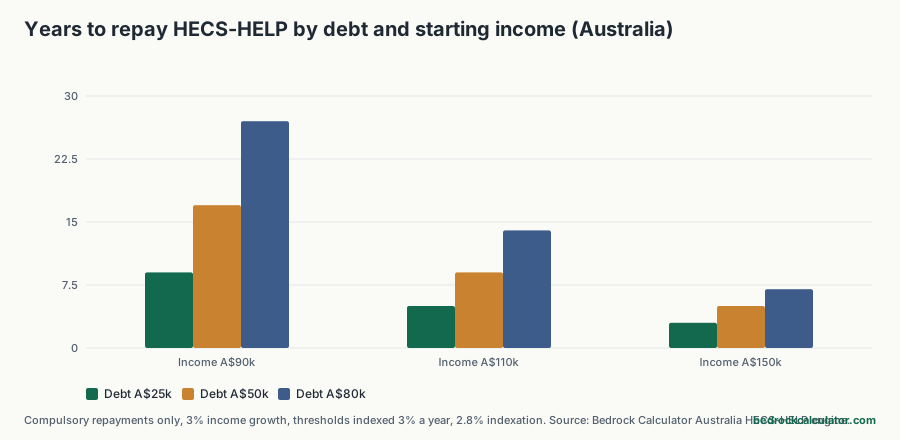
How long the debt lasts depends far more on your income than on the size of the debt. In our projection a A$50,000 debt takes 17 years to clear from a starting income of A$90,000, but only 5 years from A$150,000. From A$75,000 it never clears: after 30 years A$58,007 is still owed.
How we worked out these numbers
We ran the Australia HECS-HELP calculator on this site in two ways.
First, the compulsory repayment for the 2026-27 income year at eight levels of repayment income from A$60,000 to A$200,000. The calculator applies the marginal system that started on 1 July 2025: nothing up to A$69,528, then 15% of each dollar above it, 17% of each dollar above A$129,717, and from A$186,051 a flat 10% of your whole repayment income. For comparison it also applies the 2025-26 thresholds to the same income.
Second, a projection of three debts, A$25,000, A$50,000 and A$80,000, at four starting incomes. Each year the debt is indexed at 2.8%, the indexation rate the calculator holds for 2026, then the compulsory repayment comes off. Income grows 3% a year. The repayment thresholds rise 3% a year too, because the law resets them every 1 July in line with average weekly earnings, and we assume earnings across the economy grow at the same pace as your income. No voluntary repayments are made.
There are limits worth stating plainly. Future earnings growth is an assumption, so the thresholds in later years are estimates. The indexation rate is also held at 2.8% for every year, though it's actually reset each 1 June to the lower of CPI and wage growth. And the calculator treats all your study loans as one balance and doesn't model overseas repayment obligations.
"Repayment income" isn't the same as salary. It's your taxable income plus reportable fringe benefits, reportable super contributions such as salary sacrifice, net investment losses and some exempt foreign income. If you negatively gear a property or salary sacrifice into super, your repayment income can be higher than your taxable income.
How much HECS do I repay at each income?
Click a column heading to sort. The per-fortnight figure is the yearly amount divided by 26.
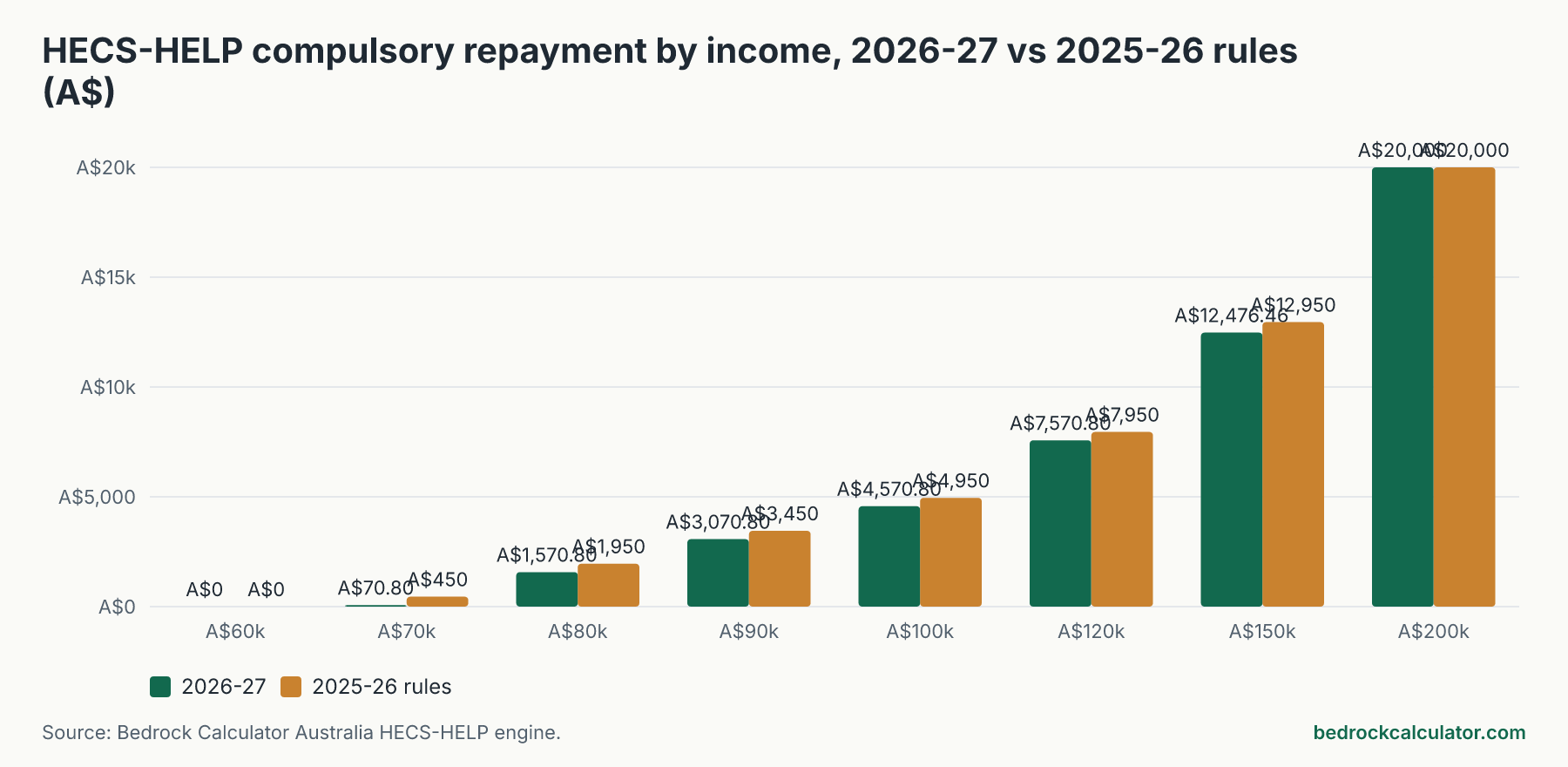
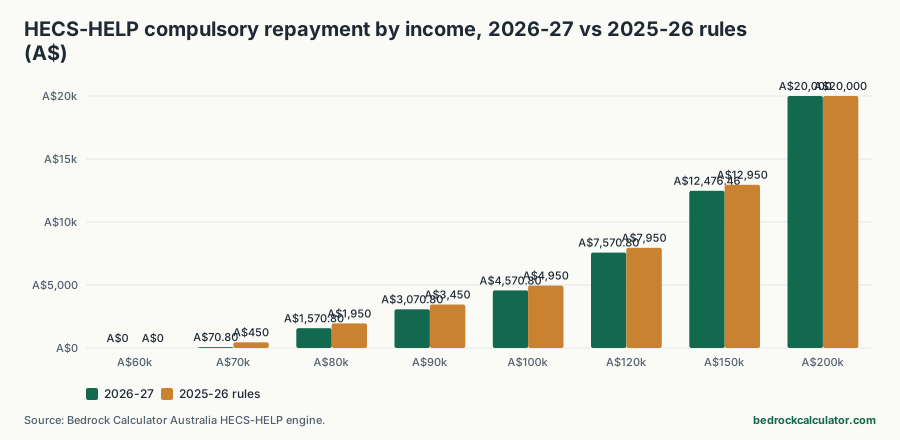
HECS-HELP compulsory repayment by income, Australia 2026-27 (A$)
Download CSVRepayment income includes taxable income plus reportable fringe benefits, reportable super contributions and net investment losses. The 2025-26 column applies the previous year's thresholds to the same income.
| A$60,000 | A$0 | A$0 | 0.0% | A$0 |
| A$70,000 | A$70.80 | A$2.72 | 0.1% | A$450 |
| A$80,000 | A$1,570.80 | A$60.42 | 2.0% | A$1,950 |
| A$90,000 | A$3,070.80 | A$118.11 | 3.4% | A$3,450 |
| A$100,000 | A$4,570.80 | A$175.80 | 4.6% | A$4,950 |
| A$120,000 | A$7,570.80 | A$291.18 | 6.3% | A$7,950 |
| A$150,000 | A$12,476.46 | A$479.86 | 8.3% | A$12,950 |
| A$200,000 | A$20,000 | A$769.23 | 10.0% | A$20,000 |
On A$100,000 the repayment works out to about A$175.80 a fortnight, or 4.6% of income. At A$200,000 it's A$20,000, the full 10.0%, because above A$186,051 the flat rate applies to the whole income rather than to the slice above a threshold.
Compared with the 2025-26 thresholds, most people repay a little less. The saving is A$379 a year at both A$70,000 and A$100,000, because the higher threshold shifts the whole scale up by the same amount. At A$200,000 there's no change: the flat top rate gives the same answer under both years' rules.
The marginal system also removed the old cliffs. Under the scheme before July 2025, crossing a threshold by one dollar could add hundreds of dollars of repayment. Now someone on A$70,000, just over the threshold, repays A$71.
How long does it take to pay off HECS?
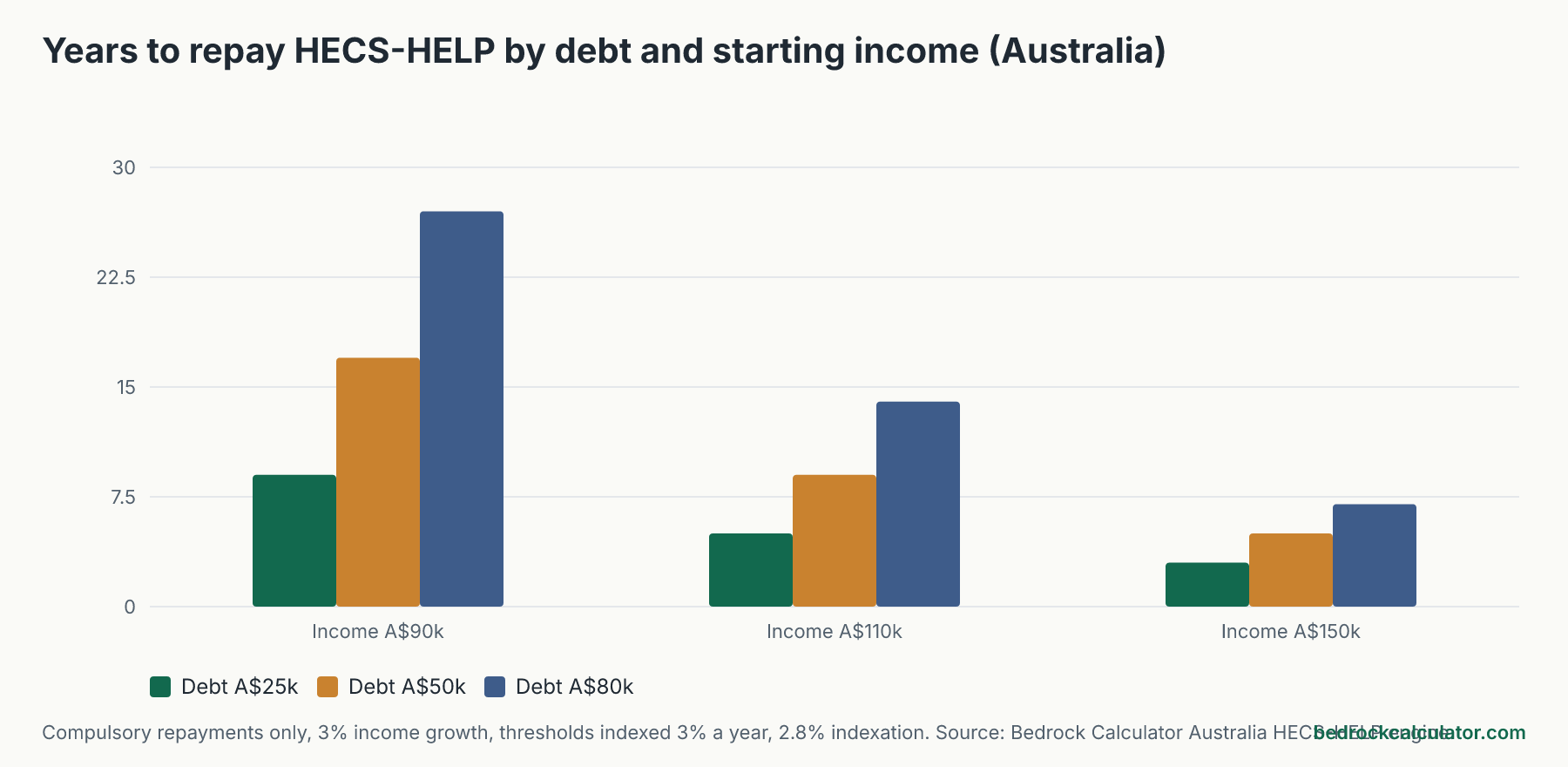
Years to repay a HECS-HELP debt from 2026-27, by debt and starting income (Australia)
Download CSVCompulsory repayments only. Income grows 3% a year; the debt is indexed at 2.8% every year; repayment thresholds indexed 3% a year with average earnings.
| A$80,000 | A$90,000 | 27 | A$119,254.99 | A$39,254.99 | A$0 |
| A$50,000 | A$90,000 | 17 | A$64,297.18 | A$14,297.18 | A$0 |
| A$80,000 | A$110,000 | 14 | A$98,236.17 | A$18,236.17 | A$0 |
| A$25,000 | A$90,000 | 9 | A$28,510.75 | A$3,510.75 | A$0 |
| A$50,000 | A$110,000 | 9 | A$57,103.42 | A$7,103.42 | A$0 |
| A$80,000 | A$150,000 | 7 | A$88,983.33 | A$8,983.33 | A$0 |
| A$25,000 | A$110,000 | 5 | A$26,900.96 | A$1,900.96 | A$0 |
| A$50,000 | A$150,000 | 5 | A$53,702.62 | A$3,702.62 | A$0 |
| A$25,000 | A$150,000 | 3 | A$26,091.06 | A$1,091.06 | A$0 |
| A$25,000 | A$75,000 | n/a | A$39,094.81 | A$14,857.58 | A$762.77 |
| A$50,000 | A$75,000 | n/a | A$39,094.81 | A$47,102.10 | A$58,007.29 |
| A$80,000 | A$75,000 | n/a | A$39,094.81 | A$85,795.34 | A$126,700.53 |
n/a means the debt is not repaid within the 30-year projection.
The pattern is clear. At a starting income of A$90,000, a A$25,000 debt lasts 9 years, A$50,000 lasts 17 years and A$80,000 lasts 27 years. At A$150,000 the same debts are cleared in 3, 5 and 7 years. At A$75,000 none of them is cleared within 30 years, which is why the chart leaves that income out and the table shows n/a: after 30 years A$763, A$58,007 and A$126,701 are still owed.
Income matters so much because repayments are a share of the income above the threshold. Someone on A$75,000 has only a small slice above it, and because the threshold rises with average earnings, that slice grows no faster than their pay. On the two larger debts the repayment never overtakes indexation, so the balance drifts up rather than down.
What indexation really costs
Indexation is how HECS-HELP keeps its value. A A$50,000 debt grows by A$1,400 in its first year at the 2.8% rate used here.
Over 30 years, the A$50,000 debt on a A$75,000 income attracts A$47,102 of indexation. You repay A$39,095 and still owe A$58,007. On A$150,000, indexation adds only A$3,703 and you repay A$53,703 in total. The largest debt on the lowest income fares worst: A$80,000 at A$75,000 picks up A$85,795 of indexation for A$39,095 repaid, with A$126,701 still owing.
Should you pay HECS off early?
There's no discount for voluntary repayments, so paying early saves only the indexation you avoid. With indexation at 2.8%, a dollar of voluntary repayment earns you a 2.8% return, tax-free and risk-free. That's worth comparing with your options. If your home loan charges a higher interest rate than that, extra repayments there save more.
Money in an offset account does the same job and stays available.
There's one more practical reason people clear HECS early: lenders count the compulsory repayment when they work out how much you can borrow. If you're about to apply for a home loan, the repayment on your income is in the table above.
Working out your own HECS-HELP repayments
Enter your balance and repayment income in the Australia HECS-HELP calculator, and try adding a voluntary amount to see how many years it saves. The repayment comes on top of income tax, so to see your full pay picture use the Australia take-home pay calculator or the Australia income tax calculator, and see Australian take-home pay for 2026-27 for what each salary leaves before HECS.