When does the Medicare levy surcharge start in 2026-27?
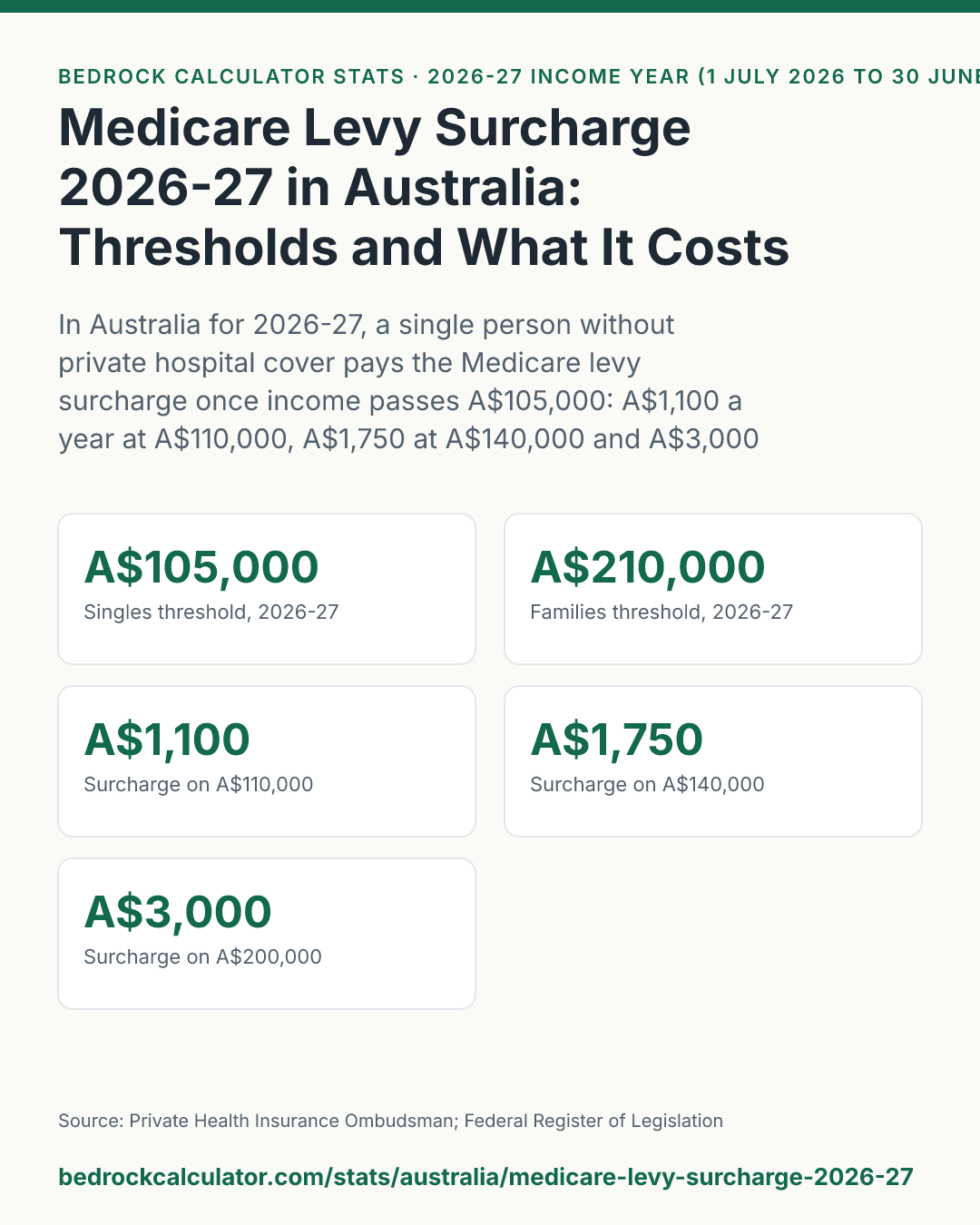
For the 2026-27 income year, the Medicare levy surcharge starts once a single person's income for surcharge purposes passes A$105,000, or A$210,000 for a family. If you're above that line and don't hold private hospital cover, it costs A$1,100 a year at A$110,000, A$1,750 at A$140,000 and A$3,000 at A$200,000.
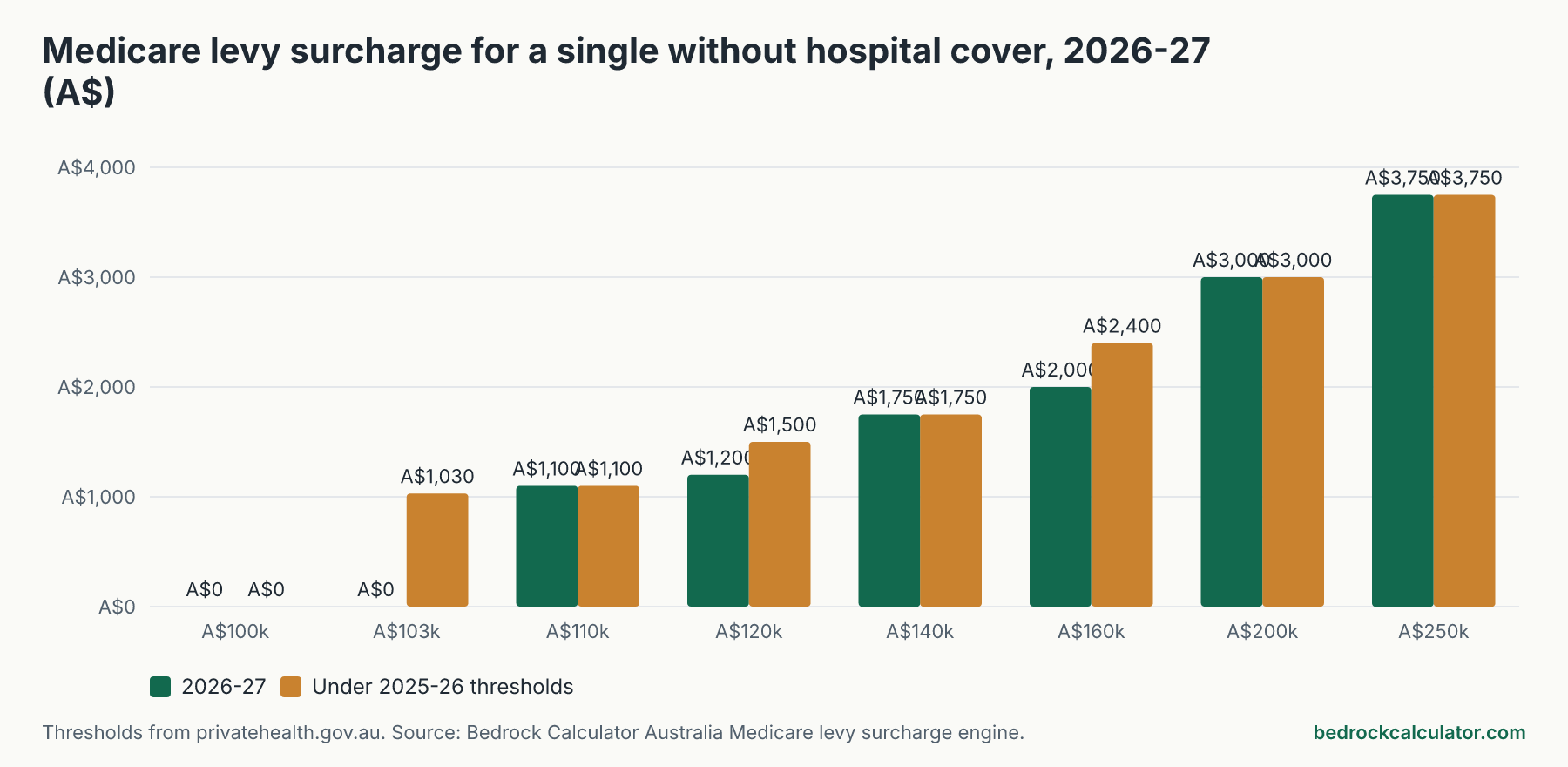
The thresholds went up on 1 July 2026, so some people who paid the surcharge last year won't pay it this year. A single earning A$103,000 would have paid A$1,030 under the 2025-26 thresholds and now pays A$0.
How we worked out these numbers
We ran the Australia Medicare levy surcharge calculator on this site at eight incomes for a single person and five combined incomes for a couple, with no private hospital cover.
The surcharge thresholds are indexed each year outside the legislation, so the figures come from the 2026-27 table the Australian Government publishes on privatehealth.gov.au. They are the calculator's defaults:
- Singles: base tier up to A$105,000, tier 1 up to A$123,000, tier 2 up to A$164,000, tier 3 above that
- Families: up to A$210,000, A$246,000 and A$328,000, plus A$1,500 for each dependent child after the first
- Rates: 1%, 1.25% and 1.5%
We also ran every single income against last year's thresholds (A$101,000, A$118,000 and A$158,000) so you can see what changed.
Every run assumes your income for surcharge purposes equals your taxable income. In real life it also includes reportable fringe benefits, reportable super contributions such as salary sacrifice, and net investment losses, all of which can push you over a threshold even when your taxable income is below it. The calculator handles these if you enter them. It doesn't model a part-year of cover or a change in family status during the year.
How much is the Medicare levy surcharge at each income?
Click a column heading to sort. The fortnightly figure is the yearly cost divided by 26.
Medicare levy surcharge for singles without hospital cover, Australia 2026-27 (A$)
Download CSVIncome for surcharge purposes equal to taxable income (no reportable fringe benefits or super contributions). The surcharge is on top of the ordinary Medicare levy. The 2025-26 column applies last year's thresholds to the same income.
| A$100,000 | 0.00% | A$0 | A$0 | A$0 |
| A$103,000 | 0.00% | A$0 | A$0 | A$1,030 |
| A$110,000 | 1.00% | A$1,100 | A$42.31 | A$1,100 |
| A$120,000 | 1.00% | A$1,200 | A$46.15 | A$1,500 |
| A$140,000 | 1.25% | A$1,750 | A$67.31 | A$1,750 |
| A$160,000 | 1.25% | A$2,000 | A$76.92 | A$2,400 |
| A$200,000 | 1.50% | A$3,000 | A$115.38 | A$3,000 |
| A$250,000 | 1.50% | A$3,750 | A$144.23 | A$3,750 |
The surcharge is a flat rate on your whole taxable income, not just the part above the threshold. That creates a cliff. Earn A$105,000 and you pay nothing; earn A$106,000 and you pay A$1,060. The same jump happens at each tier: moving from tier 1 to tier 2 at A$123,000 raises the rate on every dollar, not only the extra ones.
It's also separate from the ordinary Medicare levy. Almost everyone pays the 2% levy. The surcharge is charged on top, and only if you earn above the threshold without hospital cover.
What changed from 2025-26
Every threshold moved up. Singles who earn between the old and new lines pay less, or nothing:
- At A$103,000, the surcharge falls from A$1,030 to A$0
- At A$120,000, the rate drops from tier 2 to tier 1, saving A$300
- At A$160,000, it drops from tier 3 to tier 2, saving A$400
Outside those bands the cost is unchanged, because the rate applied to your income is the same.
Medicare levy surcharge for couples and families
For a couple the test is on combined income, against the family threshold of A$210,000. If you're over it, each partner pays the surcharge on their own taxable income at the family tier rate.
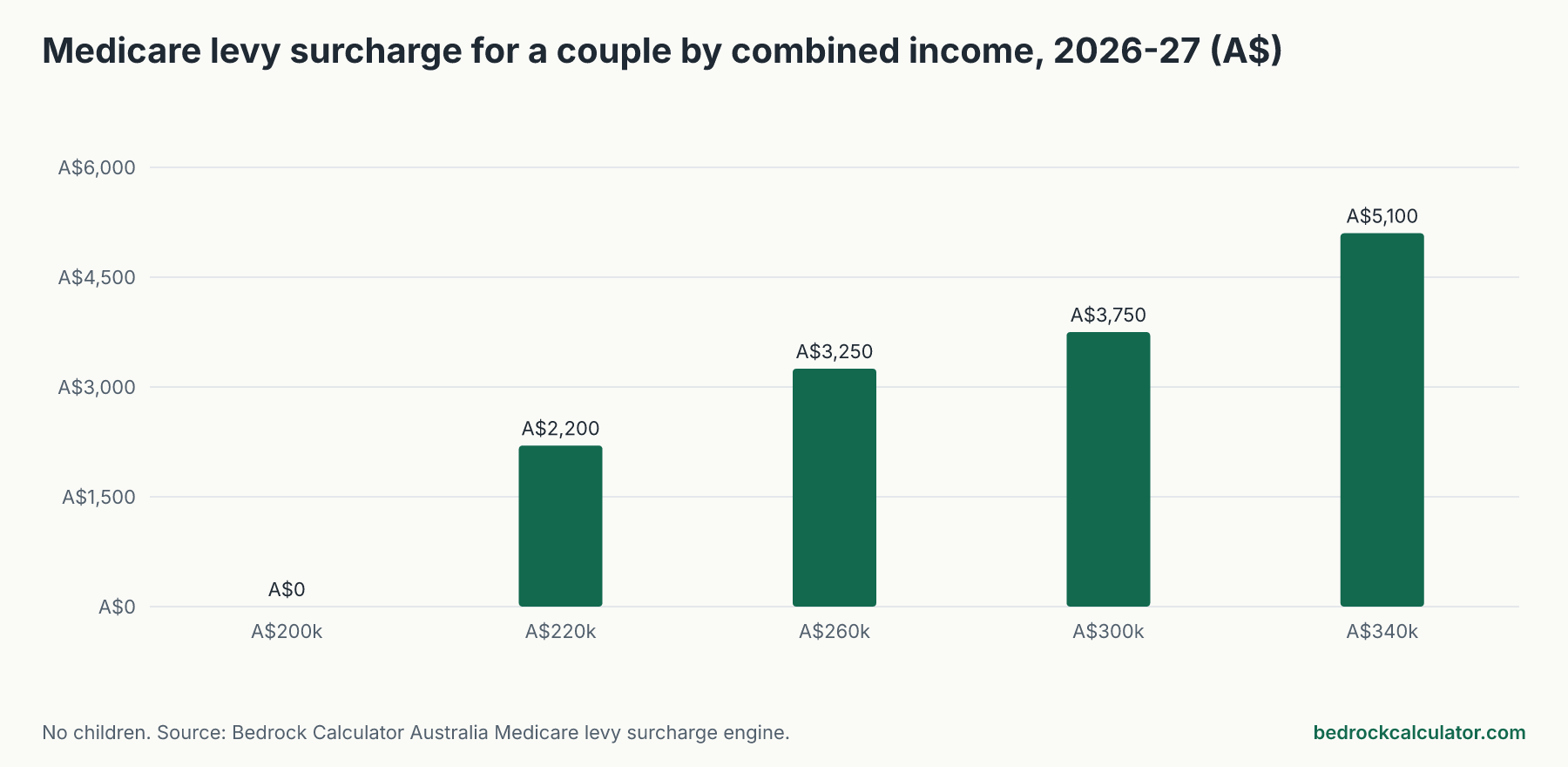
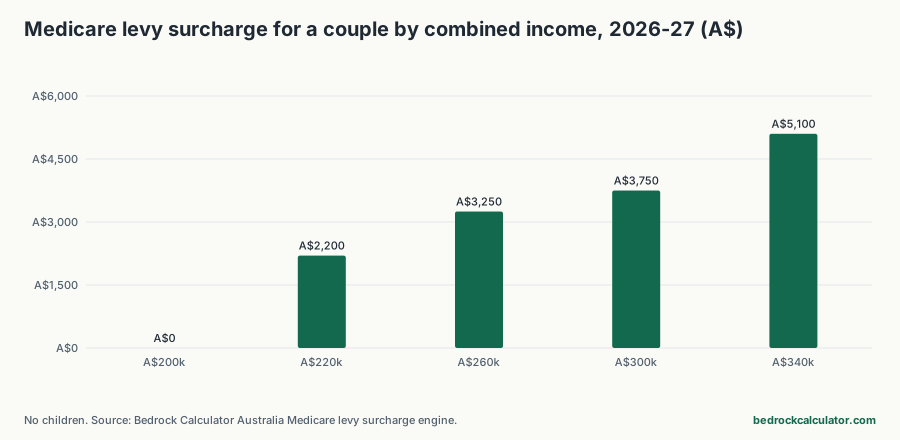
Medicare levy surcharge for a couple without hospital cover, Australia 2026-27 (A$, both partners combined)
Download CSVEach partner earns half the combined income, no dependent children. The surcharge is charged on each partner's own taxable income at the family tier rate.
| A$200,000 | 0.00% | A$0 |
| A$220,000 | 1.00% | A$2,200 |
| A$260,000 | 1.25% | A$3,250 |
| A$300,000 | 1.25% | A$3,750 |
| A$340,000 | 1.50% | A$5,100 |
A couple on A$220,000 split evenly pays A$2,200 between them without cover. At A$260,000 it's A$3,250, and at A$340,000, in the top tier, it's A$5,100.
Children help at the margin. The family threshold rises by A$1,500 for each dependent child after the first, so with three children it's A$213,000. A couple earning A$211,000 would pay A$2,110 with no children and nothing with three.
Is hospital cover cheaper than the surcharge?
The surcharge figure is your break-even. If a complying hospital policy costs you less than the surcharge, holding it leaves you better off in cash, before counting anything you'd use it for. For a single person, that break-even is A$1,100 at A$110,000, A$1,750 at A$140,000 and A$3,000 at A$200,000.
Premiums vary by insurer, state, age and excess, so we haven't put a premium figure on this page. The calculator lets you enter a quote and compare. Two points from the rules: extras-only cover doesn't count, and you need the cover for the whole year to avoid the surcharge entirely.
Can salary sacrifice keep you under the threshold?
No. Salary sacrifice lowers your taxable income, but reportable super contributions are added back when working out income for surcharge purposes. So it won't move you below A$105,000. It does reduce the surcharge itself slightly if you're already paying it, because the rate is charged on taxable income.
Check your own position
Enter your taxable income, any reportable fringe benefits or super contributions, and your family details in the Medicare levy surcharge calculator, and put in the 2026-27 thresholds above. The Australia Medicare levy calculator covers the ordinary 2% levy, and the take-home pay calculator shows the surcharge's effect on each pay. For what each salary leaves with cover held, see Australian take-home pay for 2026-27.