How much Canada Child Benefit and RESP grant money does a family get?
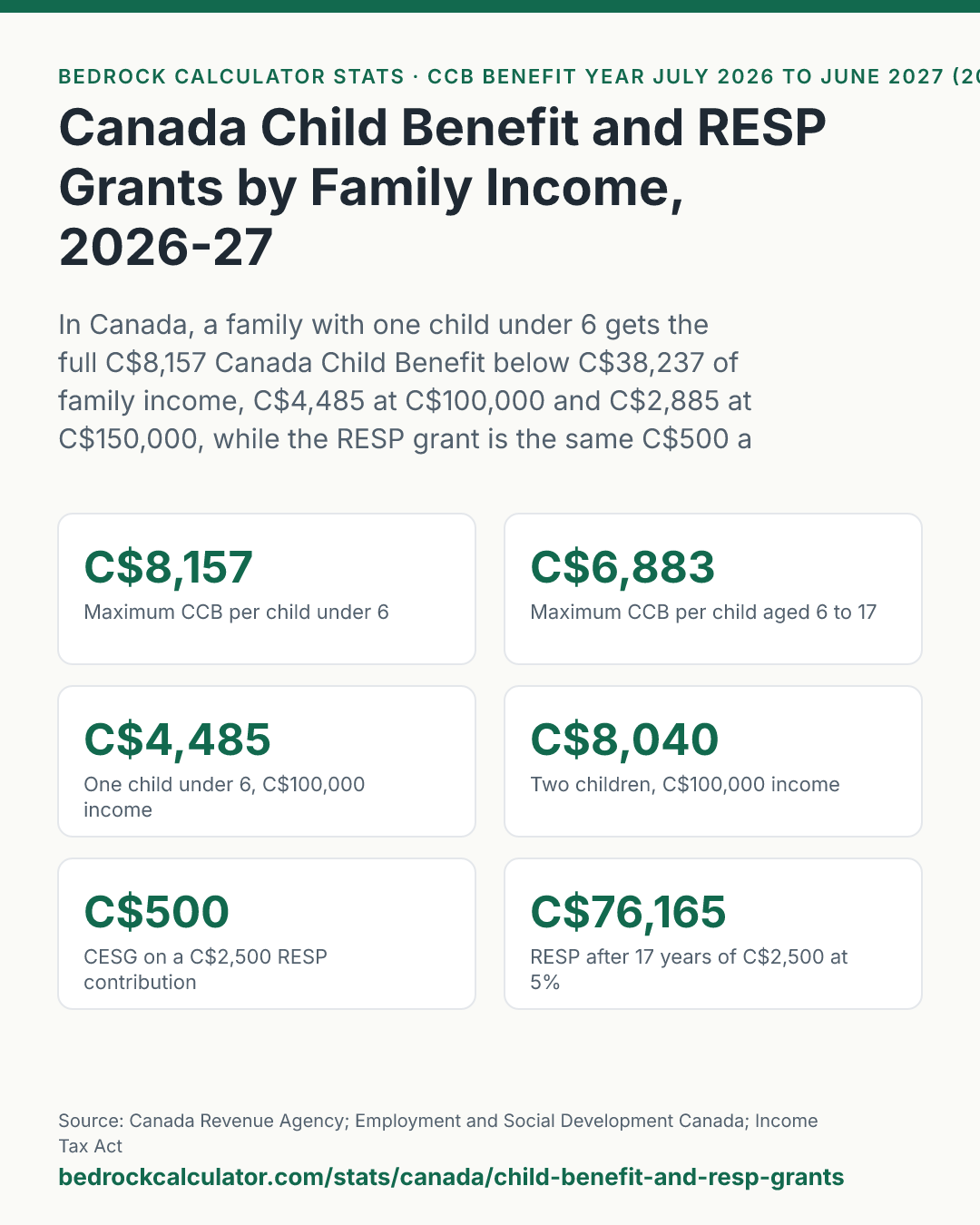
The Canada Child Benefit is one of the largest payments Canadian families with kids receive from the government, and it depends heavily on family income. For the July 2026 to June 2027 payment year, a family with one child under 6 gets the full C$8,157 a year if its adjusted family net income is below C$38,237.
At C$100,000 that falls to C$4,485, and at C$150,000 to C$2,885.
The federal RESP grant works the other way: it doesn't look at income at all. Put C$2,500 into a child's RESP and the government adds C$500, whether you earn C$30,000 or C$250,000.
How we worked out these numbers
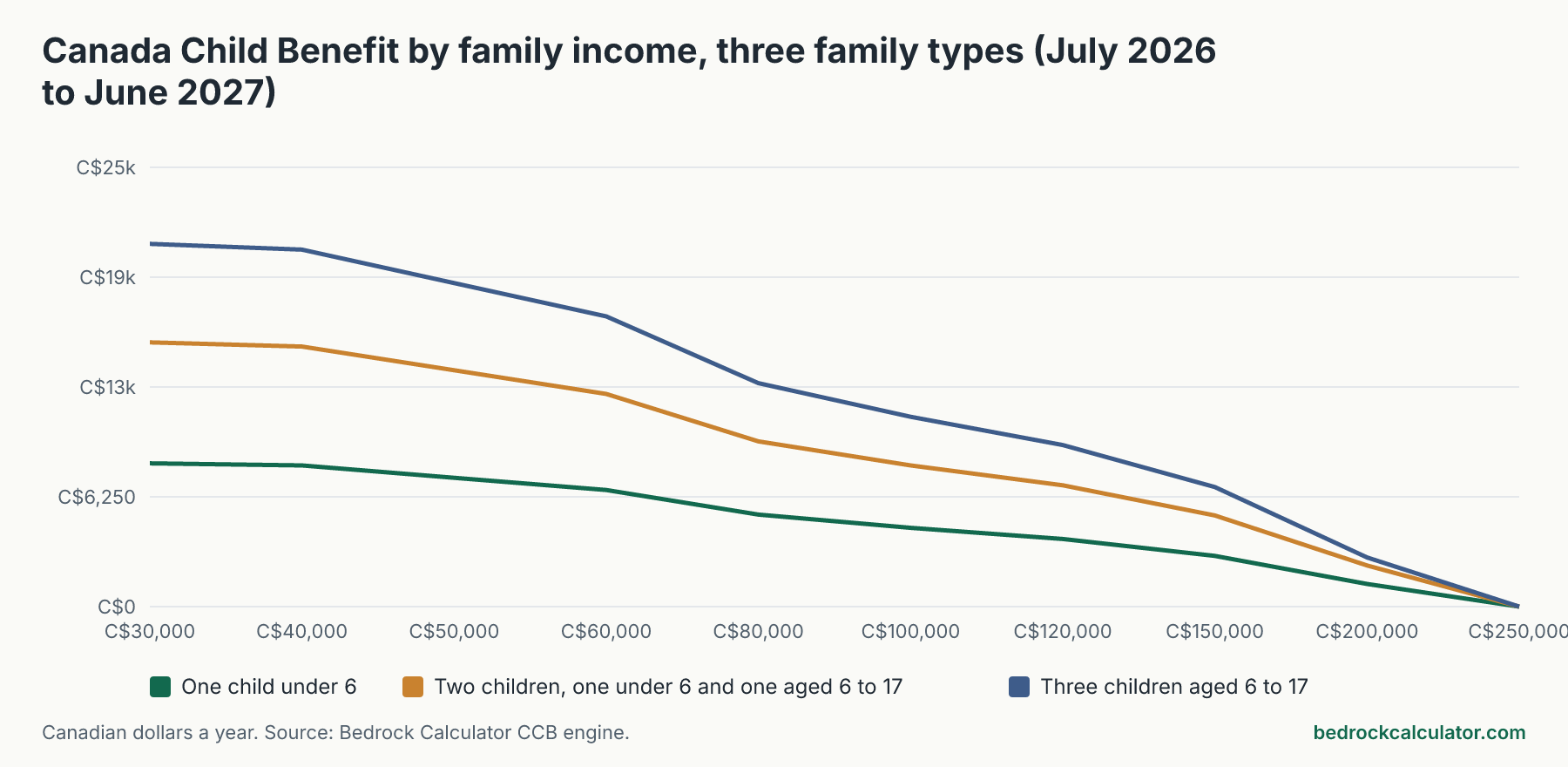
We ran the RESP and Canada Child Benefit calculator on this site at ten family incomes from C$30,000 to C$250,000, for three families:
- One child under 6
- Two children, one under 6 and one aged 6 to 17
- Three children aged 6 to 17
The calculator uses the CCB amounts for July 2026 to June 2027: up to C$8,157 a year for each child under 6 and C$6,883 for each child aged 6 to 17. Payments in that year are based on your 2025 adjusted family net income, which is the combined net income of you and your spouse or common-law partner.
What's not included: provincial and territorial child benefits, which many provinces pay alongside the CCB; the Child Disability Benefit; shared-custody arrangements, where each parent gets half; and the additional RESP grants for lower-income families. Those are real money for many families, so treat the figures here as the federal base.
The CCB at every income
Click a heading to sort. The last column is the basic RESP grant on a C$2,500 contribution, which is the same in every row.
Canada Child Benefit by adjusted family net income, July 2026 to June 2027 (Canadian dollars a year)
Download CSVFederal CCB only, based on 2025 adjusted family net income. Provincial and territorial child benefits and the Child Disability Benefit are not included.
| C$30,000 | C$8,157 | C$15,040 | C$20,649 | C$500 |
| C$40,000 | C$8,034 | C$14,802 | C$20,314 | C$500 |
| C$50,000 | C$7,334 | C$13,452 | C$18,414 | C$500 |
| C$60,000 | C$6,634 | C$12,102 | C$16,514 | C$500 |
| C$80,000 | C$5,234 | C$9,402 | C$12,714 | C$500 |
| C$100,000 | C$4,485 | C$8,040 | C$10,801 | C$500 |
| C$120,000 | C$3,845 | C$6,900 | C$9,201 | C$500 |
| C$150,000 | C$2,885 | C$5,190 | C$6,801 | C$500 |
| C$200,000 | C$1,285 | C$2,340 | C$2,801 | C$500 |
| C$250,000 | C$0 | C$0 | C$0 | C$500 |
How the CCB shrinks as income rises
The CCB is reduced in two stages, and the rate depends on how many children you have.
Below C$38,237 of family income, you get the full amount. Between C$38,237 and C$82,847, the benefit falls by 7% of the income above C$38,237 for a one-child family, 13.5% for two children and 19% for three. Above C$82,847 the reduction slows to 3.2%, 5.7% and 8% of income above that line.
That's why the drop is steep at middle incomes and gentle after. With one child under 6, the benefit is C$6,634 at C$60,000, or about C$552.80 a month, and C$4,485 at C$100,000, about C$373.76 a month.
Two and three children
More children means a higher maximum, but also a faster reduction, so the gap between families narrows as income rises.
- Two children (one under 6, one 6 to 17): C$15,040 at the top, C$12,102 at C$60,000, C$8,040 at C$100,000 and C$5,190 at C$150,000.
- Three children aged 6 to 17: C$20,649 at the top, C$10,801 at C$100,000, C$6,801 at C$150,000 and C$2,801 at C$200,000.
The CCB does eventually reach zero. In this model, that's at about C$241,000 for the one-child family, C$242,000 for two children and C$236,000 for three children aged 6 to 17.
When a child turns 6, the maximum for that child drops from C$8,157 to C$6,883, starting the month after the birthday. Families often notice the change in their monthly payment and wonder why.
The RESP grant: same at every income
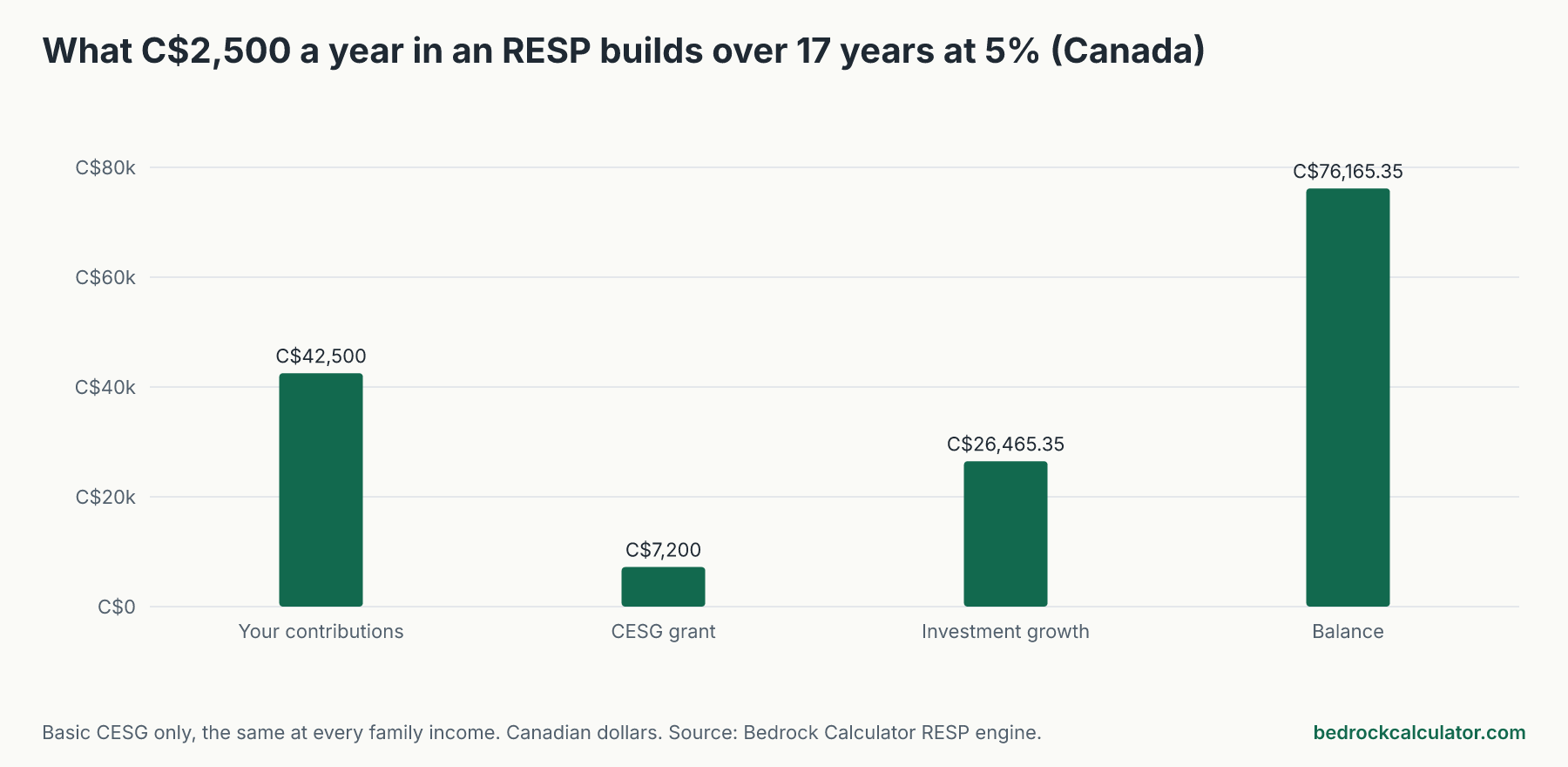
The Canada Education Savings Grant matches 20% of what you put into a child's RESP, up to C$500 a year on C$2,500 of contributions, with a lifetime cap of C$7,200 per child. If you missed earlier years, you can catch up one extra year at a time: C$5,000 in a year with unused grant room earns C$1,000.
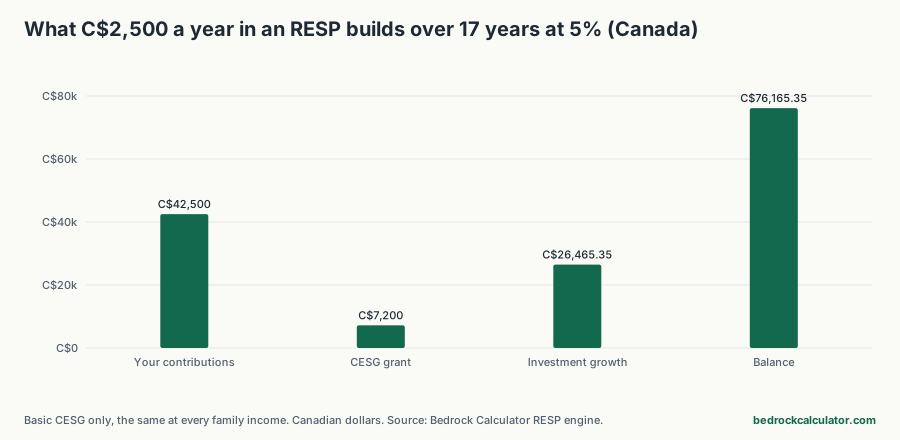
Here's what steady saving builds. Putting C$2,500 a year into an RESP from birth for 17 years, earning 5% a year, adds up to C$42,500 of your own money, C$7,200 of grant and C$26,465 of growth, for a balance of C$76,165.
Because the grant is capped at C$7,200 for life, a family that contributes C$2,500 every year reaches the cap before the child turns 17. Contributing more each year speeds up growth, but it doesn't earn more grant.
Extra help for lower-income families
The basic grant is only part of the story for families with lower incomes, and the calculator behind this page doesn't model the rest. Depending on family income, the federal government also pays an additional grant on the first part of each year's contribution and the Canada Learning Bond, which needs no contribution at all once an RESP is open. Some provinces add their own education grants too. If your family income is modest, it's worth opening an RESP even if you can't contribute much, because some of that money arrives without any savings from you.
Making the most of both
A few practical points:
- File your taxes every year, both of you. The CCB is based on your returns, and if either partner doesn't file, payments can stop.
- The CCB isn't taxable. It doesn't count as income on your return.
- Deductions that lower net income raise the CCB. RRSP contributions and the child care expense deduction both reduce adjusted family net income. The child care deduction calculator shows how much yours is worth.
- Some families direct part of the CCB into the RESP. Even C$2,500 a year, the amount that earns the full grant, is a small share of the benefit for most families.
Run your own figures
Put your own family income, children's ages and RESP plans into the RESP and Canada Child Benefit calculator. For the bigger household picture, the Canada take-home pay calculator shows your pay after tax, CPP and EI, and our 2026 TFSA, RRSP and FHSA limits cover the other registered accounts a family might use.