How much tax do Canadians pay on eligible and non-eligible dividends?
Canadian dividends are taxed more lightly than interest or wages, because the company paying them has already paid corporate tax on the profit. The dividend tax credit is how the personal tax system gives some of that back. How much depends on whether the dividend is eligible or non-eligible.
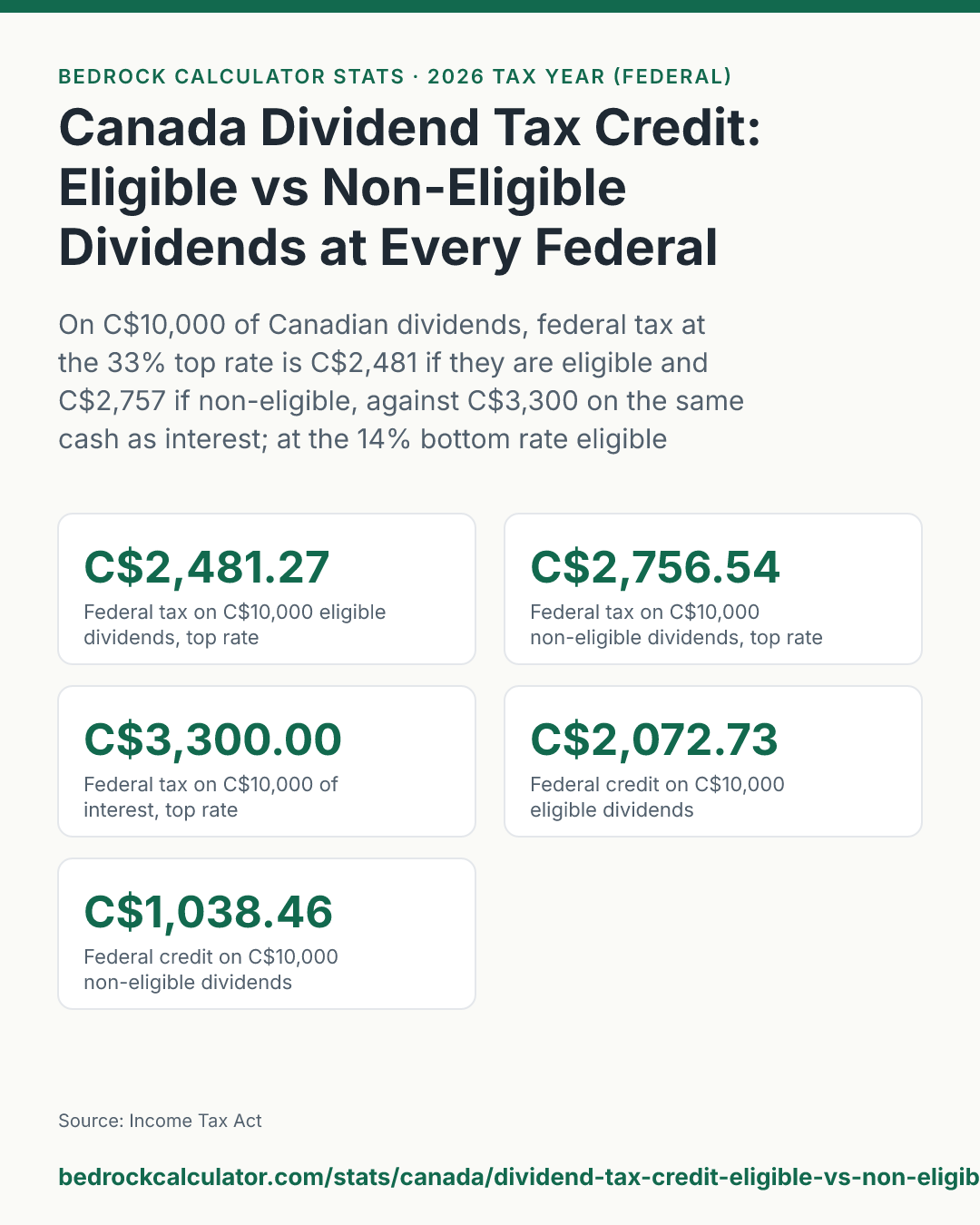
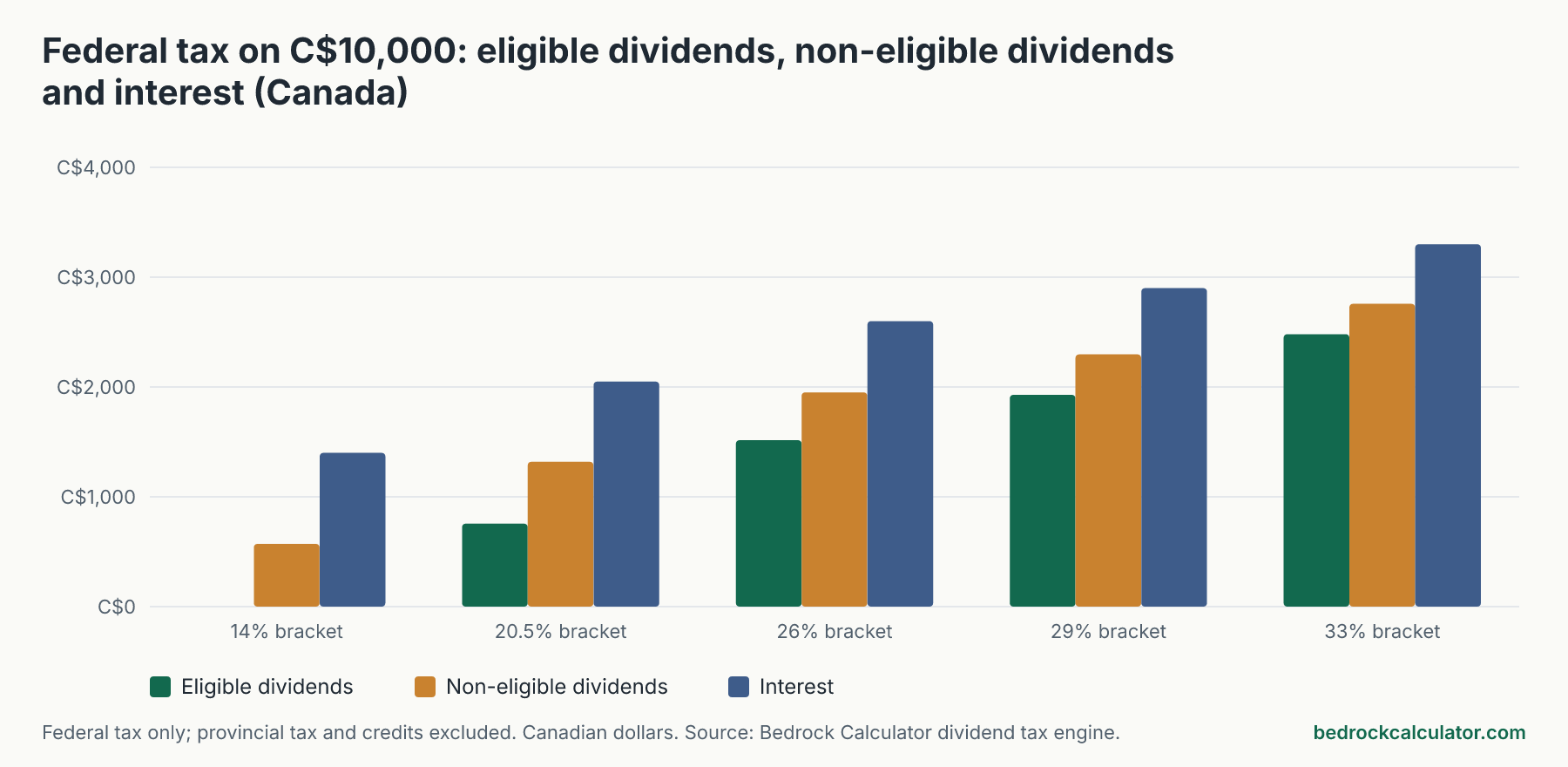
On C$10,000 of dividends, federal tax at the 33% top rate is C$2,481.27 for eligible dividends and C$2,756.54 for non-eligible ones. The same C$10,000 as interest would cost C$3,300.00. At the 14% bottom rate, eligible dividends owe no federal tax at all.
How we worked out these numbers
We ran the dividend tax credit calculator on this site for C$10,000 of cash dividends at each of the five federal marginal rates set by the Income Tax Act, once as eligible and once as non-eligible dividends. The calculator applies the gross-up in section 82 and the federal credit in section 121, both of which are written into the Act as fixed fractions.
This page shows federal tax only, and that's a real limit. Every province adds its own tax and its own dividend tax credit, at rates the site's engine doesn't hold, so we set the provincial rate and credit to zero rather than guess. Your total tax on dividends will be higher than these figures, and the gap between eligible and non-eligible dividends will be different once your province's credit is added.
We've shown the five federal rates rather than income ranges. The rates are fixed in the Act, but the income where each bracket starts is re-indexed every year, and the Canada income tax calculator is the place to see which bracket your income falls in.
One more simplification: when the credit is bigger than the tax on the dividend, the calculator shows zero tax rather than letting the extra credit reduce tax on your other income. A real return would use that leftover credit, as we explain below.
Every federal rate, side by side
Federal tax on C$10,000 of Canadian dividends vs interest, by federal marginal rate (Canadian dollars)
Download CSVFederal tax only, after the s. 121 dividend tax credit. Provincial tax and provincial dividend tax credits are not included. A credit larger than the tax on the dividend is shown as zero tax.
| 14% | C$0 | C$571.54 | C$1,400 | C$571.54 |
| 20.5% | C$756.27 | C$1,319.04 | C$2,050 | C$562.77 |
| 26% | C$1,515.27 | C$1,951.54 | C$2,600 | C$436.27 |
| 29% | C$1,929.27 | C$2,296.54 | C$2,900 | C$367.27 |
| 33% | C$2,481.27 | C$2,756.54 | C$3,300 | C$275.27 |
How the gross-up and credit work
The system has two steps, and they pull in opposite directions.
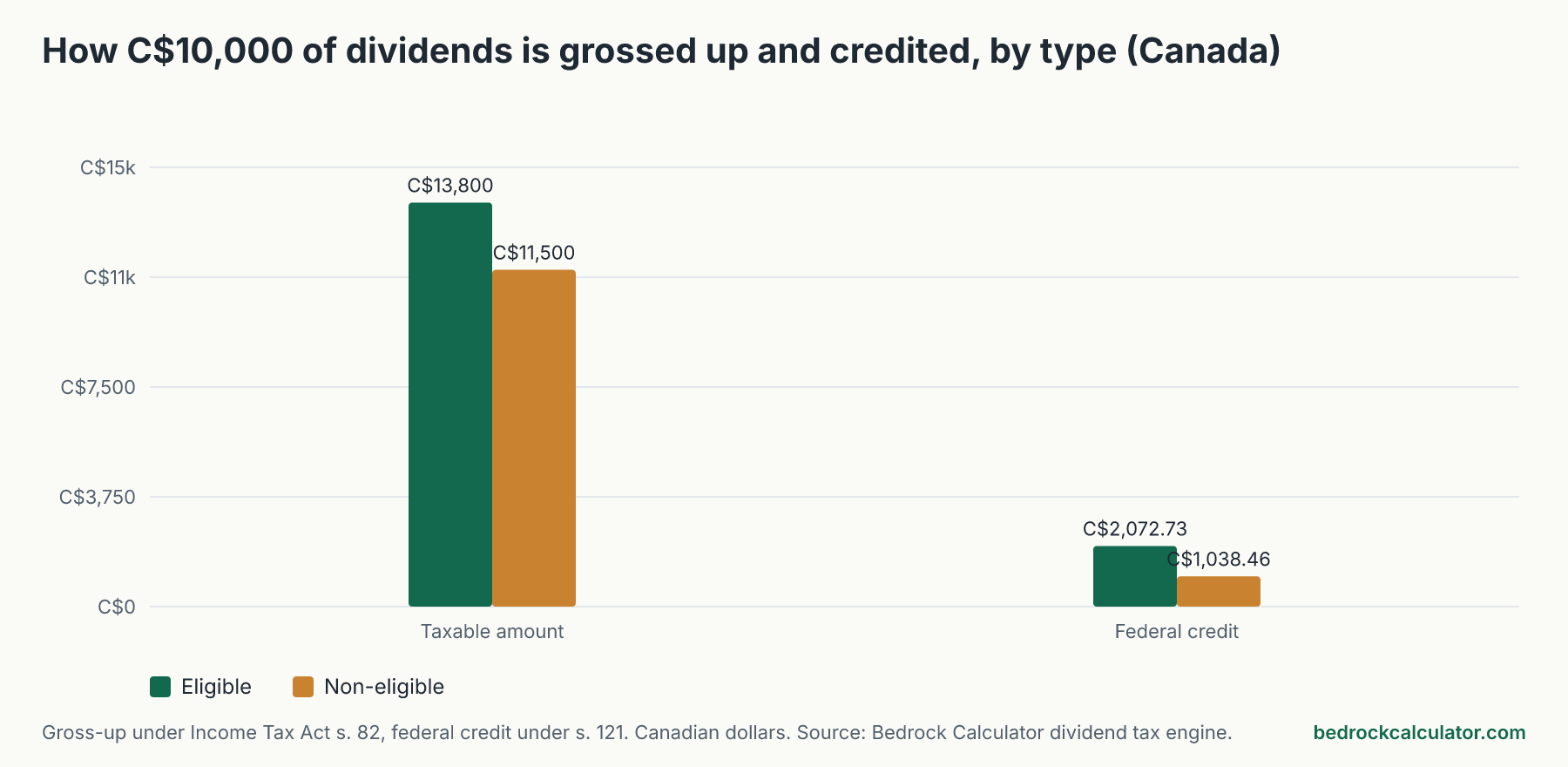
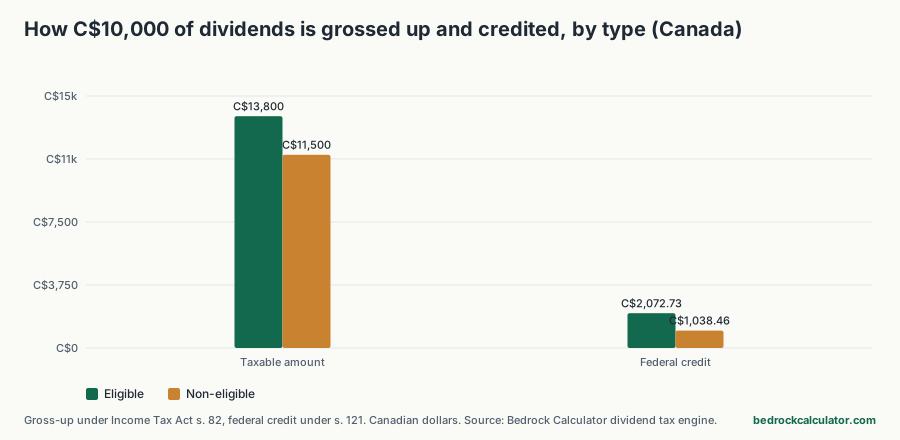
First, the gross-up. You don't report the cash you received; you report a larger "taxable amount". Eligible dividends are grossed up by 38%, so C$10,000 becomes C$13,800 on your return. Non-eligible dividends are grossed up by 15%, to C$11,500. The idea is to put back the corporate tax already paid, so the dividend is taxed as if you'd earned the company's pre-tax profit yourself.
Second, the credit. You then get a federal credit worth 15.02% of the grossed-up amount for eligible dividends, or 9.03% for non-eligible ones. On C$10,000 that's C$2,072.73 and C$1,038.46.
Because the credit is a fixed amount while the tax rises with your bracket, the credit does the most work at low incomes.
Eligible vs non-eligible: why the difference
Eligible dividends come out of profit that paid the general corporate rate, which is what most public companies pay. Non-eligible dividends come out of profit that got the much lower small business rate, which is common for owner-managed private corporations. Since less corporate tax was paid on non-eligible dividends, the personal credit is smaller.
At a 26% federal rate, C$10,000 of eligible dividends costs C$1,515.27 in federal tax and non-eligible dividends cost C$1,951.54, a difference of C$436.27. At the 33% rate, the federal gap narrows to C$275.27: C$2,481.27 against C$2,756.54. As a share of the cash, that's 24.8% against 27.6%.
Your T5 slip tells you which kind you received. Eligible dividends go in one box and other-than-eligible dividends in another, and mixing them up is one of the more common errors on Canadian returns.
When the credit is bigger than the tax
At the 14% federal rate, the federal tax on C$13,800 of grossed-up eligible dividends is smaller than the C$2,072.73 credit. So federal tax on the dividends is C$0.00, with C$140.73 of credit left over.
In a real return, that leftover isn't wasted if you have other income. It reduces federal tax on your salary, pension or interest. It's never paid out as a refund, though, so a person with no other tax to offset loses it. This is why Canadians with modest incomes can receive a fair amount in eligible dividends and pay little or no federal tax on them.
Non-eligible dividends don't go that far. At the same 14% rate, C$10,000 of them still costs C$571.54 in federal tax.
Dividends vs interest
Every row of the table shows the same pattern: eligible dividends pay the least federal tax, non-eligible dividends sit in the middle, and interest pays the most, because interest gets no gross-up and no credit. At the 33% rate, choosing eligible dividends over interest on C$10,000 saves C$818.73 of federal tax. That's why many Canadian investors hold dividend-paying Canadian shares in a taxable account and keep interest-bearing investments inside an RRSP or TFSA.
A catch for retirees
The gross-up raises your net income on paper, even though you never received that money. For most people it doesn't matter. For a retiree near the OAS clawback threshold it can, because the clawback is based on net income including the grossed-up dividends. C$10,000 of eligible dividends adds C$13,800 to net income. Our OAS clawback figures show where that starts to cost money.
Run your own numbers
Put your own dividend, your federal and provincial rates and your province's dividend tax credit into the dividend tax credit calculator to see the full picture. If you own a small business and are weighing salary against dividends, the small business deduction calculator shows the corporate side.