What are the 2026 federal and provincial income tax brackets in Canada?
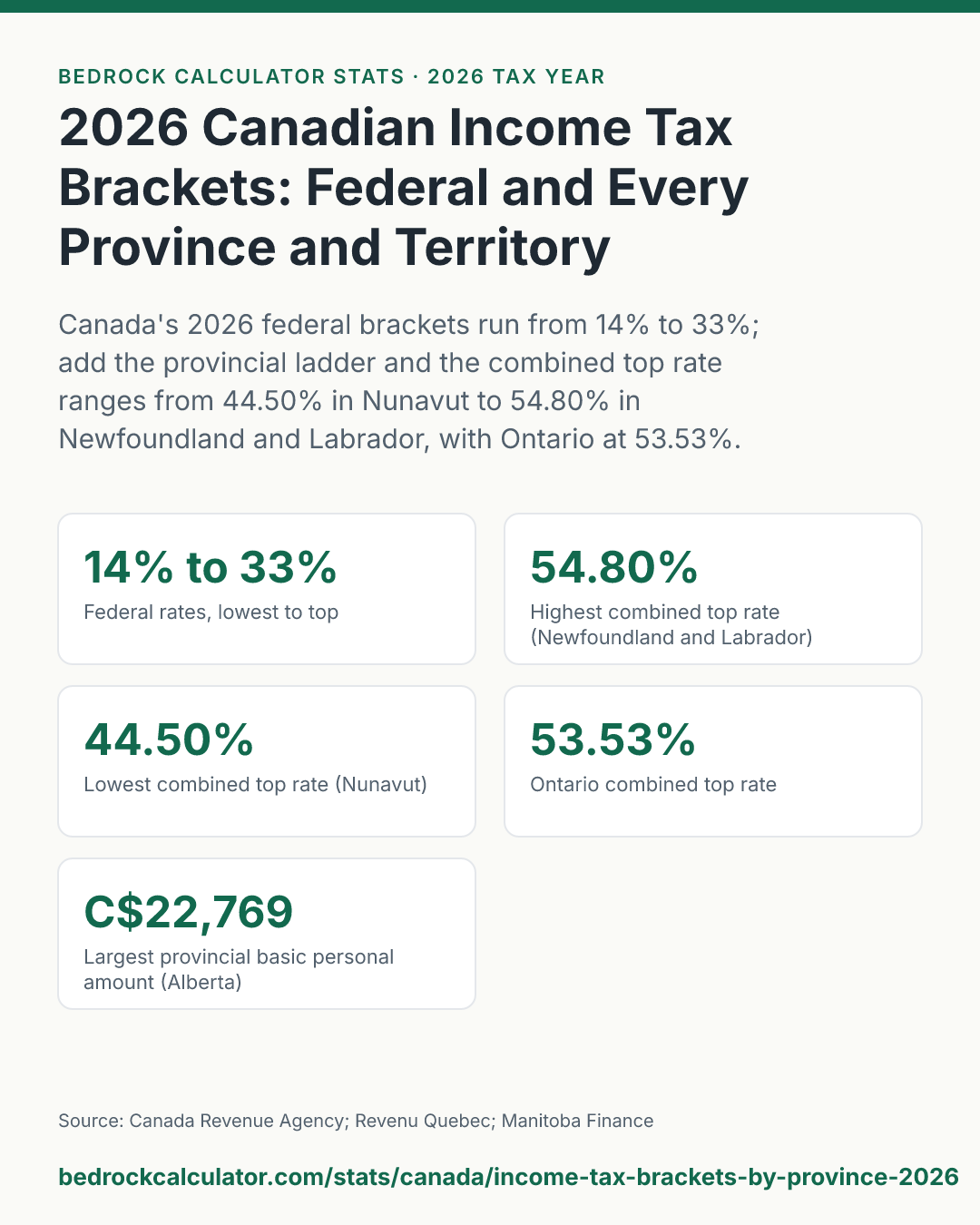
Canada's 2026 federal income tax has five brackets, from 14% on the first C$58,523 of taxable income to 33% above C$258,482. Every province and territory then adds its own ladder on top, with its own rates, thresholds and basic personal amount.
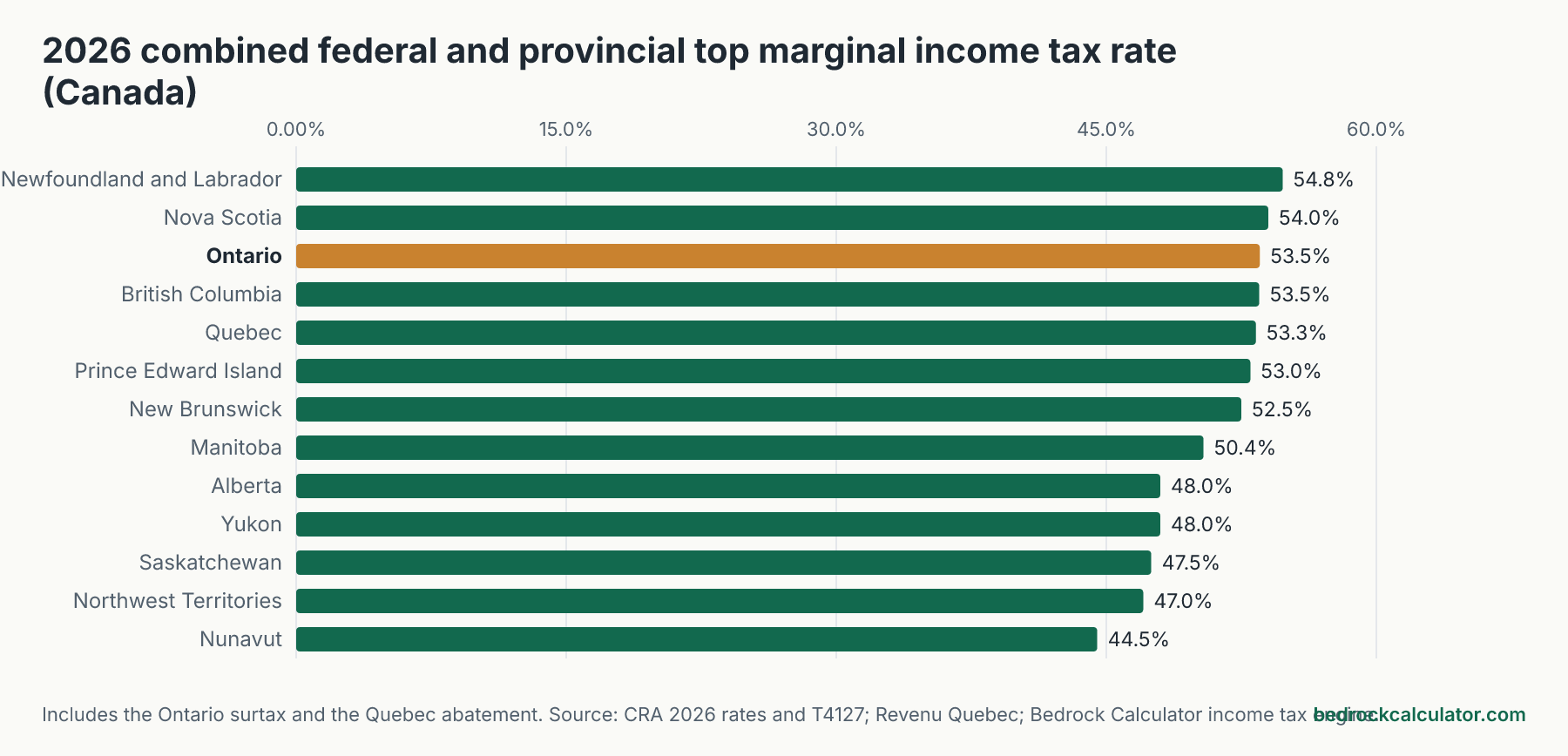
Put the two together and the top combined rate runs from 44.50% in Nunavut to 54.80% in Newfoundland and Labrador. Ontario's is 53.53% once its surtax is counted, and Quebec's is 53.31% after the federal abatement.
Where these figures come from
The federal brackets and every provincial and territorial ladder outside Quebec come from the Canada Revenue Agency's 2026 rate table and its T4127 payroll formulas for January and July 2026. Quebec's brackets and basic personal amount come from Revenu Quebec, which runs its own income tax.
Three provinces changed something partway through 2026, after payroll for the year had already started. British Columbia raised its lowest rate to 5.6%, Newfoundland and Labrador raised its basic personal amount to C$13,094, and Prince Edward Island added a new 20% bracket above C$200,000. All three apply to the whole 2026 tax year, and the tables here show those full-year figures, not the temporary payroll rates employers use for the second half of the year to catch up.
Manitoba is the one place where official sources disagree. The CRA's general rates page shows indexed Manitoba thresholds, but both 2026 editions of the CRA's payroll formulas and Manitoba Finance itself say indexation is paused, leaving the brackets at C$47,000 and C$100,000. We've used the paused figures.
The basic personal amounts, credit values and combined top rates are worked out by the same income tax engine that runs the Canada income tax calculator, so they include the Ontario surtax and the Quebec abatement exactly as the calculator applies them.
The federal brackets for 2026
The federal ladder is the same for everyone in Canada:
- 14% on taxable income up to C$58,523
- 20.5% from C$58,523 to C$117,045
- 26% from C$117,045 to C$181,440
- 29% from C$181,440 to C$258,482
- 33% above C$258,482
Each rate applies only to the slice of income inside its bracket, so moving into a higher bracket never raises the tax on the dollars below it. The federal basic personal amount is C$16,452, worth C$2,303.28 as a credit at the lowest rate. It shrinks to C$14,829 for incomes between C$181,440 and C$258,482.
Every province and territory side by side
This table sums up each jurisdiction: how many brackets it has, its lowest and top rates, where the top rate starts, its basic personal amount and what that amount is worth as a credit, and the combined federal and provincial top rate. Click any column to sort.
2026 provincial and territorial basics: brackets, basic personal amount and combined top rate (Canada)
Download CSVCombined top rate is federal plus provincial tax on the next dollar at very high income, including the Ontario surtax and the Quebec abatement.
| Newfoundland and Labrador | 8 | 8.70% | 21.80% | C$1,141,275 | C$13,094 | C$1,139.18 | 54.80% |
| Nova Scotia | 5 | 8.79% | 21.00% | C$157,124 | C$11,932 | C$1,048.82 | 54.00% |
| Ontario | 5 | 5.05% | 13.16% | C$220,000 | C$12,989 | C$655.94 | 53.53% |
| British Columbia | 7 | 5.60% | 20.50% | C$265,545 | C$13,216 | C$740.10 | 53.50% |
| Quebec | 4 | 14.00% | 25.75% | C$132,245 | C$18,952 | C$2,653.28 | 53.31% |
| Prince Edward Island | 6 | 9.50% | 20.00% | C$200,000 | C$15,000 | C$1,425 | 53.00% |
| New Brunswick | 4 | 9.40% | 19.50% | C$193,861 | C$13,664 | C$1,284.42 | 52.50% |
| Manitoba | 3 | 10.80% | 17.40% | C$100,000 | C$15,780 | C$1,704.24 | 50.40% |
| Alberta | 6 | 8.00% | 15.00% | C$370,220 | C$22,769 | C$1,821.52 | 48.00% |
| Yukon | 5 | 6.40% | 15.00% | C$500,000 | C$16,452 | C$1,052.93 | 48.00% |
| Saskatchewan | 3 | 10.50% | 14.50% | C$155,805 | C$20,381 | C$2,140.01 | 47.50% |
| Northwest Territories | 4 | 5.90% | 14.05% | C$172,346 | C$18,198 | C$1,073.68 | 47.05% |
| Nunavut | 4 | 4.00% | 11.50% | C$181,439 | C$19,659 | C$786.36 | 44.50% |
A few things stand out:
- Newfoundland and Labrador has the most brackets, 8 of them. Its top provincial rate of 21.8% only starts above C$1,141,275, which is why it has the highest combined top rate even though few people ever pay it.
- Nunavut has the lowest first-bracket rate, 4%, and the lowest combined top rate.
- Quebec has the highest first-bracket rate, 14%, and its top rate of 25.75% starts at just C$132,245. Quebec residents get back 16.5% of their basic federal tax through the abatement, which brings the combined top rate down to 53.31%.
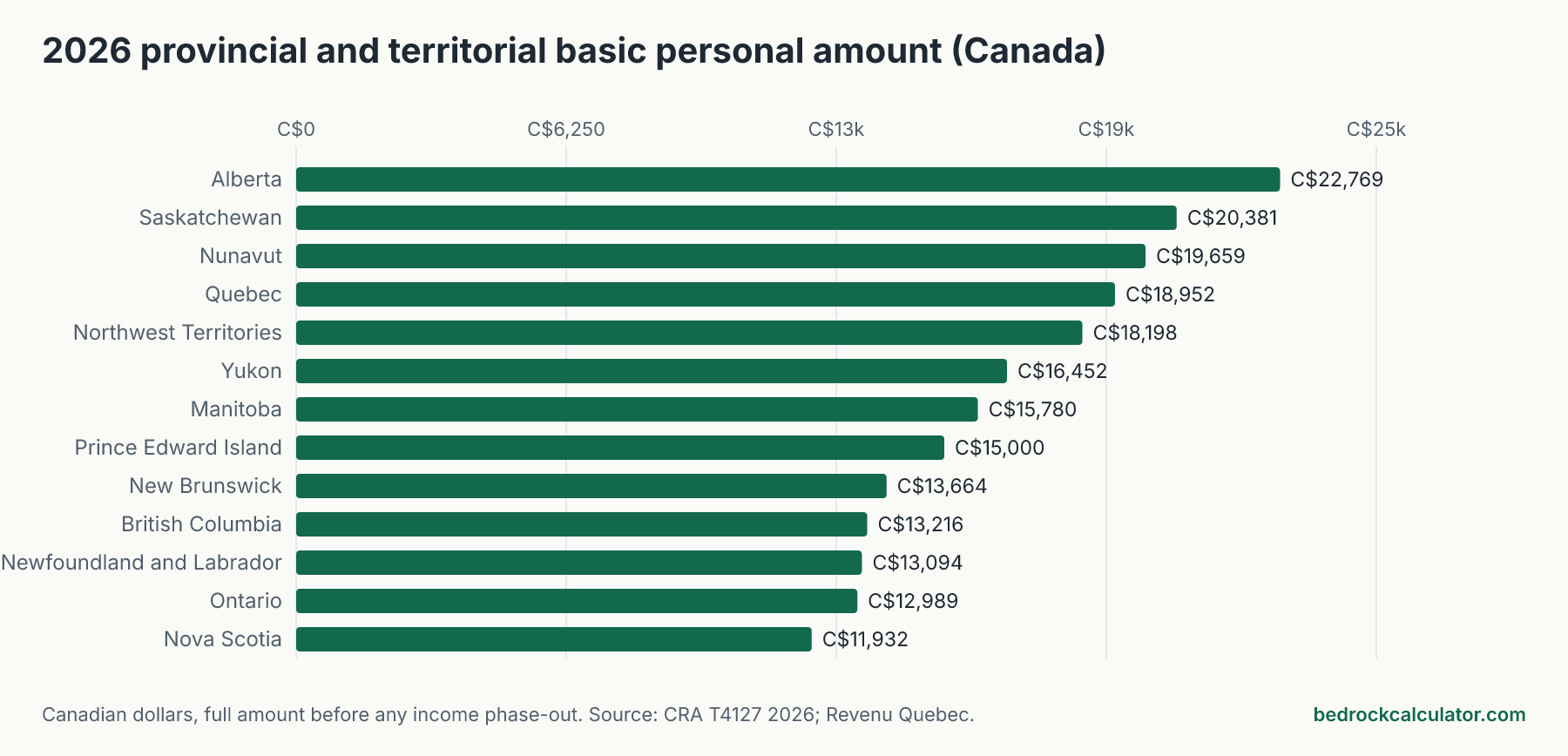
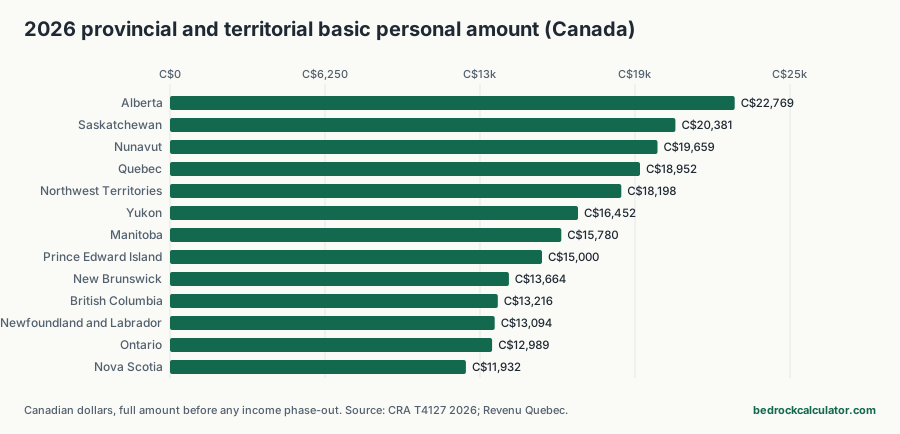
- Alberta's first bracket is 8%, and its basic personal amount of C$22,769 is the largest in the country, worth C$1,821.52 as a credit. Its combined top rate is 48.00%.
Why the basic personal amount matters more than it looks
Every jurisdiction gives you a basic personal amount, but it's a credit, not a deduction. You multiply it by the lowest rate in that ladder, and the result comes off your tax. That's why the credit value column can look surprising.
Ontario's amount is C$12,989, but at Ontario's low first rate it's worth only C$655.94. Quebec's is C$18,952 and, at Quebec's much higher first rate, worth C$2,653.28. A large basic personal amount at a low rate can be worth less than a smaller one at a higher rate.
The amounts range from C$11,932 in Nova Scotia to C$22,769 in Alberta. Two jurisdictions phase theirs out for high earners. Yukon follows the federal phase-out exactly. Manitoba's C$15,780 falls to zero between C$200,000 and C$400,000 of income.
Ontario's surtax and health premium
Ontario's published top rate of 13.16% understates what high earners pay. Ontario charges a surtax on its own basic tax: 20% of basic Ontario tax above C$5,818, plus another 36% above C$7,446. At the top, that turns the 13.16% provincial rate into a combined rate of 53.53%.
Ontario also charges the Ontario Health Premium through the tax system, up to C$900 a year. It isn't a bracket, but it's part of your Ontario income tax bill, and the income tax calculator includes it.
Every bracket, in full
Here is every 2026 bracket, federal first and then each province and territory.
2026 federal and provincial/territorial income tax brackets in Canada (Canadian dollars)
Download CSVEach rate applies only to taxable income between "from" and "to". Annual 2026 figures.
| Alberta | 1 | C$0 | C$61,200 | 8.00% |
| Alberta | 2 | C$61,200 | C$154,259 | 10.00% |
| Alberta | 3 | C$154,259 | C$185,111 | 12.00% |
| Alberta | 4 | C$185,111 | C$246,813 | 13.00% |
| Alberta | 5 | C$246,813 | C$370,220 | 14.00% |
| Alberta | 6 | C$370,220 | No upper limit | 15.00% |
| British Columbia | 1 | C$0 | C$50,363 | 5.60% |
| British Columbia | 2 | C$50,363 | C$100,728 | 7.70% |
| British Columbia | 3 | C$100,728 | C$115,648 | 10.50% |
| British Columbia | 4 | C$115,648 | C$140,430 | 12.29% |
| British Columbia | 5 | C$140,430 | C$190,405 | 14.70% |
| British Columbia | 6 | C$190,405 | C$265,545 | 16.80% |
| British Columbia | 7 | C$265,545 | No upper limit | 20.50% |
| Federal | 1 | C$0 | C$58,523 | 14.00% |
| Federal | 2 | C$58,523 | C$117,045 | 20.50% |
| Federal | 3 | C$117,045 | C$181,440 | 26.00% |
| Federal | 4 | C$181,440 | C$258,482 | 29.00% |
| Federal | 5 | C$258,482 | No upper limit | 33.00% |
| Manitoba | 1 | C$0 | C$47,000 | 10.80% |
| Manitoba | 2 | C$47,000 | C$100,000 | 12.75% |
| Manitoba | 3 | C$100,000 | No upper limit | 17.40% |
| New Brunswick | 1 | C$0 | C$52,333 | 9.40% |
| New Brunswick | 2 | C$52,333 | C$104,666 | 14.00% |
| New Brunswick | 3 | C$104,666 | C$193,861 | 16.00% |
| New Brunswick | 4 | C$193,861 | No upper limit | 19.50% |
| Newfoundland and Labrador | 1 | C$0 | C$44,678 | 8.70% |
| Newfoundland and Labrador | 2 | C$44,678 | C$89,354 | 14.50% |
| Newfoundland and Labrador | 3 | C$89,354 | C$159,528 | 15.80% |
| Newfoundland and Labrador | 4 | C$159,528 | C$223,340 | 17.80% |
| Newfoundland and Labrador | 5 | C$223,340 | C$285,319 | 19.80% |
| Newfoundland and Labrador | 6 | C$285,319 | C$570,638 | 20.80% |
| Newfoundland and Labrador | 7 | C$570,638 | C$1,141,275 | 21.30% |
| Newfoundland and Labrador | 8 | C$1,141,275 | No upper limit | 21.80% |
| Northwest Territories | 1 | C$0 | C$53,003 | 5.90% |
| Northwest Territories | 2 | C$53,003 | C$106,009 | 8.60% |
| Northwest Territories | 3 | C$106,009 | C$172,346 | 12.20% |
| Northwest Territories | 4 | C$172,346 | No upper limit | 14.05% |
| Nova Scotia | 1 | C$0 | C$30,995 | 8.79% |
| Nova Scotia | 2 | C$30,995 | C$61,991 | 14.95% |
| Nova Scotia | 3 | C$61,991 | C$97,417 | 16.67% |
| Nova Scotia | 4 | C$97,417 | C$157,124 | 17.50% |
| Nova Scotia | 5 | C$157,124 | No upper limit | 21.00% |
| Nunavut | 1 | C$0 | C$55,801 | 4.00% |
| Nunavut | 2 | C$55,801 | C$111,602 | 7.00% |
| Nunavut | 3 | C$111,602 | C$181,439 | 9.00% |
| Nunavut | 4 | C$181,439 | No upper limit | 11.50% |
| Ontario | 1 | C$0 | C$53,891 | 5.05% |
| Ontario | 2 | C$53,891 | C$107,785 | 9.15% |
| Ontario | 3 | C$107,785 | C$150,000 | 11.16% |
| Ontario | 4 | C$150,000 | C$220,000 | 12.16% |
| Ontario | 5 | C$220,000 | No upper limit | 13.16% |
| Prince Edward Island | 1 | C$0 | C$33,928 | 9.50% |
| Prince Edward Island | 2 | C$33,928 | C$65,820 | 13.47% |
| Prince Edward Island | 3 | C$65,820 | C$106,890 | 16.60% |
| Prince Edward Island | 4 | C$106,890 | C$142,520 | 17.62% |
| Prince Edward Island | 5 | C$142,520 | C$200,000 | 19.00% |
| Prince Edward Island | 6 | C$200,000 | No upper limit | 20.00% |
| Quebec | 1 | C$0 | C$54,345 | 14.00% |
| Quebec | 2 | C$54,345 | C$108,680 | 19.00% |
| Quebec | 3 | C$108,680 | C$132,245 | 24.00% |
| Quebec | 4 | C$132,245 | No upper limit | 25.75% |
| Saskatchewan | 1 | C$0 | C$54,532 | 10.50% |
| Saskatchewan | 2 | C$54,532 | C$155,805 | 12.50% |
| Saskatchewan | 3 | C$155,805 | No upper limit | 14.50% |
| Yukon | 1 | C$0 | C$58,523 | 6.40% |
| Yukon | 2 | C$58,523 | C$117,045 | 9.00% |
| Yukon | 3 | C$117,045 | C$181,440 | 10.90% |
| Yukon | 4 | C$181,440 | C$500,000 | 12.80% |
| Yukon | 5 | C$500,000 | No upper limit | 15.00% |
What these brackets don't tell you
Brackets and basic personal amounts are only the start. Your real tax also depends on other credits, such as CPP and EI contributions, the Canada employment amount, tuition, medical expenses and donations, and on provincial low-income reductions. Capital gains are only half taxed, and dividends come with their own credits.
To see what these brackets mean for a real paycheque, the take-home pay calculator adds CPP, EI and the employment credits for any province, and our take-home pay by province comparison runs four common salaries through it. For a one-off gain, see the capital gains tax calculator and capital gains tax by province.