How much OAS do you lose to the clawback at each income in 2026?
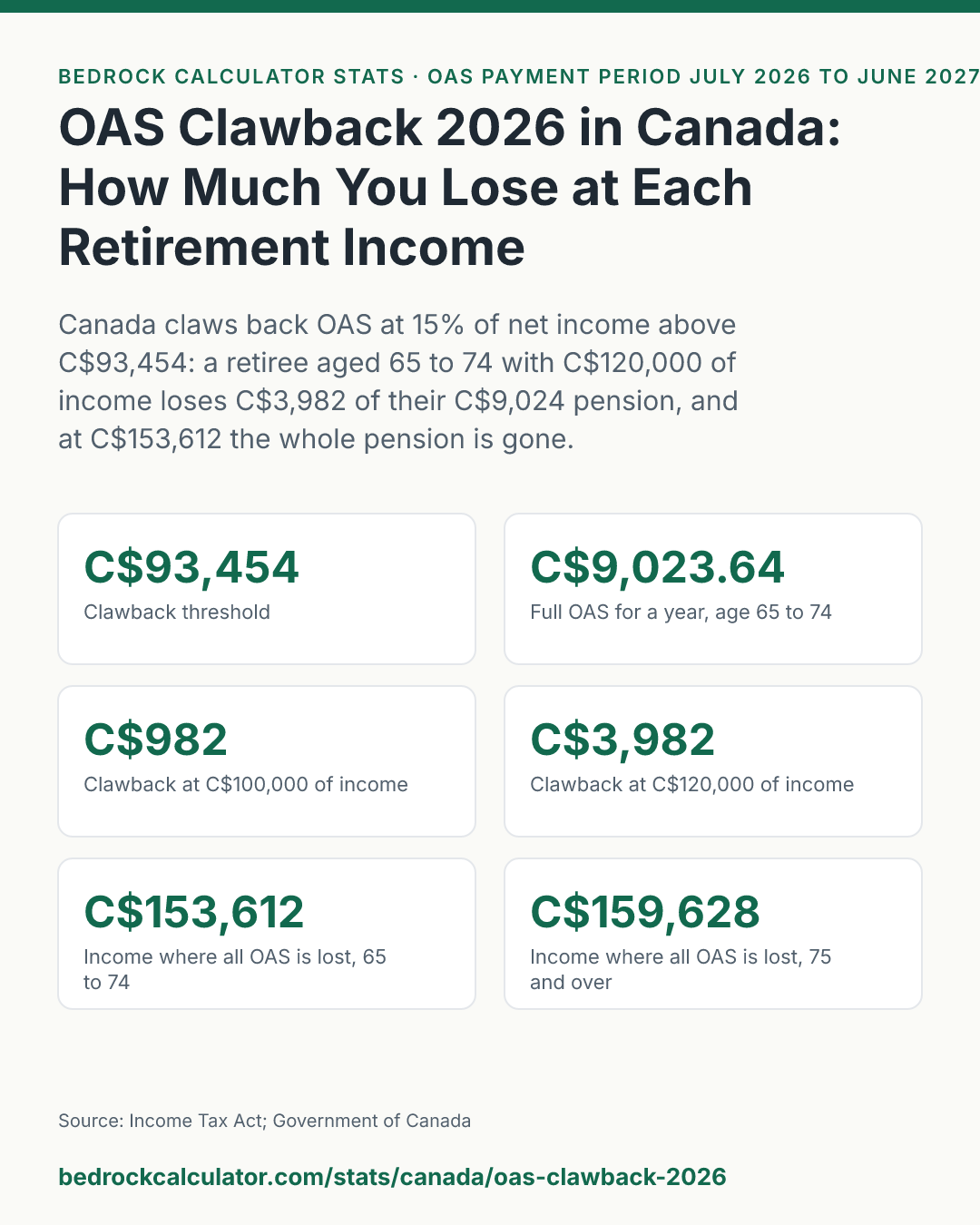
Old Age Security starts to shrink once your net income passes C$93,454. For OAS paid from July 2026 to June 2027, the government takes back 15% of every dollar above that line, through what it officially calls the recovery tax and everyone else calls the OAS clawback.
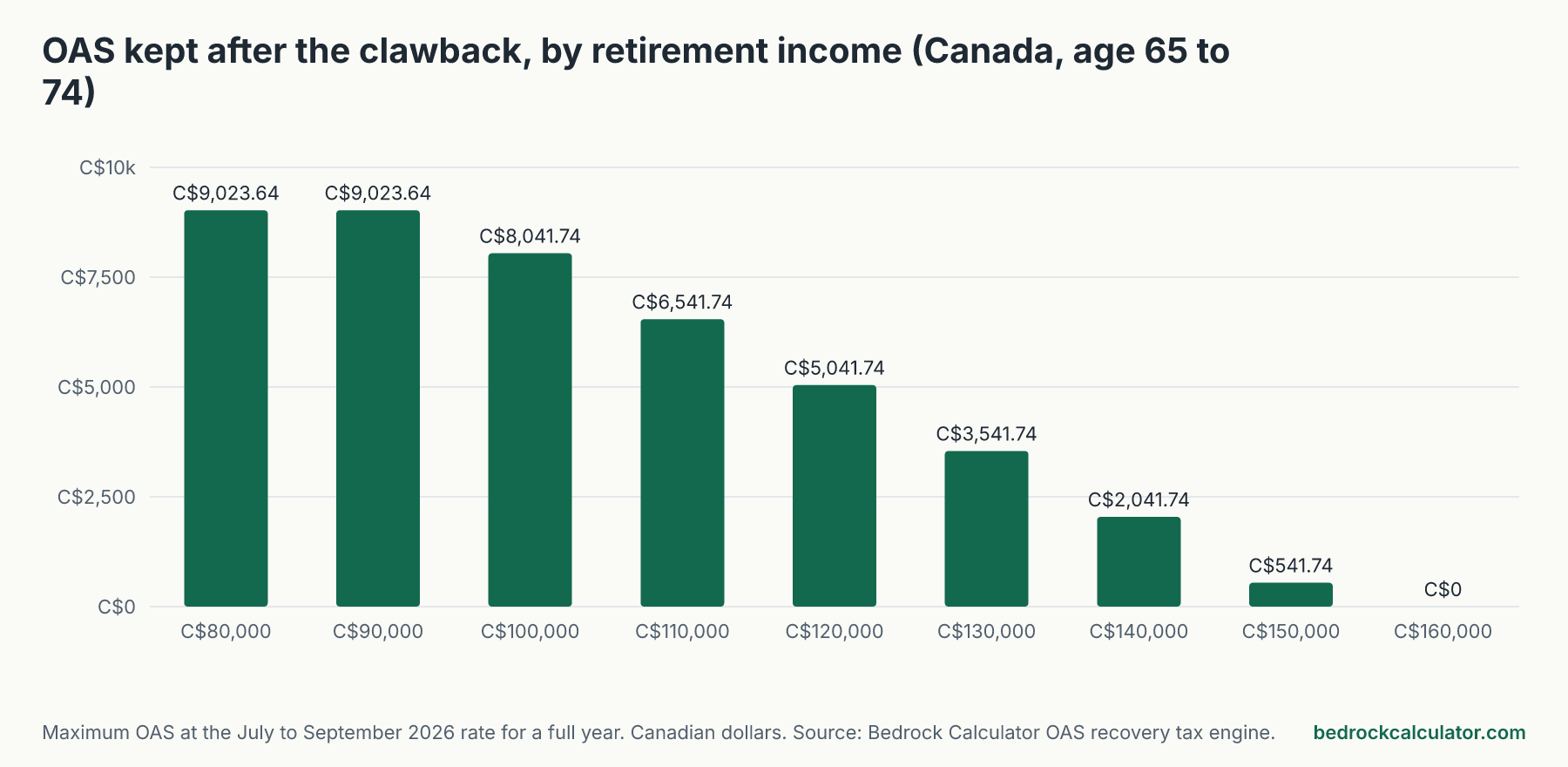
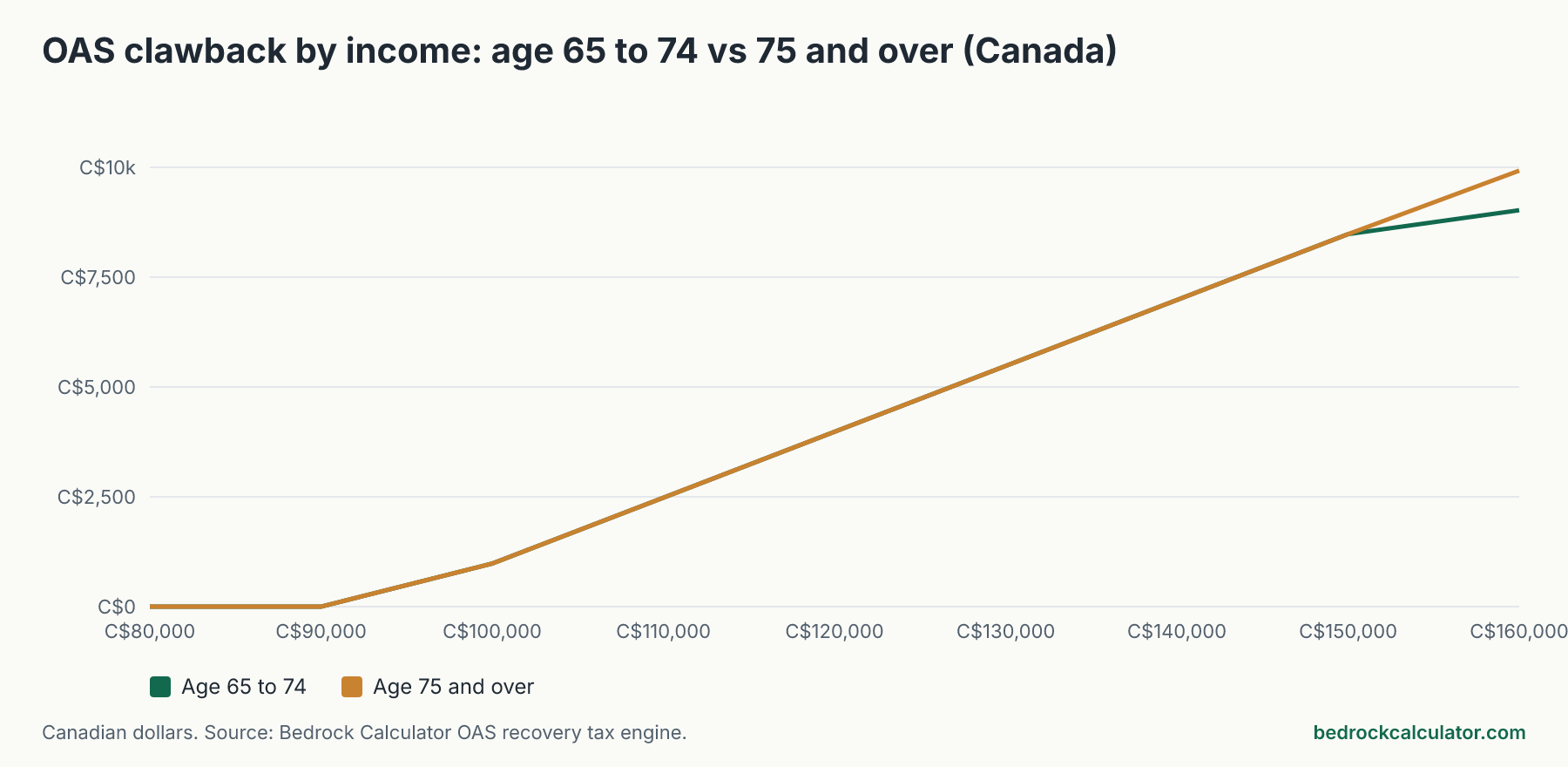
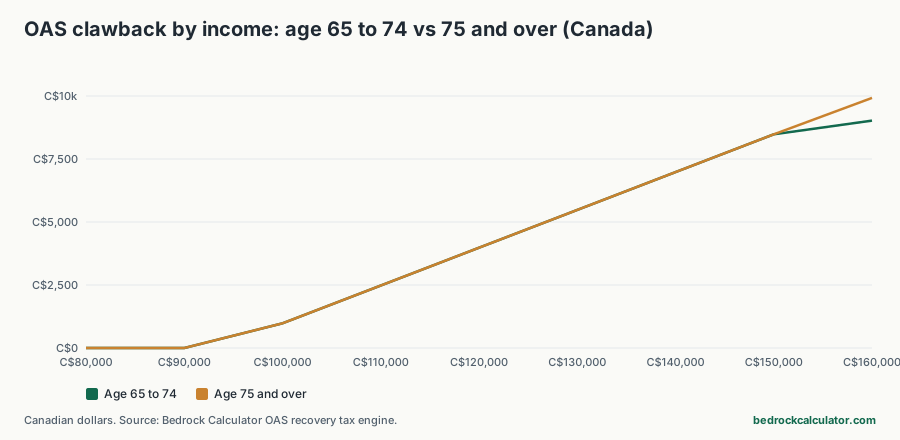
For a retiree aged 65 to 74 getting the full pension of C$9,023.64 a year, that means losing C$982 at C$100,000 of income, C$3,982 at C$120,000 and C$8,482 at C$150,000. At about C$153,612, the whole pension is gone.
How we worked out these numbers
We ran the OAS clawback calculator on this site at nine incomes from C$80,000 to C$160,000. It applies the rule in section 180.2 of the Income Tax Act: the clawback is 15% of income above the threshold, but never more than the OAS you actually received.
Two inputs come from the site's OAS table:
- The C$93,454 threshold that applies to OAS paid from July 2026 to June 2027. It's tested against your 2025 net income.
- A full year of the maximum OAS pension, using the July to September 2026 monthly amount of C$751.97 for ages 65 to 74. That's C$9,023.64 a year. From 75 the pension is 10% higher, or C$9,926.04 a year.
Some simplifications to keep in mind. OAS is re-indexed every quarter, so a real year of payments won't be exactly twelve times one quarter's amount. We've assumed a full pension, which needs 40 years of residence in Canada after 18; a partial pension is clawed back the same way but runs out sooner. And we've modelled a Canadian resident. Non-residents face a different calculation that this page doesn't cover.
The clawback at every income
The income column is your net income for the year, line 23400 of your return, which already includes the OAS itself. Click a heading to sort.
OAS clawback by retirement income in Canada, July 2026 to June 2027 (Canadian dollars)
Download CSVFull OAS pension, resident recipient. Recovery tax is 15% of net income above the threshold, capped at the OAS received.
| C$80,000 | C$0 | C$9,023.64 | 0.0% | C$0 | C$9,926.04 |
| C$90,000 | C$0 | C$9,023.64 | 0.0% | C$0 | C$9,926.04 |
| C$100,000 | C$981.90 | C$8,041.74 | 10.9% | C$81.83 | C$8,944.14 |
| C$110,000 | C$2,481.90 | C$6,541.74 | 27.5% | C$206.83 | C$7,444.14 |
| C$120,000 | C$3,981.90 | C$5,041.74 | 44.1% | C$331.83 | C$5,944.14 |
| C$130,000 | C$5,481.90 | C$3,541.74 | 60.8% | C$456.83 | C$4,444.14 |
| C$140,000 | C$6,981.90 | C$2,041.74 | 77.4% | C$581.83 | C$2,944.14 |
| C$150,000 | C$8,481.90 | C$541.74 | 94.0% | C$706.83 | C$1,444.14 |
| C$160,000 | C$9,023.64 | C$0 | 100.0% | C$751.97 | C$0 |
How the clawback works, step by step
The rule is simple once you see it. Every C$10,000 of income above C$93,454 costs C$1,500 of OAS. So at C$100,000 you're about C$6,546 over the line and lose C$982. At C$110,000 it's C$2,482, and at C$130,000 it's C$5,482. The pension doesn't fall off a cliff; it drains steadily until nothing is left.
The money isn't taken back in a lump sum. The CRA works out the recovery tax from your return, then reduces your monthly OAS cheques for the next July to June period. With C$100,000 of income, that's about C$81.83 less each month. If you were overpaid because your income jumped in a single year, the difference is settled when you file.
Who loses all of it
For ages 65 to 74 the full pension is gone at about C$153,612. Because the pension is 10% larger from age 75, so is the income needed to wipe it out: about C$159,628.
Deferring OAS pushes the line higher too. If you delay OAS to 70, the pension is permanently bigger, C$12,272.16 a year at today's rates, and it isn't fully clawed back until about C$175,268. That's one reason higher-income retirees sometimes defer: the extra pension has more room before it's lost. It only pays off if you live long enough to collect the extra months, though, and our CPP timing figures show how that kind of trade-off works out.
What counts as income
The clawback looks at net income, so anything that lands on your tax return counts:
- CPP and workplace pensions
- RRSP and RRIF withdrawals, including the minimum RRIF payment from age 72
- Interest, rental income and the taxable half of capital gains
- Canadian dividends at their grossed-up amount, which is higher than the cash you received
- OAS itself
TFSA withdrawals don't count, which is why the TFSA is so useful for retirees near the threshold. Pulling C$10,000 from a TFSA instead of a RRIF can save C$1,500 of OAS on top of the income tax. Our TFSA vs RRSP comparison looks at that choice in more detail.
Ways people reduce the clawback
None of these suit everyone, but they're the common moves:
- Pension income splitting. A couple can move up to half of eligible pension income to the lower-income spouse, which can pull the higher earner below the threshold.
- Drawing down an RRSP earlier. Taking money out in your 60s, before OAS and RRIF minimums kick in, can flatten your income later.
- Using the TFSA. Money withdrawn from a TFSA has no effect on the clawback.
- Timing large gains. Selling a property or a big investment in a year when your other income is low keeps more of the gain out of the clawback zone.
The clawback works like an extra 15% tax on top of your normal rate in that income band, so it's worth thinking about any income you can move in or out of those years.
Run your own figure
Your real clawback depends on your exact net income, your OAS amount and your age. Enter them in the OAS clawback calculator, or use the CPP and OAS calculator to see your combined government pensions at different claiming ages.