How much does the Dutch 30% ruling save?
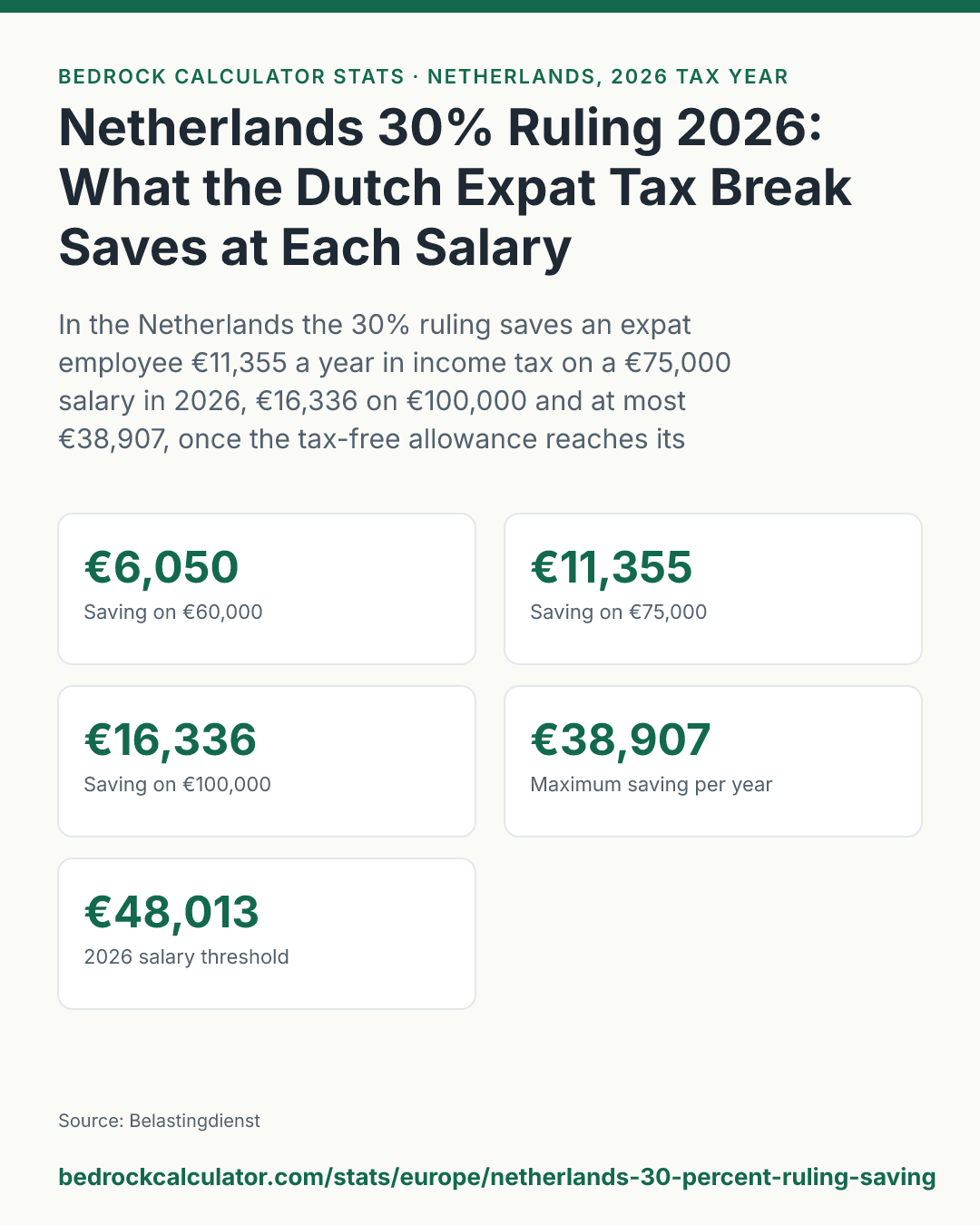
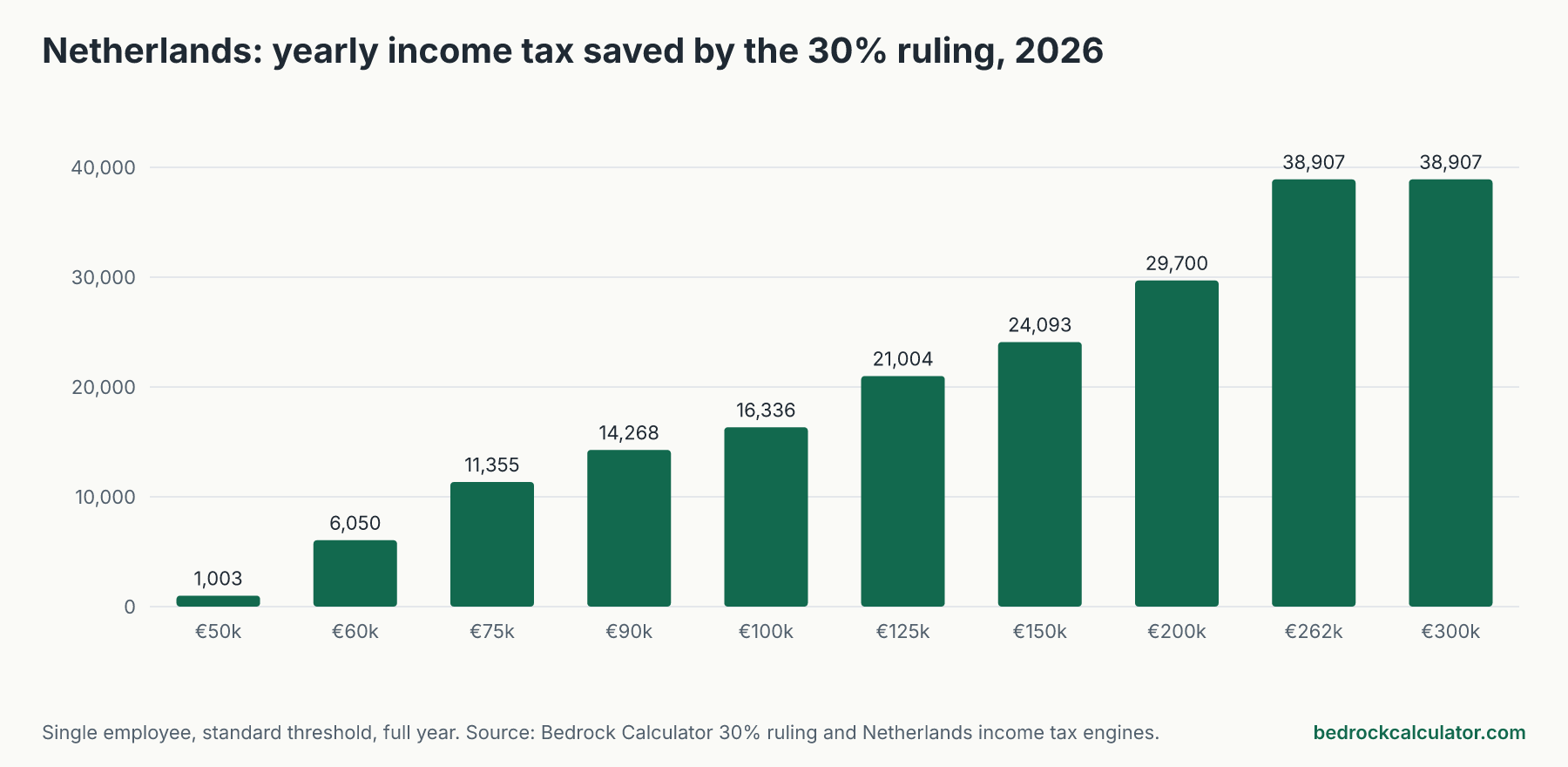
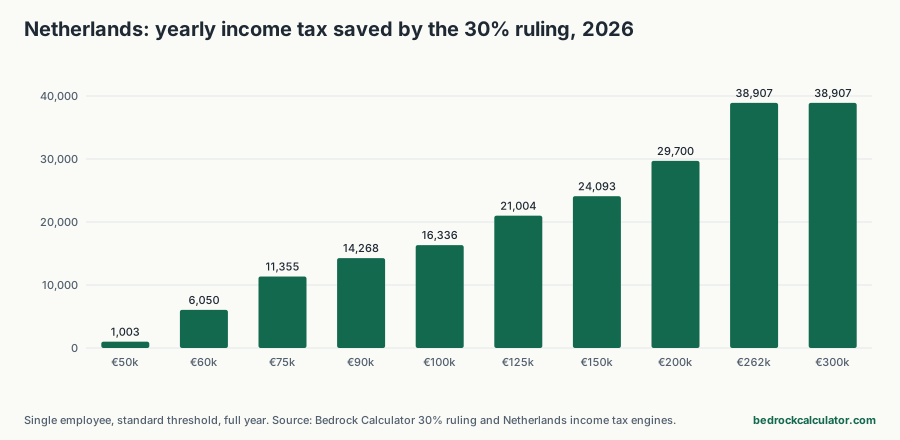
In the Netherlands, the 30% ruling (the 30%-regeling) saves an expat employee €11,355 a year in income tax on a €75,000 salary in 2026. On €100,000 the saving is €16,336, and on €150,000 it's €24,093.
The saving grows with salary until the tax-free allowance hits its cap of €78,600. From then on it stays at €38,907 a year. Near the bottom, the salary threshold of €48,013 trims the allowance, so a €50,000 salary saves only €1,003.
How the 30% ruling cuts your tax
The ruling lets your employer pay up to 30% of your salary as a tax-free allowance for the extra costs of moving to the Netherlands. You don't get extra money on top of your salary. Instead, part of the salary you already earn stops being taxed in Box 1.
Take a €90,000 salary. The allowance is €27,000, so income tax is worked out on what's left. Without the ruling, Box 1 tax after the general tax credit and the labour tax credit (the algemene heffingskorting and arbeidskorting) is €31,688. With it, it's €17,421. The difference, €14,268, is what the ruling is worth that year, about €1,189 a month.
The saving at each salary in 2026
Here's the same calculation at ten salaries for a single employee under the AOW pension age, on the ruling for the whole year. Click a column heading to sort.
Netherlands 30% ruling 2026: tax saving at each salary
Download CSVAnnual euros. Single employee below AOW age, standard salary threshold, full year under the ruling, Box 1 income tax after the general and labour tax credits. Source: Bedrock Calculator 30% ruling and Netherlands income tax engines.
| €50,000 | €1,987 | €10,859.67 | €9,856.87 | €1,002.80 | 2.0% | €40,143.13 | Salary threshold floor |
| €60,000 | €11,987 | €15,906.47 | €9,856.87 | €6,049.60 | 10.1% | €50,143.13 | Salary threshold floor |
| €75,000 | €22,500 | €23,476.67 | €12,121.37 | €11,355.30 | 15.1% | €62,878.63 | Full 30% |
| €90,000 | €27,000 | €31,688.11 | €17,420.51 | €14,267.60 | 15.9% | €72,579.49 | Full 30% |
| €100,000 | €30,000 | €37,289.11 | €20,953.27 | €16,335.84 | 16.3% | €79,046.73 | Full 30% |
| €125,000 | €37,500 | €51,291.61 | €30,287.86 | €21,003.75 | 16.8% | €94,712.14 | Full 30% |
| €150,000 | €45,000 | €64,182.15 | €40,089.61 | €24,092.54 | 16.1% | €109,910.39 | Full 30% |
| €200,000 | €60,000 | €88,932.15 | €59,232.15 | €29,700 | 14.8% | €140,767.85 | Full 30% |
| €262,000 | €78,600 | €119,622.15 | €80,715.15 | €38,907 | 14.8% | €181,284.85 | Full 30% |
| €300,000 | €78,600 | €138,432.15 | €99,525.15 | €38,907 | 13.0% | €200,474.85 | Maximum tax-free amount (WNT cap) |
A few things stand out. On €60,000 the ruling saves €6,050. On €125,000 it saves €21,004, and on €200,000 it saves €29,700. As a share of salary the saving peaks in the upper-middle range, at 16.8% on €125,000, against 15.1% on €75,000 and 16.1% on €150,000. At €300,000 it has fallen back to 13.0%, because the cap stops the allowance from growing.
Why the saving is small near the threshold
To qualify in 2026 your taxable salary, after the allowance, has to be at least €48,013. If it would drop below that, the allowance is cut until it doesn't. So on €50,000 you get an allowance of just €1,987, not the full 30%, and save €1,003. On €60,000 the allowance is €11,987.
The full 30% applies once the salary left after the allowance clears the threshold, which in 2026 means a gross salary of about €68,590 or more. In our table that's from €75,000 up. Below the threshold you don't qualify at all: a €45,000 salary gets no ruling for an employee on the standard threshold.
If you're negotiating a package near that line, this matters. A raise that lifts you over the threshold can be worth more than its headline amount, because it also unlocks part of the allowance.
The lower threshold for under-30s with a master's degree
Employees under 30 with a qualifying Dutch or equivalent master's degree have a lower threshold of €36,497. That opens the ruling to salaries the standard rule shuts out, and it makes it more generous just above the standard threshold.
Netherlands 30% ruling 2026: under 30 with a master's degree vs the standard threshold
Download CSVAnnual euros. Same employee, the lower salary threshold for under-30s with a qualifying master's degree against the standard threshold. Source: Bedrock Calculator 30% ruling and Netherlands income tax engines.
| €40,000 | €0 | €1,428.35 |
| €45,000 | €0 | €3,528.75 |
| €50,000 | €1,002.80 | €6,002.13 |
| €60,000 | €6,049.60 | €8,780.42 |
On €45,000, a qualifying under-30 saves €3,529, where a standard employee gets nothing. On €60,000 the lower threshold is worth an extra €2,731 a year. From €75,000 up both get the full 30%, so the saving is the same.
The cap at the top
The allowance can't exceed €78,600 in 2026. That's 30% of €262,000, the public-sector pay norm (the WNT norm) the cap is tied to. Up to that salary the saving keeps rising, reaching €38,907. Above it, every extra euro is fully taxed, so on €300,000 the saving is still €38,907.
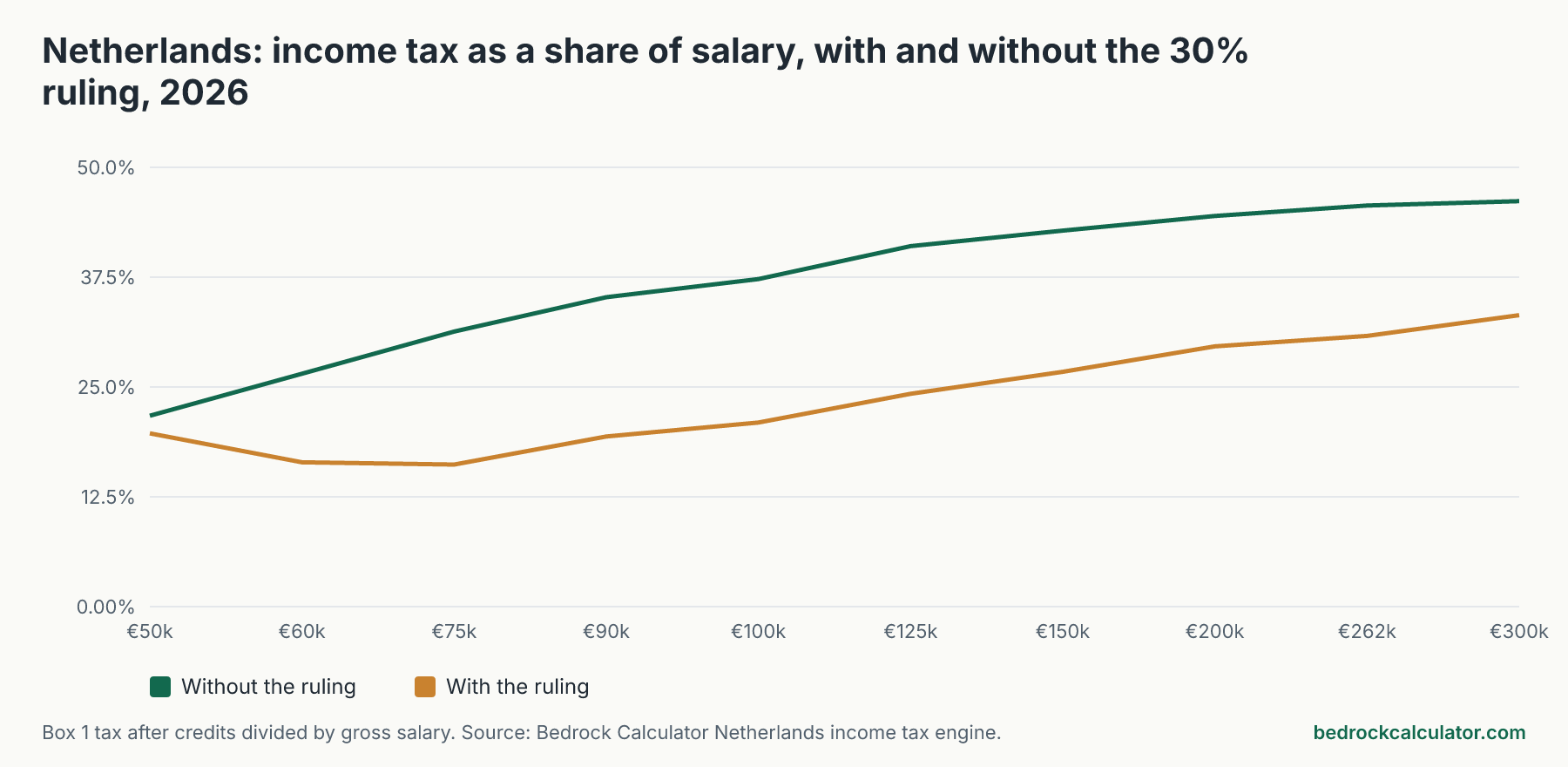
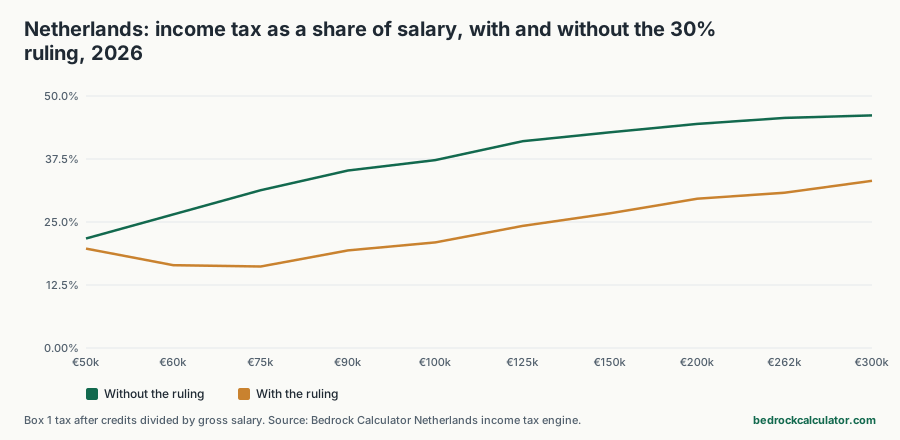
The chart shows income tax as a share of salary with and without the ruling. On €100,000 that's 37.3% without it and 21.0% with it. At €200,000 it's 44.5% against 29.6%.
What changes in 2027
A 2024 proposal to taper the ruling down in steps over its five years still shows up in older articles. It was withdrawn before it ever applied. Instead, for rulings that started on or after 1 January 2024, the maximum becomes 27% from 1 January 2027, and the salary threshold is set to rise. These figures are 2026 only, at the full 30%. Rulings that began earlier keep the old rate under transitional rules.
How we worked out these numbers
We chained two calculators on this site. The 30% ruling calculator applies the 2026 salary threshold and the cap to give the tax-free allowance and the taxable salary that's left. The Netherlands income tax calculator then works out Box 1 tax twice: once on the full salary and once on the taxable salary. Both runs treat the income as employment income and apply the general and labour tax credits, which shrink as income rises. The saving is the gap between the two.
Box 1 rates for people below AOW age already include the national insurance premiums (AOW, Anw and Wlz), so there's no separate social contribution to add for an employee. The health insurance contribution under the Zvw is paid by employers for employees and doesn't reduce your salary.
What these numbers leave out
Who qualifies. The ruling needs a Belastingdienst decision, an employer that applies it, and you must have been recruited from abroad, living more than 150 km from the Dutch border for at least 16 of the 24 months before you started. The calculator assumes you pass.
Part years. If the ruling starts or ends mid-year, the thresholds are prorated. We assume a full year.
Other effects of a lower taxable wage. The ruling lowers the wage that some benefits and pension accrual are based on, and it can change your eligibility for toeslagen. None of that is in these figures. Nor are mortgage interest, Box 3 wealth tax, or partner effects.
The 2027 rate. As above, 2026 only.
Run your own numbers
Try your own salary in the 30% ruling calculator, then run the taxable salary it gives you through the Netherlands income tax calculator. The heffingskortingen calculator breaks down the two credits that change as your taxable salary falls. For how Dutch take-home pay compares with Germany, Ireland and other countries, see our take-home pay by country study.