How much of a German gross salary is left as net pay?
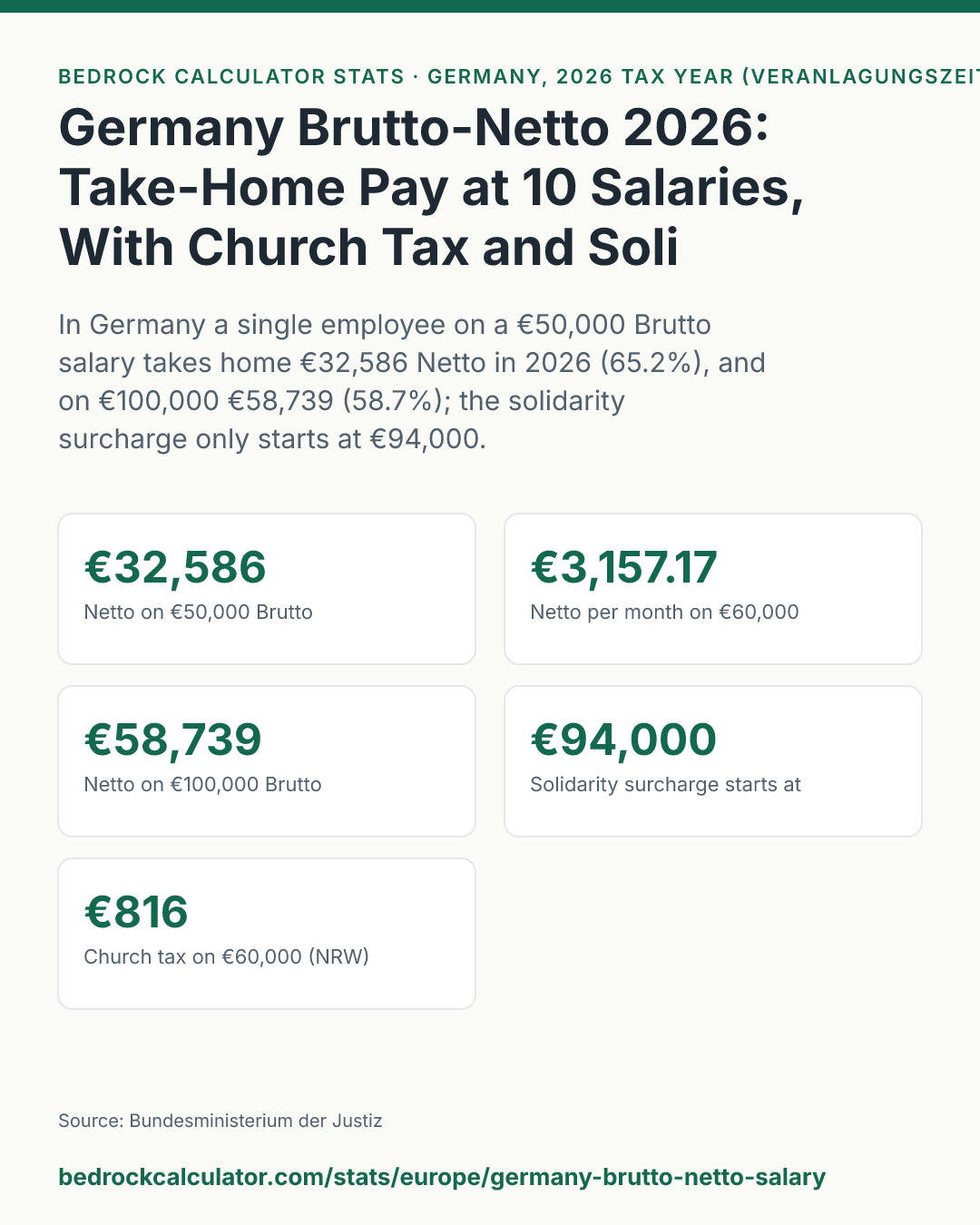
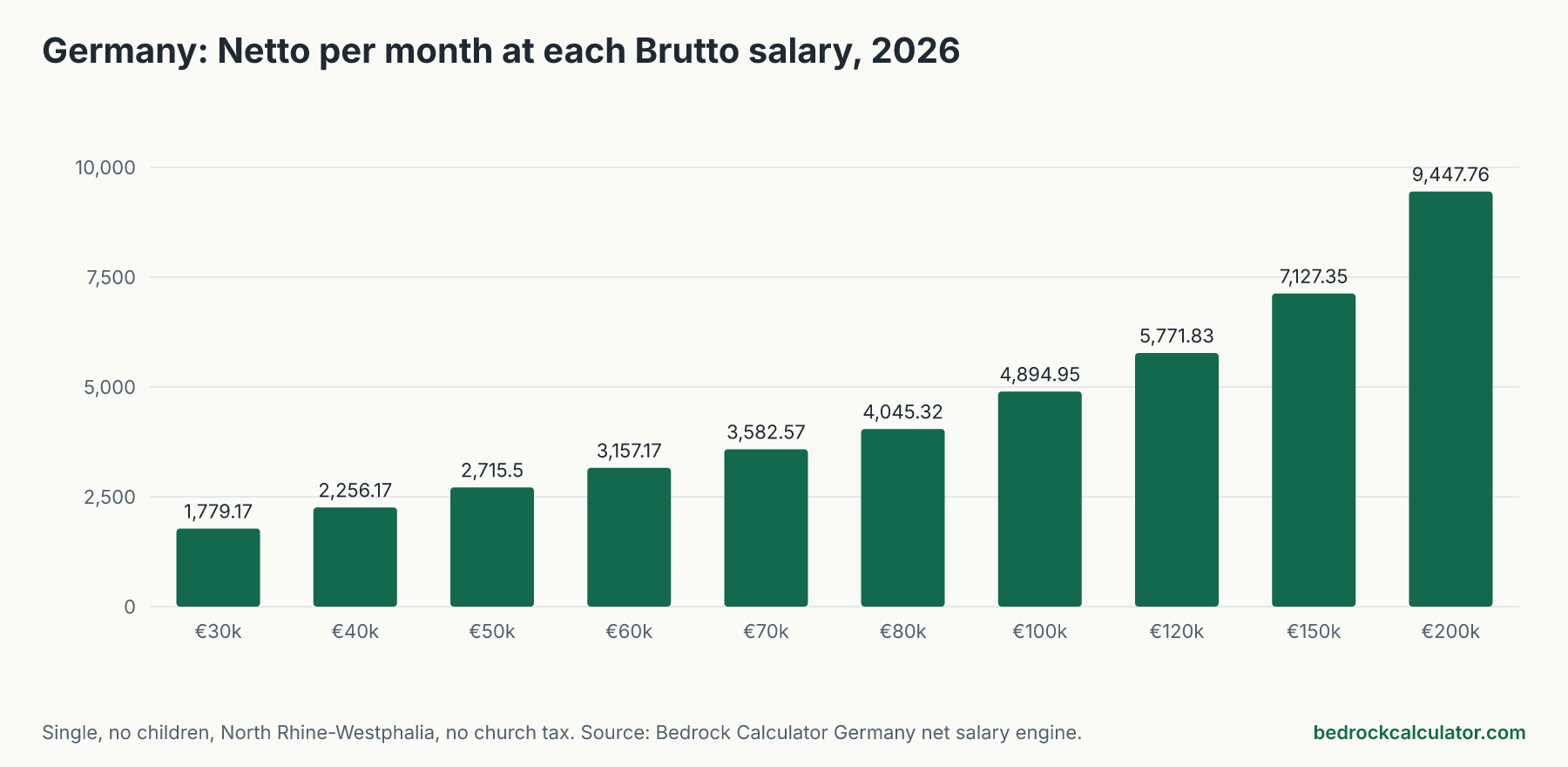
In Germany, a single employee on a €50,000 Brutto salary takes home €32,586 Netto in 2026, or €2,715.50 a month. That's 65.2% of gross pay. On €100,000 the Netto is €58,739, which is 58.7%.
The solidarity surcharge, the Soli, doesn't touch most salaries anymore. For a single person with no children it starts at a gross salary of about €94,000. Church tax is the bigger optional extra: a church member in North Rhine-Westphalia on €60,000 pays €816 a year on top.
Brutto-Netto at ten common salaries
Here is what's left of each salary once social insurance, income tax and the Soli are taken off. Every row is the same person: single, no children, living in North Rhine-Westphalia, not a church member and covered by statutory health insurance. Click a column heading to sort.
Germany Brutto-Netto 2026: take-home pay at ten salaries (single, no children, no church tax)
Download CSVAnnual euros. North Rhine-Westphalia, statutory health insurance at the average Zusatzbeitrag, childless care insurance surcharge included. Source: Bedrock Calculator Germany net salary engine.
| €30,000 | €6,525 | €2,125 | €0 | 21,350 | €1,779.17 | 71.2% |
| €40,000 | €8,700 | €4,226 | €0 | 27,074 | €2,256.17 | 67.7% |
| €50,000 | €10,875 | €6,539 | €0 | 32,586 | €2,715.50 | 65.2% |
| €60,000 | €13,050 | €9,064 | €0 | 37,886 | €3,157.17 | 63.1% |
| €70,000 | €15,197.13 | €11,812 | €0 | 42,990.87 | €3,582.57 | 61.4% |
| €80,000 | €16,257.13 | €15,199 | €0 | 48,543.87 | €4,045.32 | 60.7% |
| €100,000 | €18,377.13 | €22,614 | €269.42 | 58,739.45 | €4,894.95 | 58.7% |
| €120,000 | €18,525.53 | €30,951 | €1,261.52 | 69,261.95 | €5,771.83 | 57.7% |
| €150,000 | €18,525.53 | €43,551 | €2,395.31 | 85,528.16 | €7,127.35 | 57.0% |
| €200,000 | €18,525.53 | €64,551 | €3,550.31 | 113,373.16 | €9,447.76 | 56.7% |
A few rows people ask about most often. €40,000 Brutto leaves €27,074 a year, or €2,256.17 a month. €60,000 leaves €37,886, or €3,157.17 a month. €80,000 leaves €48,544, and €150,000 leaves €85,528.
Why social insurance is the biggest deduction on most German payslips
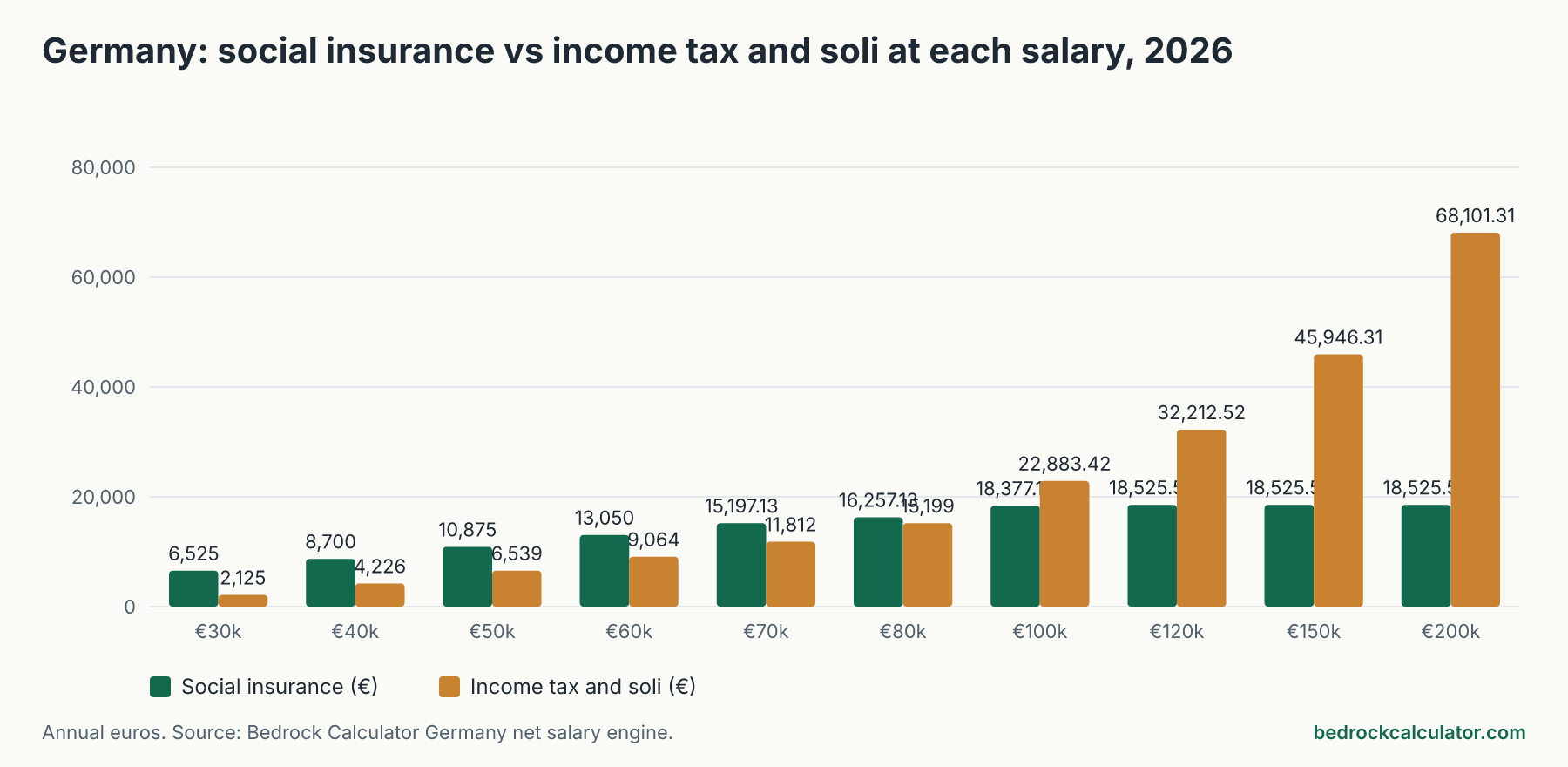
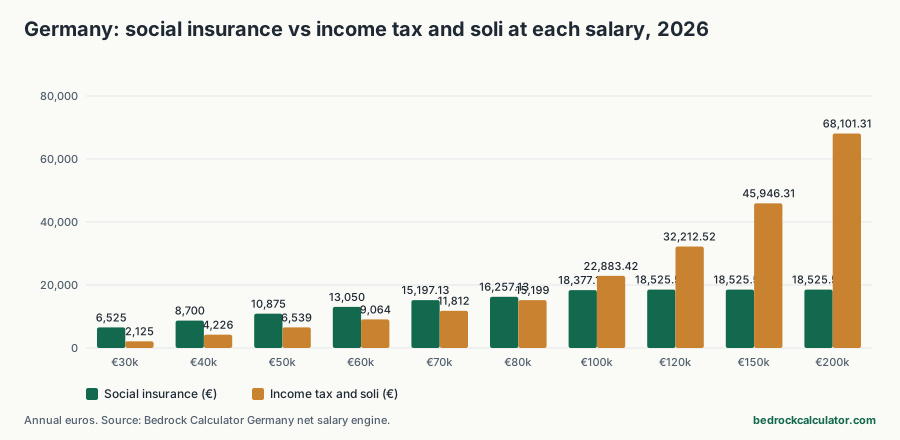
People often assume income tax is what shrinks a German salary. For most employees it isn't. On €50,000, the four social insurance contributions (pension, health, long-term care and unemployment) come to €10,875, while income tax is €6,539. At €30,000 the gap is wider still: €6,525 of social insurance against €2,125 of income tax.
That flips higher up. Social insurance is charged only up to two ceilings, the Beitragsbemessungsgrenzen. Health and care contributions stop at one salary level and pension and unemployment at a higher one. By €120,000 the employee share has reached its maximum of €18,526 and it stays there however much more you earn. Income tax has no ceiling, so on €100,000 it's €22,614 and on €200,000 it's €64,551.
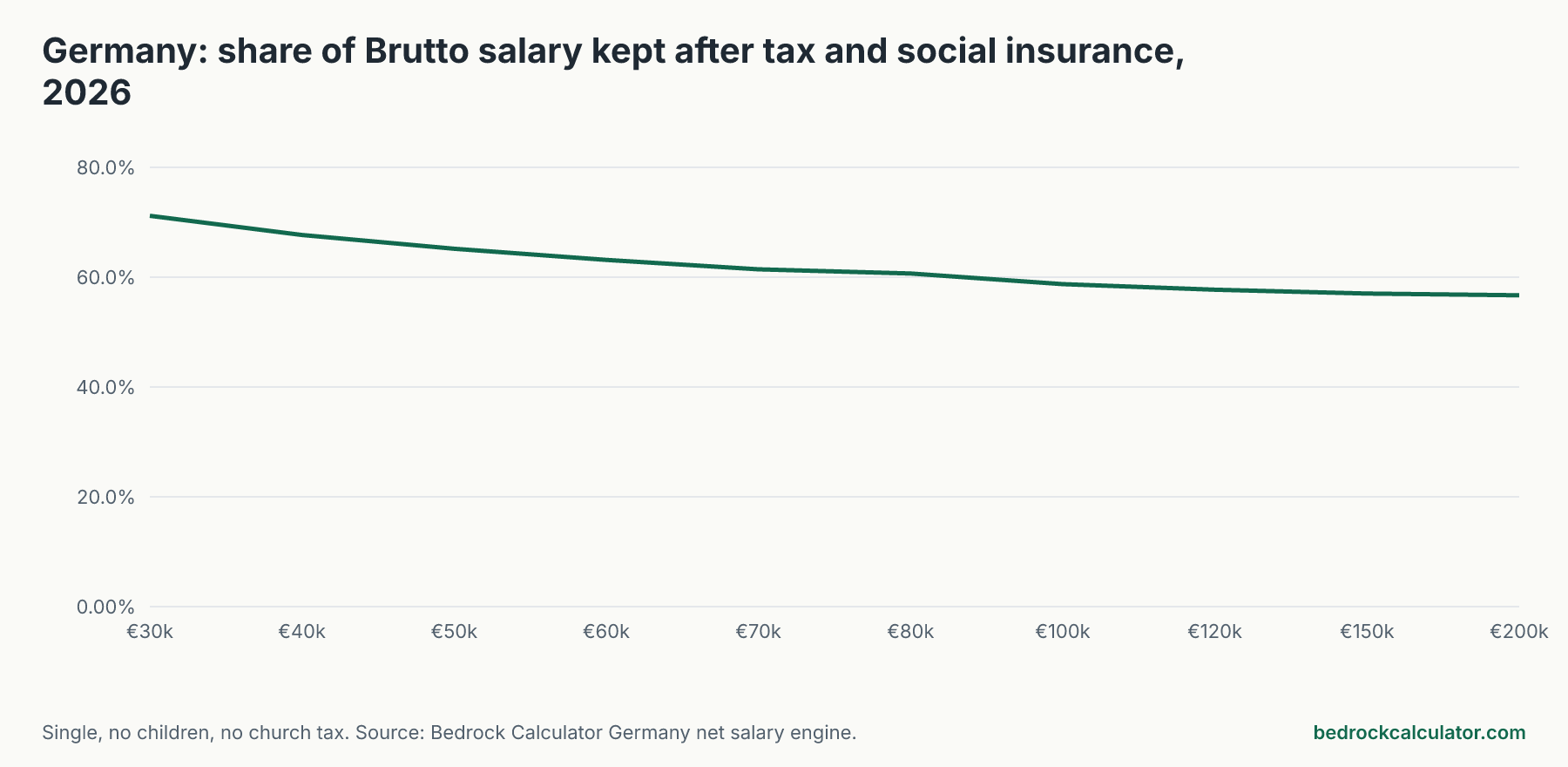
The result is a share kept that falls as pay rises, but not as steeply as the income tax rates alone would suggest. Because social insurance is capped, the drop flattens at the top of the range.
When does the solidarity surcharge start?
Since 2021 the Soli works with an exemption limit, the Freigrenze, based on your income tax. Below it you pay nothing. Just above it, a phase-in zone stops the surcharge from jumping straight to its full rate.
Running gross salaries through the Germany net salary calculator in €100 steps, a single employee with no children first pays any Soli at about €94,000. On €100,000 it's €269. On €120,000 it's €1,262, and on €200,000 it's €3,550. Every salary from €30,000 to €80,000 in our table pays none at all.
A married couple filing jointly has a Freigrenze twice as large, so the Soli starts much higher for them. The solidarity surcharge calculator shows the exact amount for any income tax figure.
How much church tax costs at each salary
Kirchensteuer is a percentage of your income tax, not of your salary: 9% in most Länder and 8% in Bavaria and Baden-Württemberg. You pay it only if you're a registered member of a church that collects it.
Because it rides on income tax, it grows faster than pay. On €30,000 a church member in North Rhine-Westphalia pays €191 a year. On €60,000 it's €816, on €100,000 €2,035, and on €200,000 €5,810. At that top salary, living in Bavaria instead of NRW saves €646 a year, purely from the lower rate.
Kirchensteuer in Germany 2026: church tax at each salary, NRW (9%) and Bavaria (8%)
Download CSVAnnual euros, single, no children. Church tax is a percentage of income tax; the cap (Kappung) some churches grant on request is not applied. Source: Bedrock Calculator Germany net salary engine.
| €30,000 | €191.25 | €170 | €21,158.75 |
| €40,000 | €380.34 | €338.08 | €26,693.66 |
| €50,000 | €588.51 | €523.12 | €31,997.49 |
| €60,000 | €815.76 | €725.12 | €37,070.24 |
| €70,000 | €1,063.08 | €944.96 | €41,927.79 |
| €80,000 | €1,367.91 | €1,215.92 | €47,175.96 |
| €100,000 | €2,035.26 | €1,809.12 | €56,704.19 |
| €120,000 | €2,785.59 | €2,476.08 | €66,476.36 |
| €150,000 | €3,919.59 | €3,484.08 | €81,608.57 |
| €200,000 | €5,809.59 | €5,164.08 | €107,563.57 |
As a share of gross salary, church tax runs from 0.6% at €30,000 to 2.9% at €200,000. That's why leaving the church, the Kirchenaustritt, is a common question among higher earners. The church tax calculator works it out for your own income tax.
Does the Bundesland change your Netto?
Mostly no. Income tax, the Soli and the social insurance rates are federal, so the same salary nets out the same in Hamburg or Hesse. There are two exceptions the calculator handles. The first is church tax, at 8% or 9%. The second is Saxony, where employees pay a larger share of long-term care insurance.
On €50,000, a single employee in Saxony takes home €32,413, which is €173 less than in North Rhine-Westphalia.
How we worked out these numbers
Every figure comes from this site's Germany net salary calculator, which applies the 2026 income tax tariff in §32a EStG, the 2026 Soli exemption limit and phase-in zone, and the 2026 social insurance rates and ceilings. We ran it once per salary with the same personal details.
Health insurance uses the general statutory rate plus the average additional contribution, the Zusatzbeitrag, set for 2026. Your own health fund may charge a little more or less. Long-term care insurance includes the surcharge for childless employees over 23, which applies to everyone in our scenario.
The calculator works out the annual tax a year-end assessment would produce and divides by twelve for the monthly figure. It applies the standard employee allowance for work expenses and the standard allowance for special expenses.
What these numbers leave out
Payslip timing. Monthly withholding follows your Lohnsteuerklasse. In tax class I the year adds up the same, but couples in classes III and V see very different monthly Netto from the annual result here.
Private health insurance. Above the compulsory insurance threshold many higher earners switch to private cover with premiums set by age and health. The figures here assume statutory insurance at every salary.
Church tax caps. Some churches cap Kirchensteuer for high earners at a share of taxable income, usually on application. The calculator doesn't apply that cap, so the church tax at €150,000 and €200,000 may be higher than some members actually pay.
Children, marriage and extras. Children lower the care insurance rate and can bring a child allowance. Married couples get income splitting. Company pensions, capital-forming payments and itemised work expenses above the standard allowance are not modelled. The employer's own contributions don't appear either.
Run your own numbers
Put your own salary, Bundesland, church status and children into the Germany net salary calculator. The Germany income tax calculator shows the tariff on its own, and the social insurance calculator splits out each contribution. To see how a German salary compares with Ireland, the UK and a dozen other countries, read our take-home pay by country comparison.