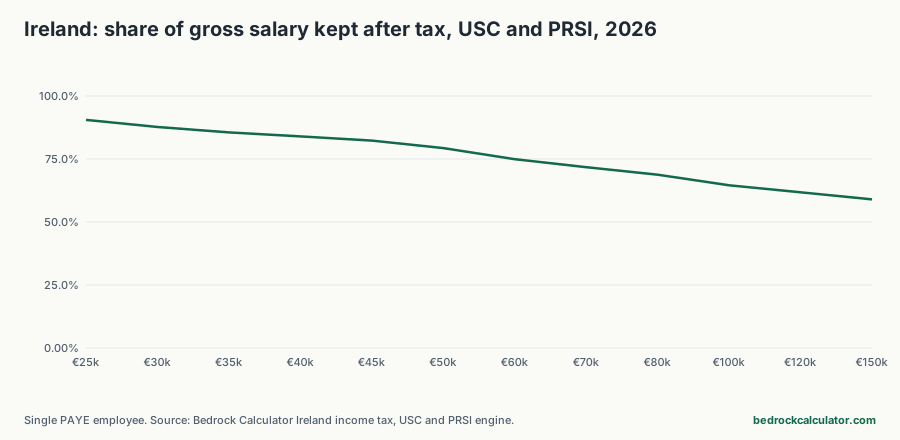
How much do you take home in Ireland after income tax, USC and PRSI?
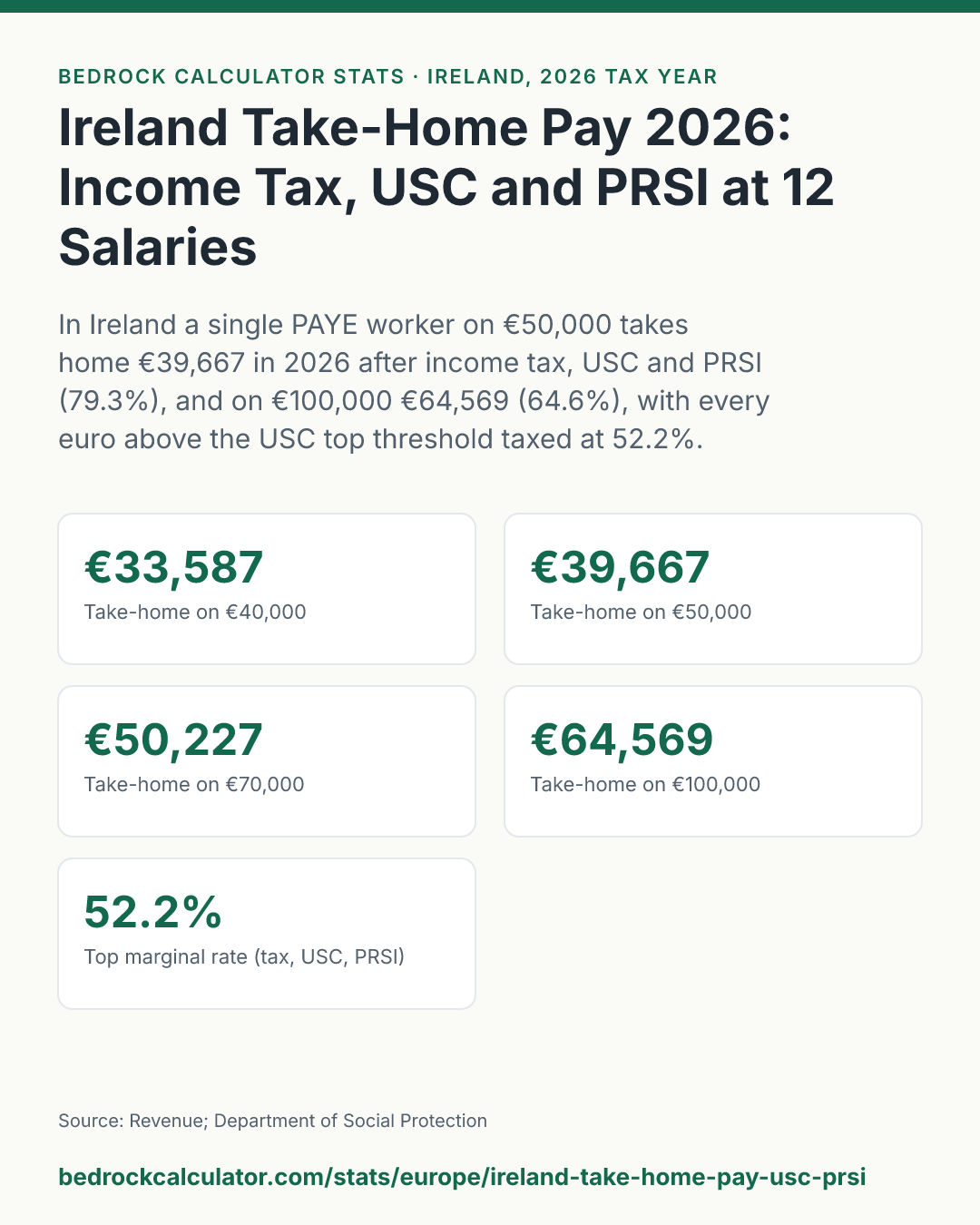
In Ireland, a single PAYE employee on €50,000 takes home €39,667 in 2026, or €3,305.60 a month. That's 79.3% of gross pay after income tax, the Universal Social Charge (USC) and PRSI. On €100,000 the take-home pay is €64,569, or 64.6%.
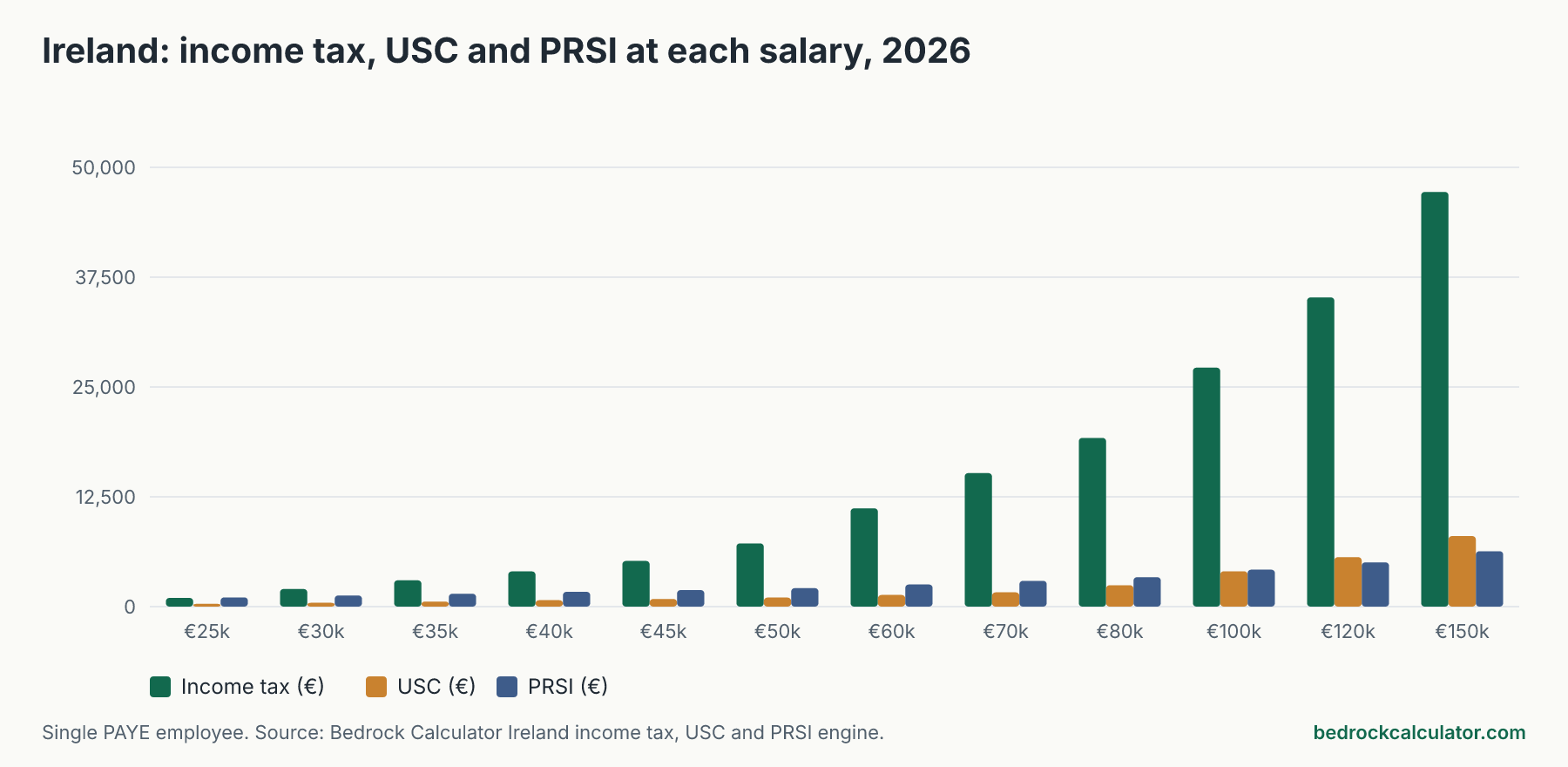
Three charges come off every Irish payslip, and they behave differently. Income tax is the biggest by far once you pass the standard rate band. PRSI is a flat 4.2% of pay. USC is small at first and then jumps to 8% above €70,044. Past that point, each extra euro you earn loses 52.2%.
Take-home pay at twelve salaries
Here's what's left for a single employee with the two standard tax credits, the personal credit and the employee (PAYE) credit, and no pension contributions. Sort by any column.
Ireland take-home pay 2026: income tax, USC and PRSI at twelve salaries
Download CSVAnnual euros. Single PAYE employee, personal and employee tax credits only, no pension contributions. Source: Bedrock Calculator Ireland income tax, USC and PRSI engine.
| €25,000 | €1,000 | €319.82 | €1,050 | 22,630.18 | €1,885.85 | 90.5% |
| €30,000 | €2,000 | €432.82 | €1,260 | 26,307.18 | €2,192.27 | 87.7% |
| €35,000 | €3,000 | €582.82 | €1,470 | 29,947.18 | €2,495.60 | 85.6% |
| €40,000 | €4,000 | €732.82 | €1,680 | 33,587.18 | €2,798.93 | 84.0% |
| €45,000 | €5,200 | €882.82 | €1,890 | 37,027.18 | €3,085.60 | 82.3% |
| €50,000 | €7,200 | €1,032.82 | €2,100 | 39,667.18 | €3,305.60 | 79.3% |
| €60,000 | €11,200 | €1,332.82 | €2,520 | 44,947.18 | €3,745.60 | 74.9% |
| €70,000 | €15,200 | €1,632.82 | €2,940 | 50,227.18 | €4,185.60 | 71.8% |
| €80,000 | €19,200 | €2,430.62 | €3,360 | 55,009.38 | €4,584.12 | 68.8% |
| €100,000 | €27,200 | €4,030.62 | €4,200 | 64,569.38 | €5,380.78 | 64.6% |
| €120,000 | €35,200 | €5,630.62 | €5,040 | 74,129.38 | €6,177.45 | 61.8% |
| €150,000 | €47,200 | €8,030.62 | €6,300 | 88,469.38 | €7,372.45 | 59.0% |
Some of the salaries people search for most: €30,000 leaves €26,307, about €2,192.27 a month. €40,000 leaves €33,587, about €2,798.93 a month. €60,000 leaves €44,947, and €70,000 leaves €50,227. €80,000 leaves €55,009, or €4,584.12 a month.
How income tax works in Ireland
Irish income tax has two rates: 20% on income up to the standard rate band and 40% on the rest. For a single person the band is €44,000 in 2026. Tax credits then come off the tax bill, not off your income. The personal and employee credits together are worth €4,000 to a single employee, which is why income tax on €30,000 is just €2,000.
Once you cross €44,000, the higher rate kicks in and income tax climbs fast. It's €5,200 on €45,000, €11,200 on €60,000 and €27,200 on €100,000.
How USC works
The Universal Social Charge has its own bands, applied to your gross income with no credits: 0.5% up to €12,012, 2% up to €28,700, 3% up to €70,044 and 8% above that. If your total income is €13,000 or less, you pay no USC at all.
For most workers USC is the smallest of the three charges. On €50,000 it's €1,033. It only starts to bite above €70,044, when the top rate applies: €4,031 on €100,000 and €8,031 on €150,000.
How PRSI works
PRSI Class A is a flat percentage of all your pay once you earn more than €352 a week, with a small credit just above that line. The calculator uses 4.2% for 2026. On €50,000 that's €2,100, more than twice the USC on the same salary. On €150,000 it's €6,300. Unlike German social insurance, there's no ceiling.
The PRSI rate is rising in steps. It goes up again on 1 October 2026, so someone paid across the whole of 2026 will pay a little more PRSI than shown here.
Your marginal rate: what you keep from a pay rise
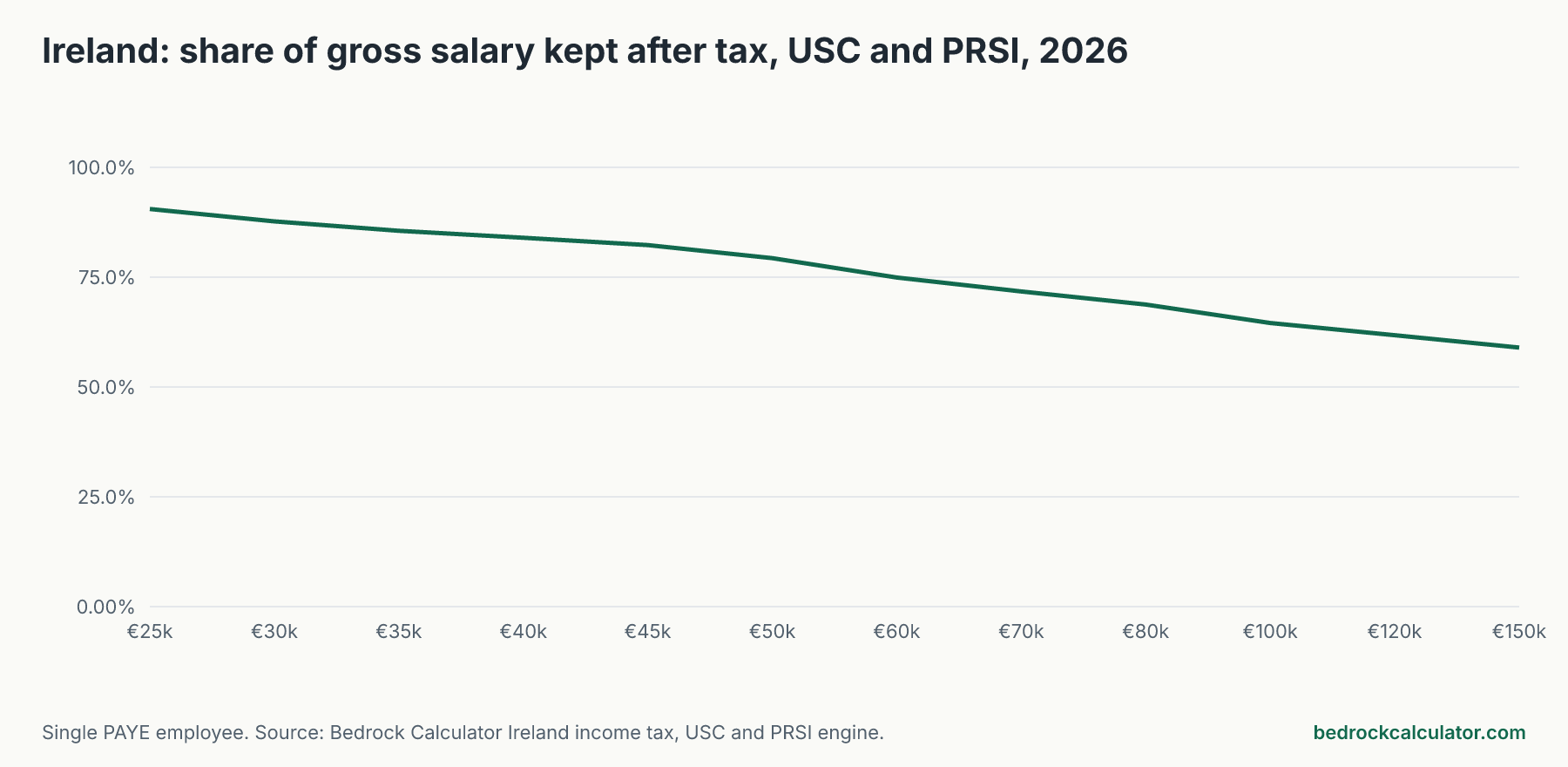
Between €28,700 and €44,000, an extra euro of pay costs 27.2% in income tax, USC and PRSI. From €44,000 to €70,044 it's 47.2%. Above €70,044 it's 52.2%, so you keep €47.80 of every extra €100.
That's why the share of pay you keep falls quite steeply, from 90.5% on €25,000 to 68.8% on €80,000 and 59.0% on €150,000.
Married couples: one income or two?
Income tax in Ireland can be jointly assessed, but USC and PRSI are always charged on each person's own pay. We ran the same household income of €80,000 three ways.
A single person on €80,000 takes home €55,009. A married couple with one earner on €80,000 takes home €58,809, which is €3,800 more, thanks to a bigger standard rate band and a second personal credit. A married couple with two earners on €40,000 each takes home €67,174, another €8,365 on top. Two incomes get the most out of the standard rate band and the employee credit, and each stays below the top USC rate.
How we worked out these numbers
Every figure comes from this site's Ireland income tax, USC and PRSI calculator. It applies the 2026 standard rate bands, the personal and employee tax credits, the 2026 USC bands and the PRSI Class A rate with its weekly exemption and credit. We ran it once per salary for a single person, and three times for the couple comparison.
What these numbers leave out
Pension contributions. Contributions to an occupational pension or PRSA reduce income tax but not USC or PRSI. They aren't deducted here. The pension tax relief calculator shows what they save.
Other credits. Only the two universal credits are applied. The rent tax credit, the single person child carer credit, medical insurance relief and others would lower income tax for those who qualify.
The October PRSI rise. As above, the calculator uses the rate for most of 2026.
Self-employed income. Self-employed people pay Class S PRSI, get the earned income credit instead of the employee credit, and pay a USC surcharge on high non-PAYE income. This page is for employees.
Employer PRSI. Your employer pays its own PRSI on top of your salary. It doesn't come out of your pay and isn't shown.
Run your own numbers
Try your own salary in the Ireland income tax, USC and PRSI calculator, including the married and two-income options. For pension savings, see the PRSA calculator. To see how Irish take-home pay compares with Germany, the UK and other countries on a mid-range salary, read our take-home pay by country comparison.