How much is Box 3 tax on Dutch savings and investments?
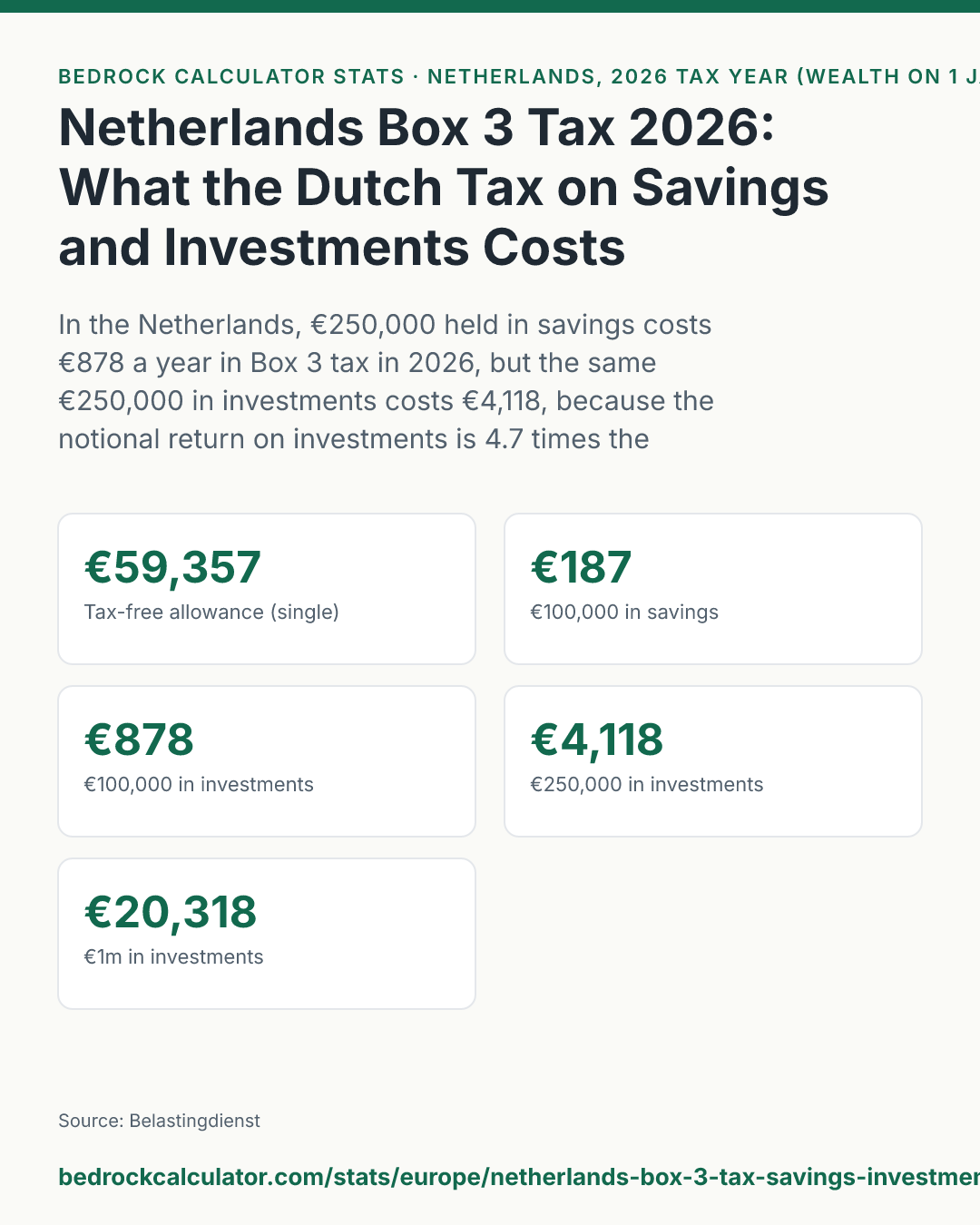
In the Netherlands, Box 3 doesn't tax what your savings and investments actually earn. It taxes a return the government assumes they earn, and that assumption depends on what you hold. €250,000 in a savings account costs a single person €878 in Box 3 tax for 2026. The same €250,000 in shares or funds costs €4,118.
The first €59,357 is tax-free per person, so modest savings pay nothing. Above that the bill rises quickly, especially for investments: €1 million held in investments costs €20,318 a year.
How Box 3 works out the tax
Box 3 starts from what you own on 1 January. Each kind of asset is given a notional return, the forfaitair rendement. For 2026 that's 1.28% on bank savings, 6.0% on investments and other assets such as shares, funds, a second home or crypto, and 2.7% on debts above €3,800, which reduces the total.
Those notional returns are added up and turned into one average rate for your whole pot. That rate is applied to the part of your wealth above the tax-free allowance, the heffingsvrij vermogen. The result is your Box 3 income, and it's taxed at 36%.
Put simply, every euro of savings above the allowance costs about 0.46% a year in tax, and every euro of investments about 2.16%. That's why the mix matters so much. The investment rate is 4.7 times the savings rate, so the same amount of wealth can cost several times more tax depending on where it sits.
Box 3 tax on €50,000 to €1 million
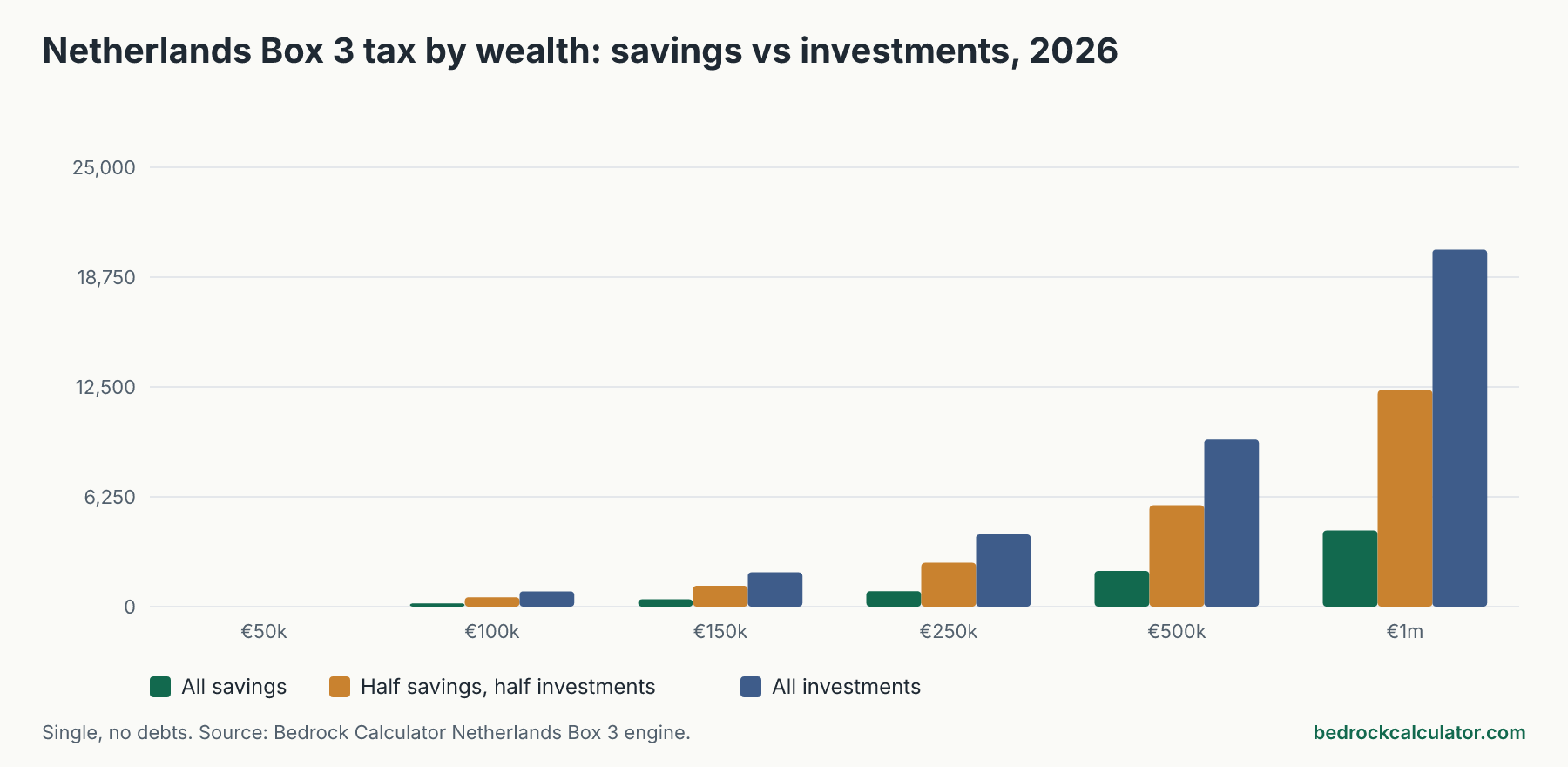
Here's the 2026 bill for a single person with no debts, at six levels of wealth and three ways of holding it. Click a column heading to sort.
Netherlands Box 3 tax 2026 by amount of wealth and how it is held
Download CSVAnnual euros, single taxpayer, no debts, standard notional-return method. Wealth is the 1 January balance. Source: Bedrock Calculator Netherlands Box 3 engine.
| €50,000 | €0 | €0 | €0 | 0.00% |
| €100,000 | €187.28 | €532.59 | €877.89 | 0.88% |
| €150,000 | €417.68 | €1,187.79 | €1,957.89 | 1.31% |
| €250,000 | €878.48 | €2,498.19 | €4,117.89 | 1.65% |
| €500,000 | €2,030.48 | €5,774.19 | €9,517.89 | 1.90% |
| €1,000,000 | €4,334.48 | €12,326.19 | €20,317.89 | 2.03% |
At €50,000 you're under the allowance and pay nothing, whatever you hold. At €100,000 the bill is €187 in savings, €533 half and half, and €878 in investments. At €500,000 it's €2,030, €5,774 and €9,518.
The gap between an all-savings and an all-investments pot grows with your wealth: €691 at €100,000, €3,239 at €250,000 and €15,983 at €1 million.
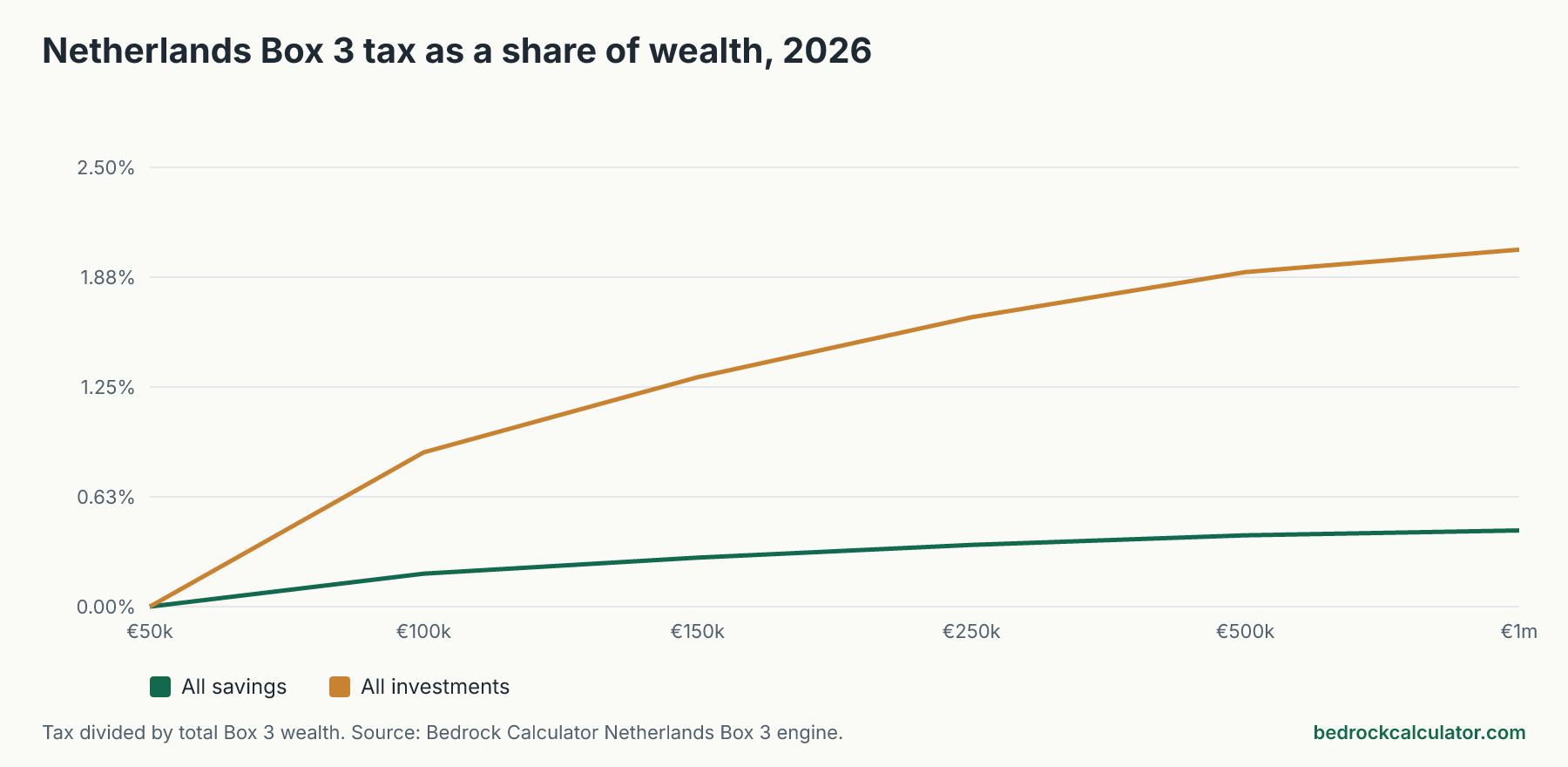
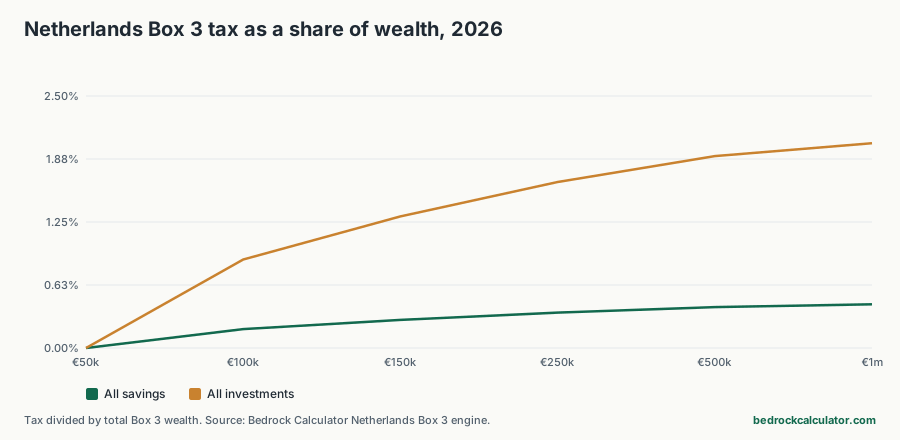
How much of your wealth goes in Box 3 tax each year
Measured against total wealth, Box 3 is a small percentage that looks a lot bigger next to real returns. An investment pot of €250,000 pays 1.65% of its value each year. At €1 million it's 2.03%. As wealth grows the allowance matters less, and the share creeps toward 2.16%.
For savings, the share stays below half a percent: 0.35% at €250,000 and 0.43% at €1 million. Whether that feels fair depends on what your bank actually pays. If your account earns less than 1.28%, Box 3 is taxing interest you didn't receive.
What a fiscal partner changes
Fiscal partners share a combined allowance of €118,714. That shields twice as much wealth. A couple with €250,000 held half and half pays €1,720 together, which is €778 less than a single person with the same pot. At €500,000 the couple pays €4,996. Partners can also split assets between their two returns however suits them best, which the calculator doesn't try to optimise.
Can you pay tax on your actual return instead?
Yes, and for many savers it's worth checking. After the Supreme Court (Hoge Raad) rulings of June 2024, you can show that your actual return was lower than the notional one and ask to be taxed on what you really made. This is the tegenbewijsregeling, and it isn't automatic: you have to file an opgaaf werkelijk rendement.
In a year when shares fell or your savings rate was low, it can cut your Box 3 bill sharply.
The figures on this page use the standard notional method only. They show what you'd owe if you don't claim, or if your actual return was higher than the notional one.
How we worked out these numbers
Every figure comes from this site's Netherlands Box 3 wealth tax calculator. We ran it for each amount of wealth with the savings and investment amounts set to the mix in each column, no debts and no fiscal partner unless stated. It applies the 2026 tax-free allowance, the 2026 notional returns and the 36% rate.
The savings and debt rates for 2026 are provisional. They're fixed early in 2027 once actual average rates are known, so the final assessment can differ slightly.
What these numbers leave out
Your home. Your main home and its mortgage sit in Box 1, not Box 3, so they're not counted here. The mortgage interest deduction calculator covers that side.
Asset detail. Real Box 3 returns separate green investments, crypto, a second home, receivables and more. The calculator uses three buckets: savings, everything else as investments, and debts.
Actual returns. As above, the tegenbewijsregeling isn't modelled.
Future reform. A move to taxing real returns has been promised for years and keeps slipping. These are the rules in force for 2026.
Run your own numbers
Enter your own savings, investments and debts in the Box 3 wealth tax calculator. For your salary and Box 1 tax, use the Netherlands income tax calculator. To see how Box 3 compares with wealth taxes elsewhere in Europe, read our comparison of wealth taxes in France, Spain, Switzerland and the Netherlands.