What are the TDS rates in India for tax year 2026-27?
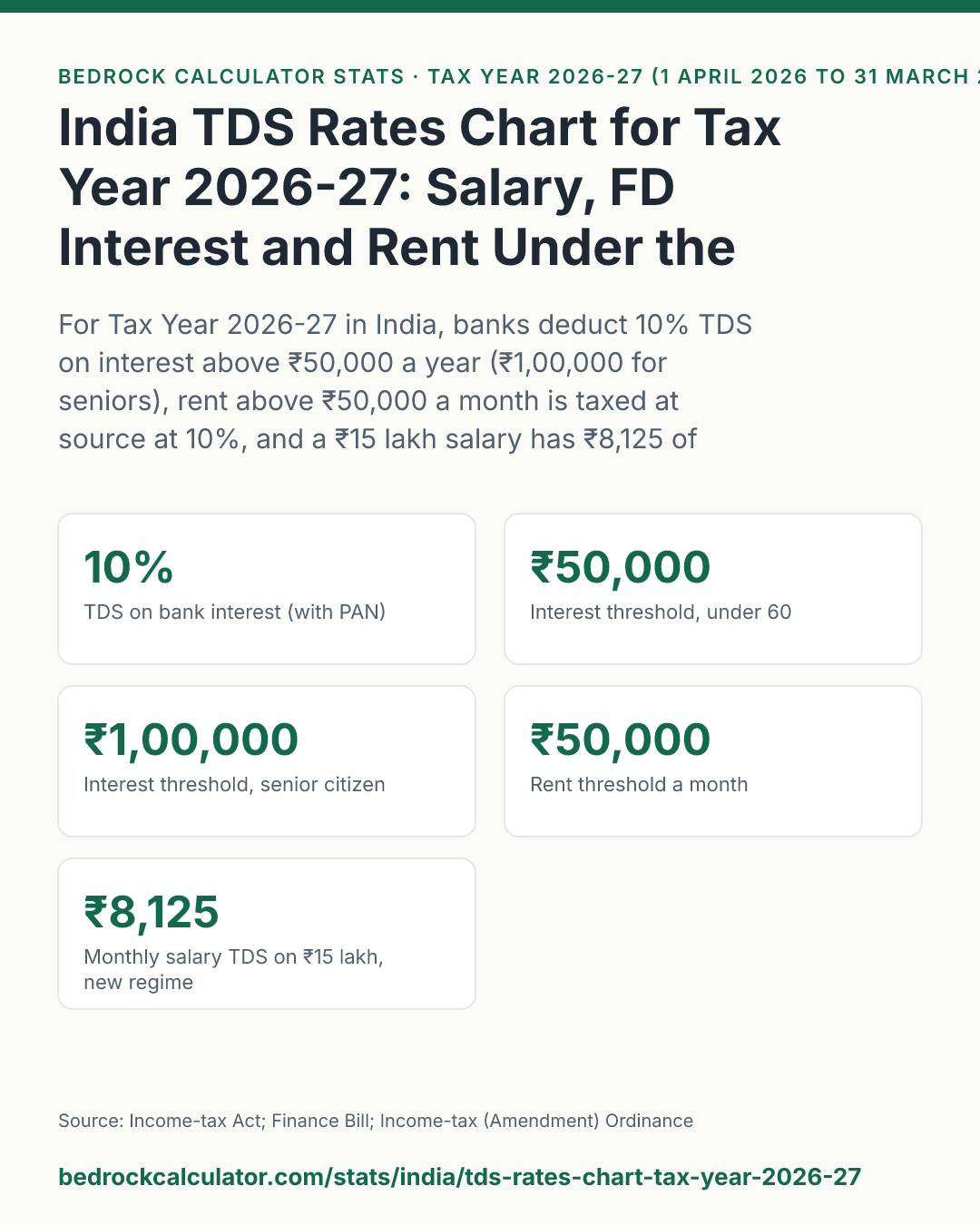
From 1 April 2026, tax deducted at source (TDS) in India runs under the Income-tax Act, 2025, with new section numbers but, for the payments most people deal with, the same rates and thresholds. For Tax Year 2026-27:
- Bank, co-operative bank and post office interest: 10% once interest from one payer passes ₹50,000 in the year, or ₹1,00,000 for a senior citizen.
- Rent paid by a business tenant: 10% on land, buildings and furniture, 2% on plant and machinery, once rent passes ₹50,000 a month.
- Salary: your employer deducts your expected tax for the year, spread over the months. On a ₹15 lakh salary under the new regime that's ₹8,125 a month.
Without a PAN, most of these jump to 20%.
The TDS rates chart
This chart covers the TDS types the TDS calculator on this site handles. Every rate and threshold in it comes from the engine behind that calculator, which we checked against the Act as passed by Parliament and the Finance Bill, 2026 in October 2026.
India TDS rates chart, Tax Year 2026-27: salary, interest and rent
Download CSVPayments to residents. Section numbers are the Income-tax Act, 2025. The no-PAN rate is section 397(2). A specified person is any payer other than an individual or HUF, or an individual or HUF whose business turnover passed ₹1 crore (₹50 lakh for a profession) the year before.
| Interest from a bank, co-operative bank or post office: others | Section 393(1), Table 5(ii) | ₹50,000 a year | 10% | 20% |
| Interest from a bank, co-operative bank or post office: senior citizen | Section 393(1), Table 5(ii) | ₹1,00,000 a year | 10% | 20% |
| Interest from other payers (specified persons) | Section 393(1), Table 5(iii) | ₹10,000 a year | 10% | 20% |
| Rent of land, building or furniture, paid by a specified person | Section 393(1), Table 2(ii) | ₹50,000 a month | 10% | 20% |
| Rent of plant, machinery or equipment, paid by a specified person | Section 393(1), Table 2(ii) | ₹50,000 a month | 2% | 20% |
| Salary | Section 392 | None: TDS when estimated tax is above nil | Average rate of tax on estimated salary | Higher of the average rate and 20% |
What changed on 1 April 2026
The Income-tax Act, 2025 replaced the 1961 Act from 1 April 2026, and the year is now called a Tax Year rather than a financial year and assessment year. Salary TDS, which was section 192, is now section 392. Most other TDS on payments to residents sits in a single table in section 393(1): interest that was section 194A is serial number 5 of that table, and rent that was section 194-I is serial number 2. The higher rate where you don't give your PAN, formerly section 206AA, is now section 397(2).
For these payments the numbers didn't change. The Finance Bill, 2026 keeps the rate in force on interest at 10% for Tax Year 2026-27, and the thresholds in section 393 are the ones Finance Act 2025 set under the old Act.
TDS on salary
Salary TDS isn't a flat rate. Your employer estimates your tax for the whole year under the regime you're in, then deducts it evenly from your pay. The new regime is the default unless you opt out.
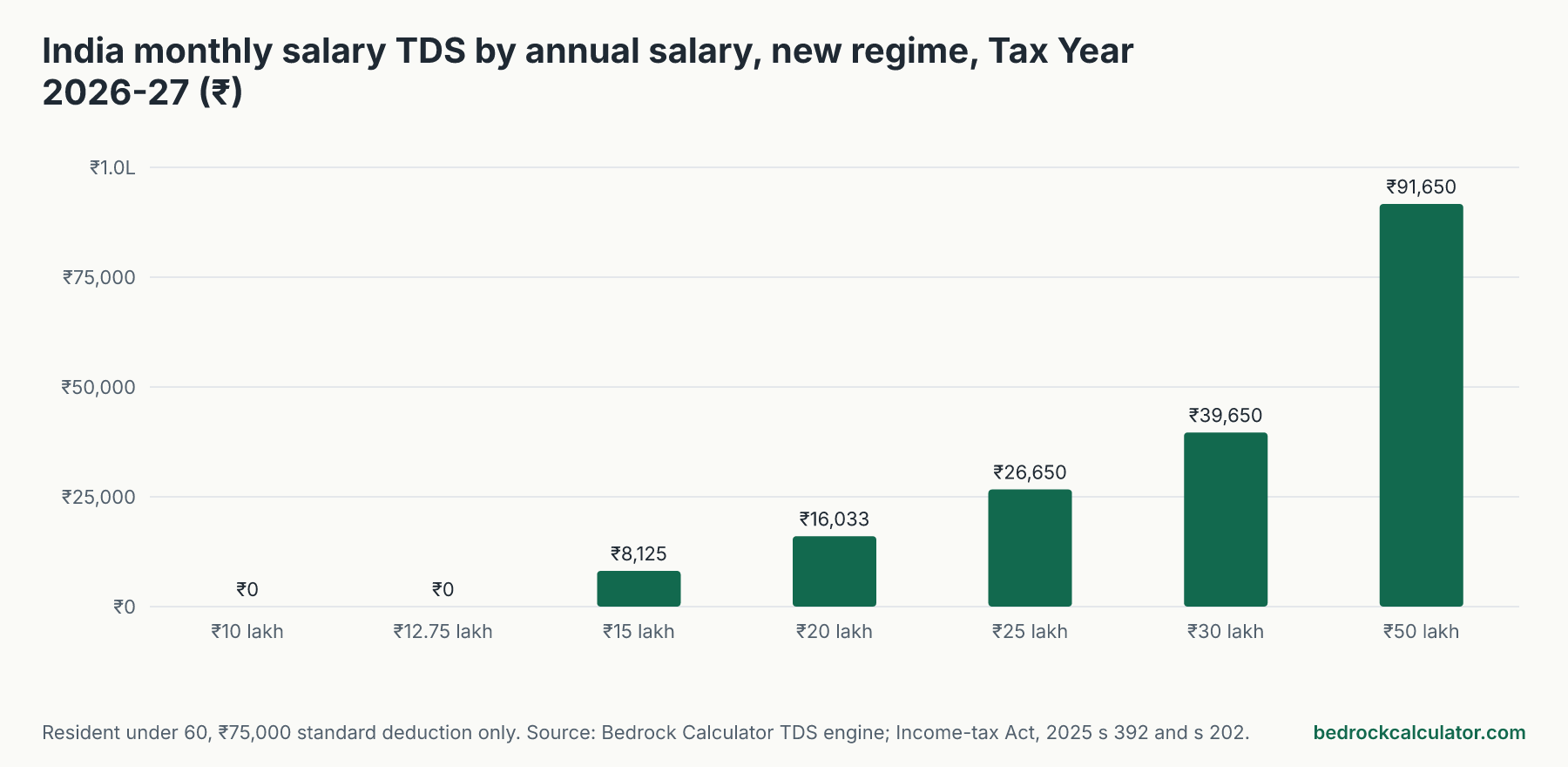
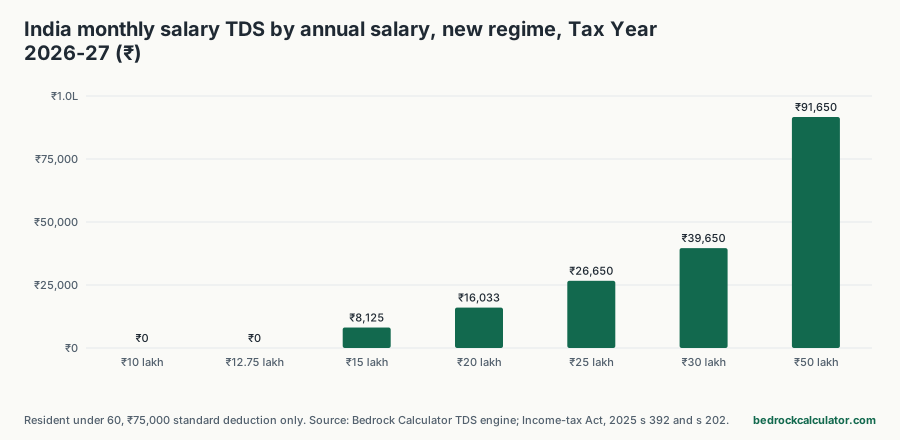
India salary TDS a month by salary, new regime, Tax Year 2026-27 (₹)
Download CSVResident under 60, new regime, ₹75,000 standard deduction, no other income or deductions, TDS spread over 12 months. Includes the 87A rebate, surcharge where due and 4% cess.
| ₹10,00,000 | ₹9,25,000 | ₹0 | ₹0 |
| ₹12,75,000 | ₹12,00,000 | ₹0 | ₹0 |
| ₹15,00,000 | ₹14,25,000 | ₹97,500 | ₹8,125 |
| ₹20,00,000 | ₹19,25,000 | ₹1,92,400 | ₹16,033 |
| ₹25,00,000 | ₹24,25,000 | ₹3,19,800 | ₹26,650 |
| ₹30,00,000 | ₹29,25,000 | ₹4,75,800 | ₹39,650 |
| ₹50,00,000 | ₹49,25,000 | ₹10,99,800 | ₹91,650 |
On a salary of ₹12.75 lakh, the ₹75,000 standard deduction brings taxable income down to the ₹12 lakh limit for the 87A rebate, so there's no tax and no TDS. Above that, monthly TDS climbs quickly: ₹0 on ₹10 lakh, ₹8,125 on ₹15 lakh, ₹16,033 on ₹20 lakh and ₹39,650 on ₹30 lakh. On ₹50 lakh it's ₹91,650 a month, ₹11 lakh for the year.
If you join partway through the year, or your pay changes, your employer recalculates and spreads the remaining tax over the months left. The TDS calculator lets you set the months remaining.
TDS on FD and post office interest
A bank, co-operative bank or post office deducts TDS once the interest it pays or credits to you in the tax year goes over the threshold: ₹50,000 if you're under 60, ₹1,00,000 if you're a senior citizen. Other payers, such as a company deposit, deduct above ₹10,000.
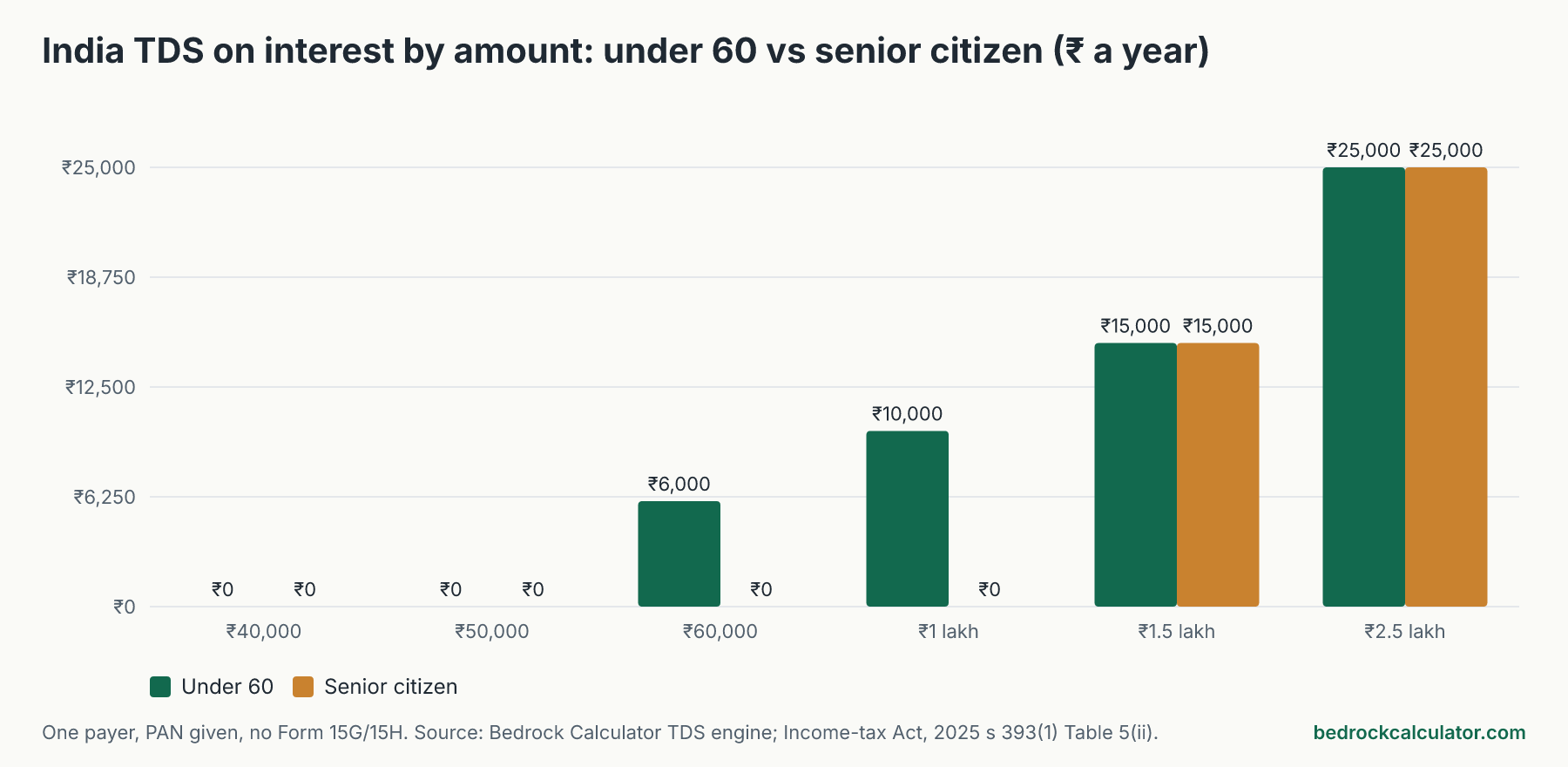
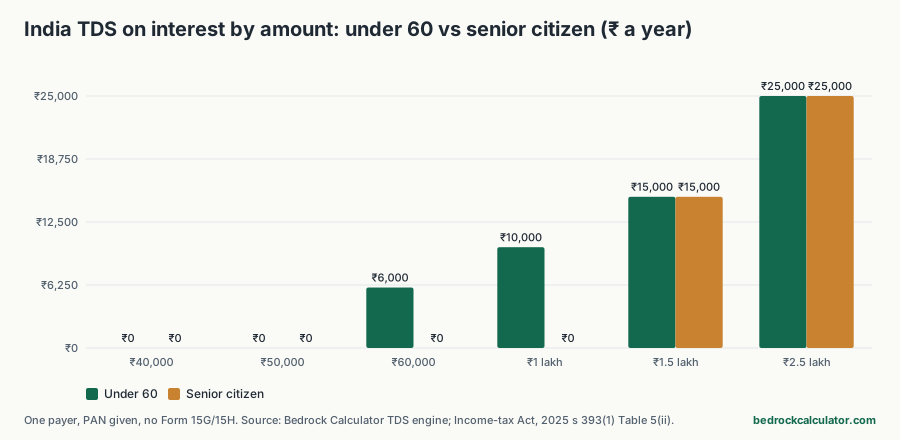
India TDS on bank and post office interest, Tax Year 2026-27 (₹ a year)
Download CSVInterest from one bank, co-operative bank or post office in the year. TDS is on the whole amount once the threshold is passed. No Form 15G or 15H.
| ₹40,000 | ₹0 | ₹0 | ₹0 |
| ₹50,000 | ₹0 | ₹0 | ₹0 |
| ₹60,000 | ₹6,000 | ₹0 | ₹12,000 |
| ₹1,00,000 | ₹10,000 | ₹0 | ₹20,000 |
| ₹1,50,000 | ₹15,000 | ₹15,000 | ₹30,000 |
| ₹2,50,000 | ₹25,000 | ₹25,000 | ₹50,000 |
Once you cross the threshold, TDS applies to the whole interest, not just the part over it. That's why ₹50,000 of interest has ₹0 deducted for someone under 60, but ₹60,000 has ₹6,000. For a senior citizen the same ₹60,000 has ₹0 deducted, and even ₹1 lakh has ₹0. At ₹1.5 lakh a senior pays ₹15,000. Without a PAN, ₹60,000 of interest to someone under 60 has ₹12,000 deducted.
The threshold is measured per payer. A bank on core banking counts all its branches together, so splitting deposits across branches of one bank doesn't help, while interest from two different banks is tested separately. If your total income is below the taxable limit, you can give the bank Form 15G, or Form 15H if you're a senior citizen, and it won't deduct anything.
TDS on rent
When a specified person, such as a company or firm, pays rent above ₹50,000 for a month, it deducts TDS on the whole month's rent. Office rent of ₹60,000 a month has ₹6,000 deducted each month, ₹72,000 over the year. Rent of exactly ₹50,000 has ₹0 deducted, because the threshold has to be exceeded. On ₹2 lakh a month the deduction is ₹20,000, and on ₹1 lakh a month of machinery hire it's ₹2,000.
Rent paid by individuals and HUFs who aren't specified persons, which covers most people renting a home, falls under a separate entry in the same table with a lower rate and annual deduction. The calculator doesn't model that entry.
TDS is not your final tax
Everything deducted is credited to your PAN and shows up in your annual statement. When you file your return, it counts against the tax you actually owe. If more was deducted than you owe, the difference is refunded; if less, you pay the balance.
What these numbers leave out
- Other TDS entries. Professional fees, contractor payments, commission, dividends, property purchases and the many other rows in section 393 aren't covered here.
- Lower deduction certificates. The tax department can authorise a lower or nil rate for a specific person.
- Rent paid by individuals. The separate entry for rent paid by individuals and HUFs who aren't specified persons isn't modelled.
- Salary details. Allowances, perquisites, deductions you declare to your employer, and the old regime all change salary TDS.
- Surcharge and cess on TDS. Salary TDS here includes them. Interest and rent TDS for residents is at the flat rates shown.
Run your own numbers
The TDS calculator works out salary, interest and rent TDS for your own figures. For salary, the CTC to in-hand calculator shows your monthly take-home after TDS, and the income tax regime calculator compares the new and old regimes. For deposits, the FD and RD calculator shows interest and TDS together.