Up to which income do you pay zero tax in India in 2026-27?
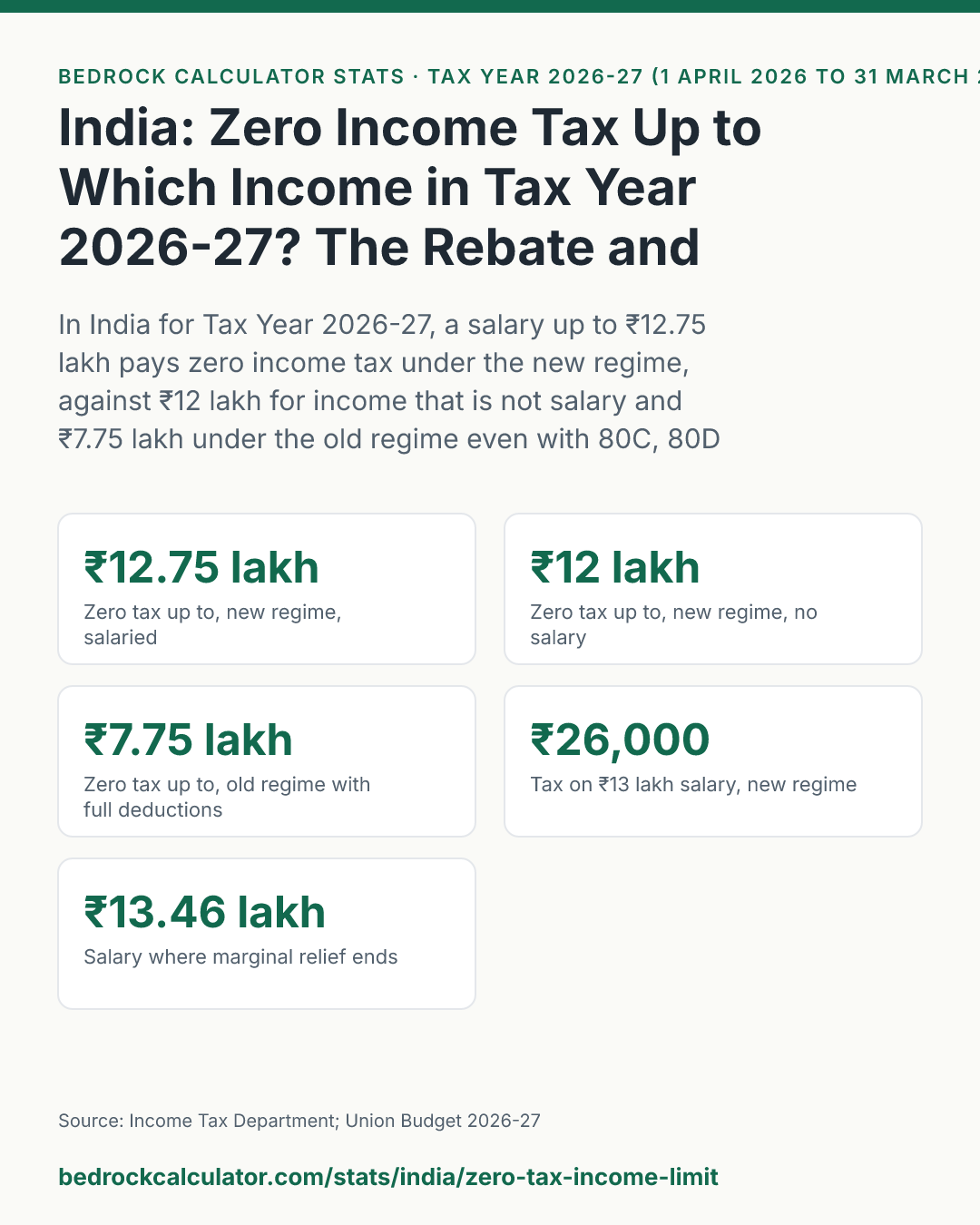
In India for Tax Year 2026-27, a salaried person pays zero income tax on a salary of up to ₹12.75 lakh under the new regime. If your income isn't salary, say business profit, freelance fees or interest, the limit is ₹12 lakh.
Under the old regime the line is far lower: ₹5.5 lakh of salary with no deductions, and ₹7.75 lakh even with 80C, 80D and NPS claimed in full.
Just above the new regime line, marginal relief means you pay roughly the amount you've gone over, plus cess, rather than the full slab tax. That cushion runs out at a salary of about ₹13.46 lakh.
Where the 12.75 lakh figure comes from
The number people quote is really two rules stacked on top of each other.
The first is the Section 87A rebate. Under the new regime, if your taxable income is ₹12 lakh or less, you get a rebate of up to ₹60,000. That's enough to cancel the slab tax on ₹12 lakh completely, so tax is zero.
The second is the standard deduction. Salaried employees and pensioners can knock ₹75,000 off their income before the slabs apply. So ₹12.75 lakh of salary becomes ₹12 lakh of taxable income, which the rebate then covers.
Add the two together and you get ₹12.75 lakh. We checked it against the engine both ways: tax is zero at exactly ₹12.75 lakh and becomes payable ₹1,000 above it.
Zero tax limits for every situation
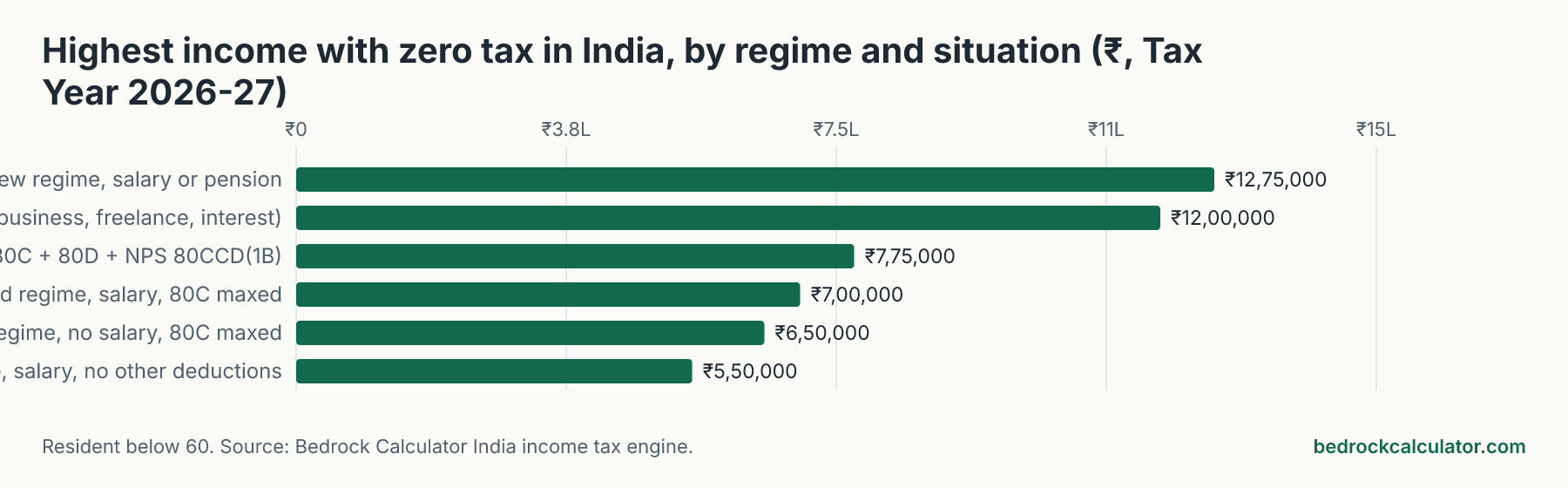
The table below shows the highest income that stays tax free in each common case. The old regime rows use the full statutory caps: ₹1,50,000 under 80C, ₹25,000 of health insurance under 80D and ₹50,000 of NPS under 80CCD(1B).
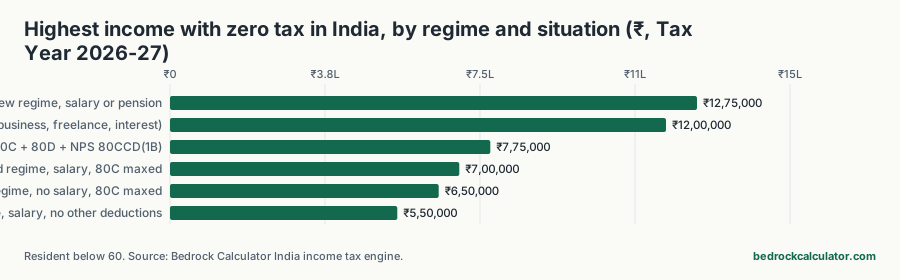
India: the most you can earn and pay zero income tax, Tax Year 2026-27
Download CSVResident below 60. Each limit is checked against the engine: zero tax at the limit, tax due ₹1,000 above it. Old-regime deductions are the full statutory caps.
| New regime, salary or pension | ₹12,75,000 | ₹12.75 lakh |
| New regime, no salary (business, freelance, interest) | ₹12,00,000 | ₹12 lakh |
| Old regime, salary, 80C + 80D + NPS 80CCD(1B) | ₹7,75,000 | ₹7.75 lakh |
| Old regime, salary, 80C maxed | ₹7,00,000 | ₹7 lakh |
| Old regime, no salary, 80C maxed | ₹6,50,000 | ₹6.5 lakh |
| Old regime, salary, no other deductions | ₹5,50,000 | ₹5.5 lakh |
The old regime's rebate covers taxable income only up to ₹5 lakh, with a maximum rebate of ₹12,500. Its standard deduction is ₹50,000. Even if you stack every common deduction on top, a salaried person gets to ₹7.75 lakh and no further. That's ₹5 lakh short of the new regime line, which is the main reason most people with modest salaries are better off on the new regime.
Is 12 lakh income tax free for freelancers and business owners?
Yes, but not 12.75 lakh. The standard deduction applies only to salary and pension. A freelancer, consultant or shopkeeper has no standard deduction, so the limit is ₹12 lakh of taxable income.
That's taxable income, not turnover or fees. If you use the presumptive scheme, only the deemed profit counts. A professional under Section 44ADA declares 50% of gross receipts as income, so on our engine gross receipts of up to ₹24 lakh still come out at zero tax, as long as there's no other income. The presumptive taxation calculator works this out for your own receipts.
What happens just above the line: marginal relief
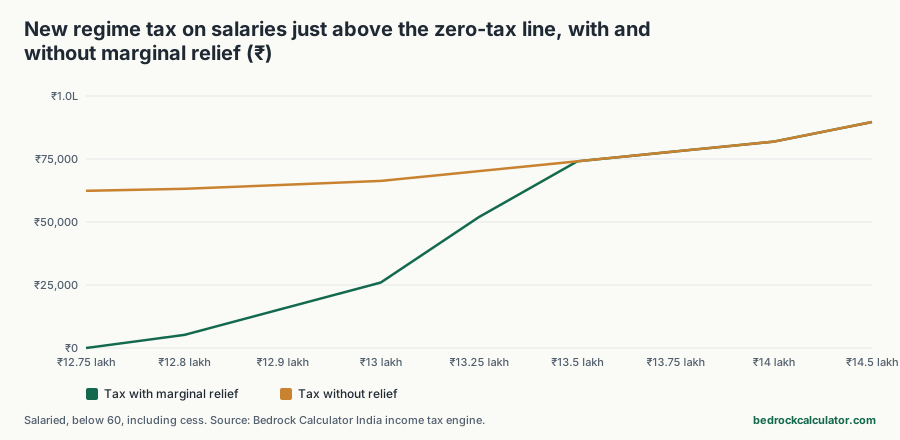
Without some protection, earning one rupee over the rebate limit would cost you the full slab tax on everything. On a salary of ₹12.8 lakh that would be ₹63,180, a nasty cliff.
Marginal relief stops that. If your taxable income is above ₹12 lakh, your tax can't be more than the amount by which you've crossed it. Cess is then added on top.
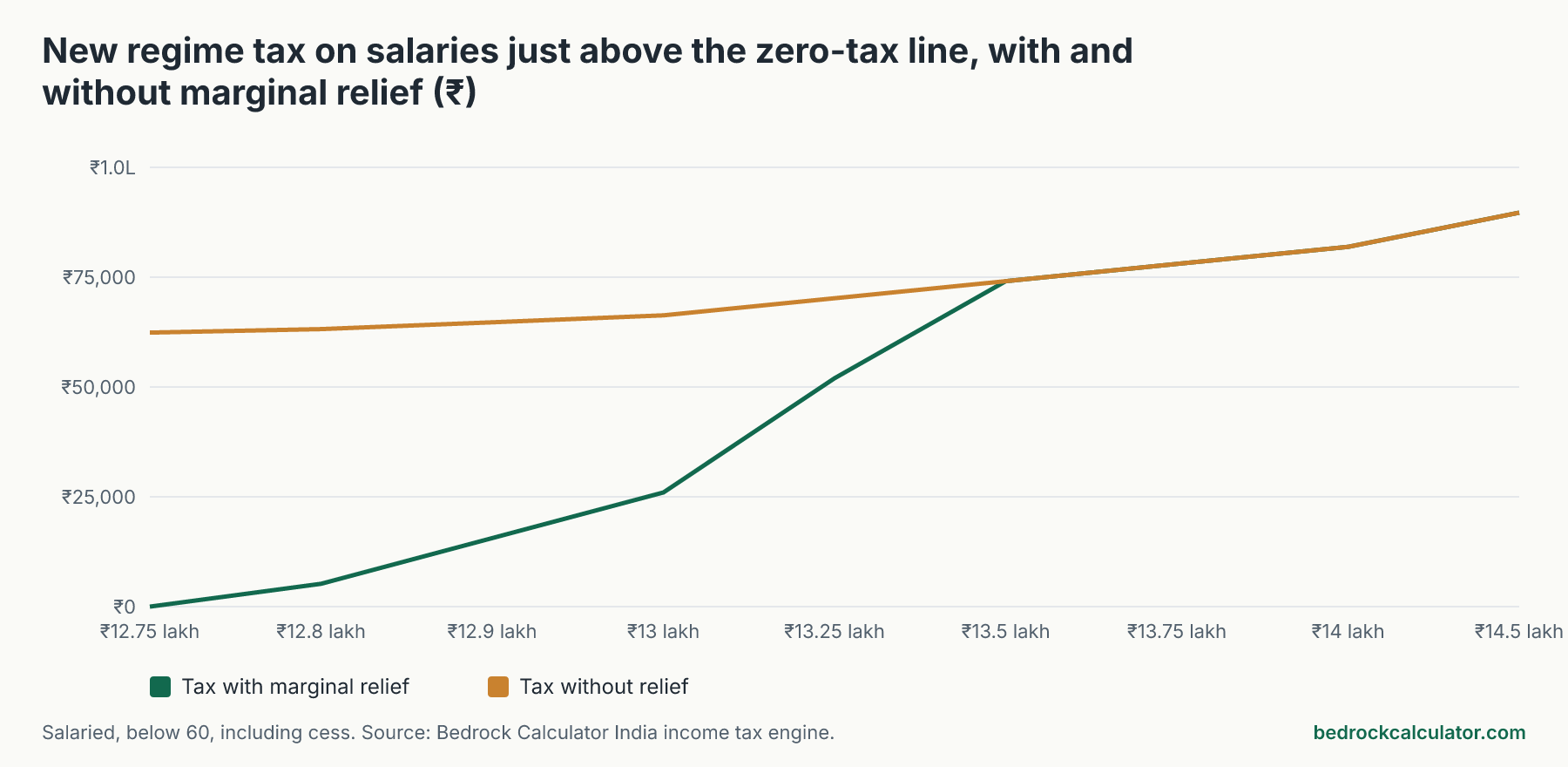
New regime tax just above ₹12.75 lakh: with and without marginal relief (₹, Tax Year 2026-27)
Download CSVSalaried, below 60, after the ₹75,000 standard deduction. "Without relief" is the full slab tax plus cess with no 87A rebate. Relief runs out at a salary of ₹13,45,588.
| ₹12.75 lakh | ₹12,75,000 | ₹0 | ₹62,400 | ₹62,400 |
| ₹12.8 lakh | ₹12,80,000 | ₹5,200 | ₹63,180 | ₹57,980 |
| ₹12.9 lakh | ₹12,90,000 | ₹15,600 | ₹64,740 | ₹49,140 |
| ₹13 lakh | ₹13,00,000 | ₹26,000 | ₹66,300 | ₹40,300 |
| ₹13.25 lakh | ₹13,25,000 | ₹52,000 | ₹70,200 | ₹18,200 |
| ₹13.5 lakh | ₹13,50,000 | ₹74,100 | ₹74,100 | ₹0 |
| ₹13.75 lakh | ₹13,75,000 | ₹78,000 | ₹78,000 | ₹0 |
| ₹14 lakh | ₹14,00,000 | ₹81,900 | ₹81,900 | ₹0 |
| ₹14.5 lakh | ₹14,50,000 | ₹89,700 | ₹89,700 | ₹0 |
So at ₹12.8 lakh you pay ₹5,200 instead of ₹63,180. At ₹13 lakh you pay ₹26,000 instead of ₹66,300, a saving of ₹40,300.
The catch is that inside this band, each extra rupee of taxable income adds ₹1.04 of tax, because cess sits on top of the relief. A raise that lands you here can leave you slightly worse off than before. Relief shrinks as your income rises, and by a salary of ₹13,45,588 (taxable income of ₹12,70,588) it's gone. From there on you simply pay the normal slab tax: ₹74,100 at ₹13.5 lakh, for example.
If your salary is likely to land in this band, it's worth looking at anything that lowers taxable income under the new regime. The main one is an employer NPS contribution under Section 80CCD(2), which still counts in the new regime.
How we worked out these numbers
For salaried cases we used the old vs new tax regime calculator on this site, which applies the slabs, the standard deduction, the 87A rebate with marginal relief, surcharge and the 4% cess. For non-salary cases we used the same engine function on taxable income with no standard deduction.
Each limit on this page is the rebate threshold plus whatever comes off before it. For every one, the engine had to return zero tax at the limit and a positive tax ₹1,000 above it, or the build fails. The point where marginal relief ends was found by searching the engine's own rebate output, not by formula.
India's Income-tax Act, 2025 took effect on 1 April 2026 and renamed the assessment year as the "Tax Year". The slabs and rebate didn't change for Tax Year 2026-27, and the engine still uses the familiar section labels such as 87A and 80C. This page checks the engine's slabs, rebate limit and standard deduction against the site's Tax Year 2026-27 table before using it.
What this leaves out
These limits assume all your income is taxed at slab rates. Capital gains taxed at special rates don't get the new regime rebate in the same way, so someone with large equity gains can owe tax even below the limits shown. The old regime figures are for people below 60; senior citizens have higher basic exemption limits there. We haven't modelled HRA or home loan interest, which can push the old regime line higher for some people.
Check your own income
The old vs new tax regime calculator tells you your exact tax at any salary. If you're on the old regime and close to the line, the 80C and 80D deduction optimizer shows how much more you can claim, and the NPS calculator shows what the extra NPS deduction builds over time. For a full table of tax at higher salaries, see income tax on ₹10 to ₹50 lakh salaries.