Which saves more tax in India, HRA or a home loan?
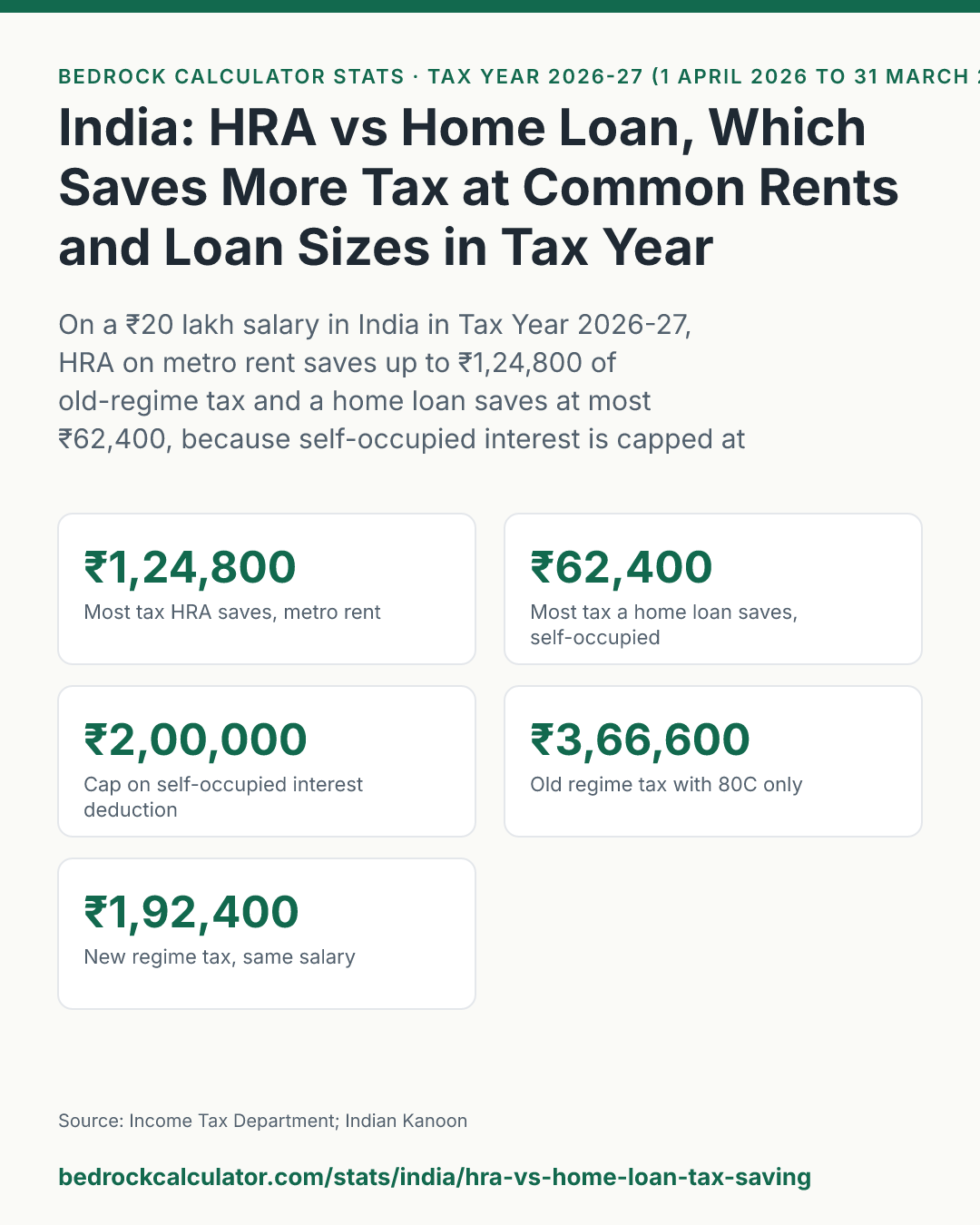
On a ₹20 lakh salary in India in Tax Year 2026-27, renting in a metro and claiming HRA can save you up to ₹1,24,800 of old-regime tax. A home loan on the house you live in saves at most ₹62,400, however big the loan, because the interest deduction for a self-occupied home stops at ₹2,00,000.
Neither one on its own makes the old regime cheaper than the new regime, which charges ₹1,92,400 on this salary. Claiming both, which is possible if you rent in one city and own a home in another, can tip it.
Our example: one salary, two ways to live
We kept everything fixed except housing. The person earns ₹20 lakh, with ₹8,00,000 of basic pay and ₹4,00,000 of HRA a year, is below 60, and claims the full ₹1,50,000 under Section 80C. On those numbers the old regime charges ₹3,66,600 before any housing benefit, and the new regime charges ₹1,92,400.
Then we asked two questions. If they rent in a metro, how much does HRA save? If instead they buy with a home loan and live in the house, how much does the interest deduction save?
How much tax HRA saves at common rents
Renting: HRA exemption and tax saved on a ₹20 lakh salary, metro (₹, Tax Year 2026-27)
Download CSVOld regime, below 60, with ₹1,50,000 of 80C in both cases. Basic pay ₹8,00,000, HRA ₹4,00,000. Includes 4% cess.
| ₹20,000 | ₹1,60,000 | ₹49,920 | ₹3,16,680 |
| ₹30,000 | ₹2,80,000 | ₹87,360 | ₹2,79,240 |
| ₹40,000 | ₹4,00,000 | ₹1,24,800 | ₹2,41,800 |
| ₹50,000 | ₹4,00,000 | ₹1,24,800 | ₹2,41,800 |
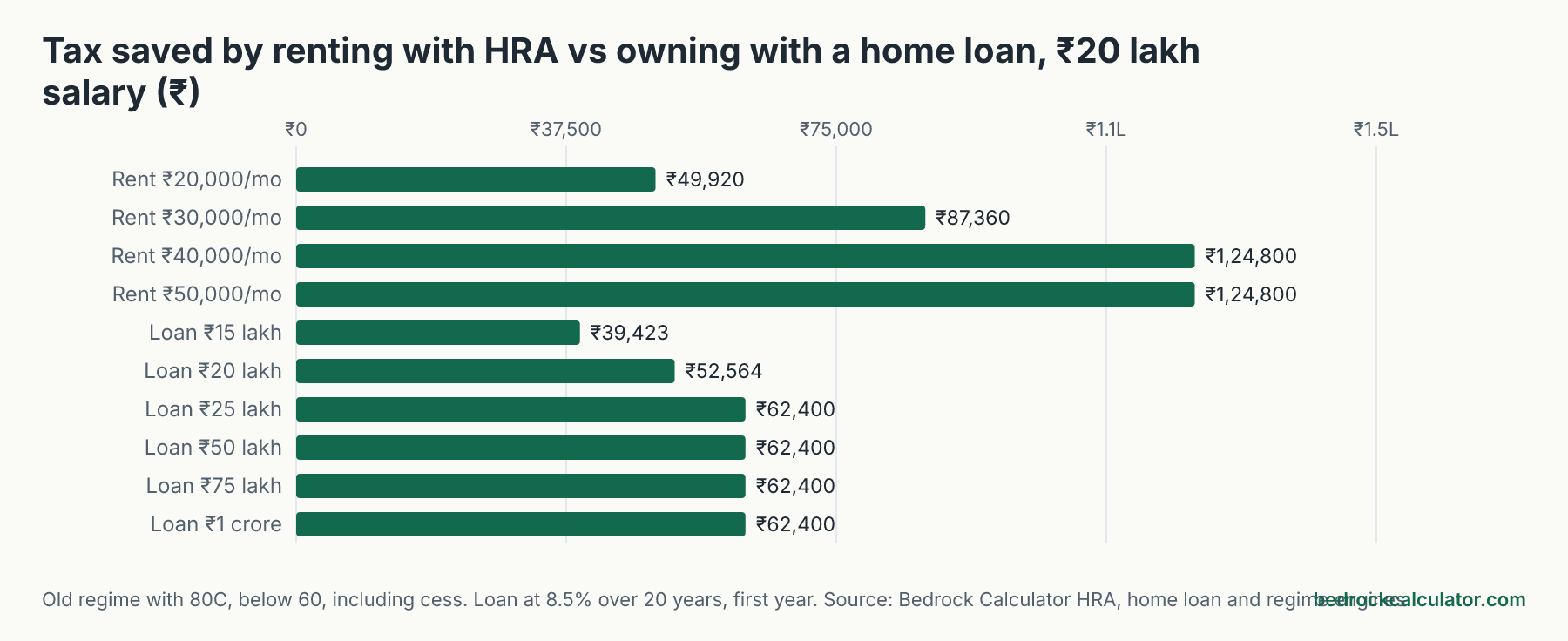
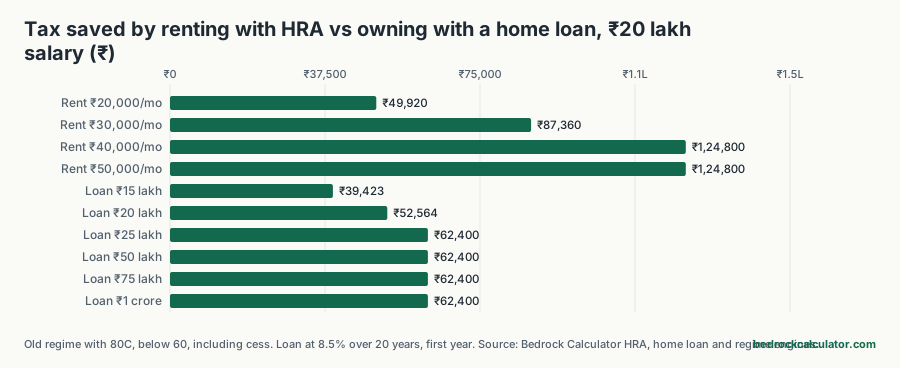
At ₹20,000 a month the HRA exemption is ₹1,60,000, saving ₹49,920. At ₹30,000 it's ₹2,80,000 and ₹87,360. By ₹40,000 a month the exemption reaches the full ₹4,00,000 of HRA paid, and the saving tops out at ₹1,24,800. Paying more rent beyond that buys no extra tax relief.
The ceiling depends on your HRA and basic pay, not just your rent. Someone with a smaller HRA component would hit the limit much sooner.
How much tax a home loan saves at common loan sizes
The loans here run at 8.5% for 20 years, and we looked at the first year, when the interest share of each EMI is highest.
Owning: home loan interest deduction and tax saved, first year of the loan (₹, Tax Year 2026-27)
Download CSVSelf-occupied home, 8.5% interest over 20 years, loan sanctioned after March 2022. Old regime with ₹1,50,000 of 80C in both cases, ₹20 lakh salary.
| ₹15 lakh | ₹13,017 | ₹1,26,355 | ₹1,26,355 | ₹39,423 | ₹3,27,177 |
| ₹20 lakh | ₹17,356 | ₹1,68,473 | ₹1,68,473 | ₹52,564 | ₹3,14,036 |
| ₹25 lakh | ₹21,696 | ₹2,10,591 | ₹2,00,000 | ₹62,400 | ₹3,04,200 |
| ₹50 lakh | ₹43,391 | ₹4,21,182 | ₹2,00,000 | ₹62,400 | ₹3,04,200 |
| ₹75 lakh | ₹65,087 | ₹6,31,774 | ₹2,00,000 | ₹62,400 | ₹3,04,200 |
| ₹1 crore | ₹86,782 | ₹8,42,365 | ₹2,00,000 | ₹62,400 | ₹3,04,200 |
On a ₹15 lakh loan the first-year interest is ₹1,26,355, all of it deductible, which saves ₹39,423. On ₹20 lakh it's ₹1,68,473 and ₹52,564.
From a ₹25 lakh loan onwards the interest is already above the ₹2,00,000 cap, so the saving is stuck at ₹62,400. A ₹50 lakh loan with an EMI of ₹43,391 pays ₹4,21,182 of interest in year one and saves exactly the same tax. On a ₹1 crore loan, ₹6,42,365 of the first year's interest gets no deduction at all.
One thing that doesn't show up here is the principal part of your EMI. It can count toward Section 80C, but our person has already used the full ₹1,50,000, so it adds nothing. If your 80C isn't full, principal repayment can help.
HRA vs home loan: which is better for tax?
On these numbers, HRA wins once metro rent goes somewhere above ₹20,000 a month: at that rent it saves ₹49,920, less than the ₹62,400 from a loan, but at ₹30,000 it saves ₹87,360. Its maximum saving of ₹1,24,800 is about double what the capped home loan deduction gives.
That's a tax answer, not a rent-or-buy answer. Buying builds equity and rent doesn't, and the EMI on even a modest loan is far bigger than the tax saved. Don't buy a home, or keep renting, purely to chase one deduction.
And remember the comparison is only inside the old regime. Even at its best, HRA brings old-regime tax down to ₹2,41,800, still more than the new regime's ₹1,92,400.
Can you claim both HRA and home loan interest?
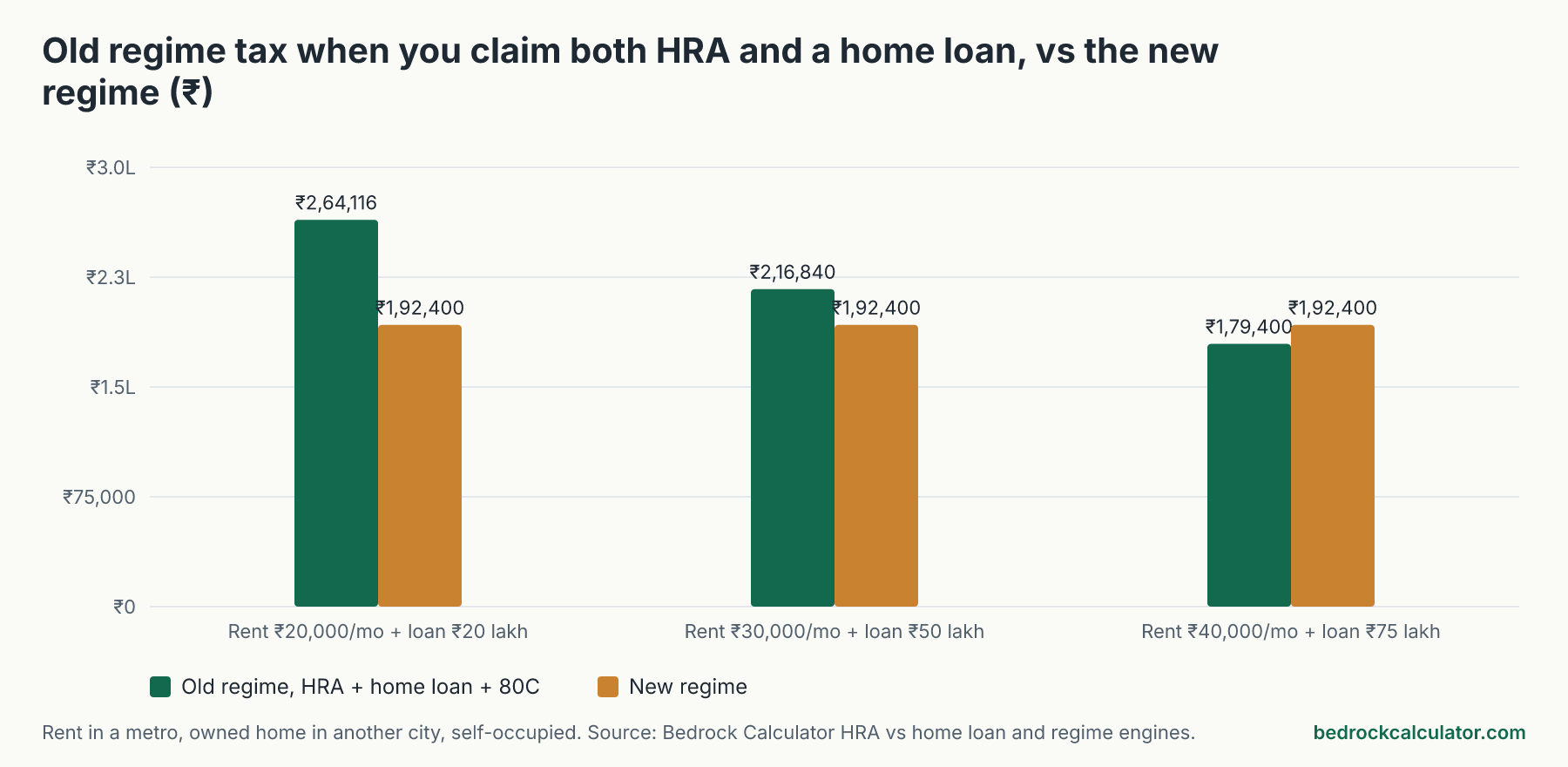
Yes, if the facts are genuine. The common case is someone who works and rents in one city while owning a home somewhere else, often where their family lives. HRA reduces salary income; home loan interest reduces income from house property. They're separate, so both can apply in the same year under the old regime.
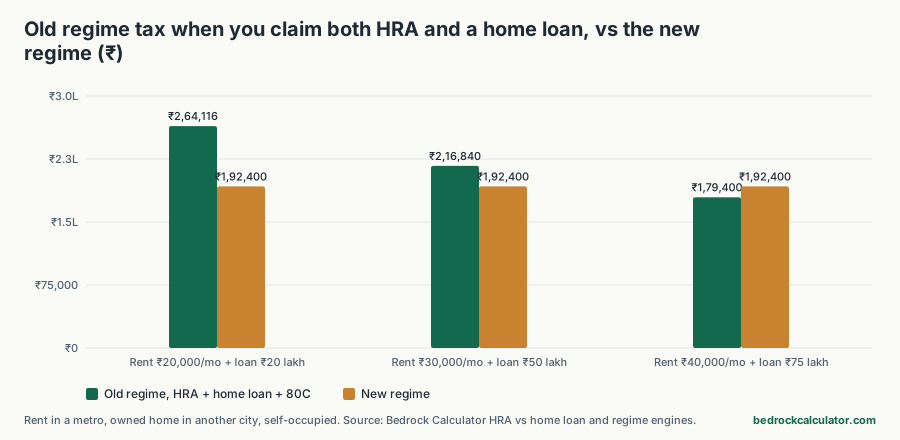
With ₹20,000 a month rent and a ₹20 lakh loan, the two together save ₹1,02,484, but the old regime still charges ₹2,64,116, more than the new regime. With ₹40,000 a month rent and a ₹75 lakh loan, the combined deduction is ₹6,00,000 and old-regime tax falls to ₹1,79,400, which finally beats the new regime's ₹1,92,400.
What you can't do is claim HRA on a rented flat while living in your own house in the same city. That's the claim that draws scrutiny, and the calculator doesn't model it.
How we worked out these numbers
The HRA exemption comes from the site's HRA exemption calculator, with the higher limit for a metro city. The home loan deduction comes from the home loan tax benefit calculator, which builds the EMI schedule and applies the self-occupied cap. The combined case uses the HRA vs home loan calculator.
The home loan calculator estimates tax saved by multiplying the deduction by a single marginal rate you enter, plus cess. We didn't use that estimate. Instead, every "tax saved" figure is the difference between two full runs of the old vs new tax regime calculator, one with and one without the benefit, so slabs and the 4% cess are included.
The engine labels these deductions under India's Income-tax Act, 2025: the home loan interest deduction is Section 22 (formerly Section 24(b)), and the additional affordable-housing deduction is Section 131 (formerly 80EEA). That extra deduction only applies to loans sanctioned between April 2019 and March 2022, so we assumed a newer loan.
What this leaves out
We've modelled the first year of the loan only. Interest falls every year, so on smaller loans the saving shrinks over time. Interest paid before construction is complete, joint loans split between co-owners, and homes that are let out rather than lived in all work differently and aren't in these tables. The salary structure (basic pay at ₹8,00,000 on ₹20 lakh) is our assumption. We've used the four-city metro list the engine applies; if your city is treated as a metro under the newer rules, use the metro figures.
Run your own comparison
Put your own rent, basic pay and loan into the HRA vs home loan calculator, then add the total to your other deductions in the old vs new tax regime calculator. For the full rent picture at different salaries, see HRA exemption by rent and city type.