How much income tax is due in India on each lakh salary in 2026-27?
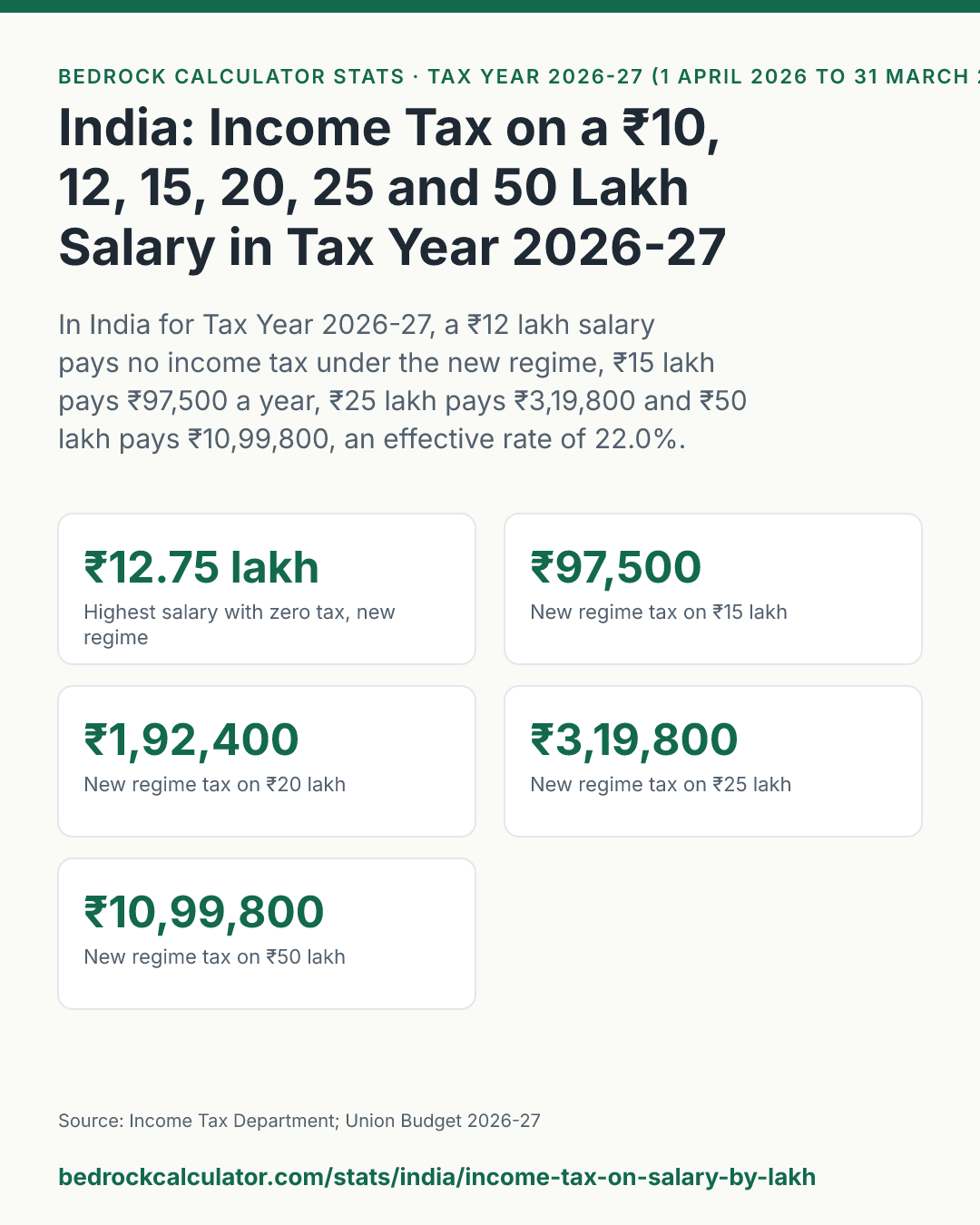
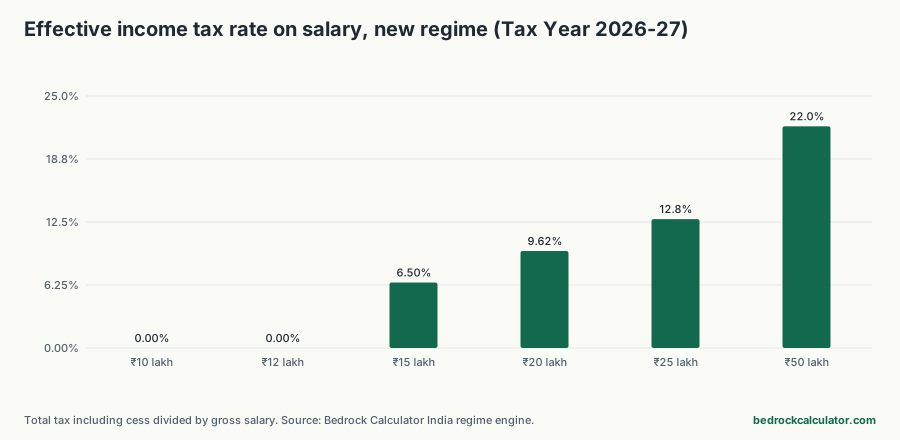
In India for Tax Year 2026-27, a salary of ₹10 lakh or ₹12 lakh pays no income tax at all under the new regime. At ₹15 lakh the bill is ₹97,500 a year, at ₹20 lakh it's ₹1,92,400, at ₹25 lakh ₹3,19,800 and at ₹50 lakh ₹10,99,800.
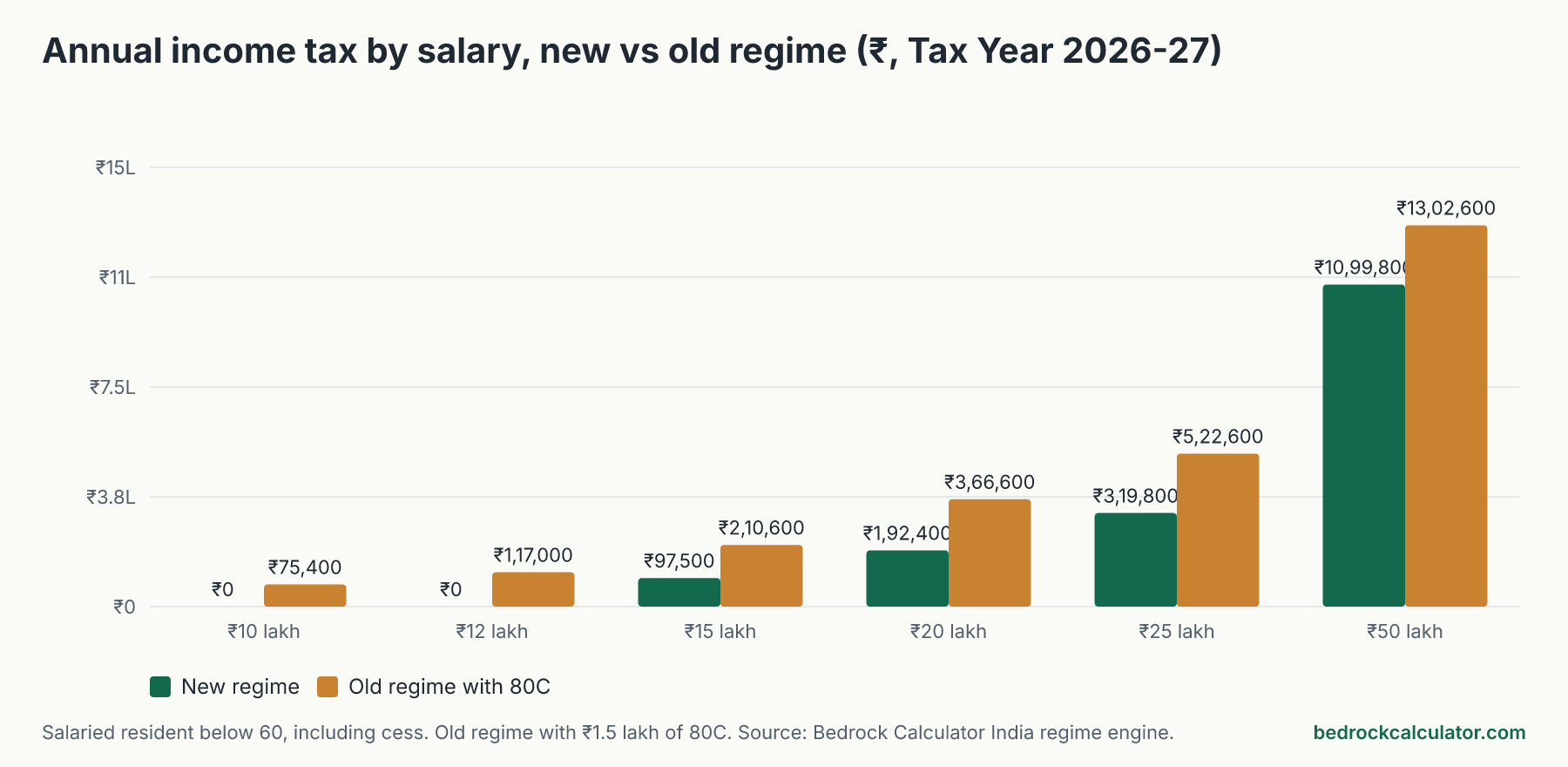
Those are the totals after the standard deduction, the Section 87A rebate and the 4% Health and Education Cess. Under the old regime every one of these salaries pays more, even with ₹1,50,000 claimed under Section 80C.
Income tax on each salary, per year and per month
Here's the full picture for a salaried employee below 60. The monthly column is simply the yearly tax divided by twelve, which is roughly what your employer will deduct as TDS each month if you stay on the new regime. The last column is your salary per month after income tax only. EPF, professional tax and any other payroll deductions come off on top of that.
India: income tax on common salaries, Tax Year 2026-27 (₹, salaried, below 60)
Download CSVTotal tax including the 87A rebate, marginal relief, surcharge and 4% cess. New regime after its standard deduction; old regime after its standard deduction, with and without ₹1,50,000 of Section 80C. Monthly figures are the annual amount divided by 12, before EPF and professional tax.
| ₹10 lakh | ₹10,00,000 | ₹0 | ₹0 | 0.0% | ₹1,06,600 | ₹75,400 | ₹83,333 |
| ₹12 lakh | ₹12,00,000 | ₹0 | ₹0 | 0.0% | ₹1,63,800 | ₹1,17,000 | ₹1,00,000 |
| ₹15 lakh | ₹15,00,000 | ₹97,500 | ₹8,125 | 6.5% | ₹2,57,400 | ₹2,10,600 | ₹1,16,875 |
| ₹20 lakh | ₹20,00,000 | ₹1,92,400 | ₹16,033 | 9.6% | ₹4,13,400 | ₹3,66,600 | ₹1,50,633 |
| ₹25 lakh | ₹25,00,000 | ₹3,19,800 | ₹26,650 | 12.8% | ₹5,69,400 | ₹5,22,600 | ₹1,81,683 |
| ₹50 lakh | ₹50,00,000 | ₹10,99,800 | ₹91,650 | 22.0% | ₹13,49,400 | ₹13,02,600 | ₹3,25,017 |
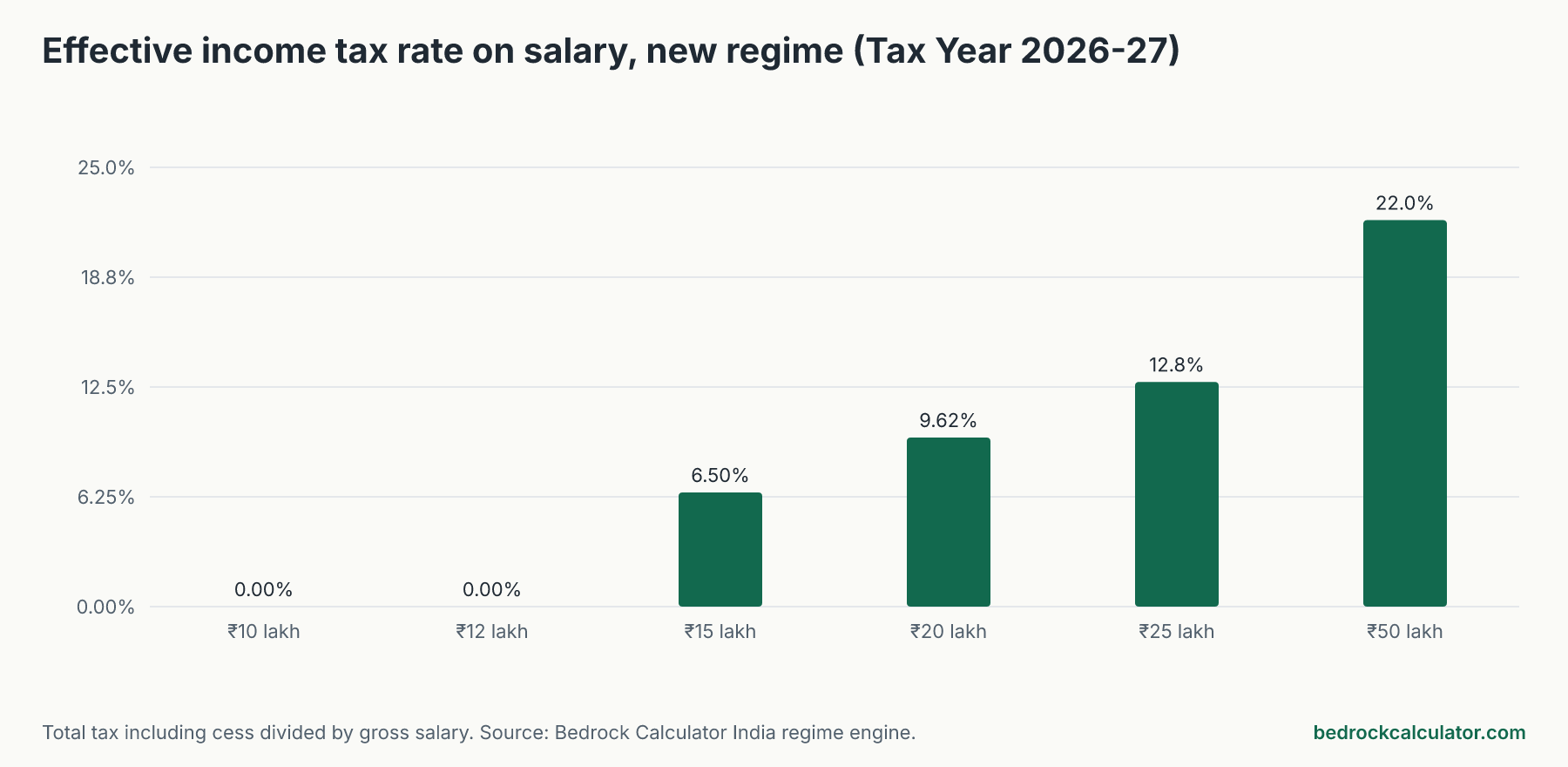
A few things stand out. The jump from ₹12 lakh to ₹15 lakh takes the tax from zero to ₹97,500, so the effective rate goes from nothing to 6.5%. From there it climbs steadily: 9.6% at ₹20 lakh, 12.8% at ₹25 lakh and 22.0% at ₹50 lakh. Even at ₹50 lakh you hand over less than a quarter of your salary in income tax.
Why a 12 lakh salary pays zero tax in the new regime
Two things work together. First, the new regime gives salaried people a ₹75,000 standard deduction, so a ₹12 lakh salary becomes ₹11.25 lakh of taxable income. Second, the Section 87A rebate cancels the tax for anyone whose taxable income is ₹12 lakh or less. On ₹12 lakh of salary the slab tax would have been ₹52,500, and the rebate wipes all of it out.
Put together, the line sits at ₹12.75 lakh of salary. Earn a little more and marginal relief keeps the tax from jumping, because your tax can't be more than the amount by which your taxable income crosses the rebate limit. That's why there's no cliff just above the line.
The old regime has a rebate too, but only up to a much lower income, so at ₹12 lakh it still charges ₹1,17,000 with a full 80C claim and ₹1,63,800 without one.
How the new regime taxes a 20 lakh salary, slab by slab
People often assume the top rate applies to the whole salary. It doesn't. Each slab of taxable income is taxed at its own rate, and only the part above each line pays the higher rate. On ₹20 lakh of salary, taxable income is ₹19.25 lakh.
How the new regime taxes a ₹20 lakh salary, slab by slab (Tax Year 2026-27)
Download CSVTaxable income is ₹19.25 lakh after the ₹75,000 standard deduction. Cess is added on top of the slab tax.
| Up to ₹4 lakh | 0.00% | ₹4,00,000 | ₹0 |
| ₹4 lakh to ₹8 lakh | 5.00% | ₹4,00,000 | ₹20,000 |
| ₹8 lakh to ₹12 lakh | 10.00% | ₹4,00,000 | ₹40,000 |
| ₹12 lakh to ₹16 lakh | 15.00% | ₹4,00,000 | ₹60,000 |
| ₹16 lakh to ₹20 lakh | 20.00% | ₹3,25,000 | ₹65,000 |
The slabs add up to ₹1,85,000. Cess at 4% adds ₹7,400, which brings the total to ₹1,92,400. The highest rate this salary touches is 20%, yet the effective rate on the whole salary is only 9.6%, because most of the income sits in the cheaper slabs below.
Tax on 15 lakh salary: new regime vs old regime
₹15 lakh is where a lot of mid-career salaries sit, and it's the first rung on our ladder where the new regime actually charges tax. The bill is ₹97,500, or ₹8,125 a month, leaving about ₹1,16,875 a month after income tax.
The old regime asks for ₹2,57,400 if you claim nothing beyond its ₹50,000 standard deduction, and ₹2,10,600 if you max out 80C. That's ₹1,13,100 more than the new regime even with 80C in full. To flip the answer you'd need a much bigger set of deductions: health insurance, NPS, home loan interest and HRA together. Our new vs old regime comparison works out exactly how much you'd need at each salary.
What about 25 lakh and 50 lakh salaries?
At ₹25 lakh the new regime charges ₹3,19,800, about ₹26,650 a month. From this point every extra rupee of salary is taxed at the top rate of 30% plus cess, so the effective rate keeps rising slowly toward that number without ever reaching it.
At ₹50 lakh the bill is ₹10,99,800, or ₹91,650 a month, leaving roughly ₹3,25,017 a month. The old regime with 80C would cost ₹13,02,600, which is ₹2,02,800 more. One detail people worry about at this level is surcharge. It applies only when taxable income goes above ₹50 lakh, and the standard deduction keeps a ₹50 lakh salary just below that, so none of the salaries in this table pays any.
How we worked out these numbers
Every figure comes from the old vs new tax regime calculator on this site. For each salary we ran it twice: once with no old-regime deductions and once with ₹1,50,000 under Section 80C. The calculator applies each regime's slabs and standard deduction, the 87A rebate with marginal relief, surcharge where it applies, and the 4% cess.
India's Income-tax Act, 2025 took effect on 1 April 2026 and renamed the assessment year as the "Tax Year". Tax Year 2026-27 runs from 1 April 2026 to 31 March 2027. The slabs didn't change from the year before, and the calculator still carries the old section labels such as 87A. Before producing any number, this page checks that the engine's slabs, rebate limit and standard deduction match the site's Tax Year 2026-27 table, and the build fails if they don't.
Every run assumes:
- A resident salaried individual below 60
- All income is salary taxed at slab rates
- No employer NPS contribution under Section 80CCD(2)
What these figures leave out
The calculator doesn't model professional tax, which most states charge on salaries and which comes off your pay separately. It doesn't net off EPF contributions, which reduce your in-hand pay but not your tax under the new regime. Capital gains, interest and other income taxed differently aren't included, and neither is HRA, which only helps under the old regime. Senior citizens get a higher exemption limit under the old regime, which this page doesn't show.
Getting your own figure
If your salary falls between the rungs here, the old vs new tax regime calculator gives the exact amount for any salary and any level of deductions. The TDS calculator shows what your employer should be deducting each month, and the professional tax calculator adds your state's charge. If you're still weighing the old regime, the 80C and 80D deduction optimizer shows how much you can actually claim.