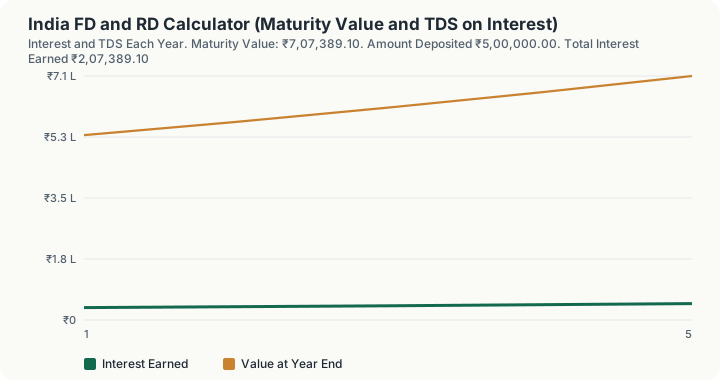
Quick Answer: A ₹5 lakh cumulative fixed deposit at 7% for 5 years, compounded quarterly, matures at ₹7,07,389.10, of which ₹2,07,389.10 is interest. No TDS is deducted because the interest in each year stays under the ₹50,000 threshold. A ₹10 lakh FD at 7.5% for 3 years crosses it every year and has ₹24,971.64 of TDS deducted in total.
What does this calculator do?
Fixed deposits (FDs) and recurring deposits (RDs) are still the default way most Indian households park savings with a bank. An FD takes one lump sum for a fixed term. An RD takes a fixed instalment every month. Both pay a rate the bank fixes when you open the deposit, and both are covered by the same tax deduction at source (TDS) rules on interest.
This calculator works out the maturity value in rupees for either type, shows the interest earned in each year of the deposit, and applies TDS the way the Income-tax Act, 2025 sets it out for Tax Year 2026-27: 10% of the interest once the interest from one bank in a year passes ₹50,000, or ₹1,00,000 for a senior citizen. It also handles the three FD payout styles banks offer: cumulative, where interest is reinvested and paid at the end, and quarterly or monthly payout, where interest is paid out to you as it is earned.
Banks set their own deposit rates under the Reserve Bank of India's deposit directions, so the rate here is whatever your bank quotes you. The default of 7% is only a placeholder.
How is this calculated?
- Cumulative FD. Interest compounds every completed quarter at one quarter of the annual rate. If the tenure ends part way through a quarter, the leftover one or two months earn simple interest on the compounded amount. Value after m months = P × (1 + r/4)^(full quarters) × (1 + r × leftover months ÷ 12).
- FD with payout. Interest is not reinvested. A quarterly payout is P × r ÷ 4 every quarter and a monthly payout is P × r ÷ 12 every month. Your principal comes back at maturity.
- Recurring deposit. Each instalment is treated as deposited at the start of its month and compounds quarterly from then on, using the standard RD formula:
A = R × ((1 + i)ⁿ − 1)/(1 − (1 + i)^(−1/3))
where R is the monthly instalment, i is the annual rate ÷ 4 and n is the number of quarters. RD tenures are rounded to a whole number of quarters.
- Interest per year. The deposit is split into 12-month blocks from the date you open it. Each block's interest is the value at the end of the block minus the value at its start (minus that block's instalments, for an RD), or the payouts in that block.
- TDS test. For each block, the calculator adds any other interest you expect from the same bank that year. If the total is above ₹50,000 (₹1,00,000 for a senior citizen), TDS applies to this deposit's interest for that block.
- TDS rate. 10% of the block's interest if your PAN is with the bank, 20% if it is not. If you have submitted the no-TDS declaration (Form 121, which replaced Forms 15G and 15H from Tax Year 2026-27), no TDS is deducted.
- Totals. Total TDS is the sum across blocks. Interest received after TDS is total interest minus total TDS.
Worked Example
Take ₹10,00,000 in a cumulative FD at 7.5% for 3 years, depositor under 60, PAN given, no other deposits with the bank.
Step 1: the quarterly rate. 7.5% ÷ 4 = 1.875% a quarter
Step 2: value after year 1. ₹10,00,000 × 1.01875⁴ = ₹10,77,135.87. The first year's interest is ₹77,135.87.
Step 3: TDS for year 1. ₹77,135.87 is above the ₹50,000 threshold, so the bank deducts 10%: ₹7,713.59.
Step 4: year 2. After 8 quarters the deposit is worth ₹11,60,221.67. Year 2 interest is ₹83,085.80 and TDS is ₹8,308.58.
Step 5: year 3 and maturity. After 12 quarters the deposit matures at ₹12,49,716.38. Year 3 interest is ₹89,494.71 and TDS is ₹8,949.47.
Step 6: totals. Interest over the term is ₹2,49,716.38, total TDS is ₹24,971.64 and the interest you receive after TDS is ₹2,24,744.74.
Step 7: the same FD for a senior citizen. The threshold rises to ₹1,00,000 and no single year's interest reaches it, so no TDS is deducted at all.
Step 8: without PAN. TDS doubles to 20%, a total of ₹49,943.27, leaving ₹1,99,773.11 of interest in hand until you claim the excess back in your return.
Step 9: a recurring deposit for comparison. ₹10,000 a month at 7% for 5 years puts in ₹6,00,000 and matures at ₹7,19,327.91, with ₹1,19,327.91 of interest. Interest in year 1 is only ₹4,621.32 because most of the money arrives late in the year, and it builds to ₹44,491.34 in year 5. None of the five years crosses ₹50,000.
What does this calculator not account for?
- Financial years. TDS is tested on the interest credited by the bank in each financial year (April to March). The calculator uses 12-month blocks from the day you open the deposit, which matches only if you open it on 1 April.
- TDS recovered from the deposit. Many banks recover TDS on a cumulative FD from the deposit itself, so less is reinvested and the maturity value comes out slightly lower. The calculator compounds the full interest and shows TDS separately.
- Discounted monthly payouts. Many banks pay monthly interest at a slightly discounted figure rather than exactly P × r ÷ 12. Check your bank's monthly payout amount.
- Your income tax. FD and RD interest is taxed at your slab rate whether or not TDS was deducted. TDS is only an advance payment of that tax. The calculator does not work out your final tax.
- Premature withdrawal. Breaking a deposit early usually means a lower rate and a penalty set by your bank's policy. Not modelled.
- Day counts and short deposits. Interest is worked out in whole months, not actual days. Very short FDs, under six months, are often paid simple interest by banks; the calculator compounds any completed quarter.
- Deposit insurance limits and bank choice. Not covered.
What mistakes do people make with this?
- Treating TDS as a cost. TDS is credited against your income tax. If your total tax is lower, you get the excess back as a refund when you file. If your slab rate is above 10%, you will owe more than the TDS.
- Splitting deposits across branches of one bank. With core banking, the threshold applies to all interest from that bank together, not branch by branch.
- Forgetting the no-TDS declaration. If the tax on your total income will be nil, submitting Form 121 to each bank at the start of the tax year stops TDS being deducted. Form 121 replaced Forms 15G and 15H from Tax Year 2026-27, so an old 15G or 15H no longer works.
- Not giving PAN. Without PAN the TDS rate doubles to 20%.
- Comparing an RD's rate with an FD's rate as if the money were invested the same. An RD at the same rate earns far less interest than an FD of the same total amount, because the money goes in gradually.
Frequently Asked Questions
What is the TDS limit on FD interest for 2026-27?
How much will ₹5 lakh in an FD become in 5 years?
Is TDS deducted on RD interest?
What is the difference between cumulative and payout FDs?
Can I avoid TDS on my FD?
Sources
- Income-tax Act, 2025 (No. 30 of 2025), Gazette of India Extraordinary, 21 August 2025, Section 393(1) Table Sl. No. 5(ii) (threshold ₹1,00,000 for a senior citizen and ₹50,000 for any other person on interest from a bank, co-operative bank or post office) , Note 1 (threshold across all branches where the bank uses core banking) and Section 393(6) (declaration for no deduction): egazette.gov.in/WriteReadData/2025/265620.pdf
- Memorandum explaining the provisions of the Finance Bill 2025, "TDS threshold rationalization", row 2 (194A threshold raised to ₹50,000 and ₹1,00,000 from 1 April 2025): indiabudget.gov.in/budget2025-26/doc/memo.pdf
- Memorandum explaining the provisions of the Finance Bill 2026, Part A.III (TDS rates for FY 2026-27 kept at the Finance Act 2025 rates): indiabudget.gov.in/doc/memo.pdf
- Reserve Bank of India, Master Direction, Reserve Bank of India (Interest Rate on Deposits) Directions, 2016 (banks' freedom on deposit tenor, senior citizen schemes and the premature withdrawal penalty policy): rbi.org.in/Scripts/BS_ViewMasDirections.aspx