Which tax regime is better in India, new or old?
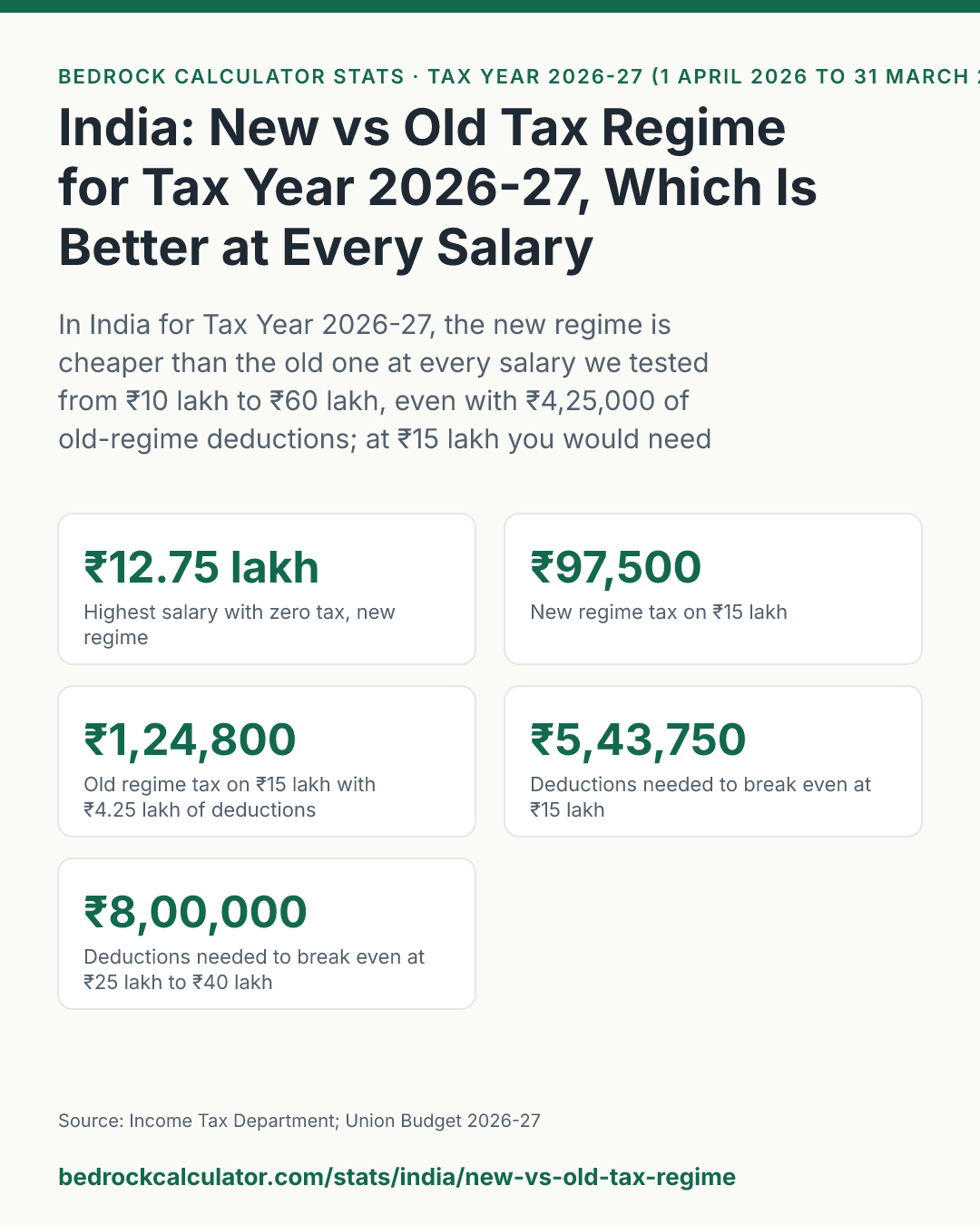
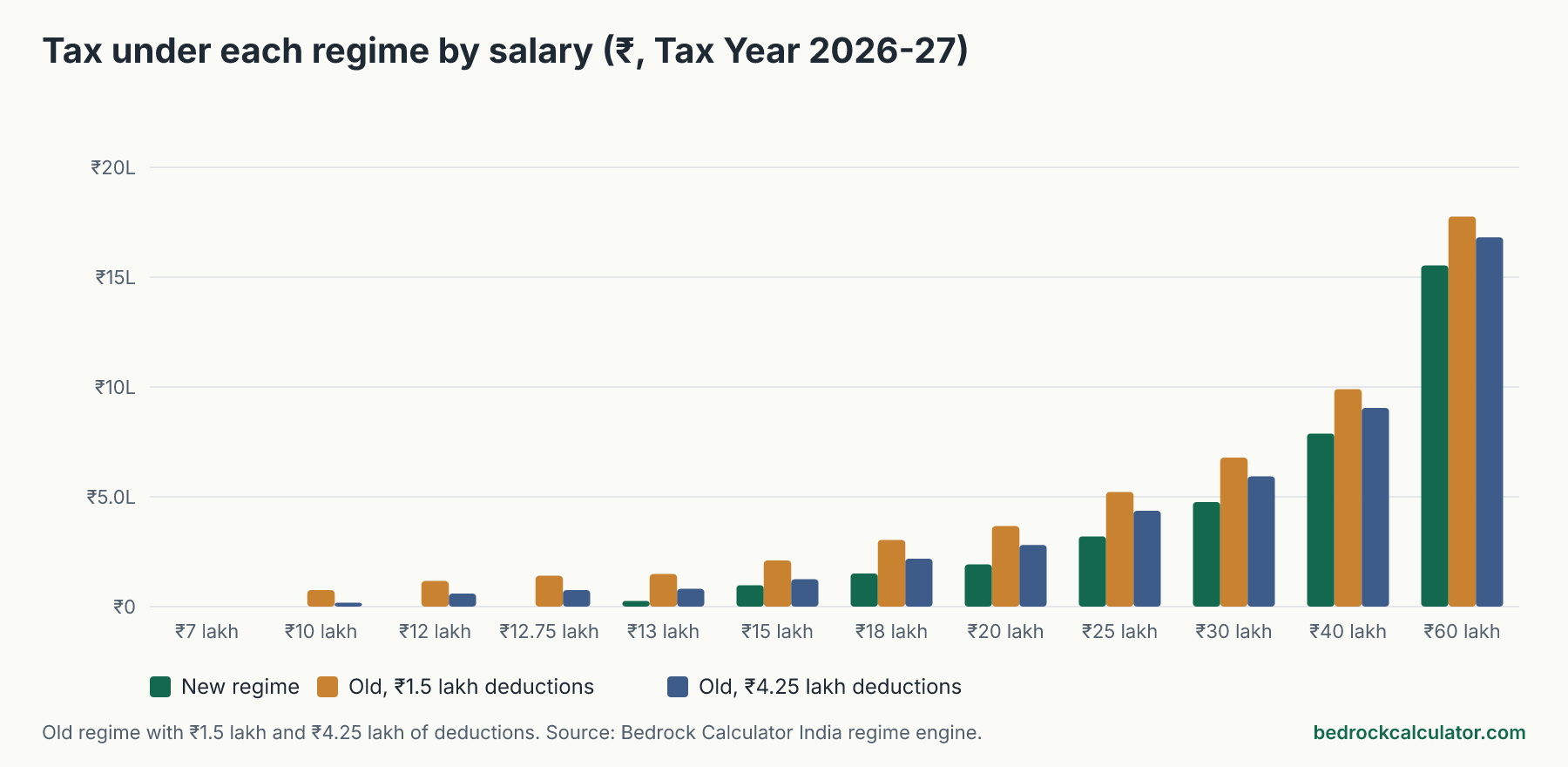
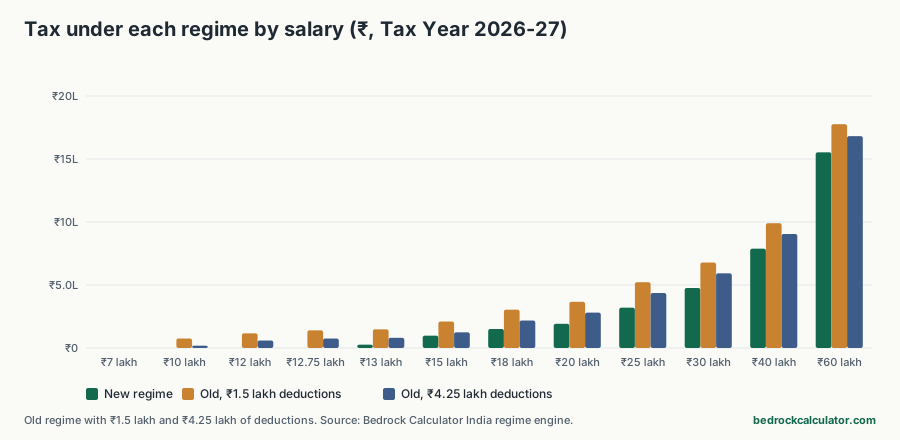
For a salaried person in India below 60, the new tax regime wins almost everywhere in Tax Year 2026-27. On every salary we tested from ₹10 lakh to ₹60 lakh it charged less tax than the old regime, even when the old regime was given ₹4,25,000 of deductions.
Below that, both regimes come to zero tax in our scenarios, so there's nothing to choose between them.
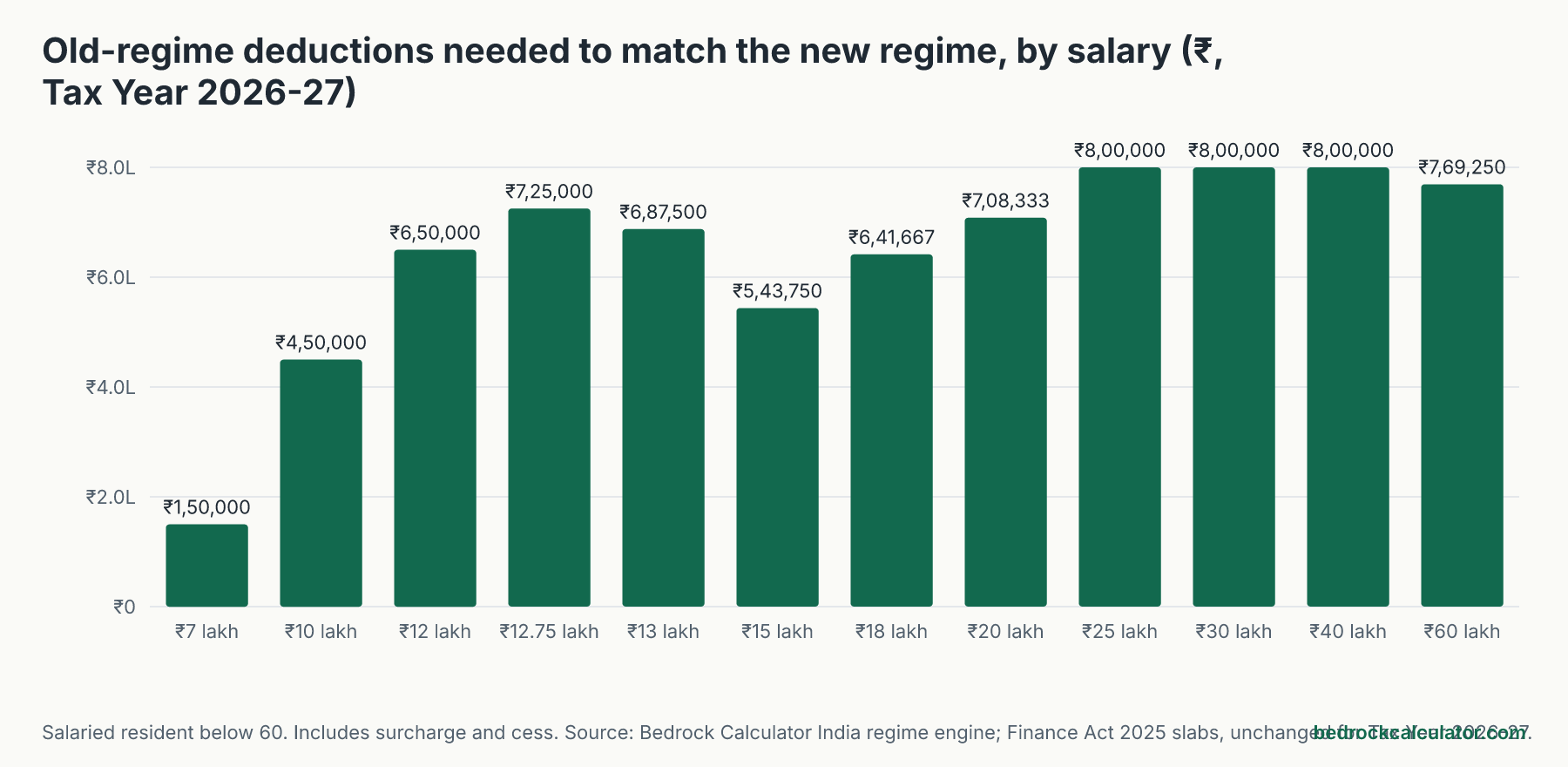
The clearest way to see it is the breakeven: how much you'd need to deduct under the old regime just to match the new one. At ₹15 lakh that's ₹5,43,750. From ₹25 lakh to ₹40 lakh it's ₹8,00,000. Few salaried people have deductions that large.
How we worked out these numbers
We ran the old vs new tax regime calculator on this site at twelve gross salaries from ₹7 lakh to ₹60 lakh and recorded the tax it returned under each regime. The calculator applies each regime's slabs, its standard deduction, the Section 87A rebate with marginal relief, surcharge where income is high enough, and the 4% Health and Education Cess.
India's Income-tax Act, 2025 took effect on 1 April 2026 and renamed the assessment year as the "Tax Year". Tax Year 2026-27 runs from 1 April 2026 to 31 March 2027. The slabs didn't change from the previous year, which is why the calculator still carries its earlier year label. Before producing a single number, this page checks that the engine's slabs, rebate thresholds, standard deduction and Section 80C cap match the site's Tax Year 2026-27 table, and the build fails if they don't.
Every run assumes:
- A resident salaried individual below 60
- The new regime's ₹75,000 standard deduction, and the old regime's ₹50,000
- All income is salary taxed at slab rates
The old regime gets three deduction packages on top of its standard deduction, so you can see how much the answer moves:
- ₹1,50,000: Section 80C maxed out at its ₹1,50,000 cap
- ₹2,25,000: 80C plus ₹25,000 of Section 80D health insurance for yourself and ₹50,000 under Section 80CCD(1B) for NPS
- ₹4,25,000: all of that plus ₹2,00,000 of home loan interest on a self-occupied house
What the calculator leaves out
Some things would change your own answer. Employer NPS contributions under Section 80CCD(2) are allowed in both regimes and aren't included here. Capital gains and other income taxed at special rates aren't modelled. Neither is professional tax charged by your state. HRA exemption depends on your rent, your city and your basic pay, so we haven't built it into the packages. If you claim HRA, add it to your deductions and compare against the breakeven column. And we've used the slabs for people below 60. Senior citizens get a higher exemption limit under the old regime, which the calculator handles but this page doesn't show.
New vs old regime tax at every salary
All amounts are in rupees. Click a column heading to sort.
India: new vs old regime tax by salary, Tax Year 2026-27 (₹, salaried, below 60)
Download CSVTotal tax including 87A rebate, marginal relief, surcharge and 4% Health and Education Cess. Old regime shown with three deduction packages on top of its standard deduction. Breakeven is the total old-regime deduction at which both regimes cost the same. Amounts in Indian rupees.
| ₹7,00,000 | ₹0 | ₹0 | ₹0 | ₹0 | ₹1,50,000 |
| ₹10,00,000 | ₹0 | ₹75,400 | ₹59,800 | ₹18,200 | ₹4,50,000 |
| ₹12,00,000 | ₹0 | ₹1,17,000 | ₹1,01,400 | ₹59,800 | ₹6,50,000 |
| ₹12,75,000 | ₹0 | ₹1,40,400 | ₹1,17,000 | ₹75,400 | ₹7,25,000 |
| ₹13,00,000 | ₹26,000 | ₹1,48,200 | ₹1,24,800 | ₹80,600 | ₹6,87,500 |
| ₹15,00,000 | ₹97,500 | ₹2,10,600 | ₹1,87,200 | ₹1,24,800 | ₹5,43,750 |
| ₹18,00,000 | ₹1,50,800 | ₹3,04,200 | ₹2,80,800 | ₹2,18,400 | ₹6,41,667 |
| ₹20,00,000 | ₹1,92,400 | ₹3,66,600 | ₹3,43,200 | ₹2,80,800 | ₹7,08,333 |
| ₹25,00,000 | ₹3,19,800 | ₹5,22,600 | ₹4,99,200 | ₹4,36,800 | ₹8,00,000 |
| ₹30,00,000 | ₹4,75,800 | ₹6,78,600 | ₹6,55,200 | ₹5,92,800 | ₹8,00,000 |
| ₹40,00,000 | ₹7,87,800 | ₹9,90,600 | ₹9,67,200 | ₹9,04,800 | ₹8,00,000 |
| ₹60,00,000 | ₹15,52,980 | ₹17,76,060 | ₹17,50,320 | ₹16,81,680 | ₹7,69,250 |
Why ₹12.75 lakh is the number to remember
Under the new regime, a salary of up to ₹12.75 lakh pays no income tax at all. The ₹75,000 standard deduction brings taxable income down to ₹12,00,000, and the 87A rebate wipes out the tax on that.
The old regime can't match it. Its rebate only applies up to ₹5,00,000 of taxable income. At ₹12 lakh, even with the full ₹4,25,000 package, the old regime still charges ₹59,800. To get to zero you'd need ₹6,50,000 of deductions.
Just past the line, marginal relief keeps the new regime from jumping. At ₹13 lakh the tax is only the slice of income above the rebate threshold, plus cess, rather than the full slab tax.
Which tax regime is better for a 15 lakh salary?
This is where a lot of people sit, so it's worth a closer look. On ₹15 lakh the new regime charges ₹97,500, an effective rate of 6.5%.
Under the old regime the tax depends on what you can claim. With only 80C it's ₹2,10,600, which is ₹1,13,100 more than the new regime. Add health insurance and NPS and it's ₹1,87,200. Add a home loan as well and it's ₹1,24,800, still ₹27,300 more than the new regime.
To break even at ₹15 lakh you'd need ₹5,43,750 of deductions in total. That's roughly the full 80C, 80D and NPS package plus a big home loan interest claim plus a meaningful HRA exemption.
Why the breakeven flattens out at higher salaries
The breakeven climbs from ₹6,50,000 at ₹12 lakh to ₹7,08,333 at ₹20 lakh, then sits at ₹8,00,000 from ₹25 lakh to ₹40 lakh.
Above those salaries, both regimes are charging their top slab rate on each extra rupee, so the gap between them stops growing. What's left is a fixed difference in how much tax the lower slabs collect on the way up. Under the new regime the lower slabs are wider and gentler, and that saving is the same whether you earn ₹25 lakh or ₹40 lakh. Deductions under the old regime come off the top, at its top rate, so the deduction needed to cancel that fixed gap is also fixed.
At ₹60 lakh surcharge kicks in under both regimes, and the breakeven moves a little to ₹7,69,250. The new regime still charges less: ₹15,52,980 against ₹16,81,680 with the largest package.
Is the old regime better with a home loan?
Not on its own, in these numbers. The ₹4,25,000 package already includes ₹2,00,000 of home loan interest, and the new regime still wins at every salary from ₹10 lakh up. A home loan helps the old regime close the gap, but you'd usually need a large HRA claim on top before it pulls ahead.
The people most likely to come out ahead under the old regime are those with several big claims at once: high rent in a metro city with a large HRA exemption, a home loan, full 80C and 80D, and NPS. If your total is above the breakeven for your salary, it's worth running the numbers.
Getting your own answer
Salaried taxpayers without business income can pick a regime each year when they file, so this isn't a permanent decision. The new regime is the default if you do nothing.
To check your own case, open the old vs new tax regime calculator and enter your gross salary and the total of your old-regime deductions. It tells you which regime costs less and how much more you'd need to deduct for the old one to tie. If you're not sure what you can claim, the 80C and 80D deduction optimizer and the HRA exemption calculator will help you build the total, and the NPS calculator shows what the extra NPS deduction is worth over time.