How much tax does the HRA exemption save in India?
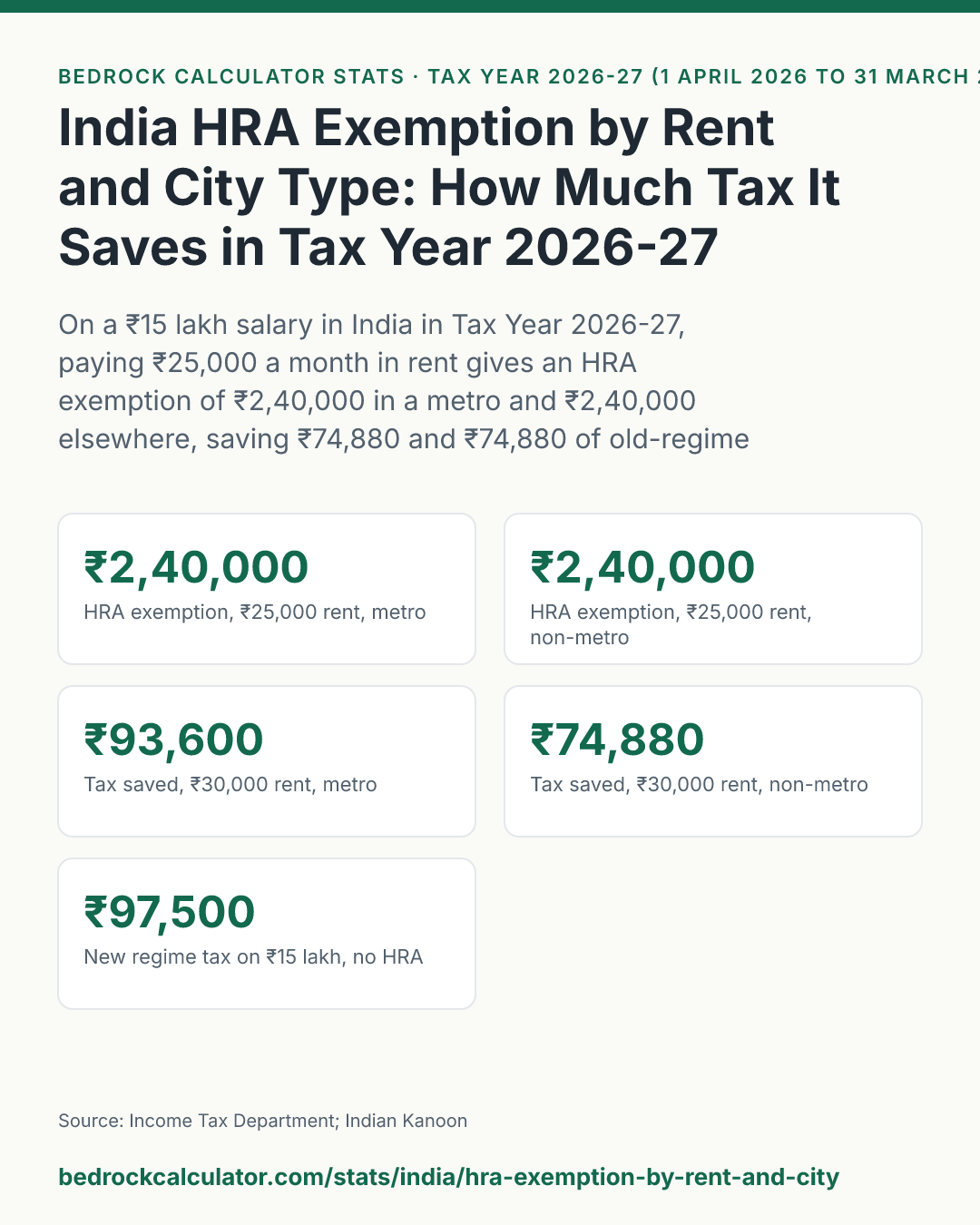
Take a ₹15 lakh salary in India with ₹6,00,000 of basic pay and ₹3,00,000 of HRA a year. Paying ₹25,000 a month in rent gives an HRA exemption of ₹2,40,000, and it makes no difference whether you live in a metro or not. That cuts your old-regime tax by ₹74,880.
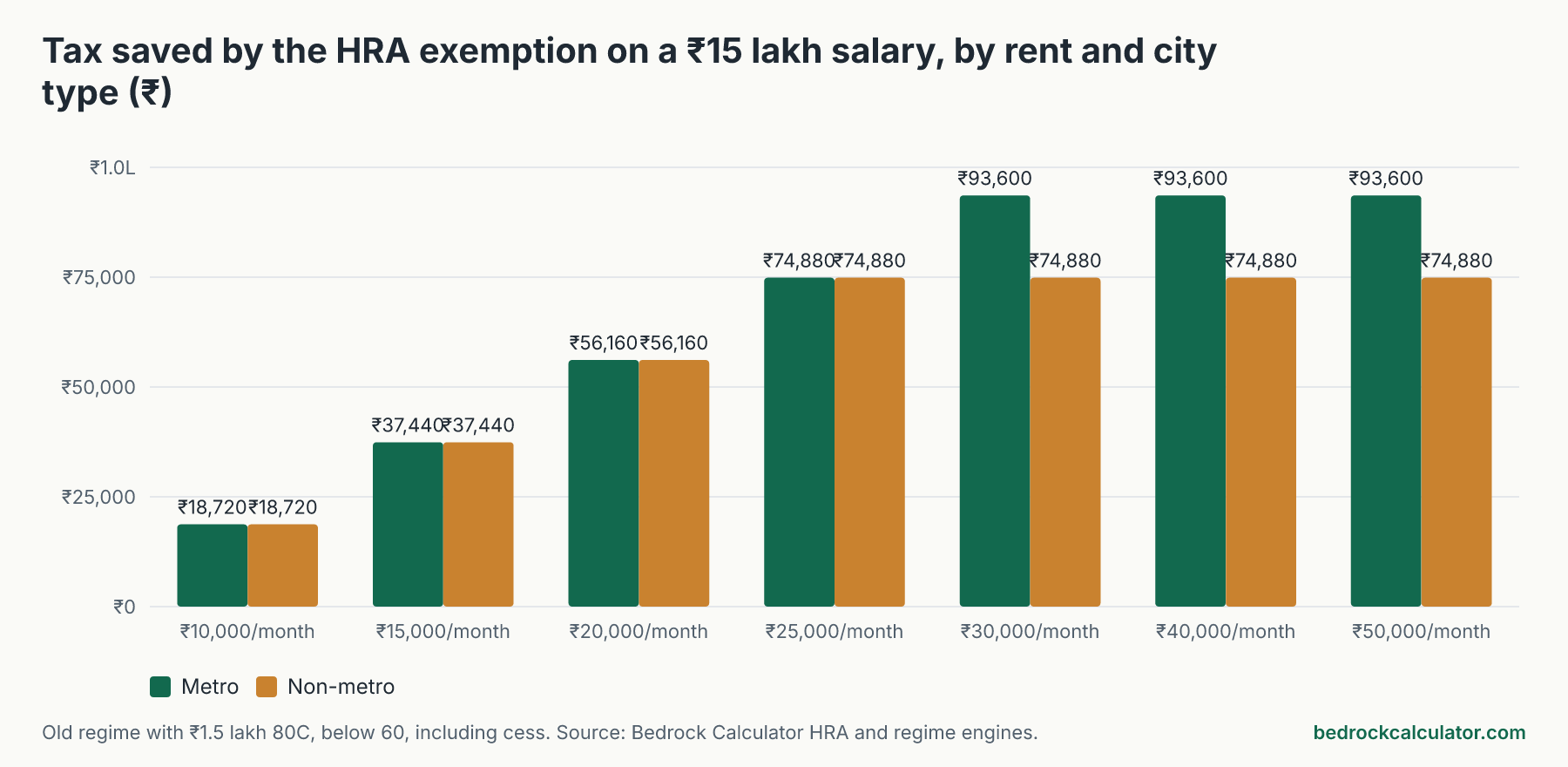
At ₹30,000 a month the metro advantage shows up: the saving is ₹93,600 in a metro and ₹74,880 elsewhere.
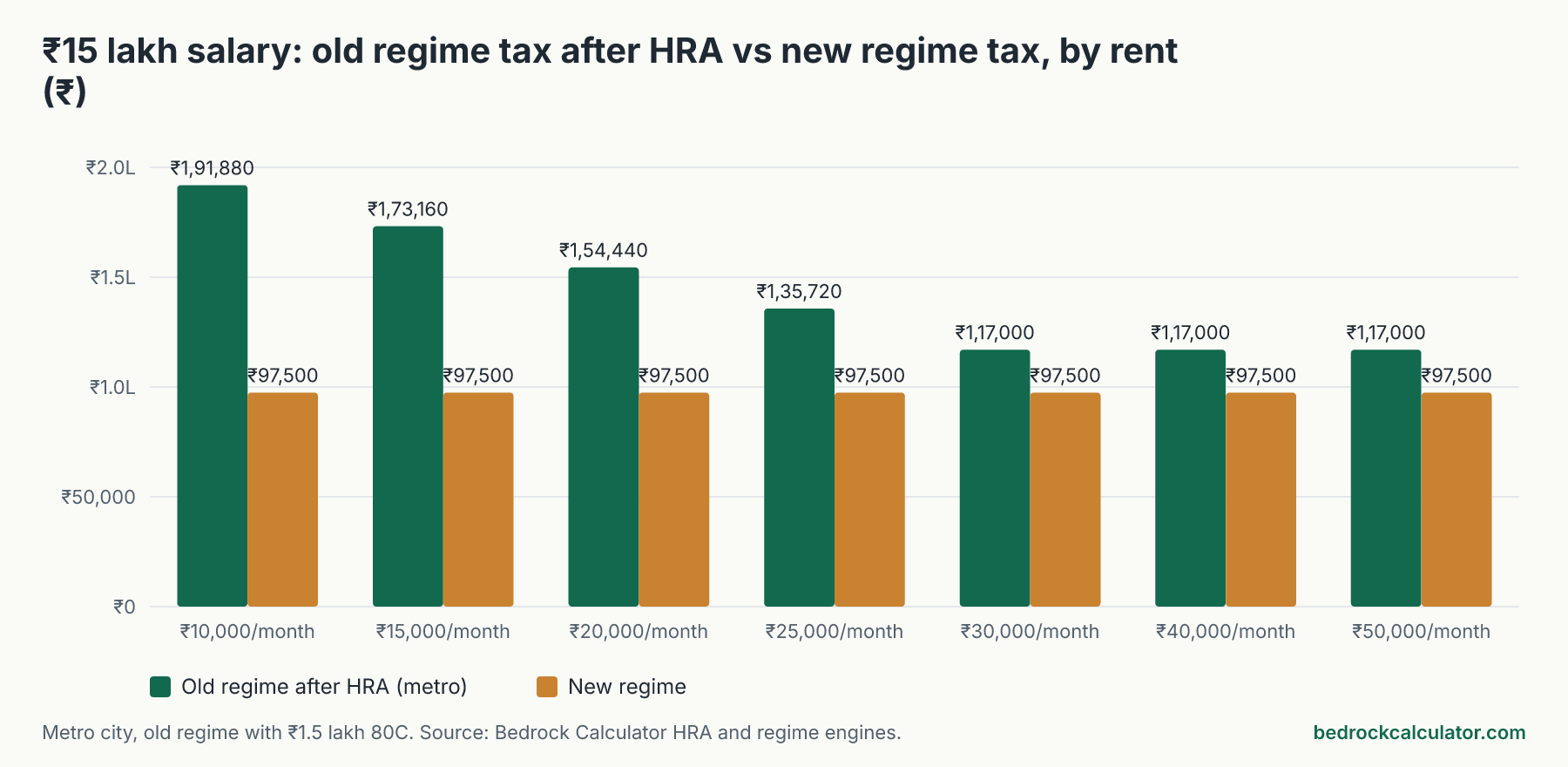
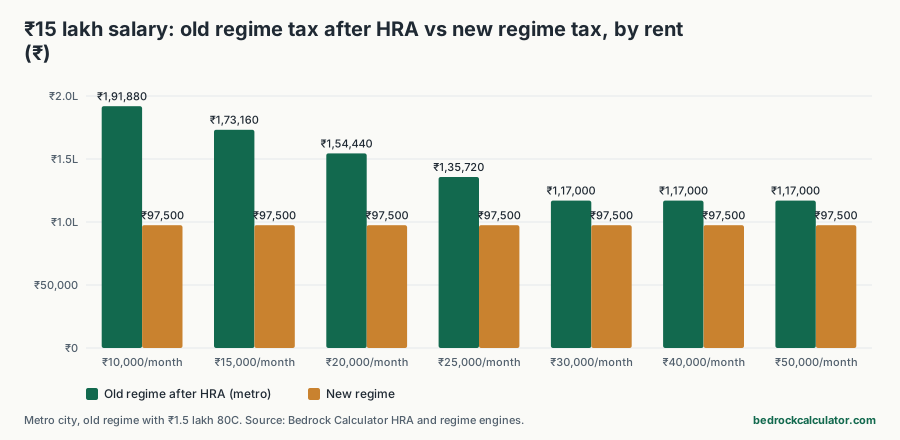
The catch for Tax Year 2026-27: HRA only counts under the old regime. Even with the biggest saving in our table, the old regime still costs more than the new regime's ₹97,500 on this salary.
HRA exemption calculation: the three limits
The exempt part of your HRA is the lowest of three numbers:
- The HRA your employer actually pays you
- The rent you pay, minus 10% of your basic salary
- 50% of basic salary if you rent in a metro, or 40% anywhere else
Whatever HRA is left over is taxed as salary. "Basic salary" here means basic pay plus any dearness allowance that counts for retirement benefits, not your gross pay or CTC.
On our ₹15 lakh example the three limits are ₹3,00,000 of HRA received, your rent minus the floor, and a city cap of ₹3,00,000 in a metro or ₹2,40,000 elsewhere. At low rents the middle one decides everything, which is why metro and non-metro come out the same.
HRA exemption and tax saved at every rent
Here's what the exemption and the tax saving look like as rent rises, on the same ₹15 lakh salary. The tax saved is the drop in old-regime tax once the exemption is added, with ₹1,50,000 of 80C already claimed in both cases.
India: HRA exemption and tax saved by monthly rent, metro vs non-metro, ₹15 lakh salary (₹, Tax Year 2026-27)
Download CSVOld regime, below 60. Basic pay ₹6,00,000 and HRA ₹3,00,000 a year. Tax saved is old-regime tax with ₹1,50,000 of 80C, minus the same with the HRA exemption, including 4% cess. Metro means the four cities in the engine's list.
| ₹10,000 | ₹60,000 | ₹60,000 | ₹18,720 | ₹18,720 | ₹1,91,880 | ₹97,500 |
| ₹15,000 | ₹1,20,000 | ₹1,20,000 | ₹37,440 | ₹37,440 | ₹1,73,160 | ₹97,500 |
| ₹20,000 | ₹1,80,000 | ₹1,80,000 | ₹56,160 | ₹56,160 | ₹1,54,440 | ₹97,500 |
| ₹25,000 | ₹2,40,000 | ₹2,40,000 | ₹74,880 | ₹74,880 | ₹1,35,720 | ₹97,500 |
| ₹30,000 | ₹3,00,000 | ₹2,40,000 | ₹93,600 | ₹74,880 | ₹1,17,000 | ₹97,500 |
| ₹40,000 | ₹3,00,000 | ₹2,40,000 | ₹93,600 | ₹74,880 | ₹1,17,000 | ₹97,500 |
| ₹50,000 | ₹3,00,000 | ₹2,40,000 | ₹93,600 | ₹74,880 | ₹1,17,000 | ₹97,500 |
Three things happen as rent goes up.
Up to about ₹25,000 a month, every extra rupee of rent adds a rupee of exemption. At ₹10,000 a month you exempt ₹60,000 and save ₹18,720. At ₹20,000 it's ₹1,80,000 and ₹56,160.
From ₹25,000 a month, the 40% cap stops non-metro renters at ₹2,40,000. Metro renters keep going until ₹30,000.
Above that, nothing more helps. In a metro the exemption reaches ₹3,00,000, which is both the 50% cap and the full HRA paid, so the saving stays at ₹93,600 whether you pay ₹40,000 or ₹50,000 a month.
Metro vs non-metro: which cities get the higher limit?
The calculator gives the 50% limit to Mumbai, Kolkata, Delhi, Chennai, Hyderabad, Pune, Ahmedabad and Bengaluru, and 40% to everywhere else. That's the list in Rule 279 of the Income-tax Rules, 2026, which took effect on 1 April 2026.
The rule added Hyderabad, Pune, Ahmedabad and Bengaluru to the four cities the old rules named, so renters in those four now read the metro column too.
Either way, the city only matters once rent is high relative to basic pay. On this salary, anyone paying ₹25,000 a month or less gets the same exemption wherever they live.
Why a bigger salary can mean a smaller HRA exemption
This one surprises people. At the same rent of ₹25,000 a month, once salary passes ₹15 lakh the exemption goes down as salary goes up, because the rent floor is a share of basic pay. A higher basic means a bigger chunk of rent doesn't count. Below that, the smaller HRA and city cap are what hold the exemption back.
HRA tax saved at ₹25,000 a month rent, by salary (₹, Tax Year 2026-27)
Download CSVBasic pay is 40% of gross salary and HRA is 50% of basic. Old regime with 80C, compared with the new regime for the same salary.
| ₹30 lakh | ₹1,80,000 | ₹1,80,000 | ₹56,160 | ₹56,160 | ₹6,22,440 | ₹4,75,800 |
| ₹10 lakh | ₹2,00,000 | ₹1,60,000 | ₹41,600 | ₹33,280 | ₹33,800 | ₹0 |
| ₹20 lakh | ₹2,20,000 | ₹2,20,000 | ₹68,640 | ₹68,640 | ₹2,97,960 | ₹1,92,400 |
| ₹15 lakh | ₹2,40,000 | ₹2,40,000 | ₹74,880 | ₹74,880 | ₹1,35,720 | ₹97,500 |
At ₹10 lakh, the metro exemption saves ₹41,600. At ₹15 lakh it saves ₹74,880, at ₹20 lakh ₹68,640, and at ₹30 lakh only ₹56,160, even though the tax rate on each rupee is higher there.
Is HRA enough to make the old regime worth it?
Not on its own, in any of our scenarios. On ₹15 lakh, the old regime with 80C and the largest metro HRA exemption still charges ₹1,17,000, against ₹97,500 under the new regime.
At ₹30 lakh the gap is wider: ₹6,22,440 under the old regime after HRA and 80C, against ₹4,75,800 under the new one. HRA tends to tip the balance only when it's combined with other large claims such as home loan interest, health insurance and NPS. Our new vs old regime comparison shows the total deductions you'd need at each salary.
How we worked out these numbers
The exemption comes from the HRA exemption calculator on this site, which applies the three-way minimum above. We then ran the old vs new tax regime calculator twice for each row: once with ₹1,50,000 of old-regime deductions, and once with that plus the HRA exemption. The difference is the tax saved, including surcharge where relevant and the 4% cess.
Our salary structure is an assumption: basic pay is 40% of gross and HRA is 50% of basic. Your payslip will differ, and that changes the answer a lot, so run your own numbers.
From Tax Year 2026-27 the HRA exemption sits in Schedule III of India's Income-tax Act, 2025, with the limits in Rule 279 of the Income-tax Rules, 2026. They replaced Section 10(13A) and Rule 2A. The three-way formula is the same; the list of higher-limit cities is longer.
What this leaves out
The calculators don't check whether you actually qualify. You need to live in the rented home, pay the rent, and keep receipts; if annual rent is large, your employer will ask for the landlord's PAN. Rent paid to a parent or spouse needs to be genuine and declared by them as income. We haven't modelled people who receive HRA for only part of the year, or those whose dearness allowance doesn't count toward basic.
Work out your own HRA
Enter your basic pay, HRA and rent in the HRA exemption calculator, then add the exemption to your other old-regime deductions in the old vs new tax regime calculator. If you also own a home with a loan, the HRA vs home loan calculator shows whether you can claim both.