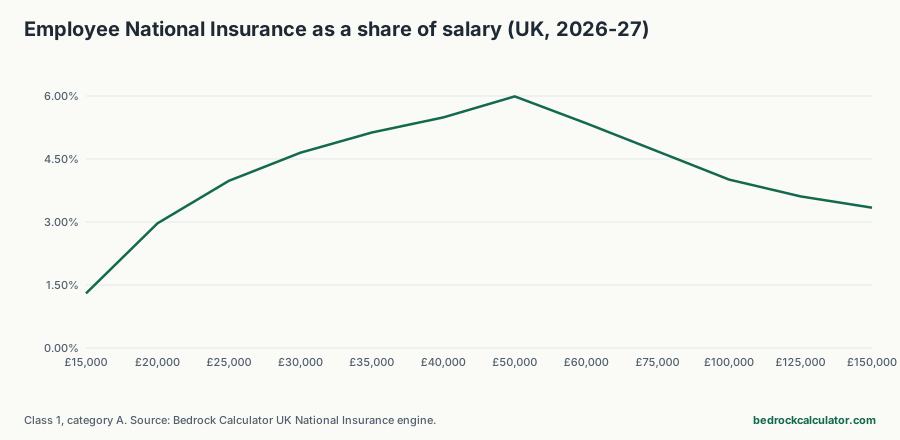
How much National Insurance do you and your employer pay at each salary?
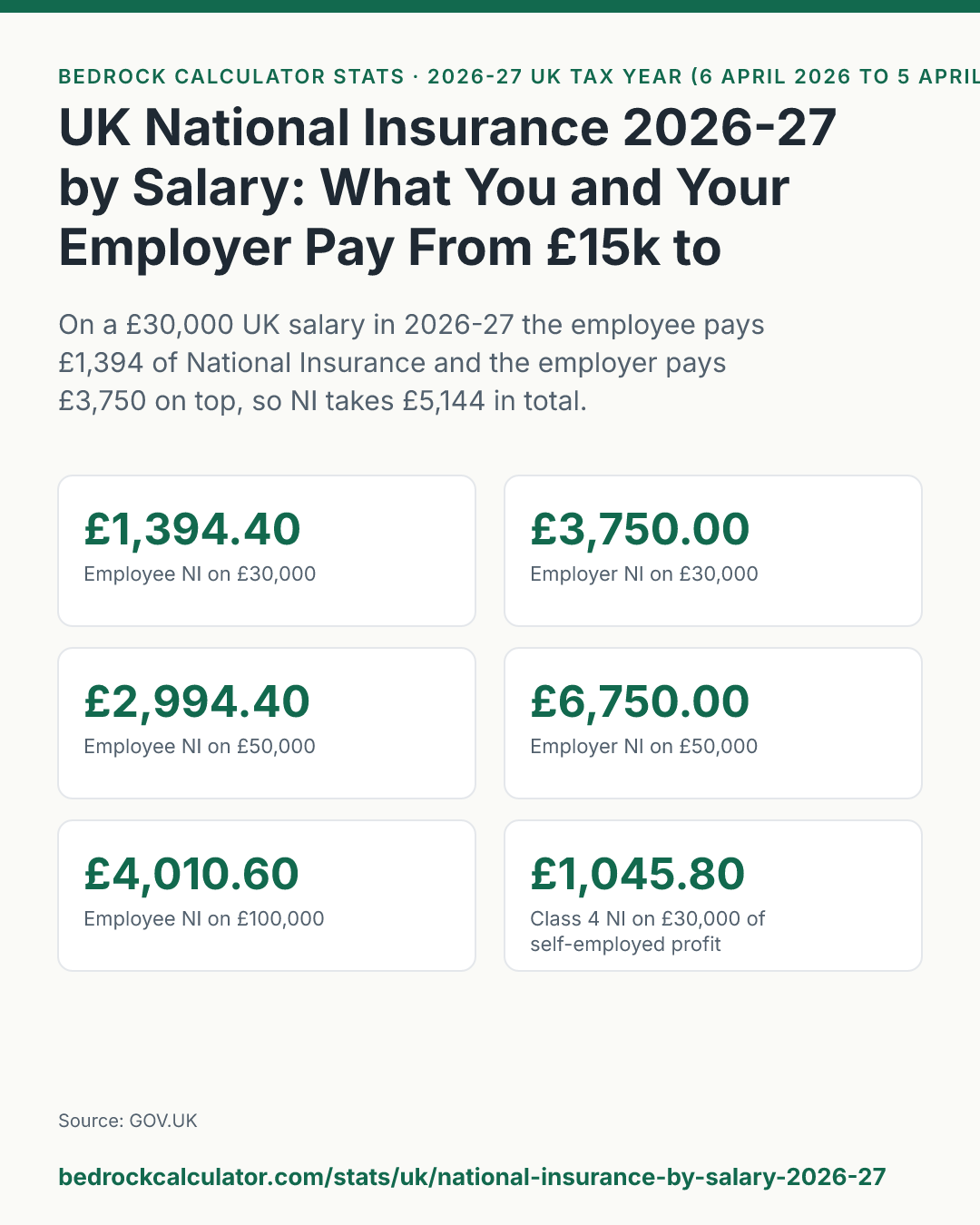
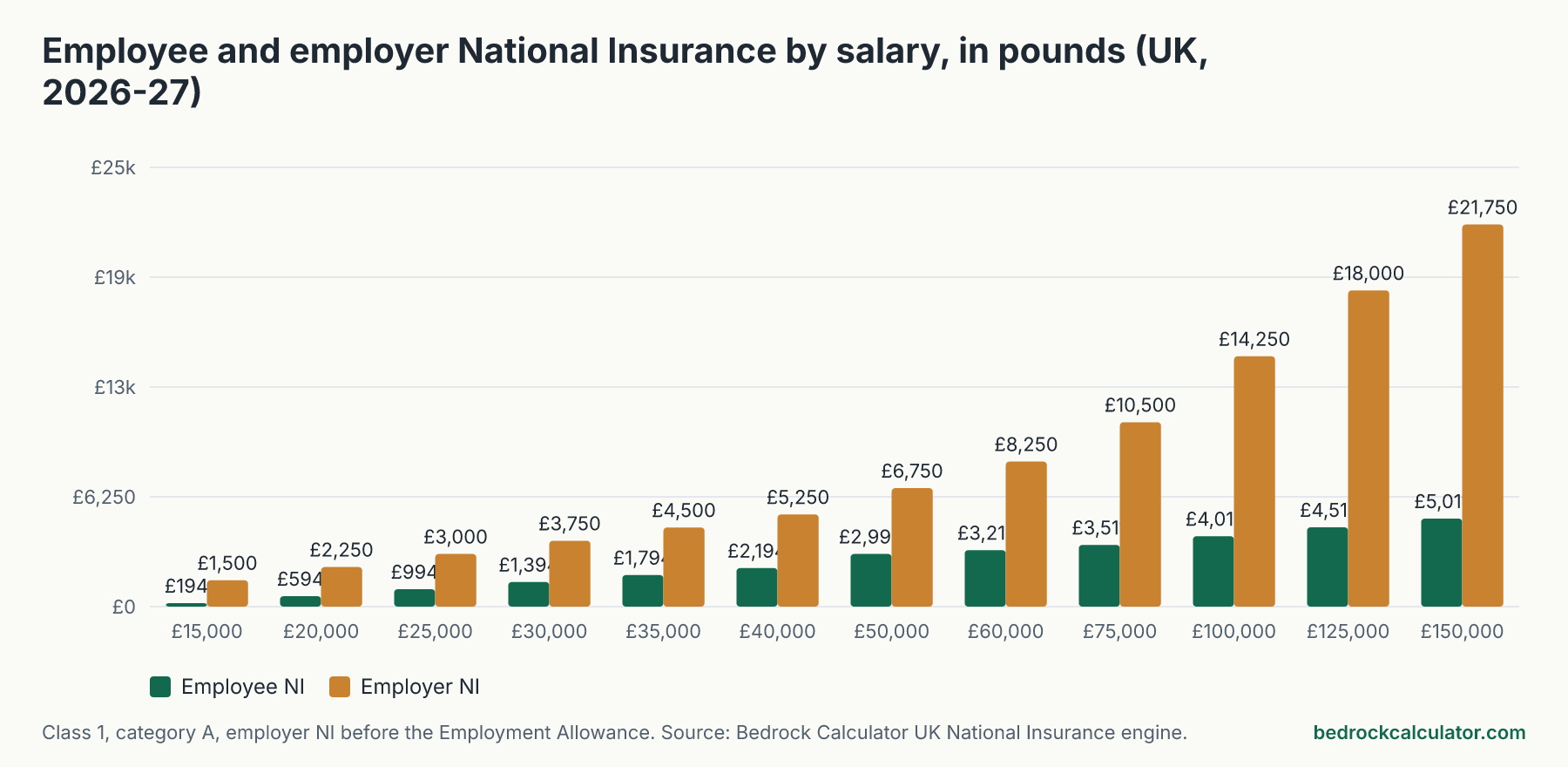
In the 2026-27 tax year an employee on £30,000 pays £1,394.40 of National Insurance, and their employer pays another £3,750.00 on top of the salary. On £50,000 the two figures are £2,994.40 and £6,750.00. On £100,000 they are £4,010.60 and £14,250.00.
The employer's share is the bigger one at every salary we checked. It's charged at a higher rate, starts at a lower threshold, and never drops back the way the employee rate does.
How we worked out these numbers
We ran the UK National Insurance calculator on this site at twelve salaries from £15,000 to £150,000. It applies the 2026-27 Class 1 rules for a standard category A employee:
- The employee pays nothing on the first £12,570, then 8% up to £50,270, then 2% on everything above that.
- The employer pays 15% on everything above £5,000, with no upper limit.
- Self-employed people pay Class 4 instead: 6% on profits between £12,570 and £50,270, and 2% above.
One thing to know about the employer figure. The calculator reports employer NI after taking off the full £10,500 Employment Allowance, as though you were the firm's only employee. That allowance is one per employer, though, not one per job, so in a firm of any size it's used up long before it reaches your salary. For that reason the main employer column here is the charge before the allowance, worked out by the same engine function the calculator uses. The table also shows the after-allowance figure the calculator itself reports.
National Insurance at every salary
Click any column heading to sort. All figures are pounds a year.
UK National Insurance by salary, 2026-27
Download CSVCategory A employee, Class 1. Employer NI shown before and after the Employment Allowance (after = the allowance used in full on this one employee). Self-employed is Class 4 on the same amount of profit. Pounds a year.
| £15,000 | £194.40 | 1.3% | £1,500 | £1,694.40 | £0 | £145.80 |
| £20,000 | £594.40 | 3.0% | £2,250 | £2,844.40 | £0 | £445.80 |
| £25,000 | £994.40 | 4.0% | £3,000 | £3,994.40 | £0 | £745.80 |
| £30,000 | £1,394.40 | 4.7% | £3,750 | £5,144.40 | £0 | £1,045.80 |
| £35,000 | £1,794.40 | 5.1% | £4,500 | £6,294.40 | £0 | £1,345.80 |
| £40,000 | £2,194.40 | 5.5% | £5,250 | £7,444.40 | £0 | £1,645.80 |
| £50,000 | £2,994.40 | 6.0% | £6,750 | £9,744.40 | £0 | £2,245.80 |
| £60,000 | £3,210.60 | 5.3% | £8,250 | £11,460.60 | £0 | £2,456.60 |
| £75,000 | £3,510.60 | 4.7% | £10,500 | £14,010.60 | £0 | £2,756.60 |
| £100,000 | £4,010.60 | 4.0% | £14,250 | £18,260.60 | £3,750 | £3,256.60 |
| £125,000 | £4,510.60 | 3.6% | £18,000 | £22,510.60 | £7,500 | £3,756.60 |
| £150,000 | £5,010.60 | 3.3% | £21,750 | £26,760.60 | £11,250 | £4,256.60 |
On £30,000 the employee's £1,394.40 works out at about £116.20 a month. The employer's £3,750.00 is roughly 2.7 times as much, which surprises many people because it never appears on a payslip. Put together, NI on that job comes to £5,144.40, or 17.1% of the salary.
Why NI takes a smaller share of bigger salaries
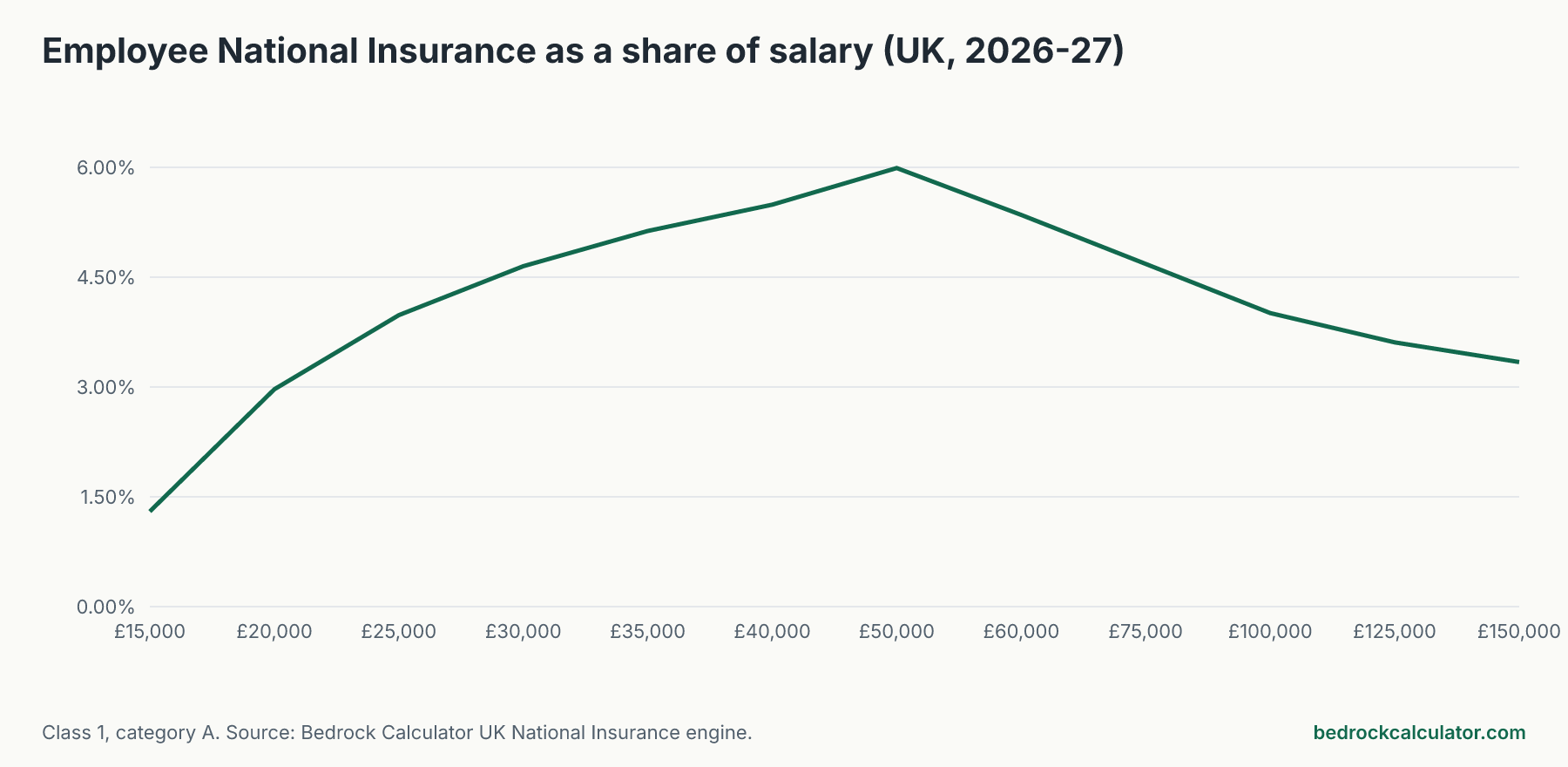
Employee National Insurance isn't progressive in the way Income Tax is. The main rate stops at £50,270, and above that you pay only 2%. So as a share of your salary, employee NI climbs until about £50,270 and then falls away. It's 4.6% of a £30,000 salary and 6.0% of £50,000, but only 4.0% of £100,000 and 3.3% of £150,000.
That's why higher earners often talk about Income Tax and barely mention NI. On £150,000 the employee pays £5,010.60 of NI, while the employer pays £21,750.00, because the employer rate keeps going at 15% on every pound. Combined, NI on £100,000 is £18,260.60, which is 18.3% of salary.
Is National Insurance the same in Scotland?
Yes. Income Tax bands differ in Scotland, but National Insurance is set for the whole of the UK, so every figure on this page applies to an employee in Scotland, Wales or Northern Ireland exactly as it does in England.
That's one reason a Scottish and an English employee on the same salary can see different take-home pay but identical NI lines on their payslips.
It also means NI doesn't react to the Personal Allowance taper on high incomes or to the Income Tax bands at all. The only thresholds that matter are the £12,570 starting point, the £50,270 upper limit for employees and the £5,000 starting point for employers.
Employee vs self-employed National Insurance
Someone running their own business pays less NI on the same amount of money. On £30,000 of profit, Class 4 comes to £1,045.80, against £1,394.40 for an employee on a £30,000 salary. That's £348.60 less. At £50,000 the gap is £748.60. And there's no employer charge at all, because there's no employer.
That doesn't make self-employment cheaper overall. You don't get paid holidays, sick pay or an employer pension contribution, and your profit figure is after your business costs, not before.
What the Employment Allowance covers
Smaller employers can knock up to £10,500 a year off their employer NI bill. For a business with just one employee, that covers the whole employer charge on salaries up to about £75,000. Above that the employer starts paying: £3,750.00 at £100,000 and £11,250.00 at £150,000.
But the allowance is for the business, not the job. A company with several staff uses it against all of them together, so most employees in most firms are effectively paying the full employer rate.
What these figures leave out
The calculator keeps to the standard case. It doesn't model:
- Other NI category letters. Employees under 21, apprentices under 25 and some veterans have a different employer threshold, and a few married women still pay a reduced rate.
- Class 2 contributions for the self-employed, which now mainly matter for protecting your State Pension record.
- Directors' NI, which is worked out on an annual basis and can fall differently through the year.
- Who can claim the Employment Allowance. A company whose only employee is a director can't claim it, and there are other conditions. The calculator assumes the full allowance is available.
- More than one job, or a mix of jobs and self-employment, where NI is worked out per source and you may be due a refund.
- Salary sacrifice, which lowers the pay that NI is charged on for both you and your employer.
Run your own numbers
Put your own salary or profit into the UK National Insurance calculator. To see NI alongside Income Tax and what actually lands in your account, use the UK take-home pay calculator or the UK income tax calculator. If your employer offers a pension through salary sacrifice, the salary sacrifice calculator shows how much NI that saves you both.