What are the 2026 US long-term capital gains tax rates?
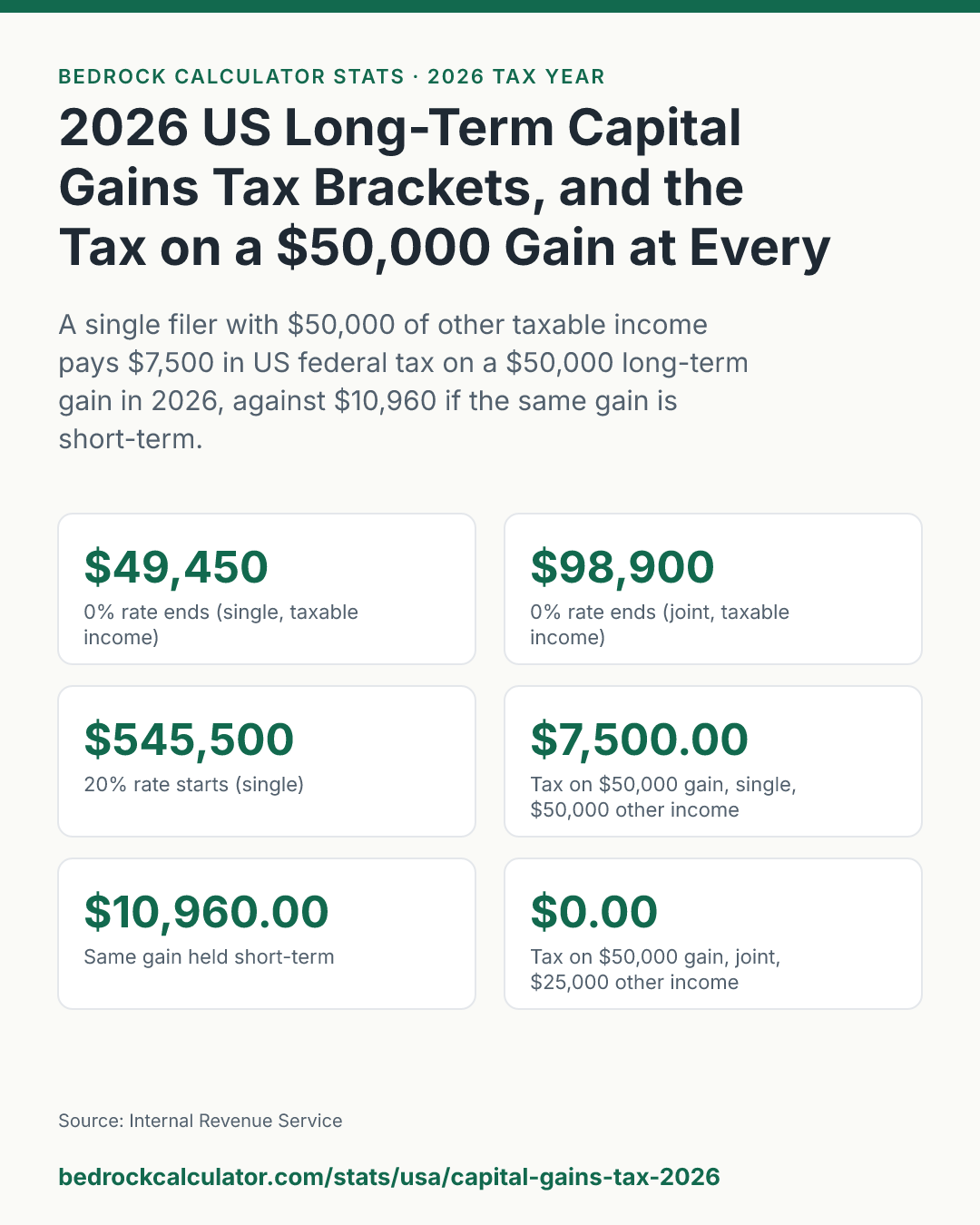
In the US in 2026, the IRS taxes a long-term capital gain at 0%, 15% or 20%, depending on your taxable income with the gain included. For a single filer the 0% band runs to $49,450 of taxable income and the 20% rate starts above $545,500. For a married couple filing jointly the breakpoints are $98,900 and $613,700.
In dollars: a single filer with $50,000 of other taxable income pays $7,500.00 on a $50,000 long-term gain. Sell the same asset after less than a year and the bill is $10,960.00.
The 2026 long-term capital gains brackets
The rate depends on taxable income, meaning income after the standard deduction or itemized deductions. Each rate applies to the part of the gain that lands inside its band, so one gain can be split across two rates.
2026 long-term capital gains brackets (taxable income including the gain)
Download CSVFrom IRS Rev. Proc. 2025-32 as held in the engine table. A rate applies to the part of the gain that falls inside its band.
| 0% | $0 | $49,450 | $0 | $98,900 |
| 15% | $49,450 | $545,500 | $98,900 | $613,700 |
| 20% | $545,500 | n/a | $613,700 | n/a |
n/a means the top band has no upper limit.
Qualified dividends use the same schedule. Short-term gains, from assets held a year or less, have no schedule of their own. They're added to wages and taxed at ordinary rates, which run from 10% to 37%.
How we worked out these numbers
We ran the capital gains tax calculator on this site for a $50,000 gain at ten levels of other taxable income, from nothing up to $750,000, for single and joint filers, once as a long-term gain and once as a short-term gain. Every figure in the tables and charts is what the calculator returned.
A few things to know about how it works:
- "Other taxable income" is income after deductions, before the gain. To translate to gross income with the standard deduction, add $16,100 for a single filer or $32,200 for a joint return.
- The gain is stacked on top of other income. The calculator taxes whatever slice of the gain falls in each band at that band's rate.
- The Net Investment Income Tax is included. The calculator applies it to the smaller of the gain and the amount by which other taxable income plus the gain exceeds the threshold.
- Short-term gains are taxed as the extra ordinary income tax the gain adds on top of your other income.
What's left out: state income tax on the gain, the home sale exclusion, the higher maximum rate on collectibles, unrecaptured depreciation on real estate, wash sales and loss carryforwards. One more simplification matters for high earners. The real NIIT threshold is tested against modified adjusted gross income, which is usually higher than taxable income, so the calculator can understate the NIIT for someone close to the threshold.
How much tax on a $50,000 capital gain?
Here's the full grid. Click a column heading to sort.
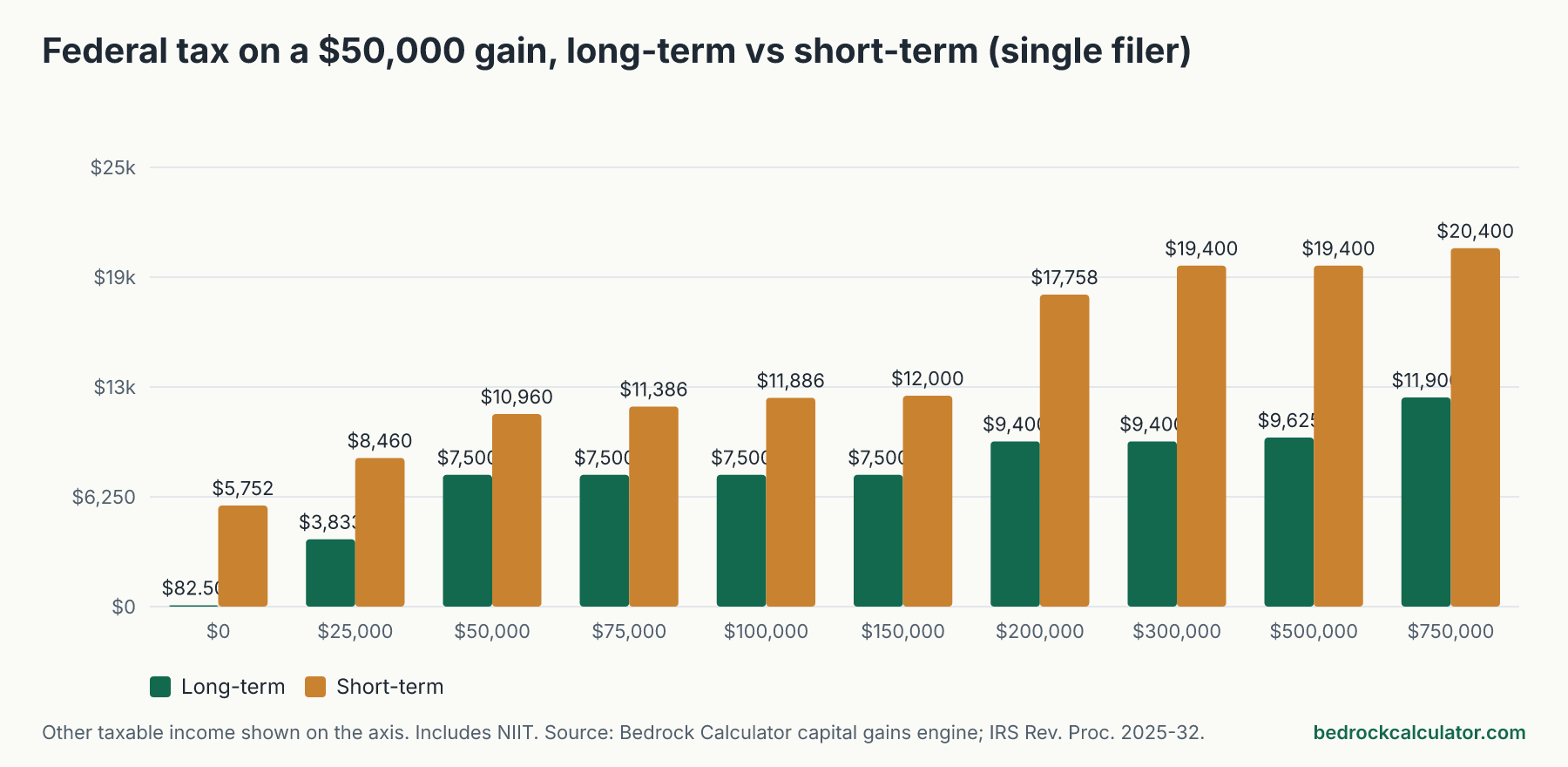
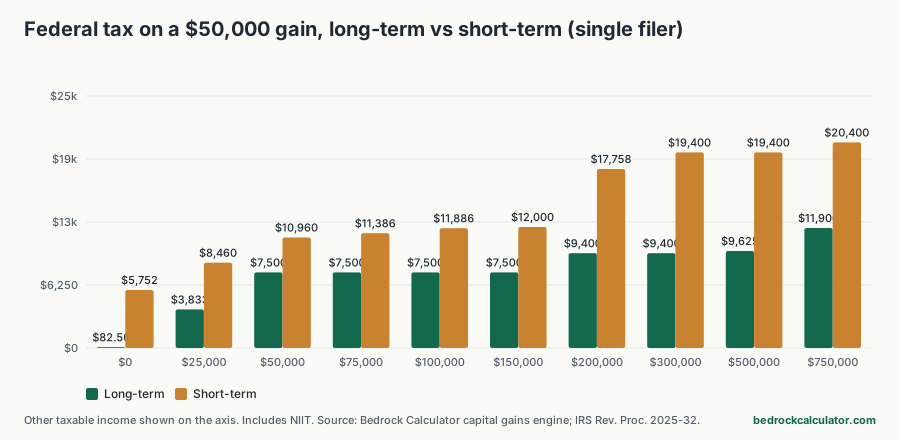
Federal tax on a $50,000 capital gain at different incomes, 2026
Download CSVOther taxable income is income after deductions, before the gain is added. Long-term total includes the 0%/15%/20% capital gains tax plus the Net Investment Income Tax where it applies. Short-term is taxed at ordinary rates plus the same NIIT.
| $0 | $82.50 | 0.17% | $5,752.00 | $0.00 | 0.00% | $5,504.00 |
| $25,000 | $3,832.50 | 7.66% | $8,460.00 | $0.00 | 0.00% | $6,000.00 |
| $50,000 | $7,500.00 | 15.00% | $10,960.00 | $165.00 | 0.33% | $6,000.00 |
| $75,000 | $7,500.00 | 15.00% | $11,386.00 | $3,915.00 | 7.83% | $8,420.00 |
| $100,000 | $7,500.00 | 15.00% | $11,886.00 | $7,500.00 | 15.00% | $10,920.00 |
| $150,000 | $7,500.00 | 15.00% | $12,000.00 | $7,500.00 | 15.00% | $11,000.00 |
| $200,000 | $9,400.00 | 18.80% | $17,758.00 | $7,500.00 | 15.00% | $11,772.00 |
| $300,000 | $9,400.00 | 18.80% | $19,400.00 | $9,400.00 | 18.80% | $13,900.00 |
| $500,000 | $9,625.00 | 19.25% | $19,400.00 | $9,400.00 | 18.80% | $19,026.50 |
| $750,000 | $11,900.00 | 23.80% | $20,400.00 | $11,900.00 | 23.80% | $20,026.00 |
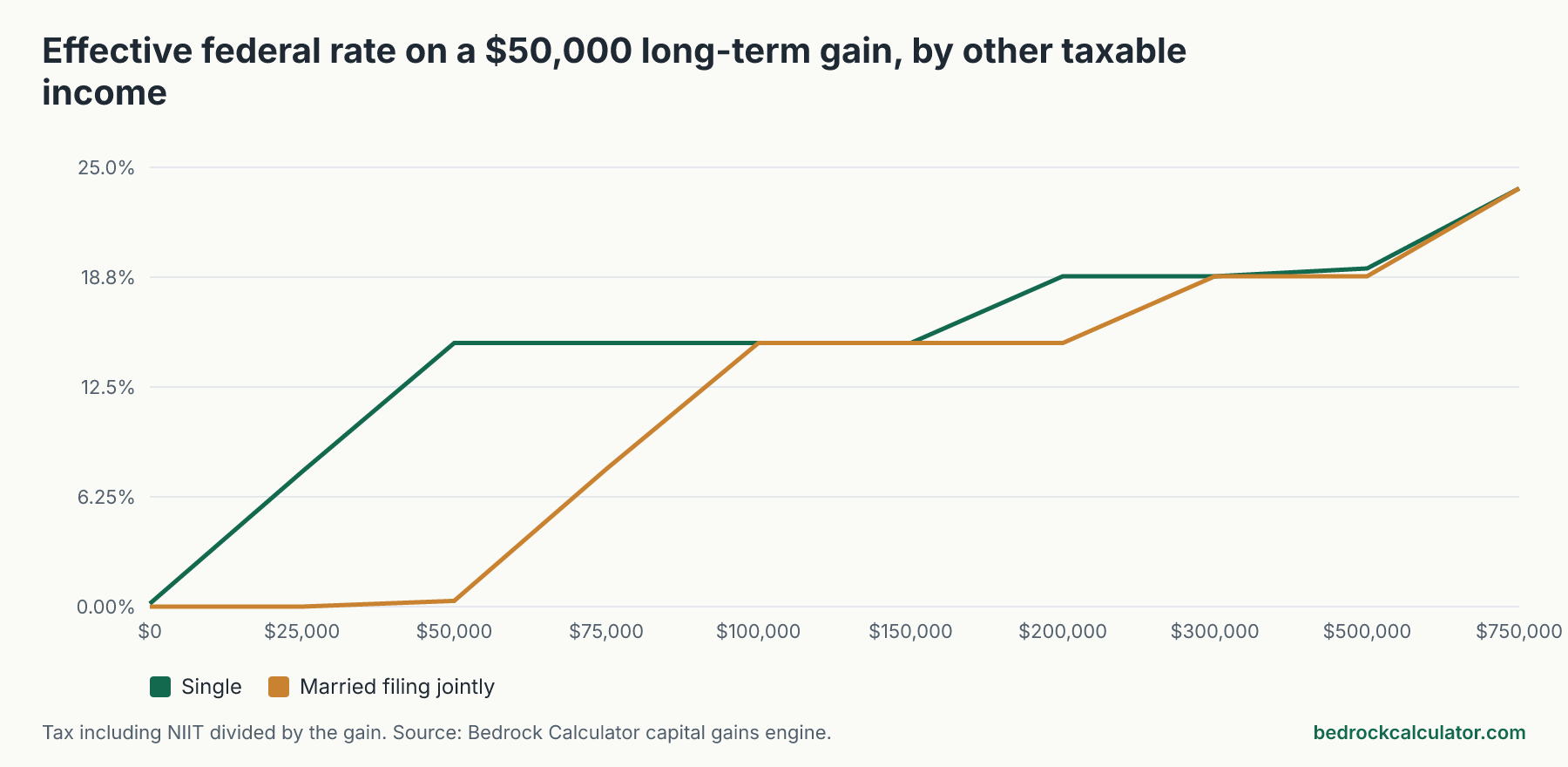
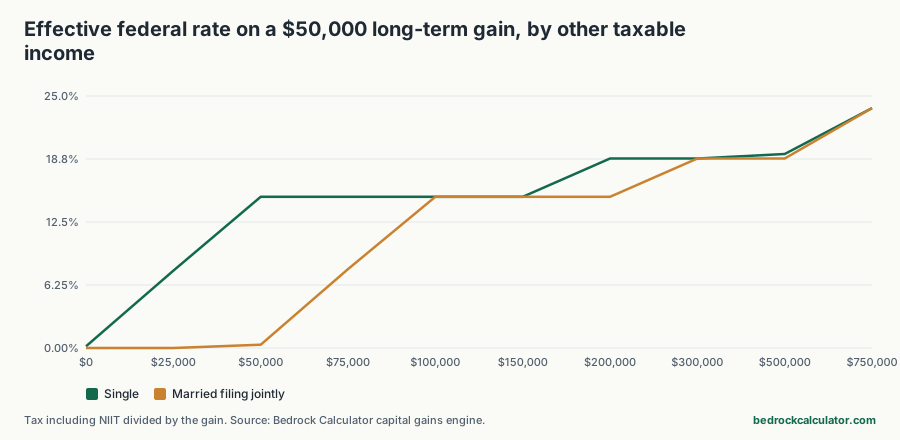
The pattern is easier to see in rates than in dollars:
- Low income: a single filer with no other taxable income pays $82.50, an effective rate of 0.17%. Almost all of the gain fits in the 0% band. A married couple with $25,000 of other taxable income pays $0.00.
- The middle: from $50,000 to $150,000 of other taxable income, a single filer pays a flat $7,500.00, exactly 15% of the gain. Most people who sell investments sit here.
- High income: at $200,000 the single filer's rate rises to 18.80% because the NIIT kicks in and adds $1,900.00. At $750,000 both filing statuses pay $11,900.00, an effective 23.80%.
How much capital gain can you take at 0% in 2026?
This is the question behind most "tax gain harvesting" plans. The answer is whatever fits between your other taxable income and the 0% ceiling.
- Single, $25,000 of other taxable income: $24,450 of room
- Married, $50,000 of other taxable income: $48,900 of room
- Married, $75,000 of other taxable income: $23,900 of room
In gross terms, with only the standard deduction, a single filer can have up to $65,550 of total income and a married couple up to $131,100 and still pay nothing on long-term gains. That's why retirees who live on savings for a few years before claiming Social Security often realize gains on purpose.
Go a dollar over the ceiling and only the dollars above it are taxed at 15%. There's no cliff. A couple with $75,000 of other income pays $3,915.00 on a $50,000 gain, because part of it fits at 0% and the rest is taxed at 15%.
Long-term vs short-term: what holding a year saves
Waiting past the one-year mark changes the bill a lot. For a single filer, the short-term version of the same $50,000 gain costs:
- $10,960.00 instead of $7,500.00 at $50,000 of other income, $3,460.00 more
- $11,886.00 instead of $7,500.00 at $100,000, $4,386.00 more
- $19,400.00 instead of $9,400.00 at $300,000, $10,000.00 more
The gap is biggest in the middle and upper brackets, where ordinary rates of 24% to 35% compare with a 15% capital gains rate. If you're close to the one-year mark on a large position, checking the purchase date before you sell is worth the minute it takes.
The Net Investment Income Tax on top
The NIIT is a flat surtax on investment income for people above a fixed income threshold, one for single filers and a higher one for joint returns. Those thresholds aren't indexed for inflation, so more people cross them each year.
In this table it first shows up at $200,000 of other taxable income for a single filer, adding $1,900.00. For a joint return it appears at $300,000, adding $1,900.00. Once you're past the threshold by more than the size of the gain, the full gain is exposed and the surtax adds 3.8% of it.
The how capital gains tax works guide walks through the stacking rule with a worked example, and the 2026 federal tax brackets guide has the ordinary rates that short-term gains use.
Getting your own number
The fastest way is to enter your own basis, sale price and taxable income in the capital gains tax calculator. If you don't know your taxable income, the federal income tax calculator shows it. Most states also tax gains as ordinary income, so if you live in one, add the state layer with a state page such as the California capital gains tax calculator.