How much is the required minimum distribution on $500,000 at each age?
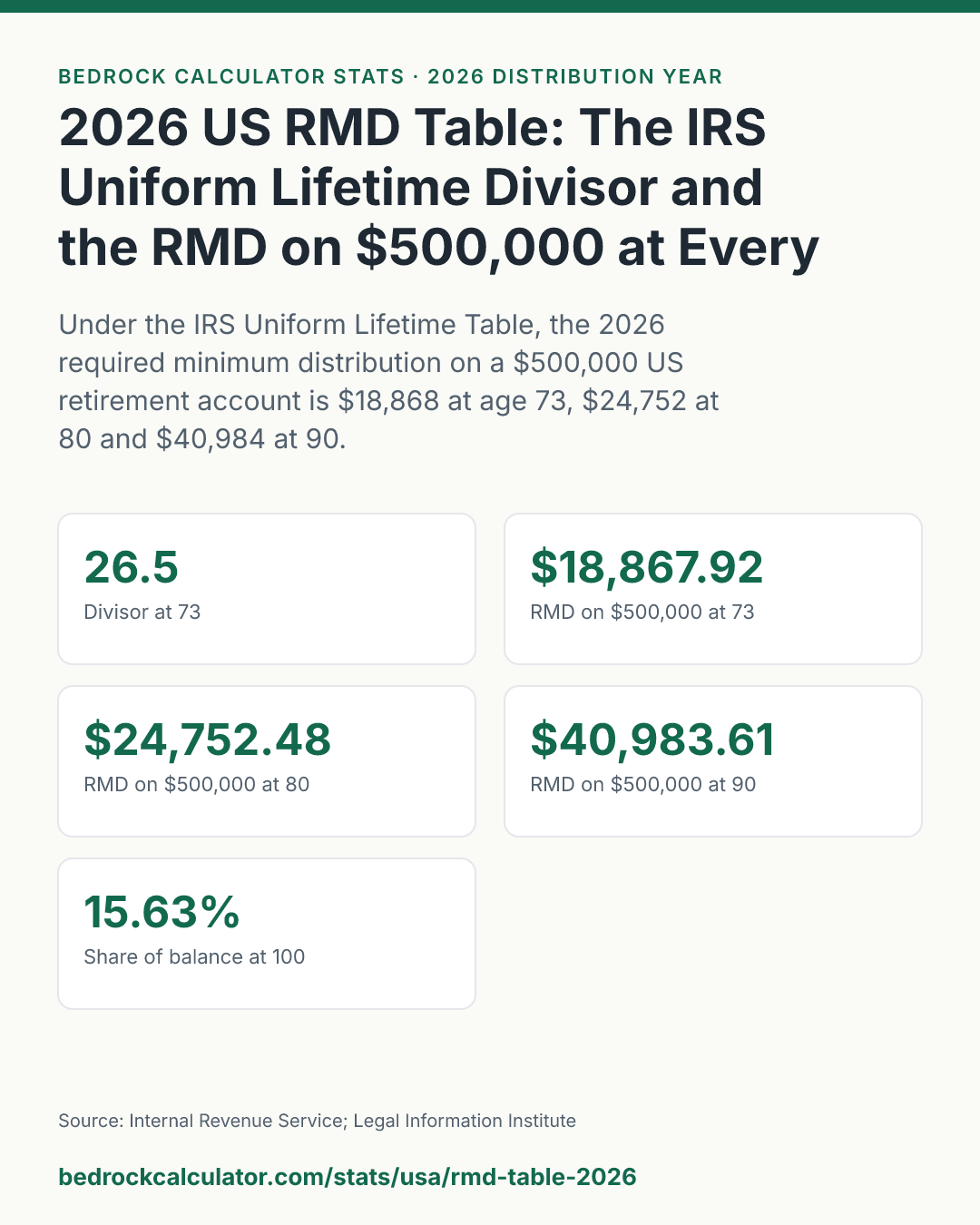
In the US, a required minimum distribution is your retirement account balance at the end of last year divided by a number from an IRS table. At 73 that number is 26.5, so a $500,000 account must pay out at least $18,867.92 in 2026, or 3.77% of the balance.
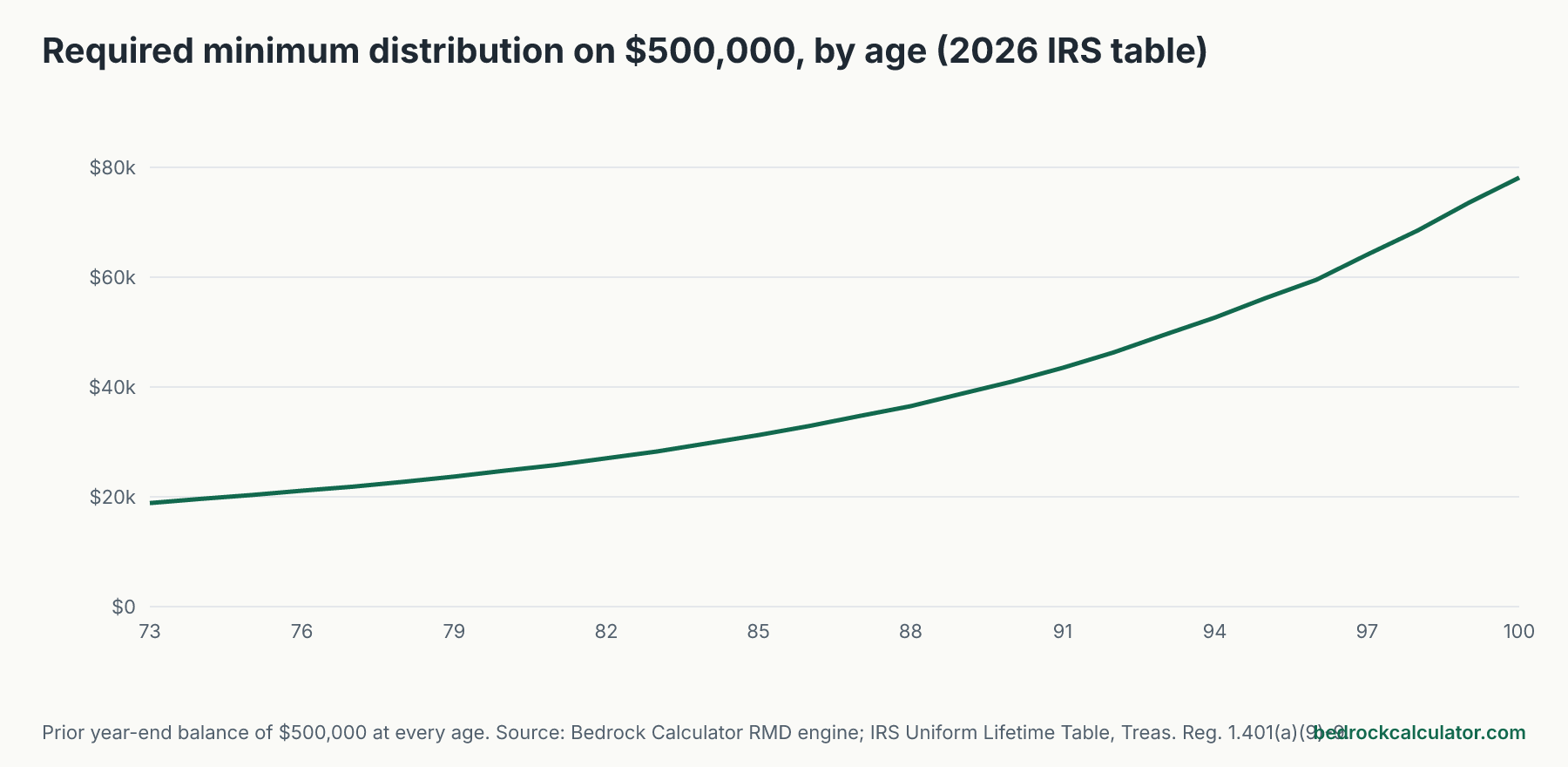
The divisor shrinks every year, so the share you must take grows. On the same $500,000 the RMD is $24,752.48 at 80, $40,983.61 at 90 and $78,125.00 at 100, by which point it's 15.63% of the account.
How we worked out these numbers
We ran the RMD calculator on this site at every age from 73 to 100 with a prior year-end balance of $500,000, and recorded the divisor and the distribution it returned. The divisors are the IRS Uniform Lifetime Table in Treasury Regulation 1.401(a)(9)-9, which has applied since 2022 and is unchanged for 2026.
Holding the balance at $500,000 at every age keeps the table easy to scale. The RMD is a straight division, so if your balance is twice as large, so is your RMD. At 75, for example, the RMD is $10,162.60 on $250,000, $20,325.20 on $500,000 and $40,650.41 on $1,000,000.
What the calculator leaves out:
- Several accounts. If you have more than one IRA, each one's RMD is worked out separately, but you can take the total from any of them. The calculator handles one balance at a time.
- The spouse exception. If your spouse is the sole beneficiary and more than ten years younger, the IRS uses a different table with longer divisors, so your RMD is smaller. That table isn't used here.
- Roth accounts. Roth IRAs, and since 2024 Roth 401(k)s, don't require distributions while the owner is alive.
- Still working. If you're still employed and don't own more than five percent of the company, you can usually delay RMDs from that employer's plan until you retire.
- Inherited accounts. Beneficiaries follow different rules, covered below.
The 2026 RMD table, age by age
Click a column heading to sort. "Share of balance" is simply one divided by the divisor.
2026 IRS Uniform Lifetime Table divisor and the RMD on $500,000, ages 73 to 100
Download CSVRMD = prior year-end balance divided by the divisor for your age at the end of 2026. Single Life Expectancy divisor shown for comparison; it applies to many inherited accounts, not to owners.
| 73 | 26.5 | $18,867.92 | $1,572.33 | 3.77% | 16.4 |
| 74 | 25.5 | $19,607.84 | $1,633.99 | 3.92% | 15.6 |
| 75 | 24.6 | $20,325.20 | $1,693.77 | 4.07% | 14.8 |
| 76 | 23.7 | $21,097.05 | $1,758.09 | 4.22% | 14.1 |
| 77 | 22.9 | $21,834.06 | $1,819.51 | 4.37% | 13.3 |
| 78 | 22 | $22,727.27 | $1,893.94 | 4.55% | 12.6 |
| 79 | 21.1 | $23,696.68 | $1,974.72 | 4.74% | 11.9 |
| 80 | 20.2 | $24,752.48 | $2,062.71 | 4.95% | 11.2 |
| 81 | 19.4 | $25,773.20 | $2,147.77 | 5.15% | 10.5 |
| 82 | 18.5 | $27,027.03 | $2,252.25 | 5.41% | 9.9 |
| 83 | 17.7 | $28,248.59 | $2,354.05 | 5.65% | 9.3 |
| 84 | 16.8 | $29,761.90 | $2,480.16 | 5.95% | 8.7 |
| 85 | 16 | $31,250.00 | $2,604.17 | 6.25% | 8.1 |
| 86 | 15.2 | $32,894.74 | $2,741.23 | 6.58% | 7.6 |
| 87 | 14.4 | $34,722.22 | $2,893.52 | 6.94% | 7.1 |
| 88 | 13.7 | $36,496.35 | $3,041.36 | 7.30% | 6.6 |
| 89 | 12.9 | $38,759.69 | $3,229.97 | 7.75% | 6.1 |
| 90 | 12.2 | $40,983.61 | $3,415.30 | 8.20% | 5.7 |
| 91 | 11.5 | $43,478.26 | $3,623.19 | 8.70% | 5.3 |
| 92 | 10.8 | $46,296.30 | $3,858.02 | 9.26% | 4.9 |
| 93 | 10.1 | $49,504.95 | $4,125.41 | 9.90% | 4.6 |
| 94 | 9.5 | $52,631.58 | $4,385.96 | 10.53% | 4.3 |
| 95 | 8.9 | $56,179.78 | $4,681.65 | 11.24% | 4 |
| 96 | 8.4 | $59,523.81 | $4,960.32 | 11.90% | 3.7 |
| 97 | 7.8 | $64,102.56 | $5,341.88 | 12.82% | 3.4 |
| 98 | 7.3 | $68,493.15 | $5,707.76 | 13.70% | 3.2 |
| 99 | 6.8 | $73,529.41 | $6,127.45 | 14.71% | 3 |
| 100 | 6.4 | $78,125.00 | $6,510.42 | 15.63% | 2.8 |
A few patterns worth knowing:
- In the first years the share is modest: 3.77% at 73 and 4.07% at 75.
- It reaches 6.25% at 85, and the RMD first exceeds 10% of the balance at 94.
- The monthly figure is just the annual RMD divided by twelve. On $500,000 it's $1,572.33 at 73 and $3,415.30 at 90. You can take it monthly, quarterly or as one lump sum, as long as the full amount is out by December 31.
When do RMDs start?
For anyone born from 1951 through 1959, RMDs start in the year you turn 73, which is why this table begins there. People born in 1960 or later start at 75 under the SECURE 2.0 Act.
Your first RMD can be delayed until April 1 of the following year, but the second one is still due by December 31 of that same year. Taking two in one year can push you into a higher tax bracket and, two years later, raise your Medicare premiums.
Will RMDs drain your account?
Not at the rates the table sets. The divisors are built from life expectancy, so in the early years the required withdrawal is often less than a balanced portfolio earns.
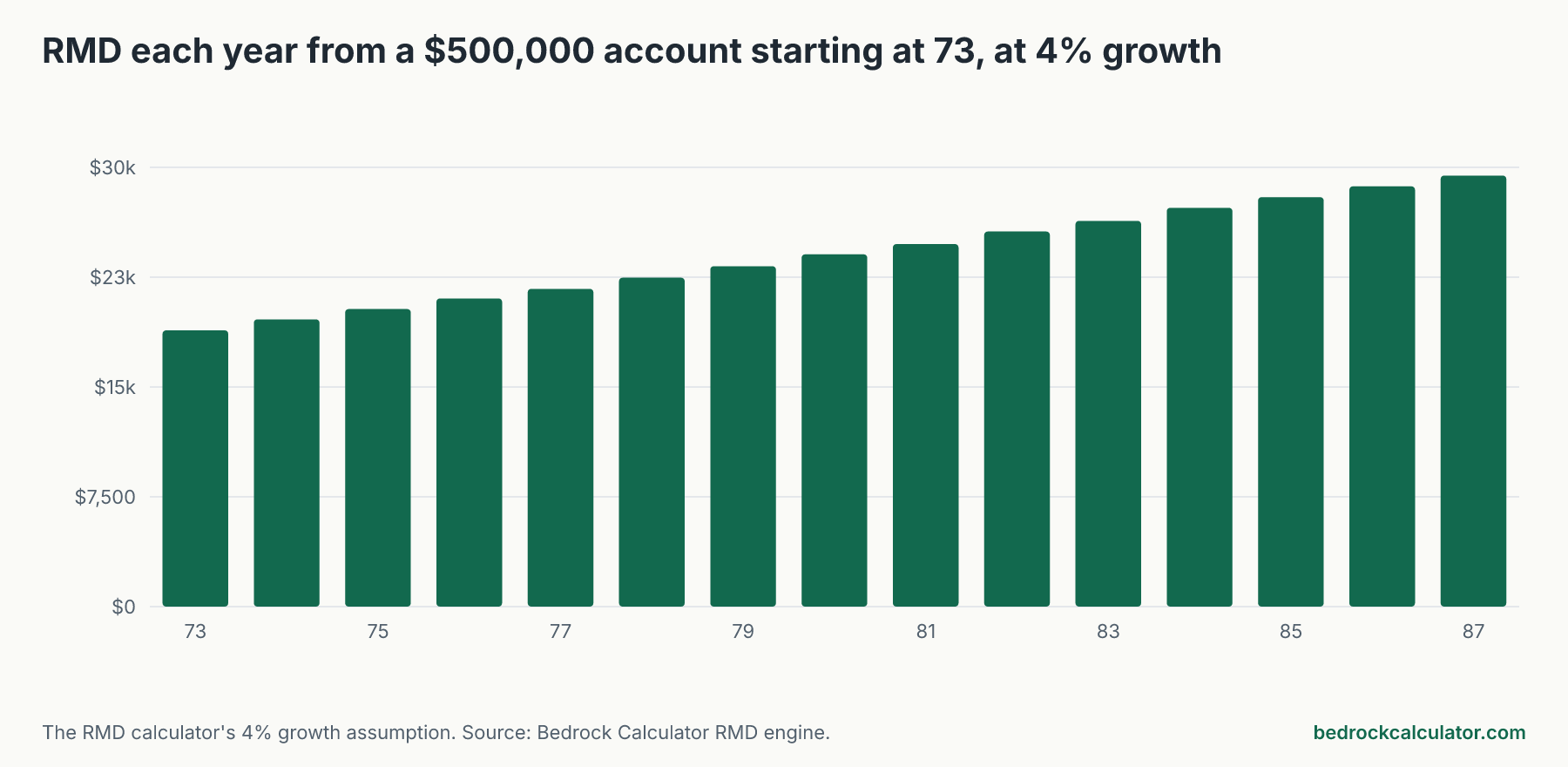
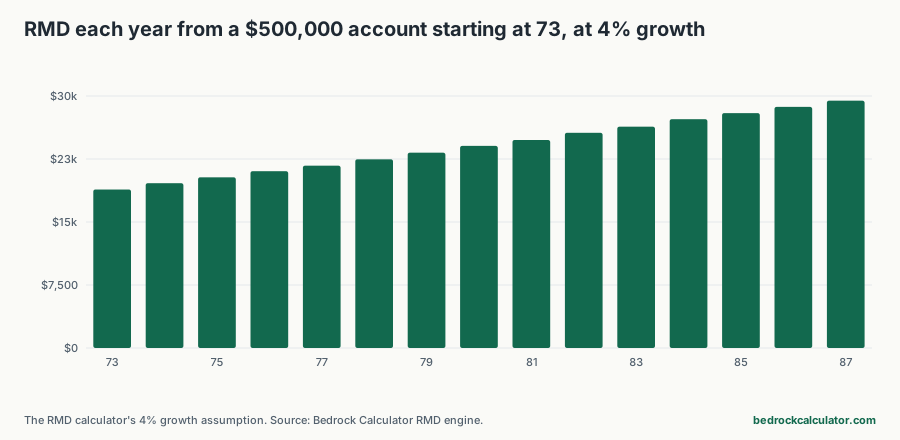
The RMD calculator projects this forward with an assumed return of 4% a year. Starting at 73 with $500,000:
RMDs from $500,000 starting at 73, if the account earns 4% a year
Download CSVThe RMD calculator's own projection: each year the RMD is taken, then the remainder grows 4%. Real returns vary.
| 73 | $18,867.92 | $500,377.36 |
| 74 | $19,622.64 | $499,984.91 |
| 75 | $20,324.59 | $498,846.73 |
| 76 | $21,048.39 | $496,910.28 |
| 77 | $21,699.14 | $494,219.58 |
| 78 | $22,464.53 | $490,625.26 |
| 79 | $23,252.38 | $486,067.79 |
| 80 | $24,062.76 | $480,485.23 |
| 81 | $24,767.28 | $473,946.67 |
| 82 | $25,618.74 | $466,261.05 |
| 83 | $26,342.43 | $457,515.36 |
| 84 | $27,233.06 | $447,493.60 |
| 85 | $27,968.35 | $436,306.26 |
| 86 | $28,704.36 | $423,905.97 |
| 87 | $29,437.91 | $410,246.78 |
Over 15 years you'd take out $361,414.48 in total, the yearly RMD would climb to $29,437.91 at 87, and the account would still hold $410,246.78. The balance barely moves for the first few years because growth roughly matches the withdrawals. Real returns won't be a steady 4%, so treat this as a shape rather than a forecast.
RMDs for beneficiaries use a different IRS table
If you inherited an IRA or 401(k) and must take yearly distributions, you generally use the IRS Single Life Expectancy Table, not the Uniform Lifetime Table. Its divisors are much shorter at the same age: 11.2 at 80, against 20.2 for an owner. We've included it in the main table for comparison.
Most non-spouse beneficiaries who inherited after 2019 also face the 10-year rule, which requires the account to be emptied by the end of the tenth year after the owner's death. The inherited IRA calculator and the 10-year rule calculator handle those cases.
What to do with this
Your RMD is taxed as ordinary income, so the size of it matters for your bracket. If your RMDs look likely to push you into a higher bracket later, converting part of a Traditional IRA to a Roth in the years before 73 can shrink them. The Roth conversion ladder calculator helps size those conversions, and the 2026 federal tax brackets guide shows where each bracket ends.
To work out your own RMD, enter your December 31, 2025 balance and your age at the end of 2026 in the RMD calculator.