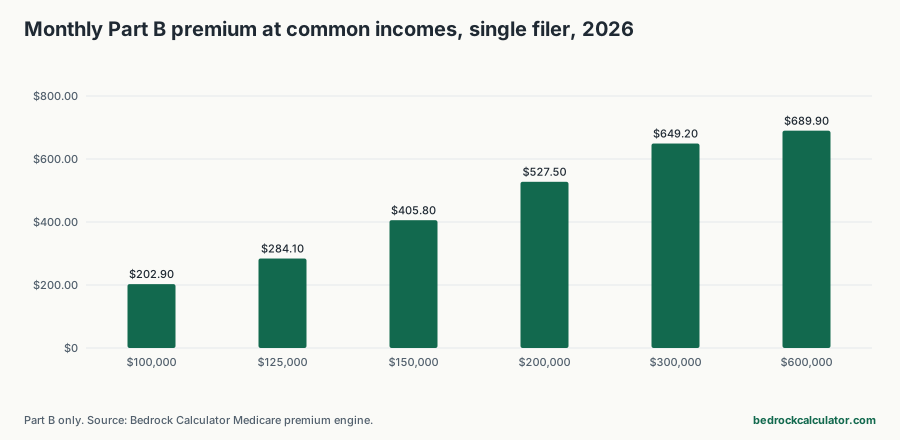
How much do Medicare Part B and Part D cost at each income in 2026?
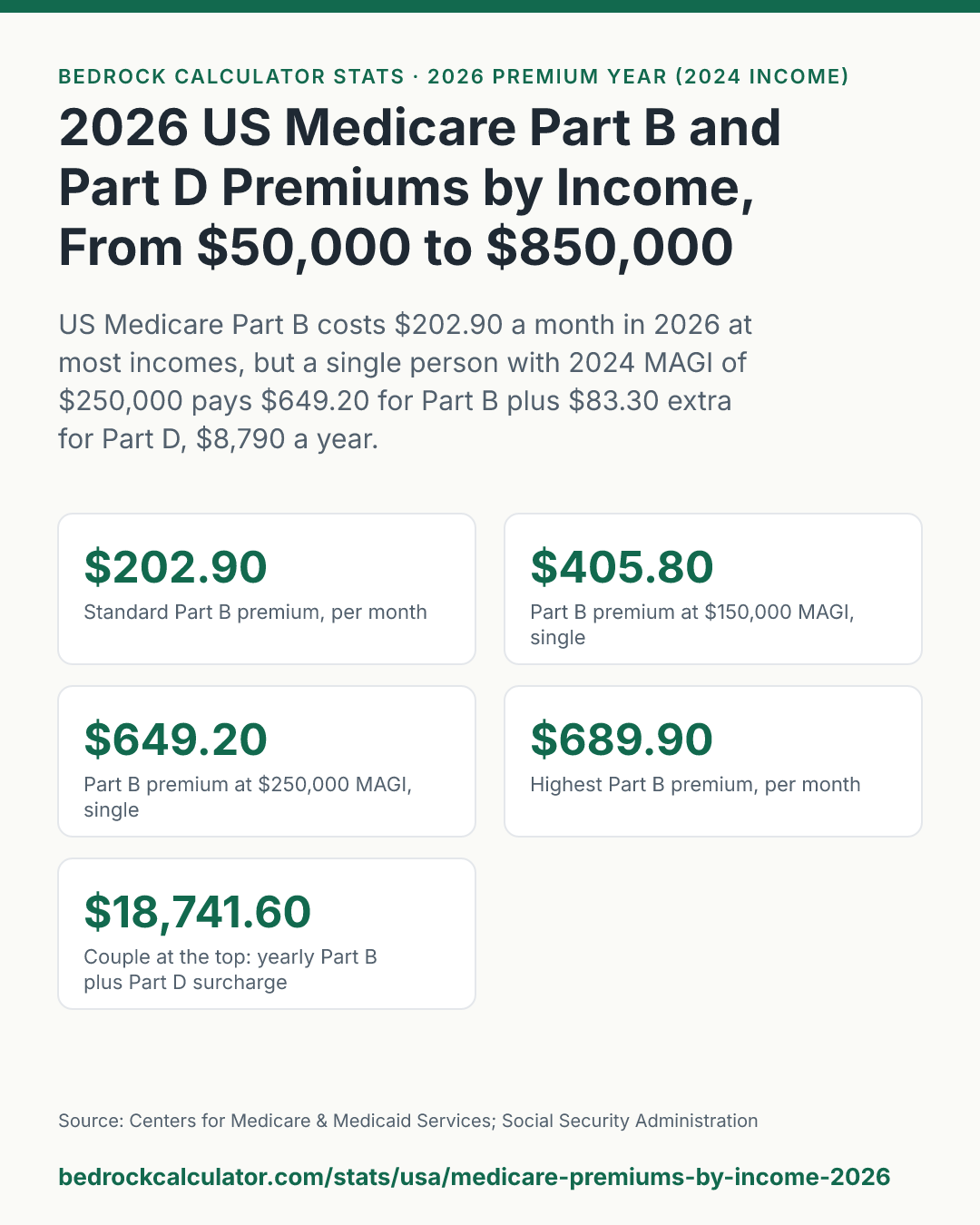
The standard US Medicare Part B premium in 2026 is $202.90 a month, which is $2,434.80 a year. That's what you pay if your 2024 income was under the first threshold. Above it, Part B rises in steps and Medicare adds a surcharge to your Part D drug plan.
A single person with 2024 MAGI of $150,000 pays $405.80 a month for Part B and $37.50 extra on Part D, $5,319.60 a year. At $250,000 it's $8,790.00. A married couple on $300,000 who are both enrolled pays $10,639.20 between them.
How we worked out these numbers
We ran the Medicare Part B premium calculator on this site at 33 income levels, in $25,000 steps from $50,000 to $850,000, twice at each: once for a single filer with one person on Medicare, once for a married couple filing jointly with both spouses enrolled. The figures come from the CMS 2026 premium and IRMAA tables held in the site's engine.
The "yearly cost" columns add up twelve months of the Part B premium and twelve months of the Part D income surcharge. Here's what they don't include:
- Your Part D plan premium. Each drug plan or Medicare Advantage plan sets its own premium, and it varies by insurer and region. The surcharge Medicare adds for higher earners is billed on top of it.
- Deductibles, coinsurance and Medigap. None of these depend on income, and none are counted here.
- Late enrollment penalties for Part B or Part D.
- The hold-harmless rule, which can limit Part B increases for some people whose premium is deducted from a Social Security check. It generally doesn't apply to anyone paying an income surcharge.
Medicare premiums at every income level
Click a column heading to sort. "Couple" means a joint return with the MAGI shown as the couple's combined income.
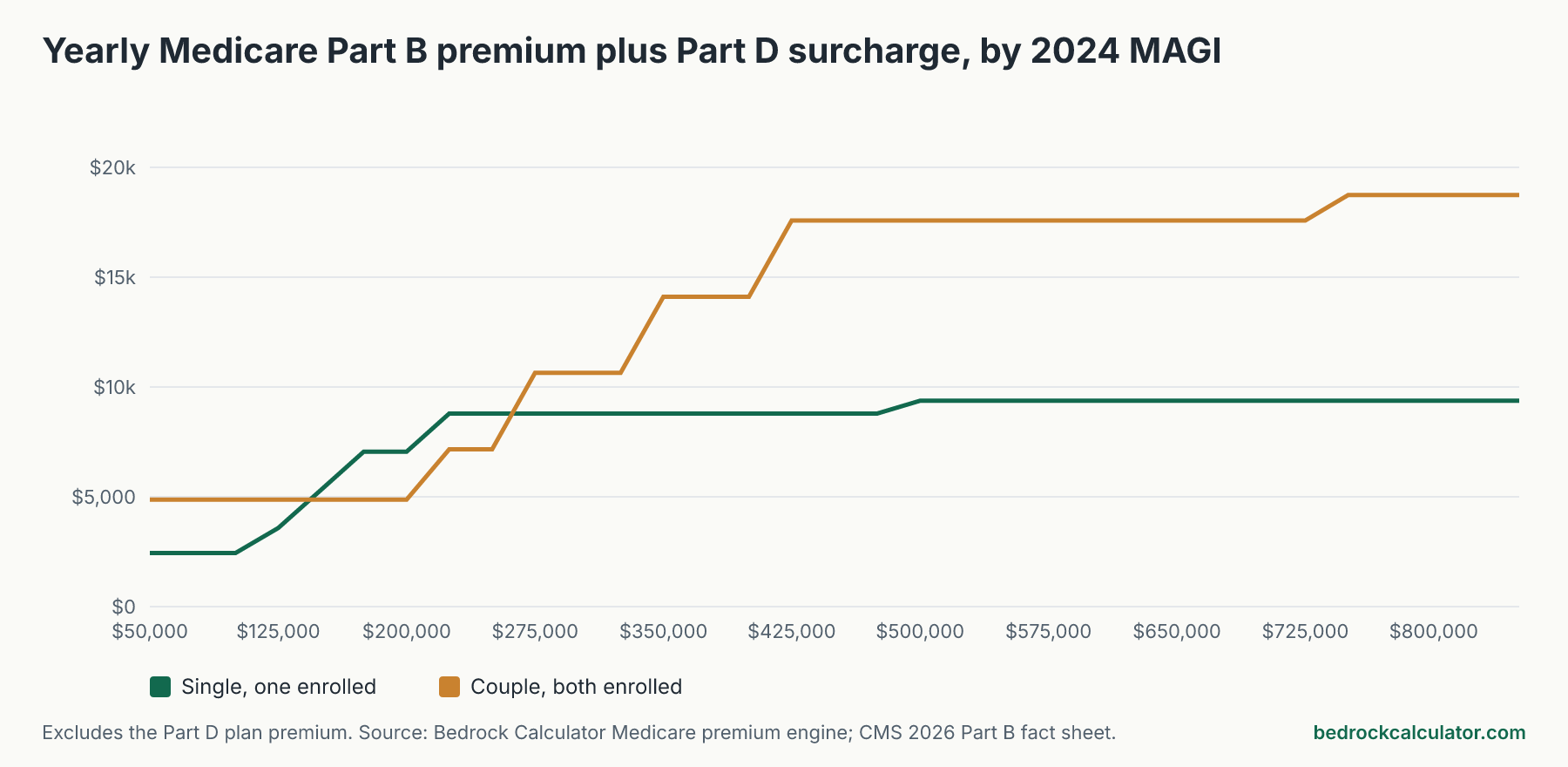
Notice how long each figure stays flat. A single filer pays the same $649.20 for Part B at $250,000 as at $400,000. The premium only changes when income crosses one of the IRMAA thresholds, and between thresholds an extra dollar costs nothing.
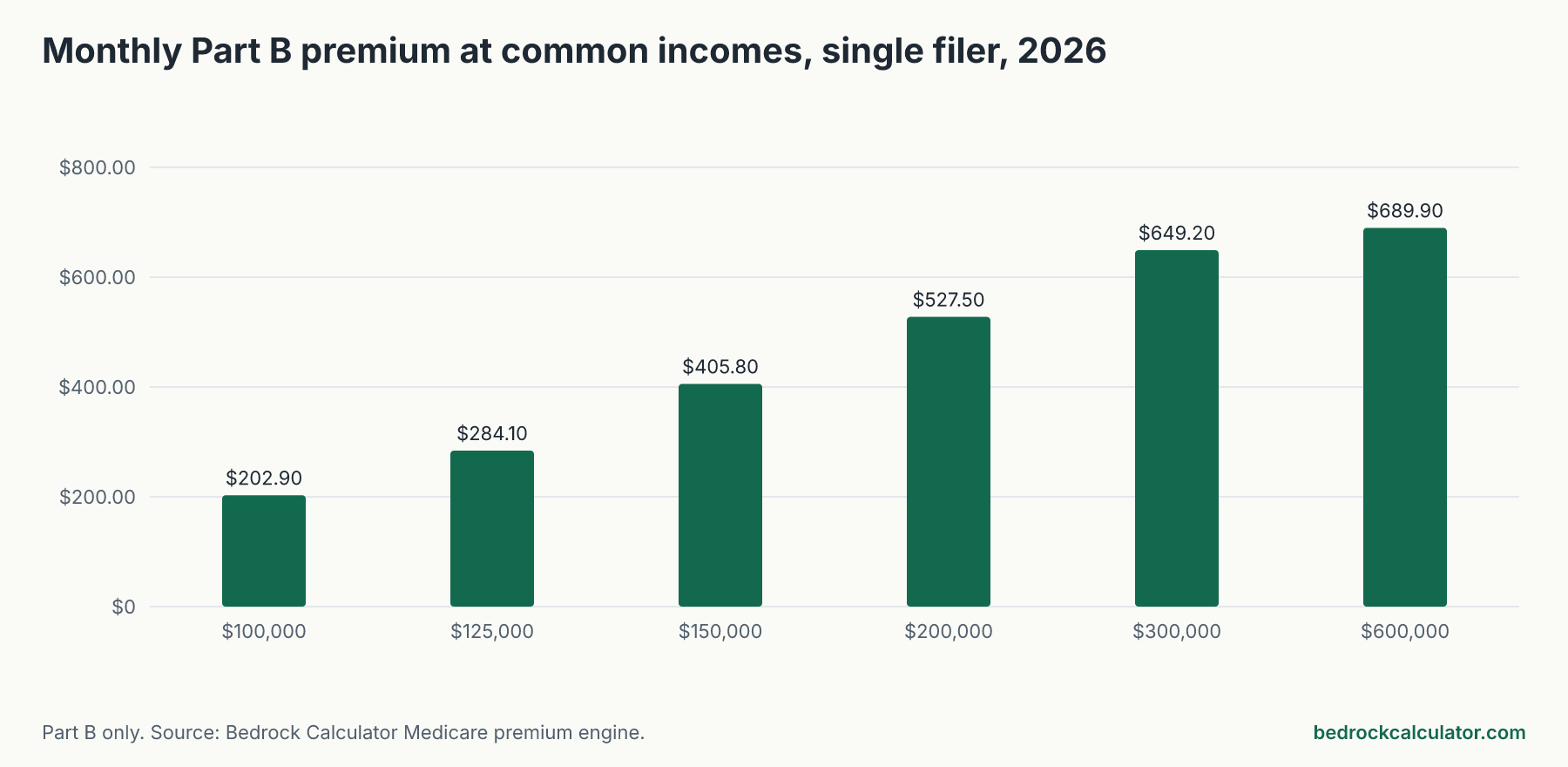
How much is Medicare Part B at $100,000, $150,000 and $200,000?
- $100,000 single: $202.90 a month, the standard premium
- $125,000 single: $284.10 a month, plus $14.50 on Part D
- $150,000 single: $405.80 a month, plus $37.50 on Part D
- $200,000 single: $527.50 a month, plus $60.40 on Part D
- $600,000 single: $689.90 a month, plus $91.00 on Part D
For a married couple, those same incomes look very different. At $150,000 or $200,000 joint, each spouse pays only the standard $202.90, because the joint thresholds are twice the single ones. A couple doesn't pay any surcharge until their joint MAGI passes $218,000.
What married couples pay for Medicare
The joint thresholds are double, but so is the bill, because each spouse who's enrolled pays the premium and the surcharge separately. That makes the household cost climb faster once it starts:
- $250,000 joint: $284.10 each for Part B, $7,166.40 a year for the household
- $300,000 joint: $405.80 each, $10,639.20 a year
- $400,000 joint: $527.50 each, $14,109.60 a year
- $800,000 joint: $689.90 each, $18,741.60 a year
At the top, the household pays $13,872.00 a year in surcharges alone, on top of the $4,869.60 that any couple pays for standard Part B.
Can a Roth conversion raise your Medicare premium?
Yes, and by more than you might expect, because of the cliffs. Take a single person whose 2024 MAGI is $108,000, just under the first threshold, who adds a $1,500 Roth conversion. Their premiums two years later go up by $1,148.40, which is 76.6% of the amount converted.
A married couple at $217,000 joint who convert the same $1,500 pays $2,296.80 more, 153.1% of the conversion, since both spouses cross the threshold together. The same conversion at $95,000 single costs $0.00, because it doesn't reach the threshold.
The lesson isn't to avoid conversions. It's to size them to the room left in your current tier. The Medicare IRMAA calculator shows that headroom for any MAGI.
Which year's income sets your 2026 premium
Medicare uses your tax return from two years earlier, so 2026 premiums are based on 2024 MAGI. MAGI for this purpose is adjusted gross income plus tax-exempt interest, so municipal bond income counts even though it isn't taxed.
If your income has dropped since 2024 because you retired, lost a pension, divorced or lost a spouse, you can ask Social Security to use a more recent year with Form SSA-44. The IRMAA appeal calculator works out what that would save. If you're retiring before 65 and need cover until Medicare starts, the early retirement health insurance calculator prices the gap years.
For the tier-by-tier thresholds and what each one costs to cross, see our 2026 IRMAA brackets page. For the payroll tax that funds Medicare while you're working, see the 2026 Social Security and Medicare tax guide.