How much can you contribute to a 401(k), IRA or HSA in 2026?
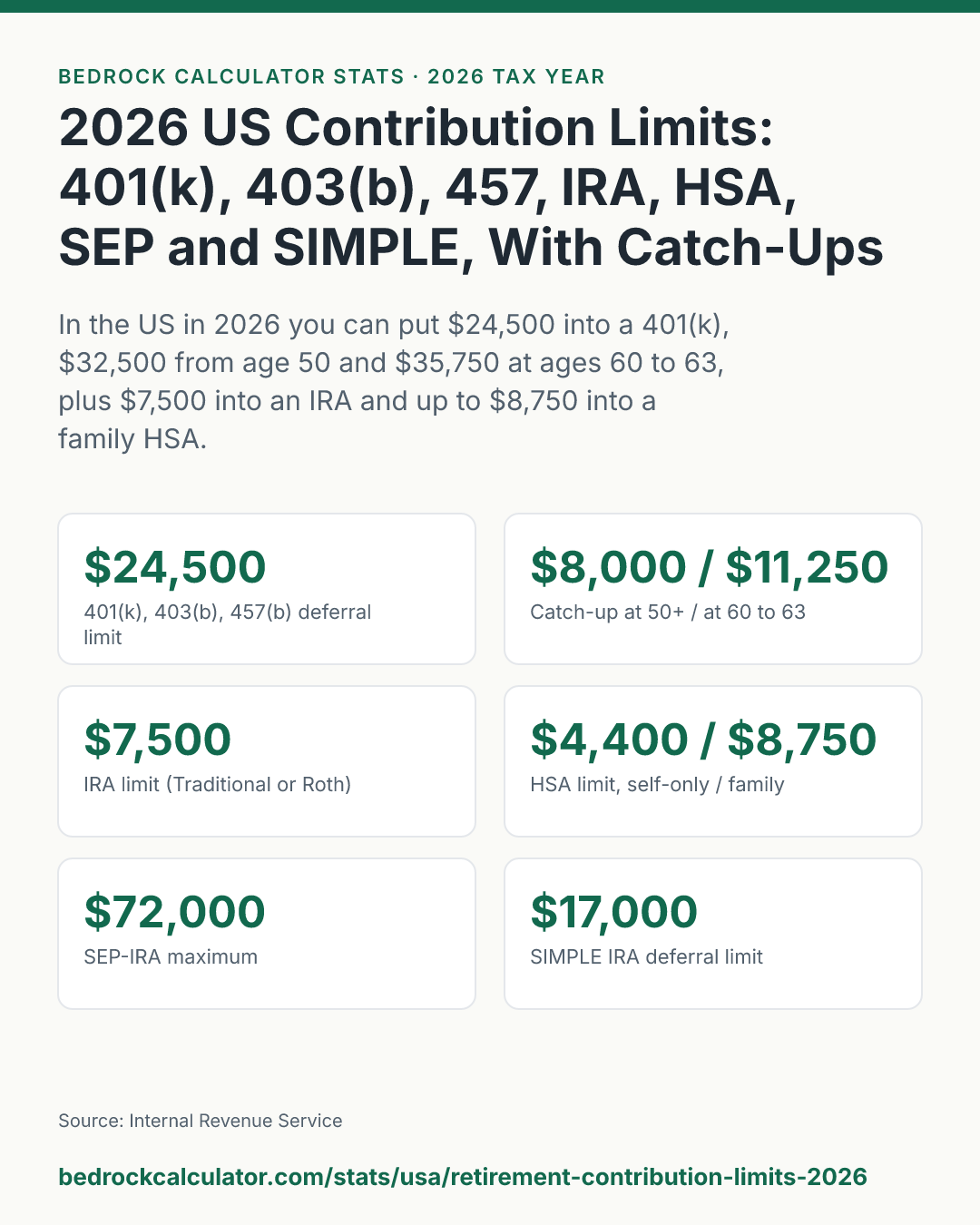
The 2026 IRS limit for your own contributions to a US 401(k), 403(b) or governmental 457(b) is $24,500. From age 50 it's $32,500, and in the years you turn 60 through 63 it's $35,750. An IRA takes $7,500, or $8,600 from 50. An HSA takes $4,400 with self-only coverage or $8,750 with family coverage.
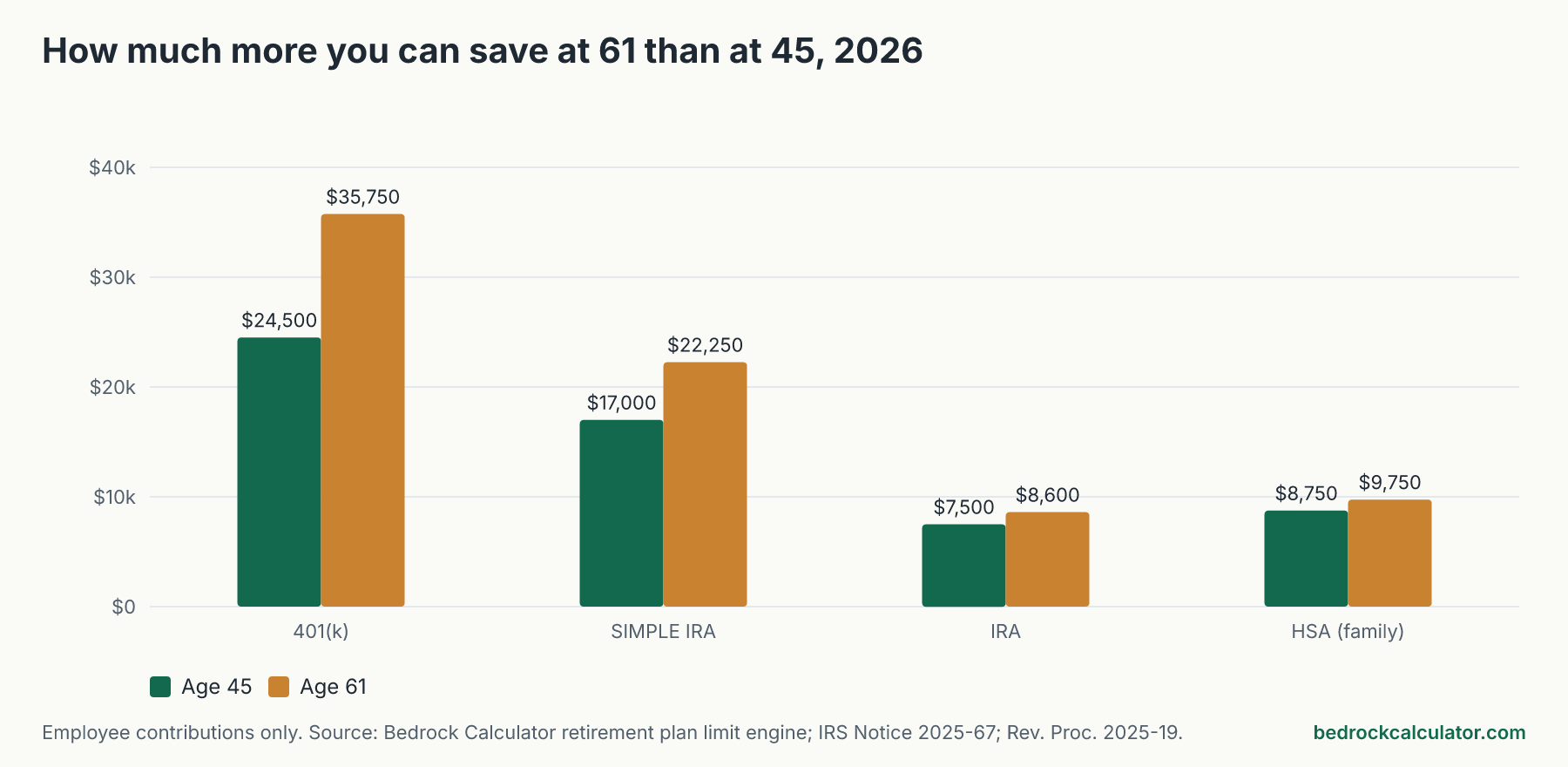
Put the three together and a 45-year-old with a 401(k), an IRA and a family HSA can shelter $40,750 of their own money this year. At 61 the same three accounts take $54,100.
How we put this table together
Every limit on this page is read from the site's own engine, not typed in. Most come from the shared plan-limit constants that the calculators use, and the rest come from running the calculators themselves. For example, the 403(b), 457(b) and HSA limits are what the 403(b), 457(b) and HSA calculators return when you ask for more than the law allows at a given age.
Two things are deliberately missing:
- Roth IRA income limits. The income ranges where your right to contribute to a Roth IRA phases out aren't built into any calculator on this site yet. We'd rather leave them off than type them in unchecked, so look them up in IRS Notice 2025-67 before you contribute if your income is high.
- The 457(b) final-three-years catch-up. Its size depends on how much deferral room you left unused in earlier years, which only your plan can work out.
One more note if you use the 401(k) calculator: it caps your contribution at the under-50 limit of $24,500 and doesn't add a catch-up, so people 50 and over should run it with that in mind.
2026 contribution limits by account and age
The table shows the most a person can put in from their own pay at five sample ages. Employer matches and profit-sharing come on top where a plan allows them.
2026 contribution limits by account and age
Download CSVMost a person can put in from their own pay, at each sample age. Employer contributions are on top where a plan allows them. Catch-ups for 401(k)-type plans start at 50, with a larger one at 60 to 63; the HSA catch-up starts at 55.
| 401(k) employee deferral | $24,500 | $32,500 | $32,500 | $35,750 | $32,500 |
| 403(b) employee deferral | $24,500 | $32,500 | $32,500 | $35,750 | $32,500 |
| Governmental 457(b) deferral | $24,500 | $32,500 | $32,500 | $35,750 | $32,500 |
| HSA, family coverage | $8,750 | $8,750 | $9,750 | $9,750 | $9,750 |
| HSA, self-only coverage | $4,400 | $4,400 | $5,400 | $5,400 | $5,400 |
| SIMPLE IRA deferral | $17,000 | $21,000 | $21,000 | $22,250 | $21,000 |
| SIMPLE IRA deferral, higher-limit plan | $18,100 | $22,100 | $22,100 | $23,350 | $22,100 |
| Solo 401(k) employee deferral | $24,500 | $32,500 | $32,500 | $35,750 | $32,500 |
| Traditional or Roth IRA | $7,500 | $8,600 | $8,600 | $8,600 | $8,600 |
Read down the age columns and the catch-up rules become clear:
- 401(k), 403(b), 457(b) and Solo 401(k): $24,500 under 50, plus $8,000 from 50. In the years you turn 60, 61, 62 and 63 the catch-up rises to $11,250, then drops back at 64. That's why the age 65 column is lower than the age 61 one.
- SIMPLE IRA: $17,000, or $18,100 in a plan that uses the higher limit for small employers. The catch-up is $4,000 from 50 and $5,250 at 60 to 63.
- IRA: $7,500, plus $1,100 from 50. There's no extra catch-up at 60 to 63. This is one limit across all your Traditional and Roth IRAs together.
- HSA: $4,400 self-only or $8,750 family. The HSA catch-up starts at 55, not 50, and adds $1,000.
The 2026 401(k) limit with the age 60 to 63 catch-up
The bigger catch-up for people aged 60 to 63 came in with the SECURE 2.0 Act. It replaces the regular catch-up for those four years rather than adding to it, so someone who turns 61 in 2026 can defer $35,750 into a 401(k), 403(b) or governmental 457(b), against $32,500 for someone who's 57 or 65.
There's also a total cap on what goes into a 401(k) or 403(b) from all sources, you and your employer combined, of $72,000 before catch-ups. Most people never come close, but it matters for high earners with generous employer contributions and for the self-employed.
Other 2026 retirement plan limits
Download CSV| 403(b) 15-years-of-service catch-up, lifetime | $15,000 |
| 403(b) 15-years-of-service catch-up, per year | $3,000 |
| Age 50+ catch-up, 401(k), 403(b), 457(b) | $8,000 |
| Age 50+ catch-up, IRA | $1,100 |
| Age 50+ catch-up, SIMPLE IRA | $4,000 |
| Age 60 to 63 catch-up, 401(k), 403(b), 457(b) | $11,250 |
| Age 60 to 63 catch-up, SIMPLE IRA | $5,250 |
| Compensation that can be counted for employer contributions | $360,000 |
| SEP-IRA maximum contribution | $72,000 |
| Total annual additions to a 401(k), 403(b) or Solo 401(k), employee plus employer, before catch-ups | $72,000 |
403(b) plans have one extra option. If you've worked 15 years or more for the same school, hospital or other qualifying employer, you may be able to add up to $3,000 a year, with a lifetime cap of $15,000, on top of the age catch-up. Whether you qualify depends on how much you've contributed before; the 403(b) calculator runs the three tests.
Can you deduct a Traditional IRA if you have a 401(k)?
Anyone with earned income can contribute to a Traditional IRA. Whether you can deduct it depends on your income and on whether you or your spouse are covered by a retirement plan at work.
Traditional IRA deduction phase-out ranges, 2026 (modified AGI)
Download CSVFull deduction at or below the first figure, none at or above the second. Worked out by running the traditional IRA deduction calculator in $1,000 steps on a $7,500 contribution.
| Married filing jointly, only your spouse is covered | $242,000 | $252,000 |
| Married filing jointly, you are covered | $129,000 | $149,000 |
| Single or head of household, covered by a workplace plan | $81,000 | $91,000 |
If neither of you is covered at work, there's no income limit on the deduction. If you're covered, a single filer gets the full deduction up to $81,000 of modified AGI and none from $91,000. For a married couple where you're covered, the range is $129,000 to $149,000. If only your spouse is covered, it's $242,000 to $252,000.
We found those ranges by running the Traditional IRA deduction calculator at every $1,000 of income and noting where the deduction starts to shrink and where it hits zero.
SEP-IRA vs Solo 401(k) vs SIMPLE for the self-employed
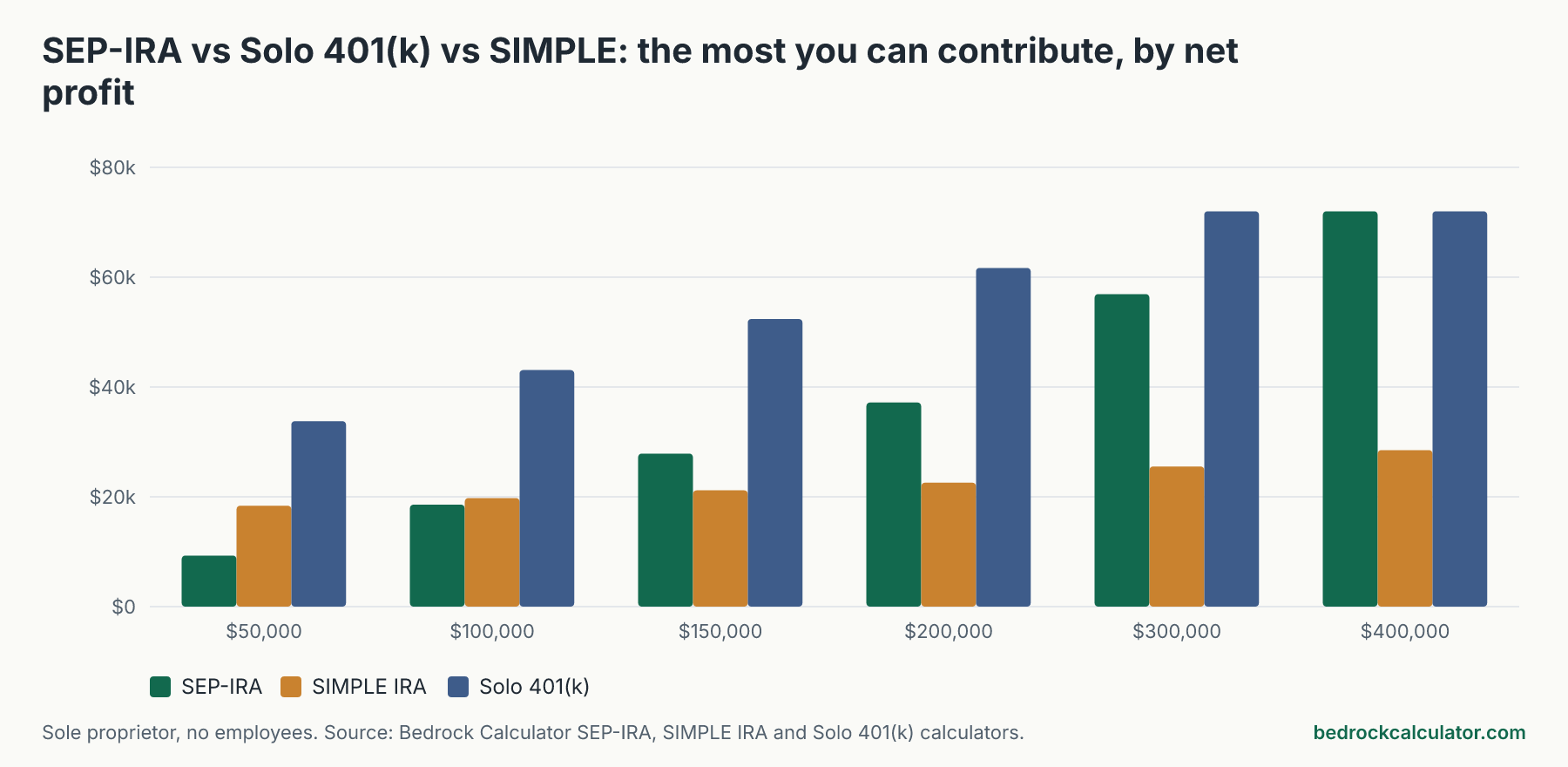
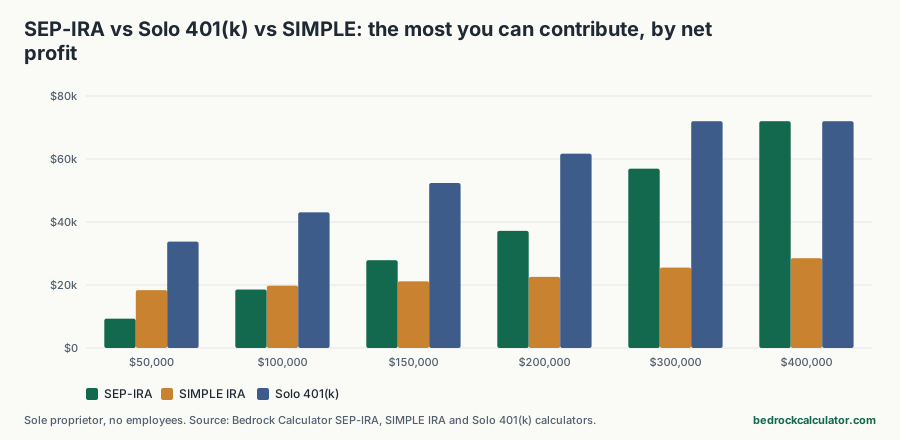
If you work for yourself with no employees, you choose the plan, and the choice changes how much you can save. Here's the most each one allows at different levels of net profit, from the site's SEP-IRA, SIMPLE IRA and Solo 401(k) calculators.
Most a self-employed person can contribute in 2026, by net profit
Download CSVSole proprietor with no employees, Schedule C net profit before the contribution. Solo 401(k) is the full employee deferral plus the 20% employer share. SIMPLE uses the 3% match.
| $50,000 | $9,293.52 | $18,394.03 | $33,793.52 | $45,043.52 |
| $100,000 | $18,587.04 | $19,788.06 | $43,087.04 | $54,337.04 |
| $150,000 | $27,880.57 | $21,182.08 | $52,380.57 | $63,630.57 |
| $200,000 | $37,176.57 | $22,576.49 | $61,676.57 | $72,926.57 |
| $300,000 | $56,908.75 | $25,536.31 | $72,000.00 | $83,250.00 |
| $400,000 | $72,000.00 | $28,496.14 | $72,000.00 | $83,250.00 |
The SEP is simple but limited at modest incomes: on $50,000 of profit it allows $9,293.52. The Solo 401(k) allows the same employer share plus a full employee deferral, so on the same profit it allows $33,793.52. The gap stays at $24,500.00 through $200,000 of profit, then narrows as both plans run into the $72,000 cap. By $400,000 the SEP reaches the cap too and the two are level for anyone under 50.
At 61 the Solo 401(k) pulls ahead again, because the catch-up sits outside the cap: $83,250.00 at $400,000 against $72,000.00 for a SEP. The SIMPLE IRA comes out ahead of the SEP at low profits, $18,394.03 at $50,000, but it falls well behind both once profit passes $100,000.
These figures are for a sole proprietor with no staff. A SEP must give every eligible employee the same percentage of pay as the owner, and a 401(k) with employees stops being "solo", so neither figure holds for a business that has staff.
Getting your own number
The limits above are ceilings, and the right amount for you depends on your income, your tax bracket and what your employer adds. The 401(k) calculator projects your balance with your employer match, the Roth IRA calculator shows what tax-free growth adds up to, and the HSA investment calculator compares an invested HSA with a taxable account.
If you're deciding whether to make pre-tax or Roth contributions, the tax rate you save at today matters. Our 2026 federal tax brackets guide and the marginal vs effective tax rate guide show which rate a deduction actually saves you.