How much tax is due on crypto gains in each US bracket?
In the US, crypto gains are taxed like gains on any other property, so the bill depends on how long you held the coin and how much other income you have.
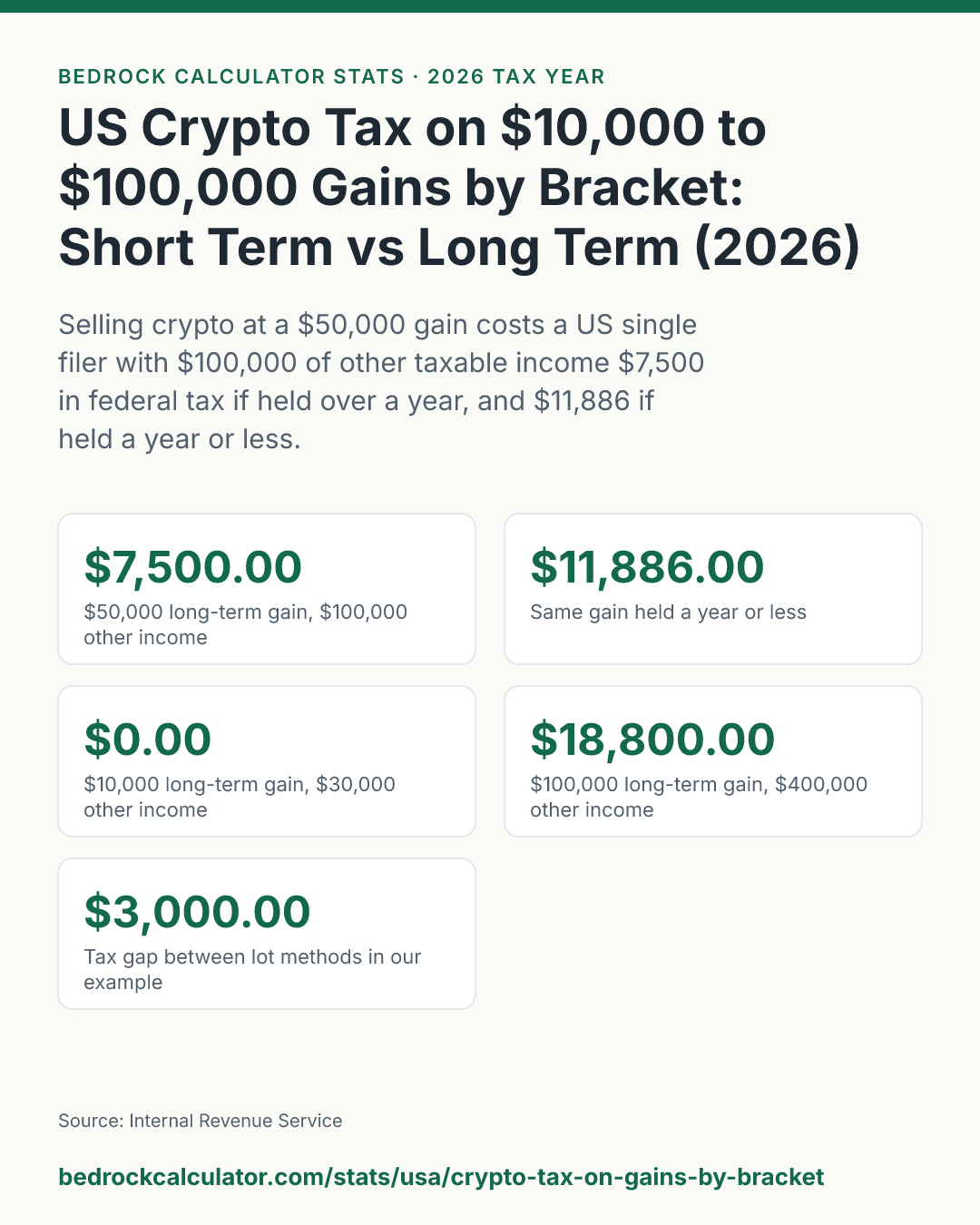
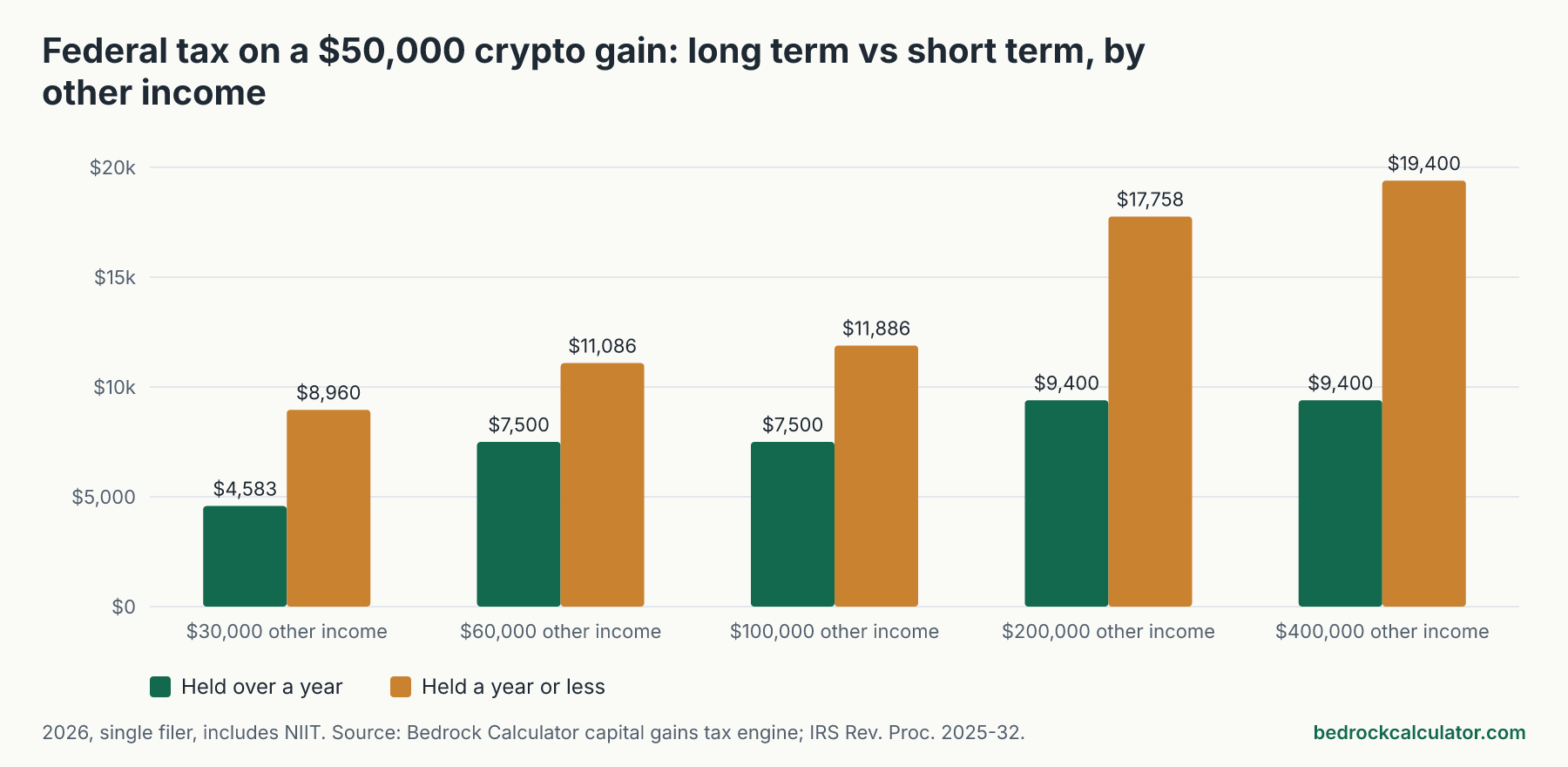
A single filer with $100,000 of other taxable income owes $1,500.00 in federal tax on a $10,000 gain held over a year and $2,286.00 on the same gain held a year or less. On a $50,000 gain it's $7,500.00 against $11,886.00.
At low incomes a long-term gain can be taxed very lightly. With $30,000 of other taxable income, a $10,000 long-term gain costs $0.00. At high incomes the gap between short and long term gets wide: with $400,000 of other income, holding a $100,000 gain past the one-year mark saves $20,000.00.
How the IRS taxes crypto
The IRS says digital assets are property, not currency. Selling a coin for dollars, swapping it for another coin, or spending it on something are all disposals, and each one can produce a gain or a loss: what you got for it minus what you paid.
- Held more than a year: a long-term gain, taxed at the capital gains rates. Those rates are lower than ordinary rates, and they depend on your total taxable income with the gain included.
- Held a year or less: a short-term gain, added to your other income and taxed at ordinary income rates.
- High earners can also owe the Net Investment Income Tax on the gain.
Crypto you receive from mining, staking or airdrops is a different matter. It's ordinary income when you receive it, and this page doesn't cover it.
How we worked out these numbers
We ran the capital gains tax calculator on this site for gains of $10,000, $25,000, $50,000 and $100,000, for a single filer with five levels of other taxable income, once as long term and once as short term. Other taxable income means income after deductions, before the gain. If you take the standard deduction, your gross income is that much higher.
The calculator stacks the gain on top of your other income, taxes each slice at the rate for the band it falls in, and adds the Net Investment Income Tax where it applies. It uses the 2026 federal brackets.
Every gain and income level
Sort by any column. The last column is how much holding over a year saves.
Federal tax on a crypto gain by size, holding period and other income (US, 2026, single)
Download CSVOther taxable income is income after deductions, before the gain. Includes the Net Investment Income Tax. No state tax.
| $30,000 | $10,000 | $0.00 | $1,200.00 | $1,200.00 |
| $30,000 | $25,000 | $832.50 | $3,460.00 | $2,627.50 |
| $30,000 | $50,000 | $4,582.50 | $8,960.00 | $4,377.50 |
| $30,000 | $100,000 | $12,082.50 | $20,446.00 | $8,363.50 |
| $60,000 | $10,000 | $1,500.00 | $2,200.00 | $700.00 |
| $60,000 | $25,000 | $3,750.00 | $5,500.00 | $1,750.00 |
| $60,000 | $50,000 | $7,500.00 | $11,086.00 | $3,586.00 |
| $60,000 | $100,000 | $15,000.00 | $23,086.00 | $8,086.00 |
| $100,000 | $10,000 | $1,500.00 | $2,286.00 | $786.00 |
| $100,000 | $25,000 | $3,750.00 | $5,886.00 | $2,136.00 |
| $100,000 | $50,000 | $7,500.00 | $11,886.00 | $4,386.00 |
| $100,000 | $100,000 | $15,000.00 | $23,886.00 | $8,886.00 |
| $200,000 | $10,000 | $1,880.00 | $3,438.00 | $1,558.00 |
| $200,000 | $25,000 | $4,700.00 | $8,808.00 | $4,108.00 |
| $200,000 | $50,000 | $9,400.00 | $17,758.00 | $8,358.00 |
| $200,000 | $100,000 | $18,800.00 | $36,971.25 | $18,171.25 |
| $400,000 | $10,000 | $1,880.00 | $3,880.00 | $2,000.00 |
| $400,000 | $25,000 | $4,700.00 | $9,700.00 | $5,000.00 |
| $400,000 | $50,000 | $9,400.00 | $19,400.00 | $10,000.00 |
| $400,000 | $100,000 | $18,800.00 | $38,800.00 | $20,000.00 |
Why the same gain is taxed so differently
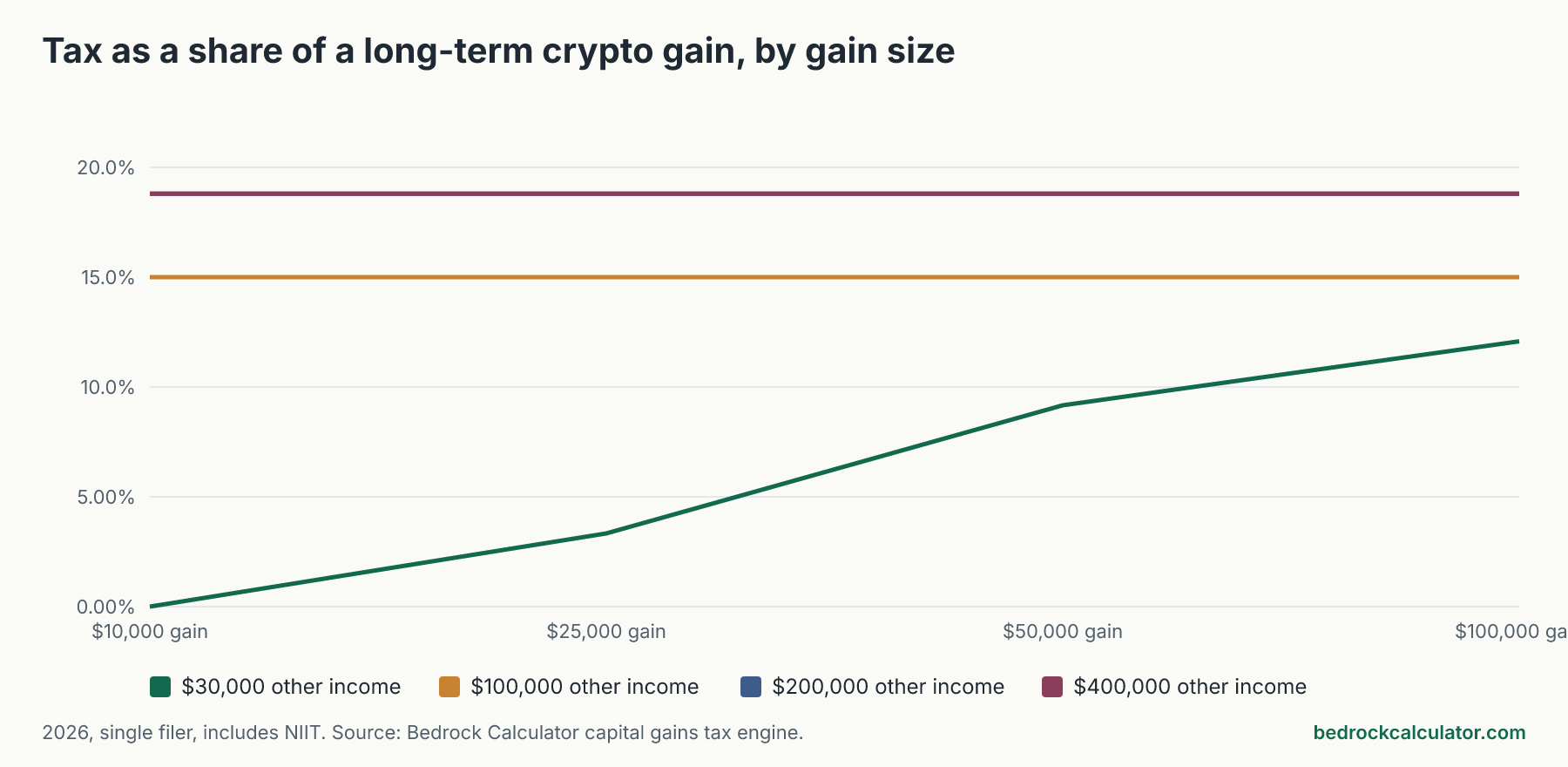
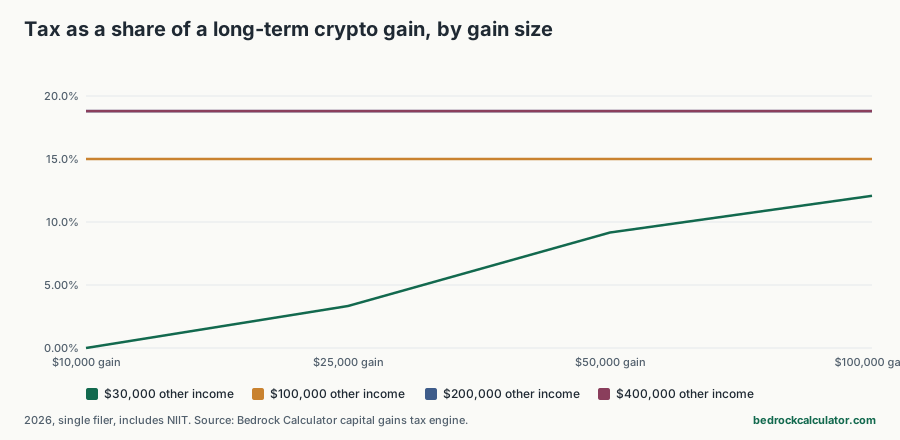
Look across a row and the share of the gain going to tax barely moves at middle incomes. With $60,000 or $100,000 of other taxable income, long-term gains are taxed at a flat 15.0% of the gain in our runs, because the whole gain lands in one band.
At the low end it's different. With $30,000 of other taxable income, part of the gain falls in the zero-rate band, so a $10,000 long-term gain costs $0.00 and a $100,000 gain costs $12,082.50, or 12.1% of it. Short-term gains at that income are taxed at 12.0% of a $10,000 gain, rising to 20.4% of $100,000 as the gain climbs through the ordinary brackets.
At the high end, the Net Investment Income Tax kicks in. With $400,000 of other income it adds $3,800.00 to the tax on a $100,000 gain. That's why the long-term share there is 18.8% rather than the bare capital gains rate. A short-term gain at that income is taxed at 38.8%.
The one-year line matters most in the middle and at the top
If you're close to the one-year mark on a winning position, waiting can be worth real money. On a $50,000 gain, waiting saves $4,377.50 with $30,000 of other income, $4,386.00 with $100,000 and $10,000.00 with $400,000. Prices can move while you wait, of course, and a smaller gain taxed at the lower rate can still leave you worse off than a bigger one sold sooner.
Which coins you sell changes the tax
When you've bought the same coin at different prices, the IRS lets you choose which units you're selling, as long as you can identify them. That choice sets both your gain and whether it's short or long term.
Same crypto sale, three cost-basis methods
Download CSVOne unit sold at $40,000 from three lots bought at $10,000 (held 24 months), $30,000 (18 months) and $20,000 (6 months). Tax at $80,000 of other taxable income, single.
| HIFO | $10,000.00 | Long term | $1,500.00 |
| LIFO | $20,000.00 | Short term | $4,400.00 |
| FIFO | $30,000.00 | Long term | $4,500.00 |
In the crypto tax calculator's example, one coin is sold at $40,000 from three lots bought at $10,000, $30,000 and $20,000. First-in, first-out (FIFO) sells the oldest, cheapest lot, a $30,000.00 long term gain taxed at $4,500.00. Last-in, first-out (LIFO) sells the newest lot, a $20,000.00 short term gain taxed at $4,400.00. Highest-in, first-out (HIFO) sells the most expensive lot, a $10,000.00 long term gain taxed at $1,500.00. Same sale, a $3,000.00 difference. We used that calculator for the gains under each method and the capital gains tax calculator for the tax on each.
What this leaves out
- State income tax. Most states tax gains as ordinary income on top of these federal figures.
- The NIIT test. The real threshold is measured against modified adjusted gross income, which is usually higher than taxable income, so the calculator can understate the NIIT for someone near the line.
- Losses. Losses offset gains, and up to a set amount of net loss can offset other income each year, with the rest carried forward. Not modeled.
- Fees. Trading and network fees can be added to your cost or taken off your proceeds. We assume the gain is already net of them.
- Joint returns, which have wider brackets than the single-filer figures here.
Run your own numbers
Enter your gain, holding period and other taxable income in the capital gains tax calculator. If you bought in several lots, the crypto tax calculator compares your gain under FIFO, LIFO and HIFO. For the bigger picture on 2026 capital gains rates, see our page on capital gains tax in 2026.