How much does PMI cost, and when does it drop off?
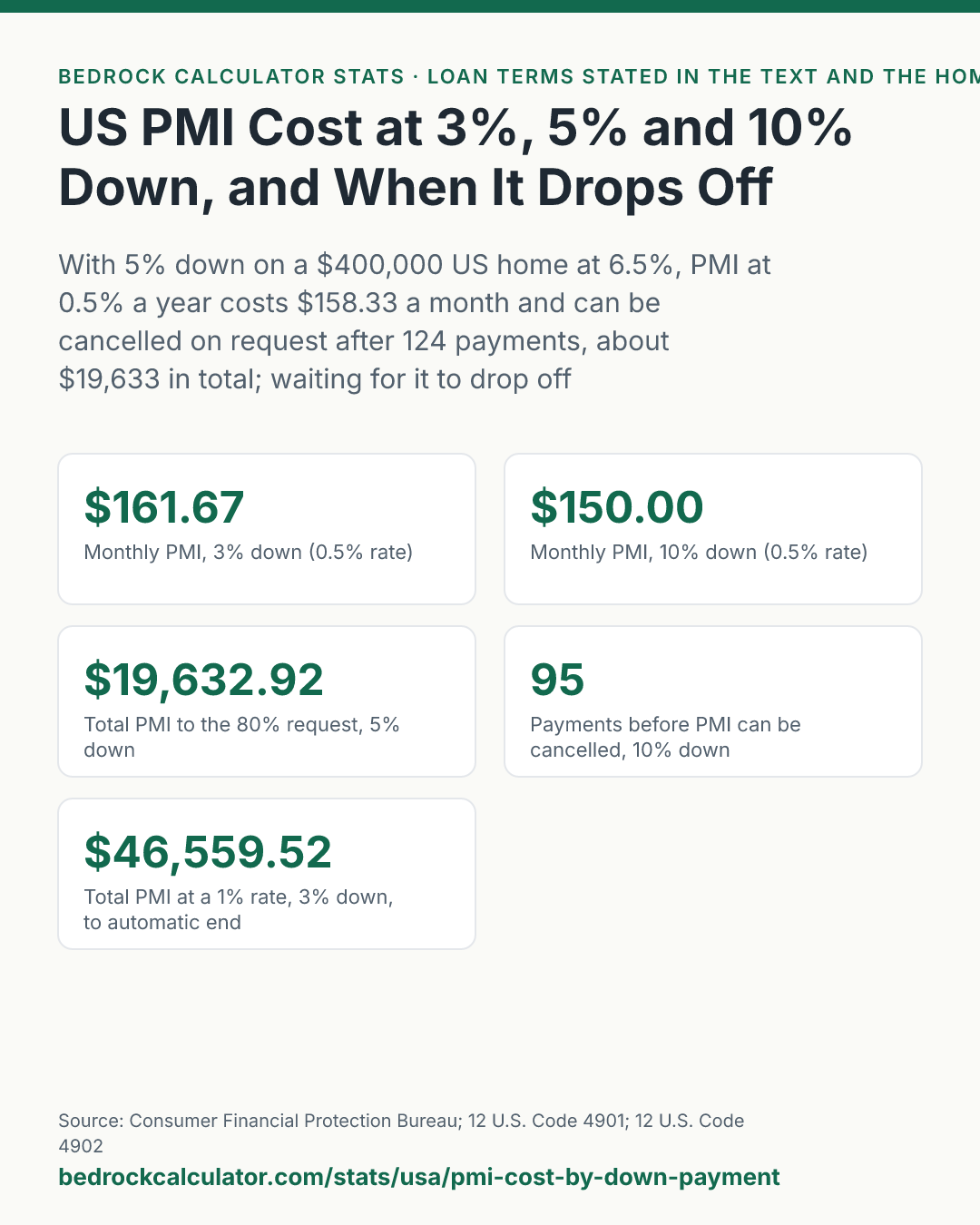
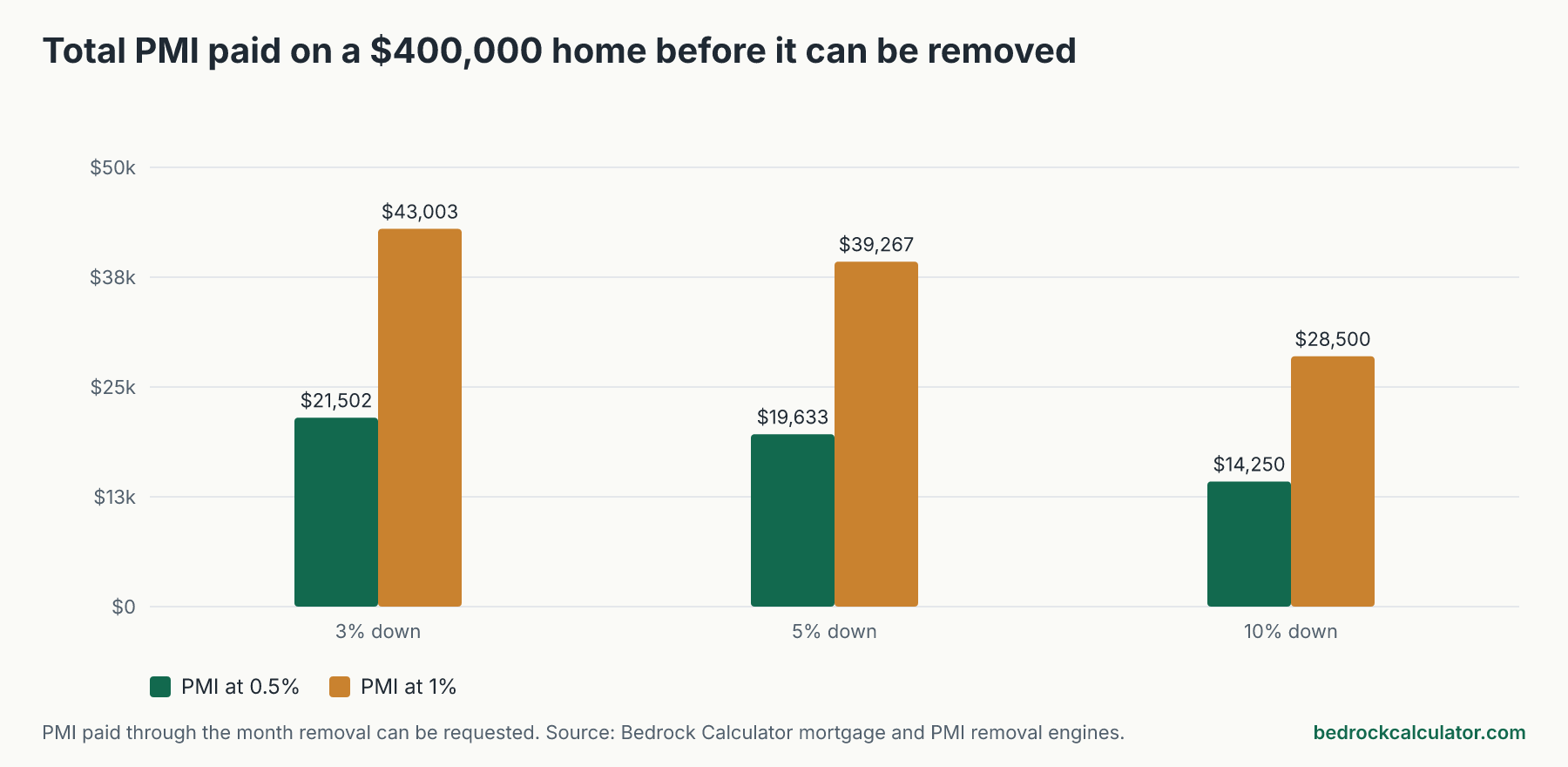
Put 5% down on a $400,000 home in the US with a 30-year loan at 6.5%, and private mortgage insurance at a 0.5% annual rate adds $158.33 to every monthly payment. You can ask to cancel it after payment 124, about 10 years 4 months in, by which point you'll have paid $19,632.92.
If you never ask, it drops off on its own at payment 135, and the total reaches $21,374.55.
With 10% down, PMI can come off after 7 years 11 months. With 3% down it takes 11 years 1 month.
How we worked out these numbers
We used two calculators on this site. The mortgage calculator gives the loan amount, the monthly PMI premium and the full monthly payment for a $400,000 home at 6.5% over 30 years, with 3%, 5%, 10% and 20% down. The PMI removal calculator engine then works out the two dates that matter under the federal Homeowners Protection Act:
- The request date. You can ask your servicer in writing to cancel PMI once your balance is scheduled to reach 80% of the home's original value. "Original value" means the lower of the purchase price and the appraisal at closing.
- The automatic date. If you do nothing, the servicer must end PMI once the balance is scheduled to reach 78% of the original value, as long as you're current on payments.
We assumed no extra payments and no change in the home's value.
The PMI rate is an input, not a market quote. Insurers price PMI by your credit score, your down payment and the coverage your lender requires. We ran two rates, 0.5% of the loan a year (the mortgage calculator's default) and 1%, to show a lower and a higher case. Your loan estimate shows your actual premium.
The full comparison
PMI on a $400,000 home at 6.5%, 30-year fixed
Download CSVFlat premium on the original loan. "Request" is the month the balance reaches 80% of the price on schedule; "automatic" is the month it is scheduled to reach 78%. No extra payments, no appreciation.
| 3% | 1% | $388,000 | $323.33 | 133 | $43,002.89 | 144 | $46,559.52 |
| 5% | 1% | $380,000 | $316.67 | 124 | $39,267.08 | 135 | $42,750.45 |
| 10% | 1% | $360,000 | $300.00 | 95 | $28,500.00 | 109 | $32,700.00 |
| 3% | 0.5% | $388,000 | $161.67 | 133 | $21,502.11 | 144 | $23,280.48 |
| 5% | 0.5% | $380,000 | $158.33 | 124 | $19,632.92 | 135 | $21,374.55 |
| 10% | 0.5% | $360,000 | $150.00 | 95 | $14,250.00 | 109 | $16,350.00 |
What the table shows
A bigger down payment helps in two ways. It lowers the premium, because PMI is charged on a smaller loan: $161.67 a month at 3% down against $150.00 at 10% down, at the same rate. And it gets you to the 80% line years sooner. That second effect matters more. With 10% down you reach the request date at payment 95; with 3% down it's payment 133.
Early payments barely move the balance. On a 30-year loan, most of each early payment is interest. That's why getting from 5% equity to 20% equity takes more than a decade even though you're paying every month. Our page on how much of each mortgage payment is interest shows why.
The PMI rate doubles the bill. At 1% instead of 0.5%, total PMI to the request date with 3% down rises from $21,502.11 to $43,002.89. A better credit score can be worth a lot here.
Ask, don't wait
The gap between the request date and the automatic date is about a year with 3% or 5% down. With 5% down and a 0.5% rate, asking at 80% saves $1,741.63 compared with waiting. At 1%, it saves $3,483.37.
To have the request granted, you generally need a good payment history, no second liens on the home, and evidence the home hasn't lost value since you bought it. Your servicer may ask for an appraisal.
You can reach the request date sooner with extra principal. The automatic date can't move that way, because the law ties it to the original payment schedule. The PMI removal calculator shows both dates with any extra payment you plan.
What it does to your monthly payment
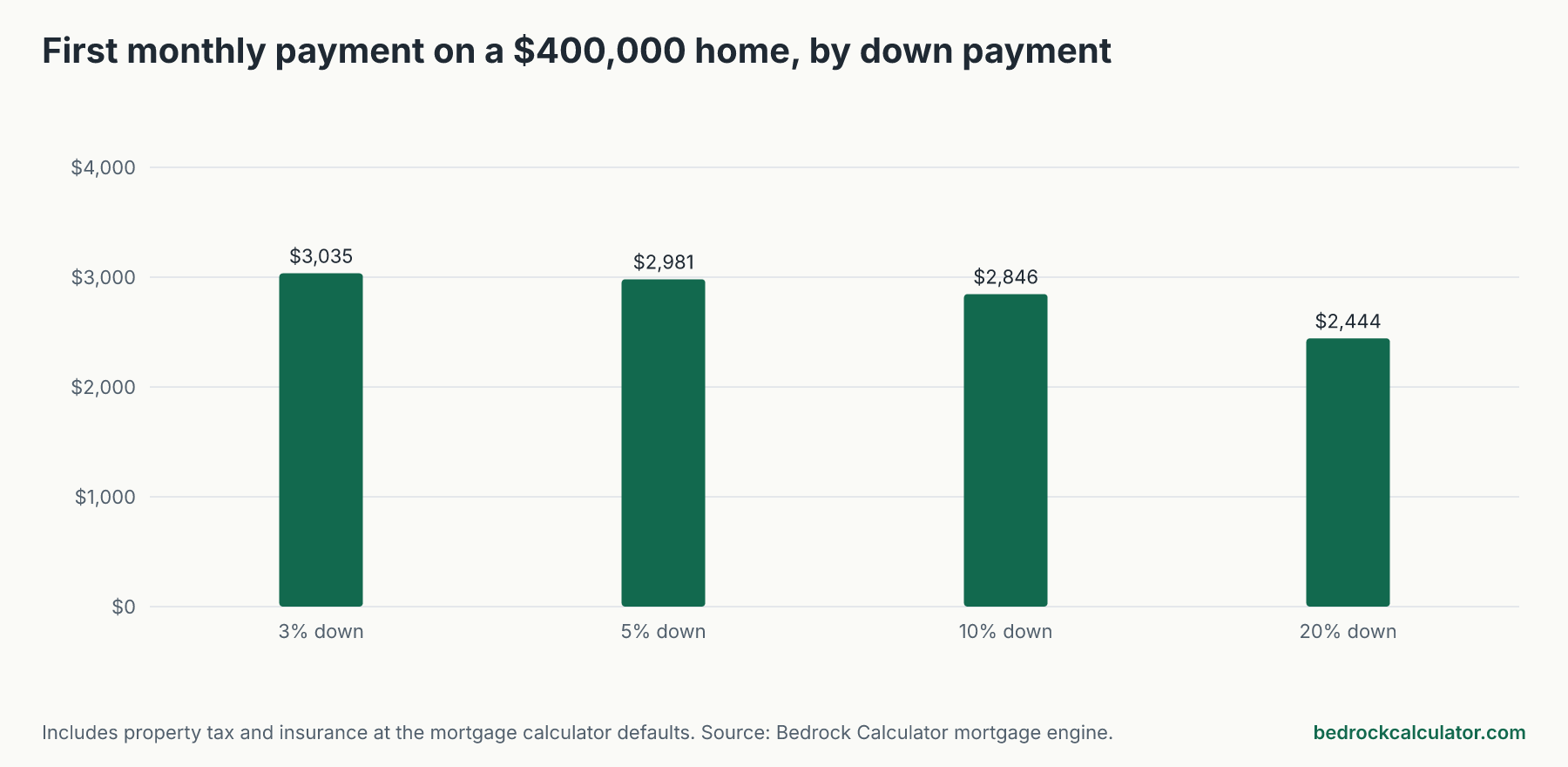
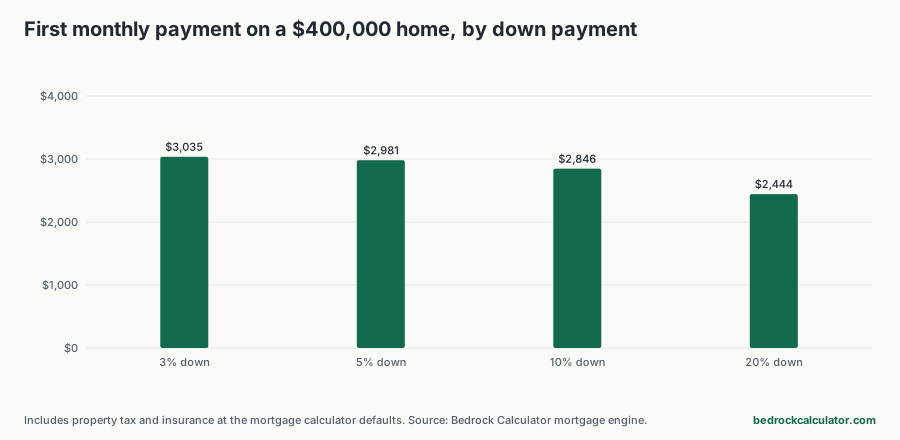
The first monthly payment, including property tax at 0.89% of the price and insurance of $1,500 a year (the mortgage calculator's defaults), is $3,035.02 with 3% down and $2,846.37 with 10% down. With 20% down there's no PMI at all, and the payment is $2,443.55. Part of each gap is PMI and part is simply the larger loan.
What this leaves out
- Real PMI pricing. The calculators charge one flat annual rate on the original loan. Insurers use pricing grids by credit score and loan-to-value, and some loans use single-premium or lender-paid PMI instead.
- Appreciation. If your home gains value, many lenders will remove PMI early on a new appraisal. That's a lender or investor policy, not a legal right, and we assumed no change in value here.
- FHA, VA and USDA loans. FHA mortgage insurance follows its own rules and often lasts for the life of the loan. VA loans have a funding fee instead of PMI. None of these are covered here.
- The midpoint rule. By law PMI must also end at the midpoint of the loan term, month 180 on a 30-year loan, if nothing else has ended it. With these down payments the 78% date always comes first.
Run your own numbers
Use the mortgage calculator with your own price, down payment and PMI rate. Then plug the premium into the PMI removal calculator to see your request date, your automatic date and what extra principal would change. If you're still saving, the down payment savings calculator shows how long it takes to reach a bigger down payment.