How much does extra principal save on a 30-year mortgage?
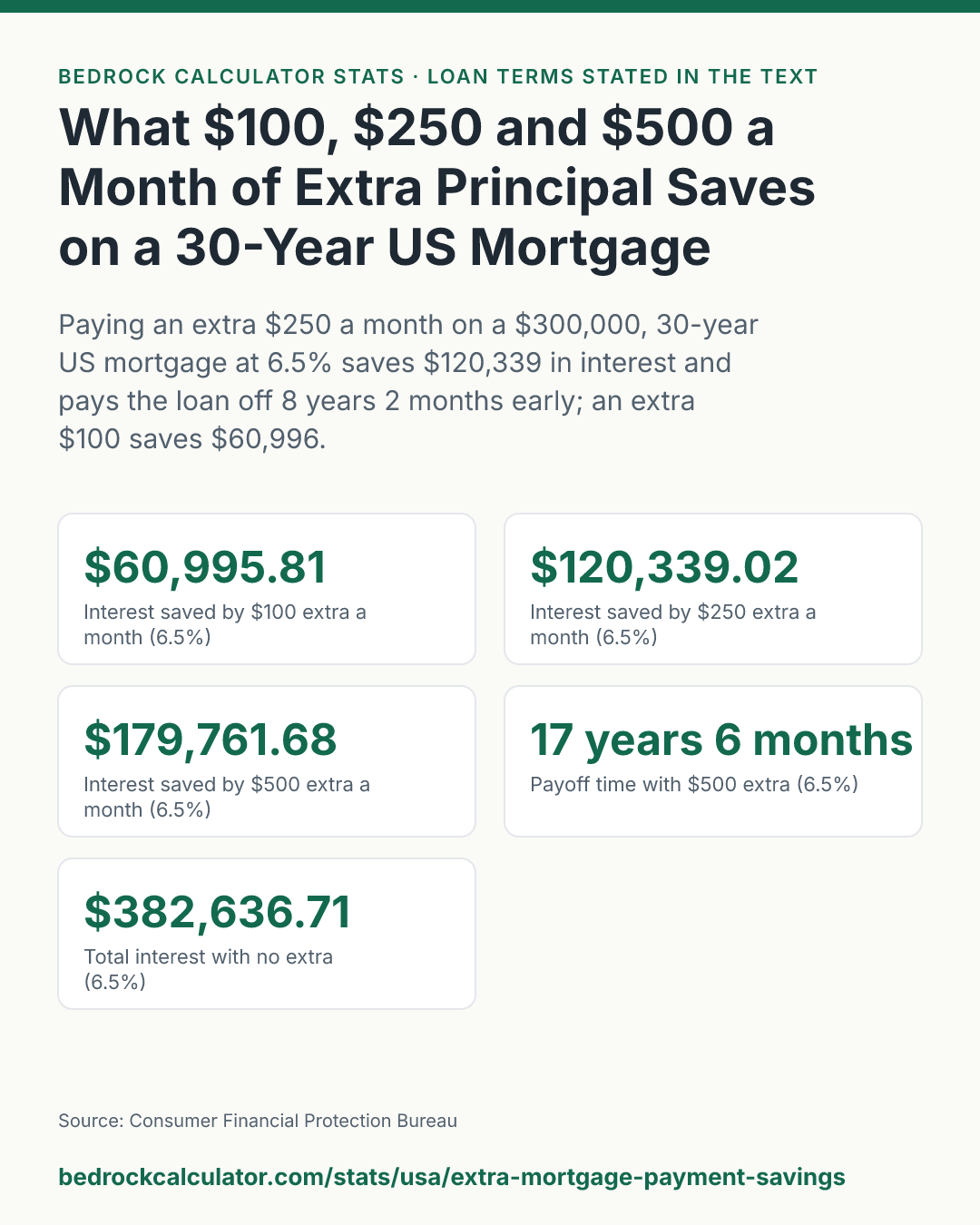
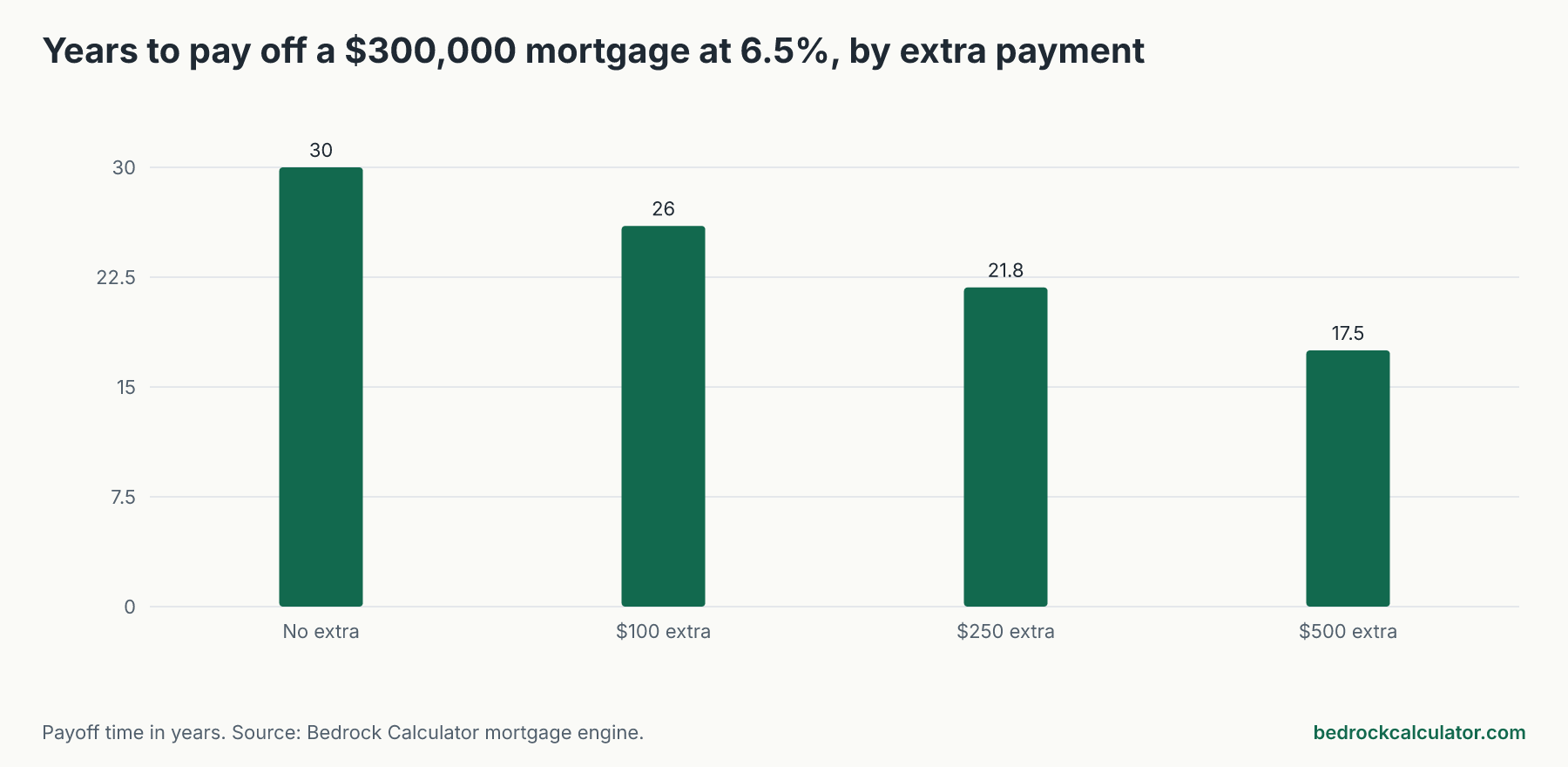
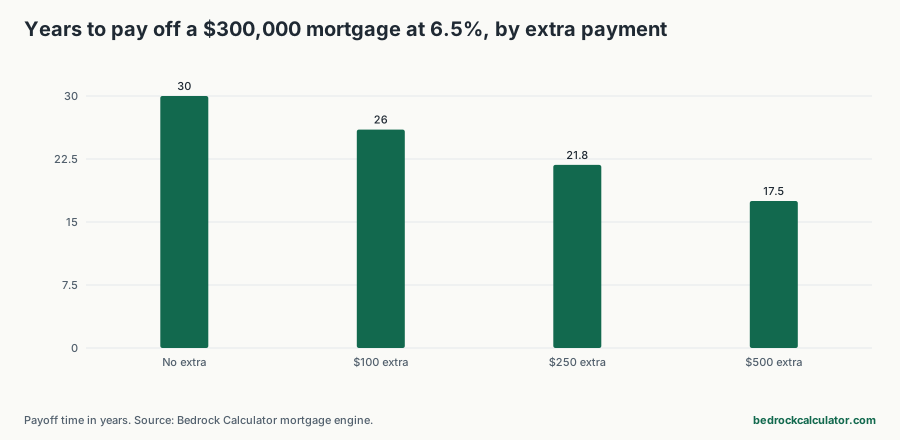
On a $300,000, 30-year US mortgage at 6.5%, paying an extra $100 a month toward principal saves $60,995.81 in interest and ends the loan 4 years early. An extra $250 a month saves $120,339.02 and cuts 8 years 2 months. An extra $500 a month saves $179,761.68 and pays the loan off in 17 years 6 months.
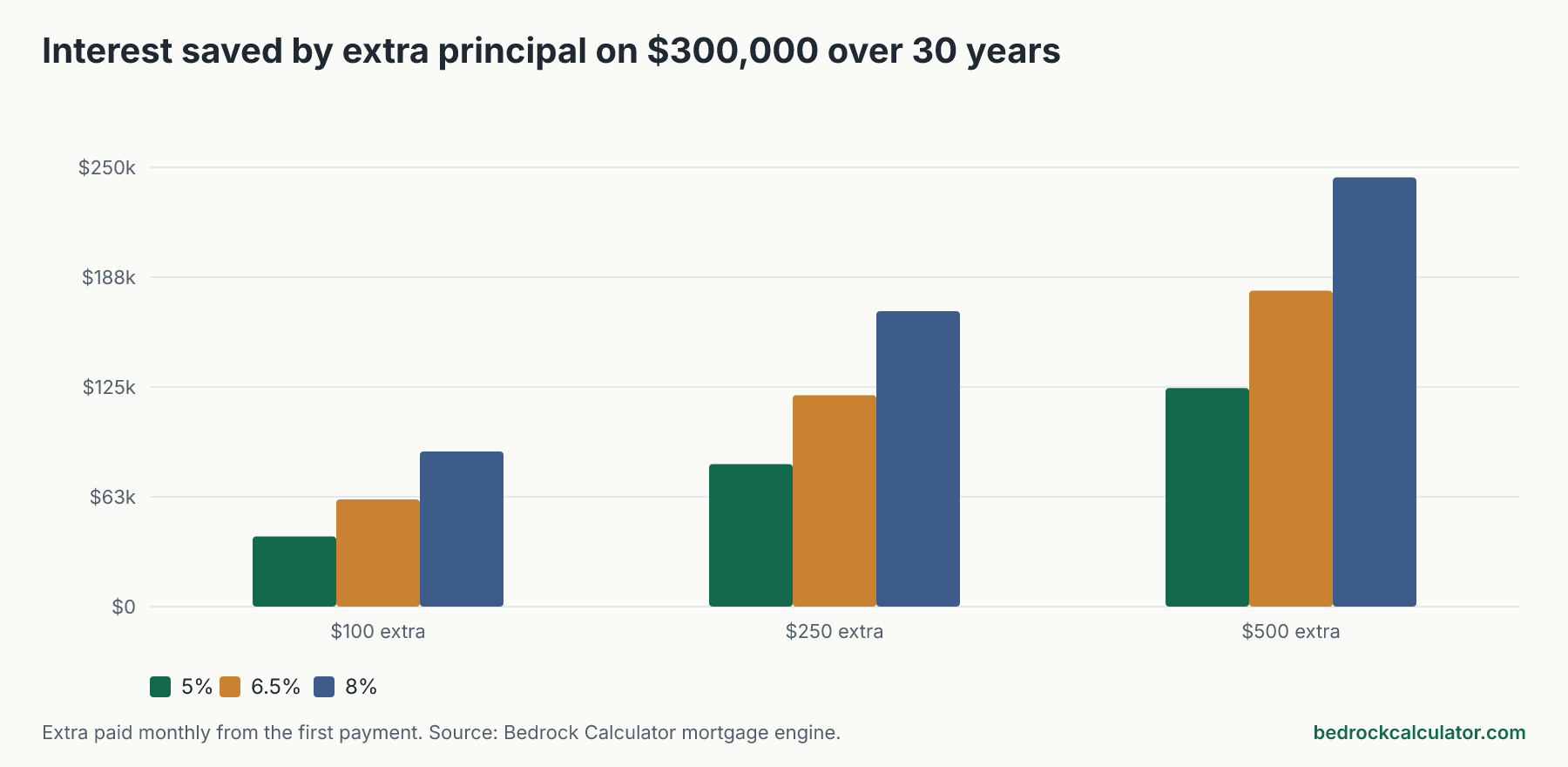
The higher your rate, the more each extra dollar is worth. At 8%, the same $250 a month saves $168,164.31.
How we worked out these numbers
We ran the mortgage calculator on this site with a $375,000 home, 20% down, a $300,000 loan, a 30-year term and no mortgage insurance. We tried four extra payments, none, $100, $250 and $500 a month, at three rates: 5%, 6.5% and 8%.
The calculator treats the extra the way most US mortgage servicers do when you mark it as principal: it's added to every monthly payment starting with the first one, and all of it reduces the balance. Interest is then charged each month on the lower balance. When the balance hits zero, the loan is done. The "interest saved" figure is the total interest without extra payments minus the total with them.
Your required payment doesn't change. At 6.5% it stays $1,896.20 for principal and interest. The extra is on top.
Every combination
Extra principal on a $300,000, 30-year mortgage
Download CSVExtra paid every month from the first payment, applied entirely to principal. Principal and interest only.
| 5% | $0 | 30 years | 360 | $279,769.69 | $0.00 | n/a |
| 5% | $100 | 26 years 4 months | 316 | $239,831.77 | $39,937.92 | 3 years 8 months |
| 5% | $250 | 22 years 5 months | 269 | $198,612.20 | $81,157.49 | 7 years 7 months |
| 5% | $500 | 18 years | 216 | $155,384.95 | $124,384.74 | 12 years |
| 6.5% | $0 | 30 years | 360 | $382,636.71 | $0.00 | n/a |
| 6.5% | $100 | 26 years | 312 | $321,640.90 | $60,995.81 | 4 years |
| 6.5% | $250 | 21 years 10 months | 262 | $262,297.69 | $120,339.02 | 8 years 2 months |
| 6.5% | $500 | 17 years 6 months | 210 | $202,875.03 | $179,761.68 | 12 years 6 months |
| 8% | $0 | 30 years | 360 | $492,470.60 | $0.00 | n/a |
| 8% | $100 | 25 years 6 months | 306 | $404,167.62 | $88,302.98 | 4 years 6 months |
| 8% | $250 | 21 years 3 months | 255 | $324,306.29 | $168,164.31 | 8 years 9 months |
| 8% | $500 | 16 years 11 months | 203 | $248,248.66 | $244,221.94 | 13 years 1 month |
Why a small extra payment saves so much
In the early years of a 30-year loan, most of each payment is interest. At 6.5%, the first year's payments are mostly interest, as we show in how much of each mortgage payment is interest. An extra $100 of principal in month one is $100 the lender can't charge interest on for the remaining life of the loan. Those avoided interest charges compound in your favor.
That's why the savings aren't proportional. At 6.5%, $100 a month saves $60,995.81, while five times as much, $500, saves $179,761.68. The bigger payment ends the loan so much sooner that there are fewer months left for any payment to save interest in.
Extra principal or a 15-year loan?
Paying $500 extra a month at 6.5% brings the payoff down to 17 years 6 months, with total interest of $202,875.03. A 15-year loan at the same rate goes further still, but locks you into the higher payment every month. Extra principal on a 30-year loan gets you part of the way while letting you stop if money gets tight.
See 15-year vs 30-year mortgages compared for the full comparison.
Is paying extra the best use of the money?
It depends on what else the money could do. Paying down a mortgage at 6.5% is like earning a guaranteed 6.5% return on that money, before any tax effects. That's hard to beat with savings accounts. But a few things usually come first:
- An emergency fund. Money you put into your house is hard to get back out quickly. You'd need to sell, refinance or borrow against it.
- Higher-rate debt. A credit card at 20% or more costs far more than a mortgage. Our credit card payoff timelines show how long that debt lasts.
- An employer retirement match. Free matching money usually outweighs anything you'd save on mortgage interest.
At 5%, $250 a month saves $81,157.49. At 8% it saves $168,164.31. If your rate is low, investing the money may come out ahead over the long run, though without a guarantee.
What this leaves out
- Starting partway through the loan. These figures assume you start paying extra with the first payment. If you start in year 10, the savings are smaller because more of the interest has already been paid. The mortgage payoff calculator handles a loan you've already had for a while.
- One-off lump sums or biweekly payments. The calculator models a fixed monthly extra amount only.
- How your servicer applies it. Some servicers hold extra money as a future payment unless you tell them it's for principal. Check your statement.
- Prepayment penalties. Rare on modern conventional mortgages, but check your loan documents.
- Tax. Paying less interest also means a smaller mortgage interest deduction, if you itemize.
Run your own numbers
Enter your own loan, rate and extra amount in the mortgage calculator. If you'd rather lower your required payment after a lump sum, the mortgage recast calculator shows what a recast does. And the biweekly mortgage calculator shows the effect of paying half the payment every two weeks, which adds up to one extra payment a year.