Is a 15-year or a 30-year mortgage cheaper overall?
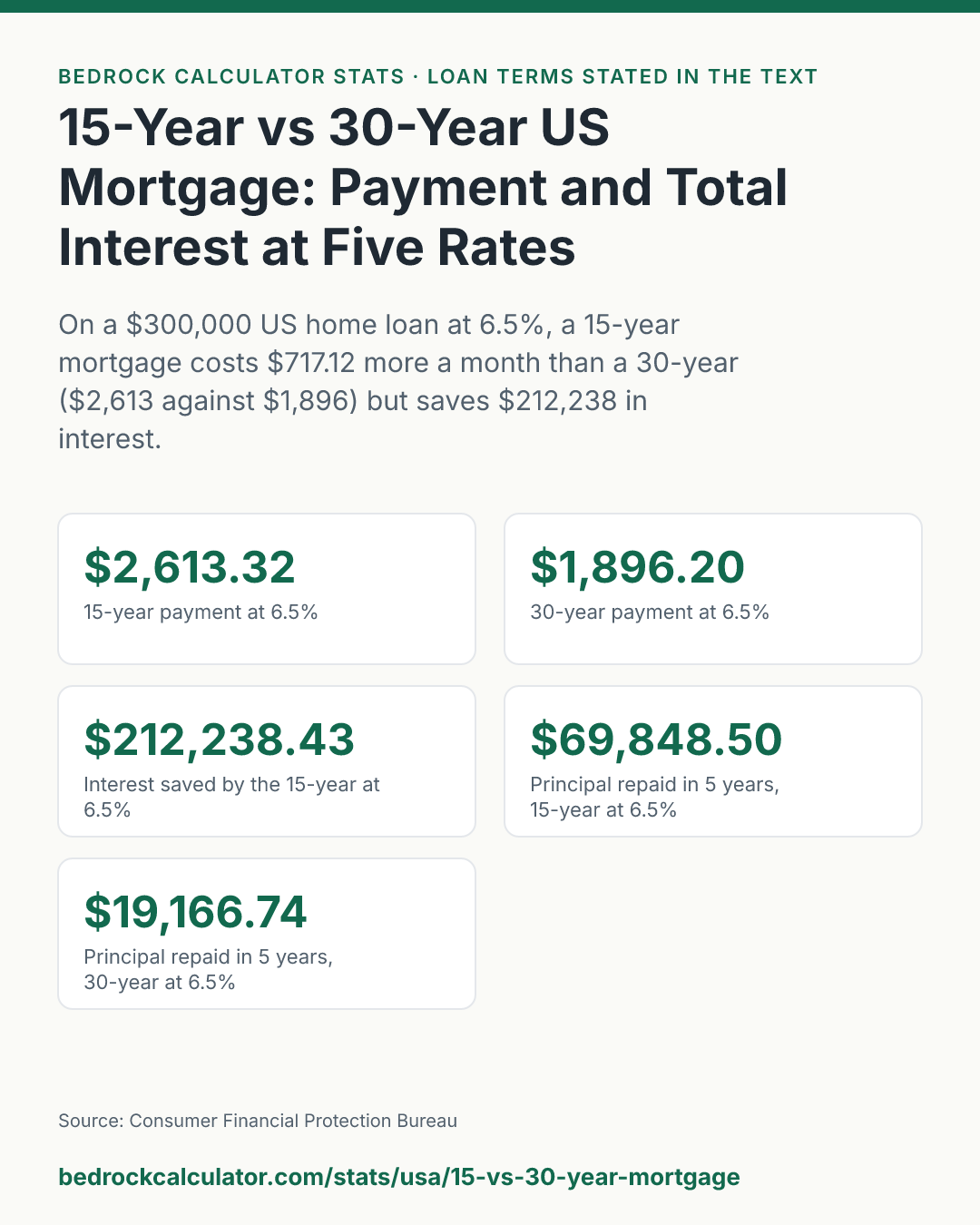
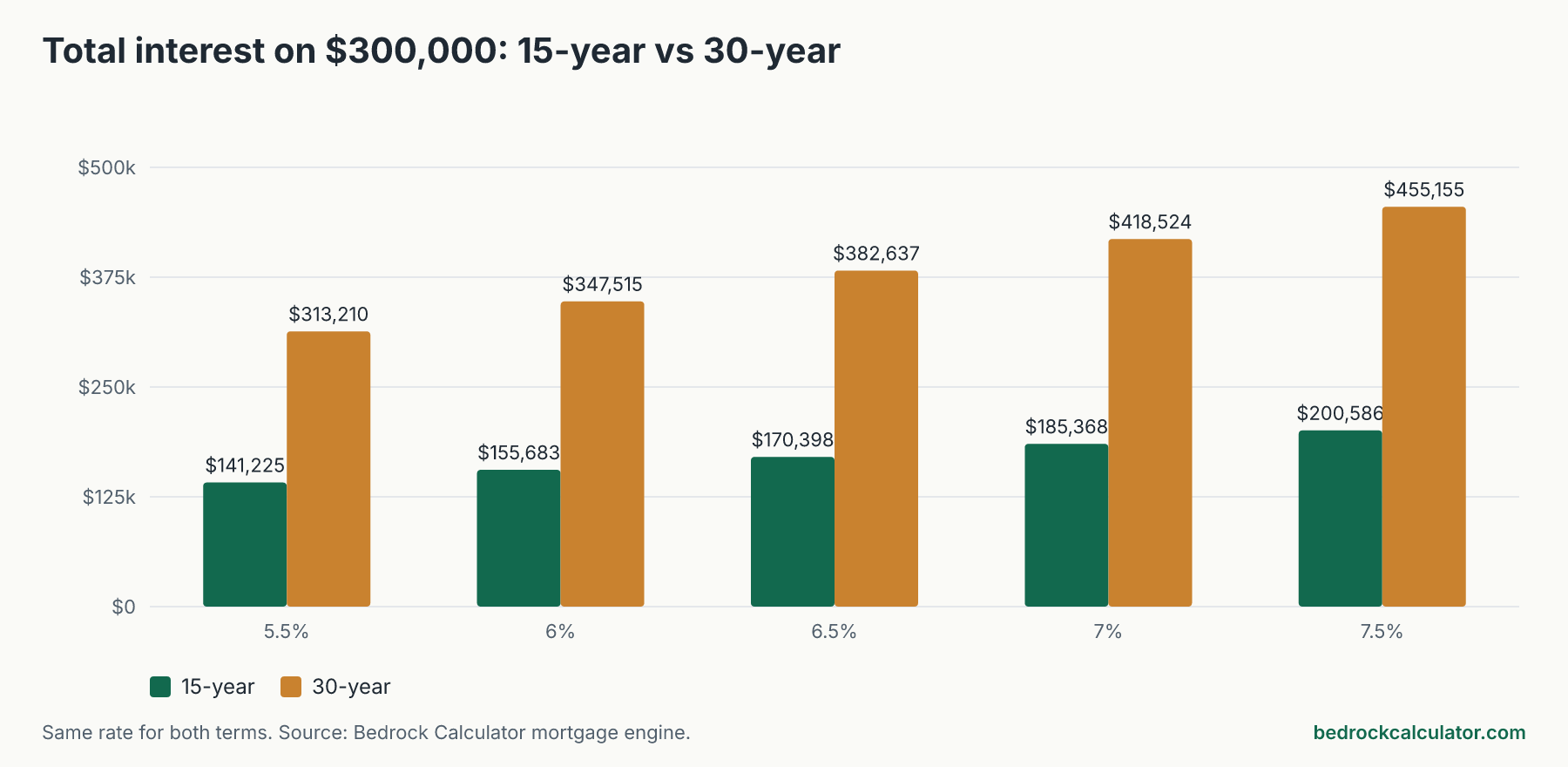
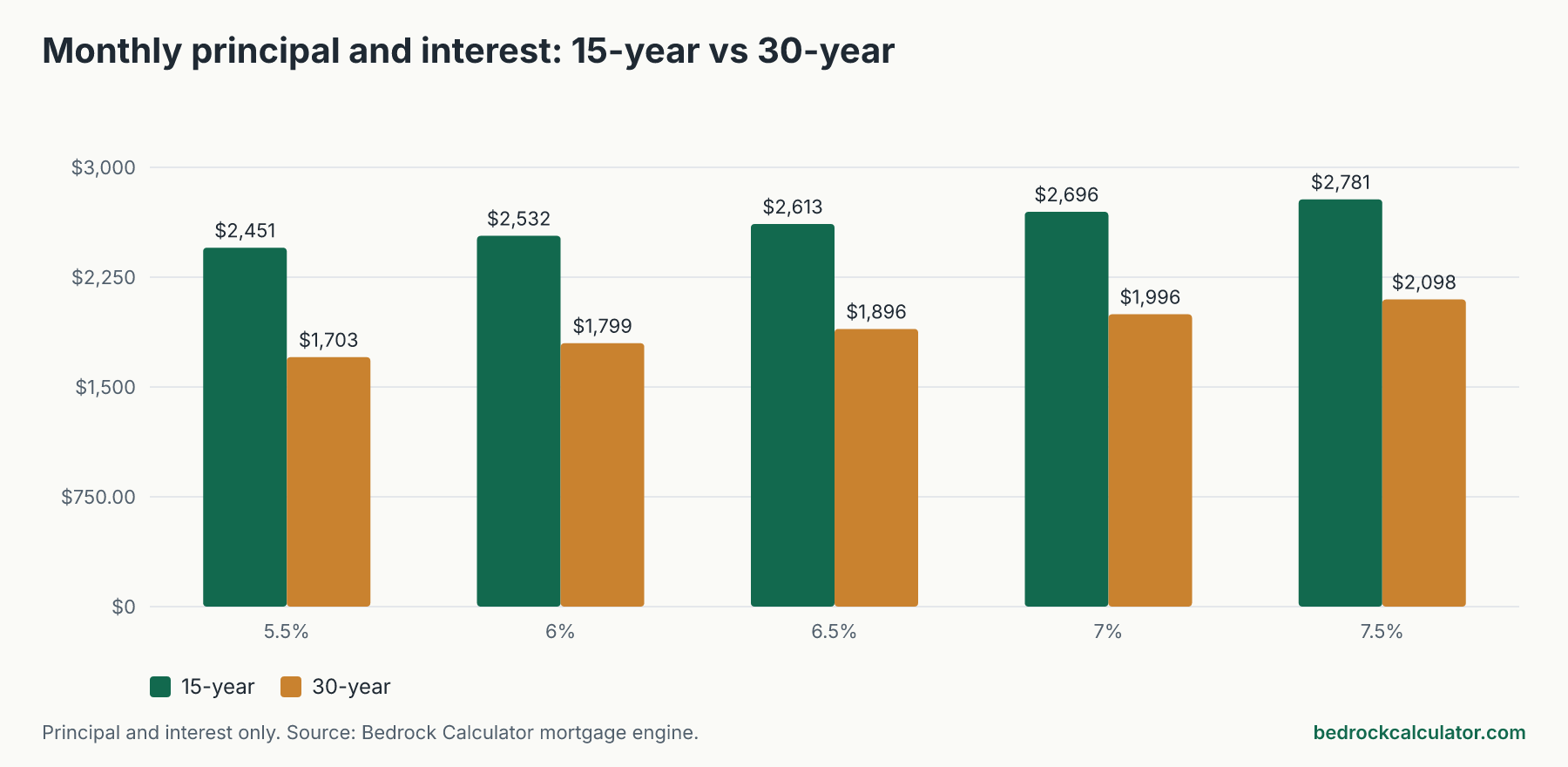
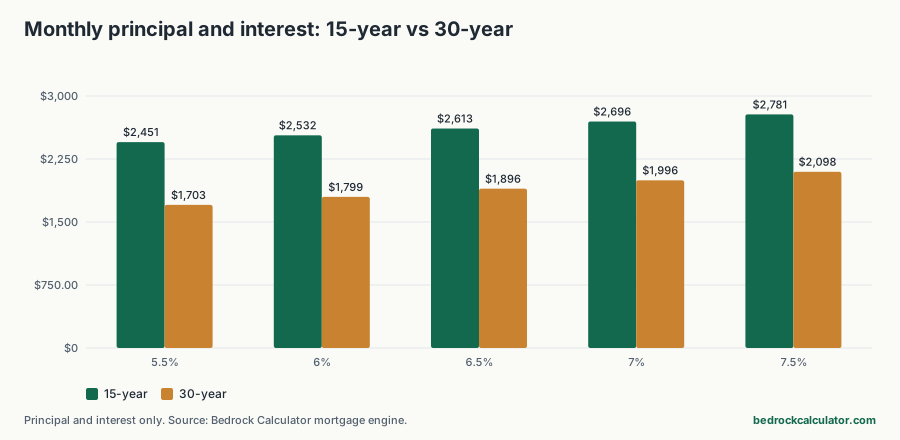
On a $300,000 US mortgage at 6.5%, the 15-year loan costs $2,613.32 a month and the 30-year costs $1,896.20. That's $717.12 more each month for the shorter loan. In return, it saves $212,238.43 in interest, because the 15-year loan pays only $170,398.28 in total against $382,636.71 for the 30-year.
At every rate we tested, from 5.5% to 7.5%, the 15-year loan's total interest was well under half the 30-year's.
How we worked out these numbers
We ran the mortgage calculator on this site for both terms at five rates: 5.5%, 6%, 6.5%, 7% and 7.5%. Each run is a $375,000 home with 20% down, which makes a $300,000 loan with no private mortgage insurance. There are no extra payments, and every payment is made on schedule.
We kept the rate the same for both terms on purpose, so that the term is the only thing that changes. In the US market, lenders usually quote a lower rate on 15-year loans than on 30-year loans. If you can get a lower rate on the 15-year, the savings are larger than shown here and the payment gap is a little smaller. To compare two real quotes, run each one through the calculator.
All figures are principal and interest only. Property tax, insurance and HOA dues are the same whichever term you pick, so they don't change the comparison.
Every rate side by side
15-year vs 30-year mortgage on $300,000, same rate
Download CSVPrincipal and interest only, fixed rate, every payment made on schedule, no extra principal.
| 5.5% | $2,451.25 | $1,703.37 | $747.88 | $141,225.11 | $313,210.43 | $171,985.32 |
| 6.5% | $2,613.32 | $1,896.20 | $717.12 | $170,398.28 | $382,636.71 | $212,238.43 |
| 6% | $2,531.57 | $1,798.65 | $732.92 | $155,682.79 | $347,515.44 | $191,832.65 |
| 7.5% | $2,781.04 | $2,097.64 | $683.40 | $200,586.24 | $455,155.38 | $254,569.14 |
| 7% | $2,696.48 | $1,995.91 | $700.57 | $185,367.94 | $418,524.05 | $233,156.11 |
Two patterns stand out:
- The interest saved grows with the rate. At 5.5% the 15-year saves $171,985.32; at 7.5% it saves $254,569.14. Higher rates make every extra year of borrowing more expensive.
- The payment gap shrinks as rates rise. At 5.5% the 15-year costs $747.88 more a month; at 7.5% the extra is $683.40. That's because the 30-year payment is mostly interest at high rates, so it rises faster with the rate than the 15-year payment does.
Why the 15-year loan saves so much
Interest is charged on what you still owe. A 15-year loan repays principal much faster, so the balance that interest is charged on falls quickly. A 30-year loan spends its early years paying mostly interest, as we show in our page on how much of each mortgage payment is interest.
You can see the difference in equity after five years:
Principal repaid in the first five years
Download CSVSum of the principal portion of the first 60 payments. The last column is what the 30-year loan still owes when the 15-year loan is paid off.
| 5.5% | $74,132.99 | $22,618.43 | $208,468.30 |
| 6.5% | $69,848.50 | $19,166.74 | $217,678.77 |
| 6% | $71,972.67 | $20,836.86 | $213,146.93 |
| 7.5% | $65,712.46 | $16,147.39 | $226,281.27 |
| 7% | $67,761.22 | $17,605.47 | $222,055.66 |
At 6.5%, after 60 payments the 15-year borrower has repaid $69,848.50 of principal. The 30-year borrower has repaid $19,166.74. And when the 15-year loan is paid off, the 30-year borrower still owes $217,678.77.
When the 30-year loan makes more sense
The 15-year loan wins on total cost every time, but total cost isn't the only thing that matters.
Cash flow. The 15-year payment at 6.5% is 37.8% higher. If that payment would leave you without an emergency fund, or stop you saving in a 401(k) with an employer match, the higher payment can cost more than it saves.
Flexibility. With a 30-year loan you can still pay extra whenever you can afford it, and drop back to the lower required payment in a tight month. A 15-year loan locks in the higher payment. Our page on what extra principal saves on a 30-year loan shows how close you can get to a 15-year payoff that way.
Qualifying. Lenders look at your payment against your income. A lower payment can make it easier to qualify for the same home.
What this leaves out
- Different rates for different terms. We used the same rate for both, as explained above.
- Taxes. If you itemize, mortgage interest may be deductible, which slightly narrows the gap in after-tax cost. Many households take the standard deduction instead, and the calculator doesn't model the deduction.
- What you'd do with the difference. The extra $717.12 a month on the 15-year could instead be invested. Whether that beats paying down a 6.5% loan depends on returns no one can promise.
- Closing costs, PMI and refinancing. These figures assume one loan held to the end with 20% down.
Run your own numbers
Try both terms with your own loan amount and quoted rates in the mortgage calculator, which adds tax, insurance and PMI. If you already have a 30-year loan and are thinking about refinancing into a 15-year, the mortgage refinance calculator shows the break-even on closing costs. Or see how close extra payments get you with the mortgage payoff calculator. Our guide on how a mortgage payment is calculated explains the formula behind both payments.