How long does it take to break even on mortgage points?
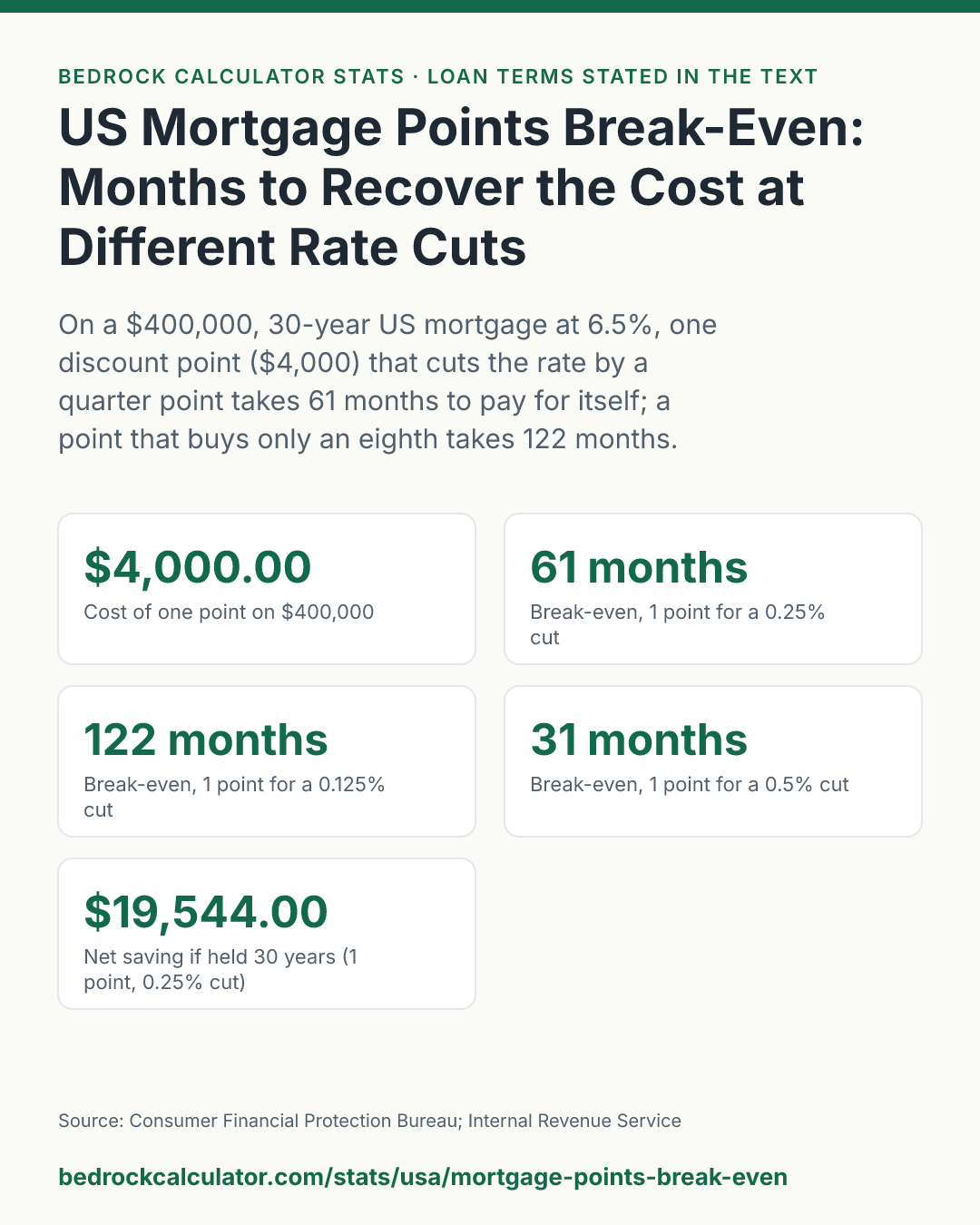
On a $400,000, 30-year US mortgage at 6.5%, one discount point costs $4,000.00 at closing. If it lowers the rate by a quarter point, your payment drops by $65.40 a month, and it takes 61 months, about 5.1 years, before the savings add up to what you paid.
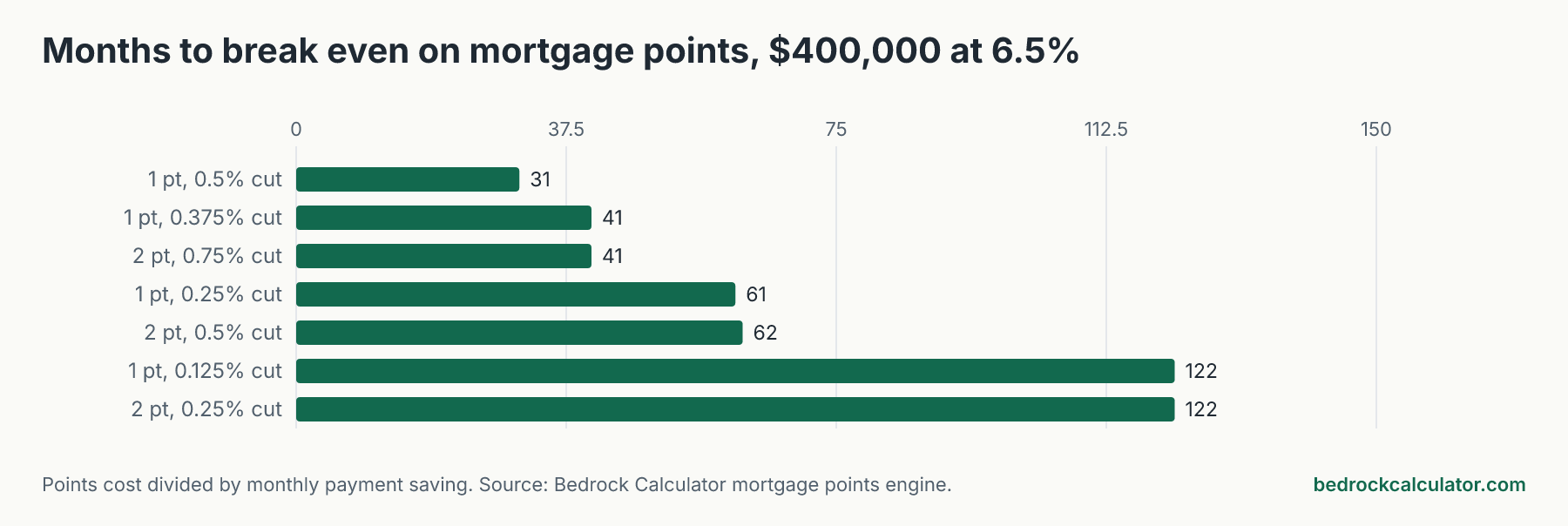
The rate cut is what decides it. A point that buys a half-point cut pays for itself in 31 months. A point that buys only an eighth of a point takes 122 months, more than ten years.
How we worked out these numbers
We ran the mortgage points calculator on this site for a $400,000, 30-year fixed loan with a starting rate of 6.5%. We tried one point and two points, with rate cuts from 0.125% to 0.75%.
One point is 1% of the loan amount, paid upfront at closing. For each case, the calculator works out the monthly principal and interest payment with and without the points, then divides the cost of the points by the monthly saving. That gives the number of months until you've earned your money back, rounded to the nearest month. It also reports the net saving if you kept the loan for all 30 years: the total interest saved, minus what the points cost.
We varied the rate cut because there's no fixed exchange rate. A quarter point of rate per point is a common rule of thumb in the US market, but what a lender actually offers changes by lender, by loan type and by day. Always compare your own quote.
Every combination
Mortgage points break-even on $400,000 at 6.5%, 30-year fixed
Download CSVBreak-even is the cost of the points divided by the monthly payment saving, rounded to whole months. Net saving assumes the loan runs its full term.
| 1 | 6% | $4,000.00 | $130.07 | 31 | 2.6 | $42,825.20 |
| 1 | 6.125% | $4,000.00 | $97.83 | 41 | 3.4 | $31,218.80 |
| 2 | 5.75% | $8,000.00 | $193.98 | 41 | 3.4 | $61,832.80 |
| 1 | 6.25% | $4,000.00 | $65.40 | 61 | 5.1 | $19,544.00 |
| 2 | 6% | $8,000.00 | $130.07 | 62 | 5.2 | $38,825.20 |
| 1 | 6.375% | $4,000.00 | $32.79 | 122 | 10.2 | $7,804.40 |
| 2 | 6.25% | $8,000.00 | $65.40 | 122 | 10.2 | $15,544.00 |
Why the rate cut matters more than the number of points
Look at two rows side by side. One point for a quarter-point cut breaks even in 61 months. Two points for a half-point cut break even in 62 months. Twice the cost, twice the saving, and almost exactly the same break-even. What changes the answer is how much rate each point buys.
That's why the first thing to ask a lender isn't "how many points?" but "how much lower is the rate per point?" A deal of two points for just a quarter-point cut takes 122 months to break even, the same as one point for an eighth.
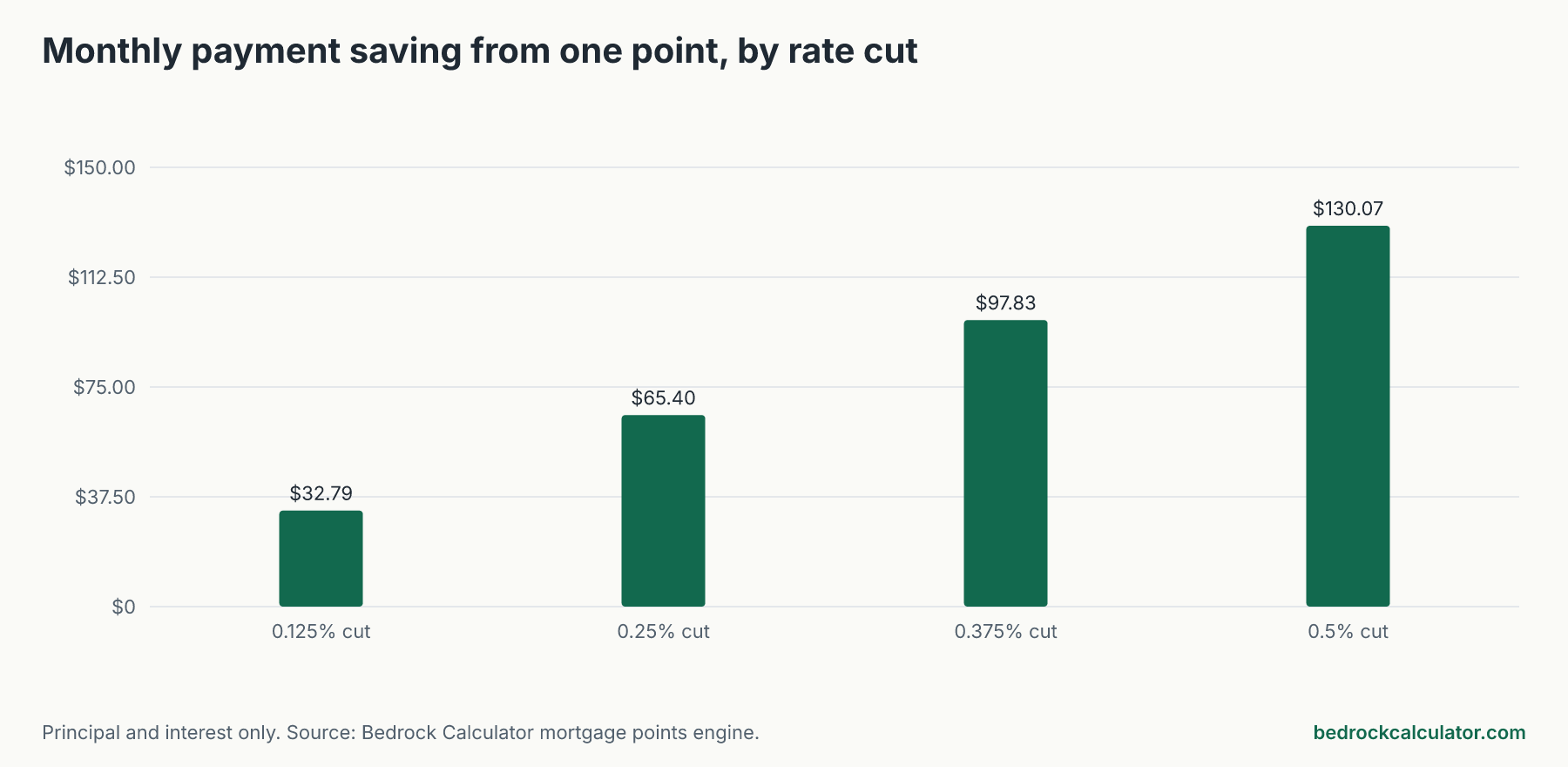
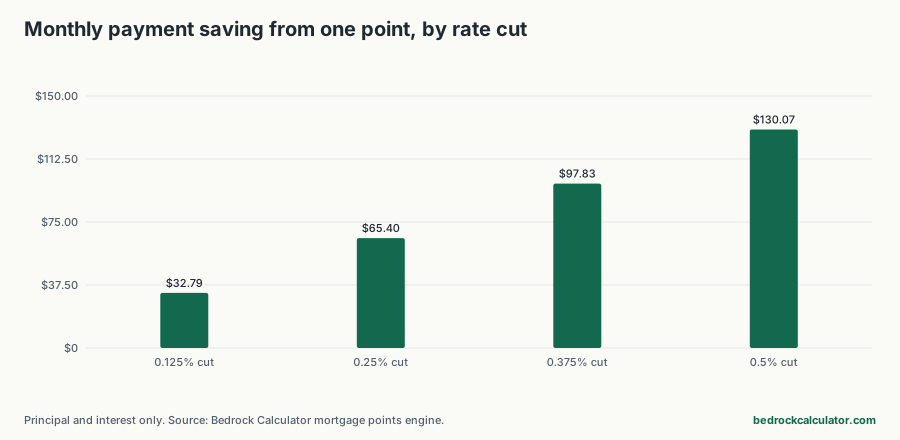
The monthly saving from one point grows in step with the rate cut: $32.79 for an eighth, $65.40 for a quarter and $130.07 for a half. The cost stays $4,000.00 whichever cut you get.
Will you keep the loan long enough?
This is the real question. Points only pay off if you keep this exact loan past the break-even. Plenty of things end a mortgage early:
- Selling the home. Most owners sell or move long before a 30-year loan runs out.
- Refinancing. If rates fall a year or two after you close, refinancing would wipe out the points you paid, since the new loan starts fresh.
- Paying the loan off early. Extra principal payments shorten the loan, so there are fewer months of savings.
If you're confident you'll keep the loan well past the break-even, the long-run saving can be large. At 6.5% with one point for a quarter-point cut, it's $19,544.00 over the full 30 years. If you're unsure, a smaller loan cost now usually beats a bigger saving you may never collect.
Starting rates make a small difference too. At 7.5%, one point for the same quarter-point cut saves $68.15 a month and breaks even in 59 months.
What this leaves out
The calculator uses the simple break-even most lenders and borrowers use. It doesn't account for:
- What else the cash could do. Money spent on points can't earn interest elsewhere. Counting that would push the break-even later.
- Balance differences. A lower rate also means slightly faster principal repayment, which this simple measure ignores. The effect is small over the first few years.
- Taxes. Points on a loan to buy your main home can be deductible as mortgage interest, generally in the year you pay them if you itemize and meet the IRS conditions. Points on a refinance are usually deducted over the life of the loan. The calculator ignores tax, so if you itemize, your real break-even may be a little shorter.
- Lender credits. The opposite trade, taking a higher rate in return for money toward closing costs, isn't modeled here.
Run your own numbers
Enter your own loan amount, rate quote with and without points, and the number of points in the mortgage points calculator. To see the full payment with tax and insurance, use the mortgage calculator. If you're weighing a refinance, the refinance break-even calculator applies the same logic to closing costs. And for a sense of how much each rate step changes total interest, see 15-year vs 30-year mortgages at five rates.