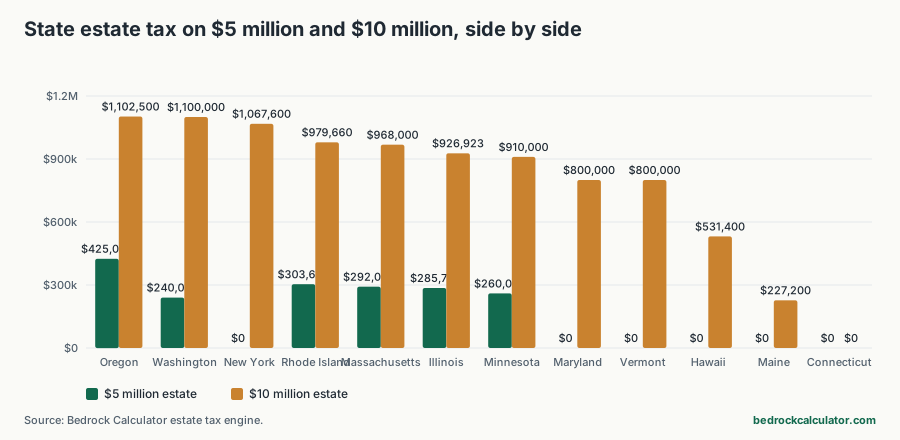
How much state estate tax do a $5 million and a $10 million estate owe?
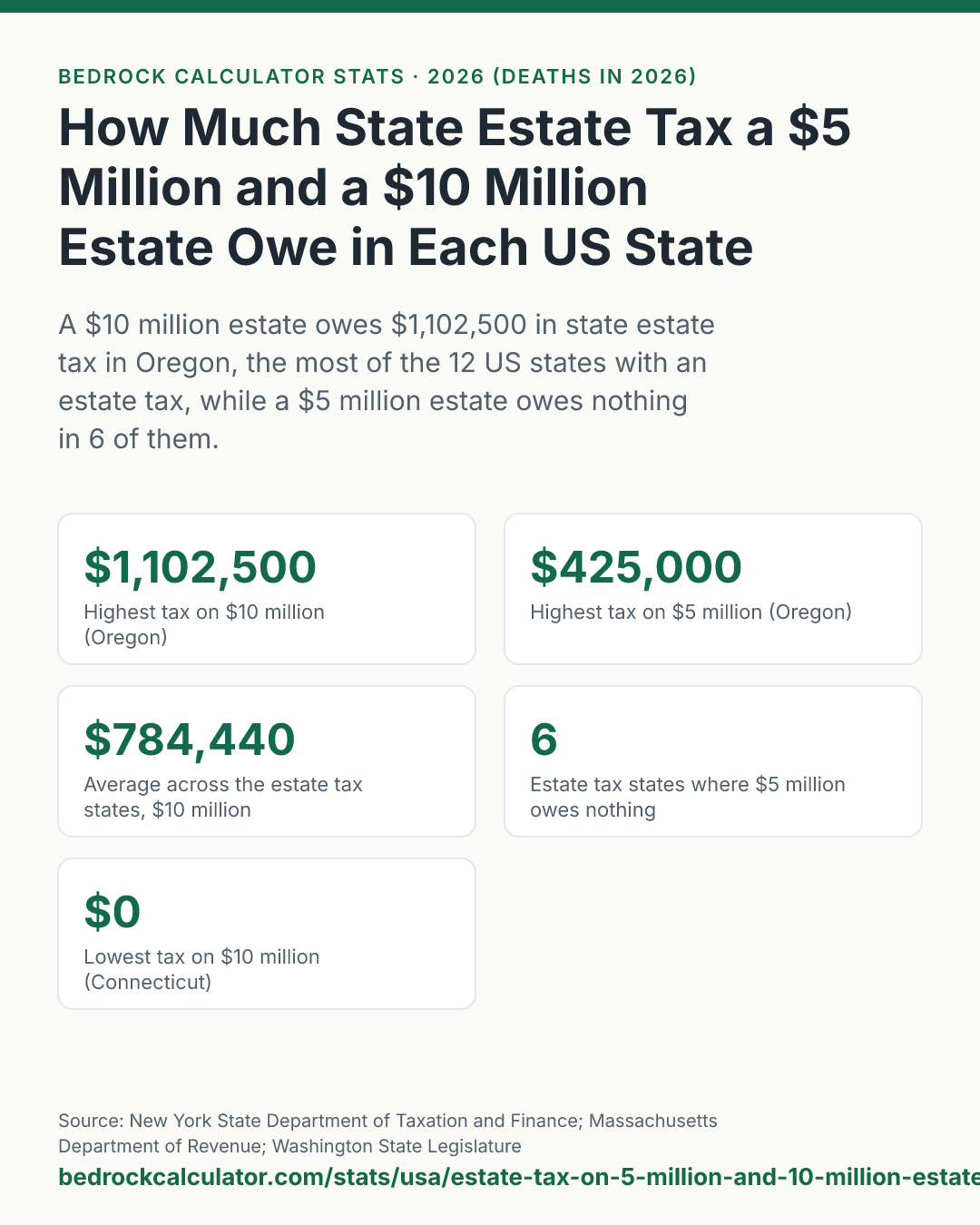
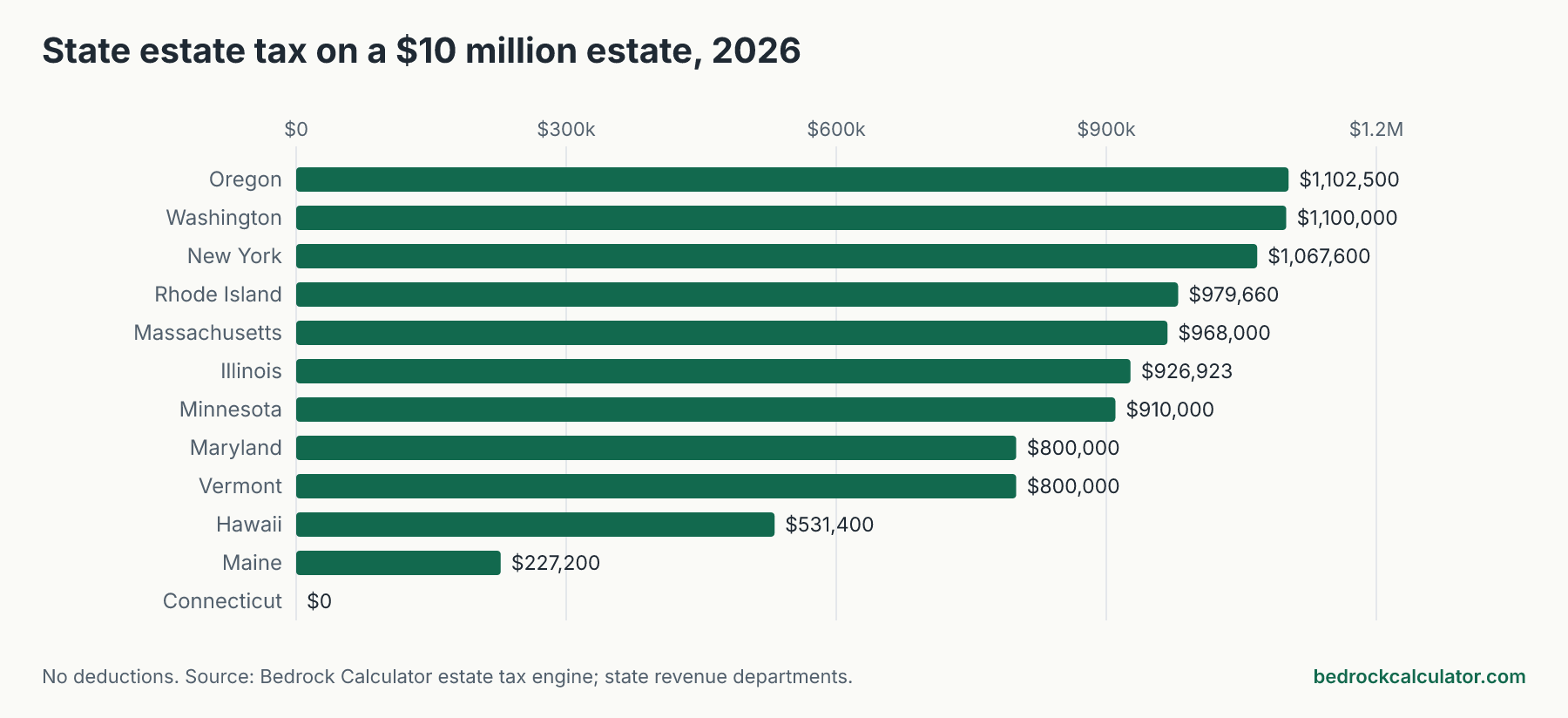
Only 12 US states charge an estate tax in 2026, and what they take from a large estate varies enormously. A $10 million estate owes the most in Oregon: $1,102,500, an effective rate of 11.0%. Washington ($1,100,000) and New York ($1,067,600) are close behind. In Connecticut the same estate owes $0.
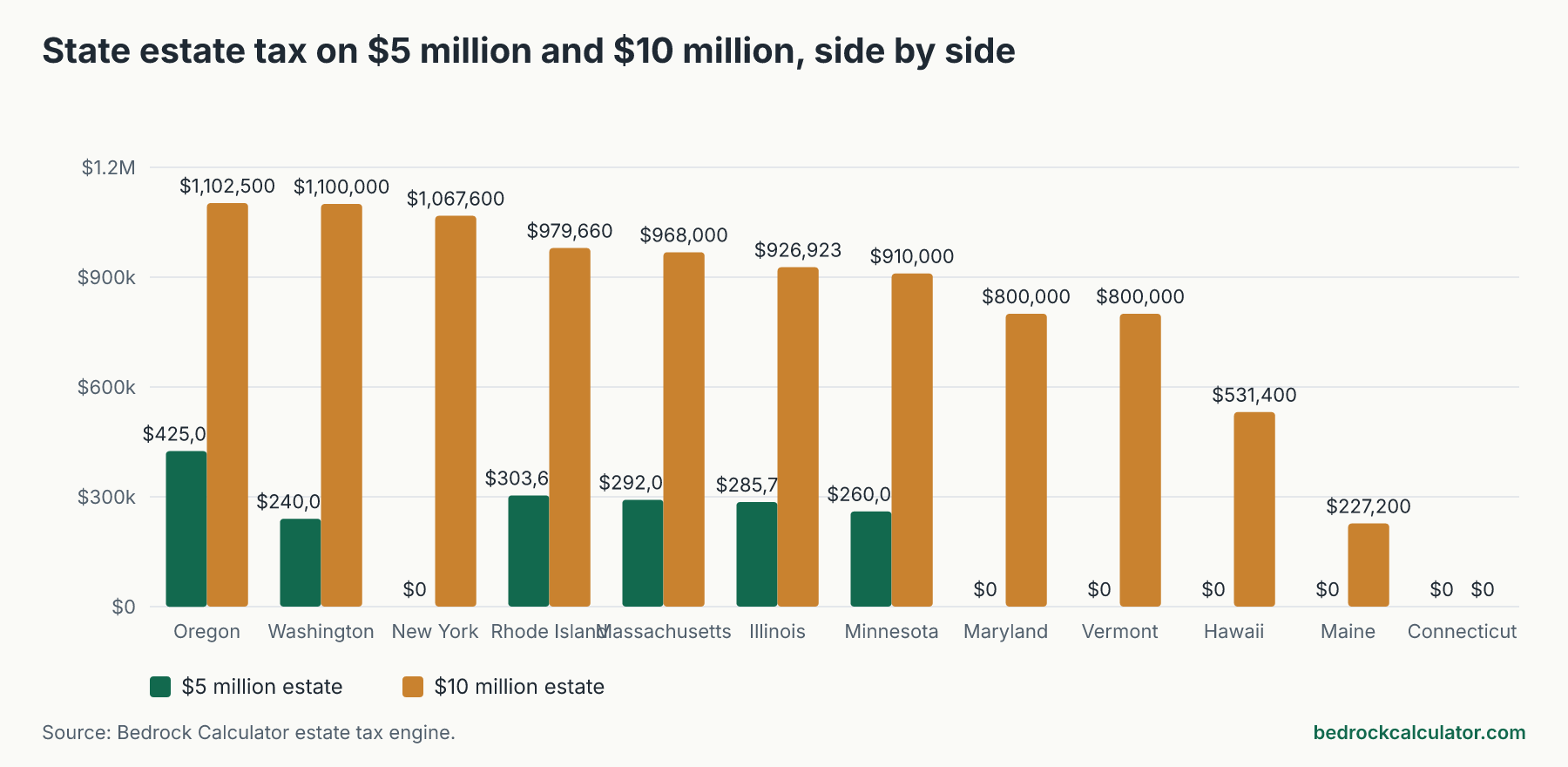
At $5 million the picture splits in two. Half of the estate tax states, 6 of them, charge nothing, because their exemptions are at or above that amount. The other 6 charge real money, led by Oregon at $425,000.
How we worked out these numbers
We ran the estate tax calculator for every state with an estate tax, once with a $5,000,000 estate and once with a $10,000,000 estate, and recorded the state tax due. Each run uses the 2026 exemption and rate schedule for that state, including the parts that make some states unusual: New York's cliff, the credit used by Massachusetts and Rhode Island, and the special calculation Illinois uses.
What the numbers don't include:
- Federal estate tax. The calculator models state tax only. The federal exemption is much higher than any state's and is figured separately, so check it too if the estate is large.
- Deductions. We assume none. In practice, everything left to a surviving spouse is usually deductible, as are gifts to charity, debts and funeral and administration costs. A married couple's estate often owes no state tax at the first death.
- Washington's mid-year change. We use the schedule for deaths on or after July 1, 2026.
- The District of Columbia, which has an estate tax but isn't in our engine's table.
- Real estate in another state, lifetime gifts that some states add back, and trusts, all of which change the taxable estate.
State estate tax on $5 million and $10 million, state by state
Click any column heading to sort. The effective rate is the tax divided by the whole estate.
State estate tax on a $5 million and a $10 million estate, 2026
Download CSVNo deductions; deaths in 2026 (Washington: on or after July 1, 2026). Federal estate tax not included.
| Oregon | $1,000,000 | $425,000 | 8.50% | $1,102,500 | 11.03% |
| Washington | $3,000,000 | $240,000 | 4.80% | $1,100,000 | 11.00% |
| New York | $7,350,000 | $0 | 0.00% | $1,067,600 | 10.68% |
| Rhode Island | $1,838,056 | $303,660 | 6.07% | $979,660 | 9.80% |
| Massachusetts | $2,000,000 | $292,000 | 5.84% | $968,000 | 9.68% |
| Illinois | $4,000,000 | $285,714 | 5.71% | $926,923 | 9.27% |
| Minnesota | $3,000,000 | $260,000 | 5.20% | $910,000 | 9.10% |
| Maryland | $5,000,000 | $0 | 0.00% | $800,000 | 8.00% |
| Vermont | $5,000,000 | $0 | 0.00% | $800,000 | 8.00% |
| Hawaii | $5,490,000 | $0 | 0.00% | $531,400 | 5.31% |
| Maine | $7,160,000 | $0 | 0.00% | $227,200 | 2.27% |
| Connecticut | $15,000,000 | $0 | 0.00% | $0 | 0.00% |
Why Oregon, Washington and New York top the list
Oregon has the lowest exemption in the country, so almost the whole estate is in the tax base. Its rates climb as the estate grows, which gives it the biggest bill at both sizes: $425,000 on $5 million and $1,102,500 on $10 million.
Washington has a higher exemption, but its rates on a large estate go higher than most states', so a $10 million estate owes $1,100,000. At $5 million it owes $240,000.
New York is the swing case. Its exemption is $7,350,000, so a $5 million estate owes $0. But a $10 million estate is well past New York's cliff, which means the whole estate is taxed, not just the excess. That's how New York goes from nothing to $1,067,600.
The middle of the pack
Massachusetts, Rhode Island, Illinois and Minnesota have low exemptions, so a $5 million estate pays a meaningful bill in each. Massachusetts, for example, comes to $292,000 at $5 million and $968,000 at $10 million.
Maryland and Vermont exempt exactly $5 million, so a $5 million estate owes nothing there. Hawaii and Maine have higher exemptions and charge less on $10 million than most. Connecticut has the highest exemption of any state, $15,000,000, so neither estate owes it anything.
How these estates compare nationally
Averaged across just the 12 estate tax states, a $5 million estate owes $150,531 and a $10 million estate $784,440. Spread across all 50 states, counting the ones with no estate tax, the average drops to $36,127 and $188,266. In 39 states a $10 million estate owes no state estate tax at all.
That gap is why people with large estates sometimes weigh where they live in retirement. Domicile decides which state's estate tax applies, though real estate is taxed by the state where it sits, so a vacation home in Massachusetts or Oregon can pull an estate into that state's tax even if you live elsewhere.
Run your own estate
The estate tax calculator lets you enter your estate's value and deductions for any state. State pages add local detail: see the New York estate tax calculator, the Massachusetts estate tax calculator, the Washington estate tax calculator and the Oregon estate tax calculator. For the exemption and rate in every state, see our estate and inheritance tax by state study.