What is the sales tax rate in each US state in 2026?
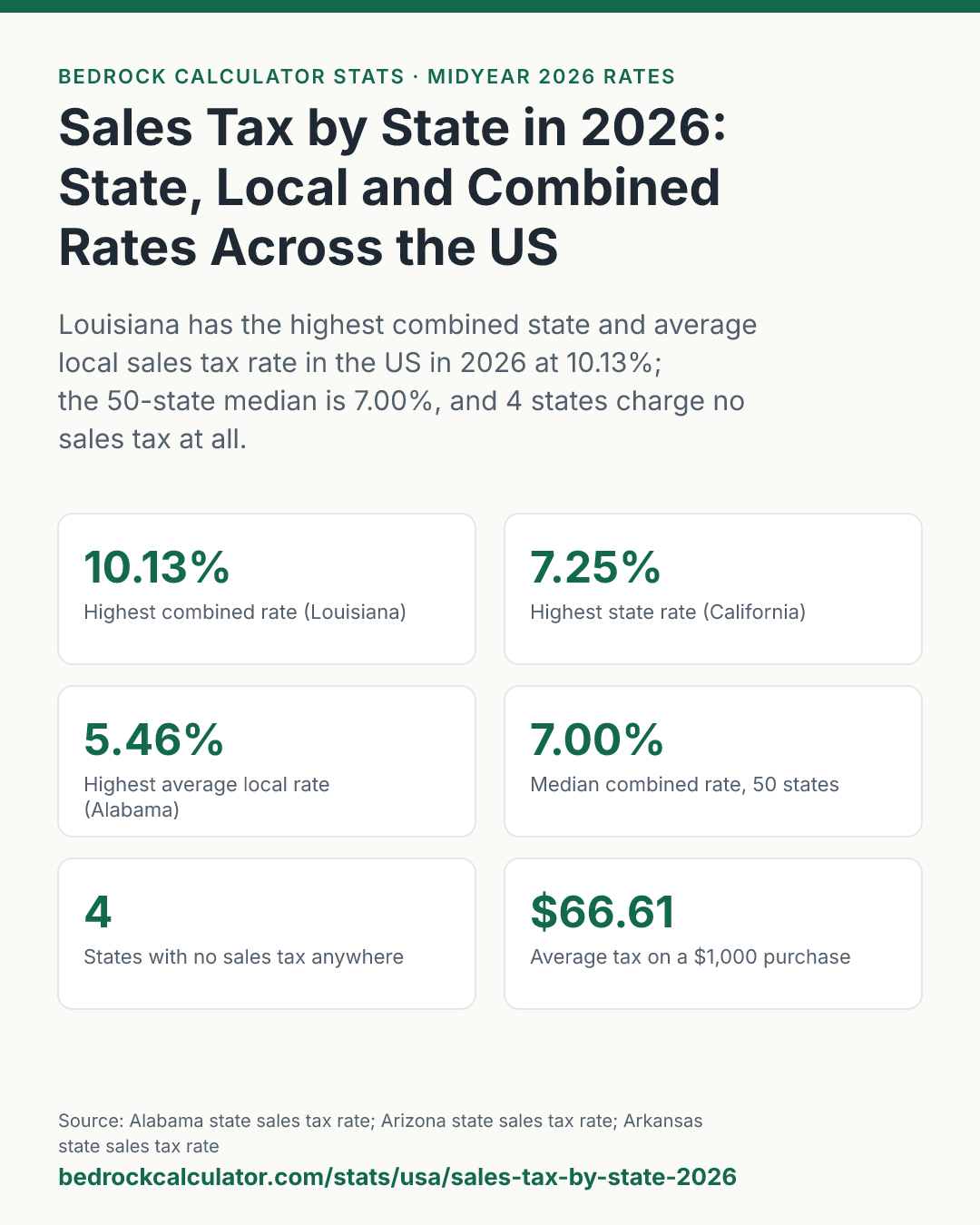
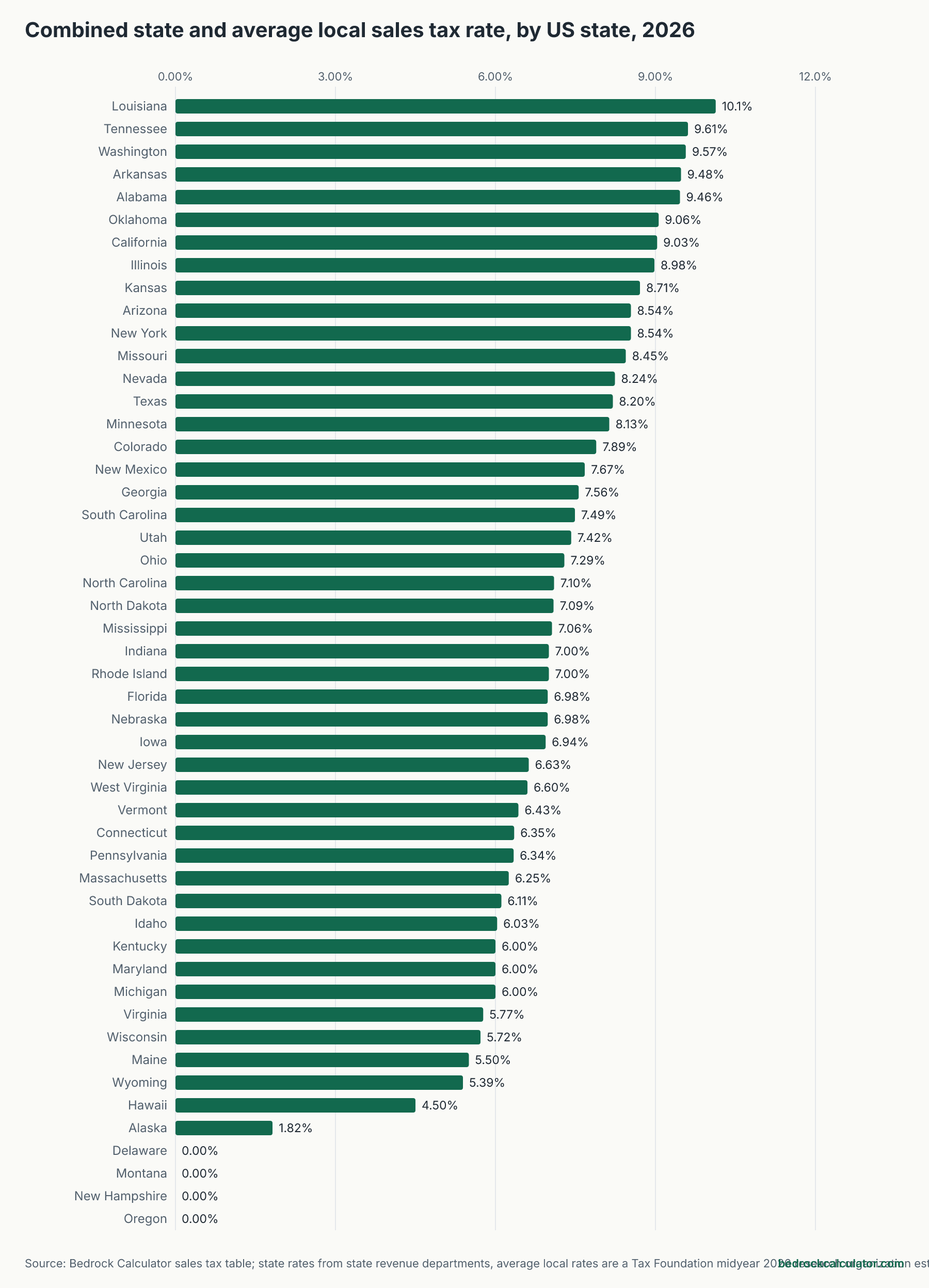
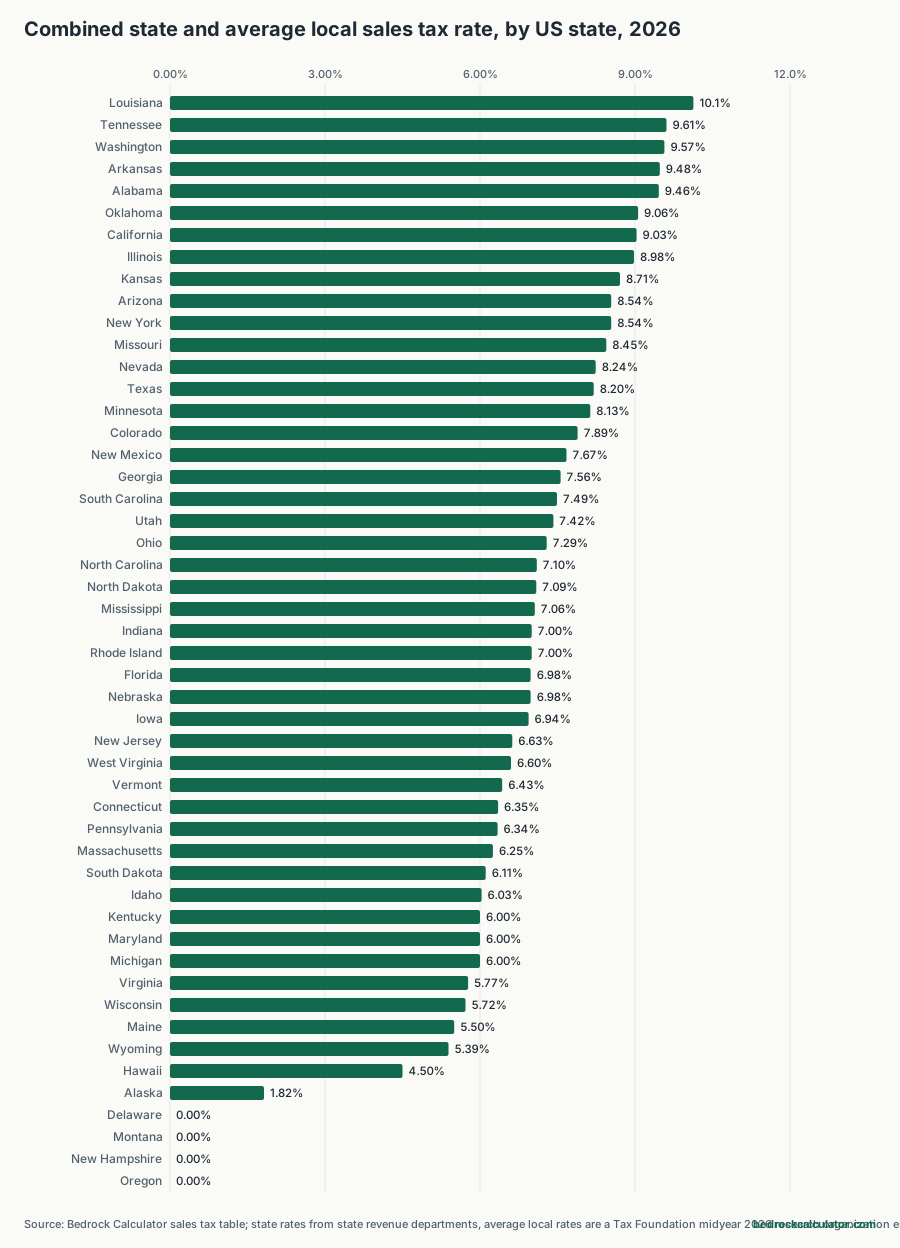
Louisiana has the highest sales tax in the US in 2026 once local taxes are counted, a combined 10.13%. The top five are Louisiana (10.13%), Tennessee (9.61%), Washington (9.57%), Arkansas (9.48%), Alabama (9.46%).
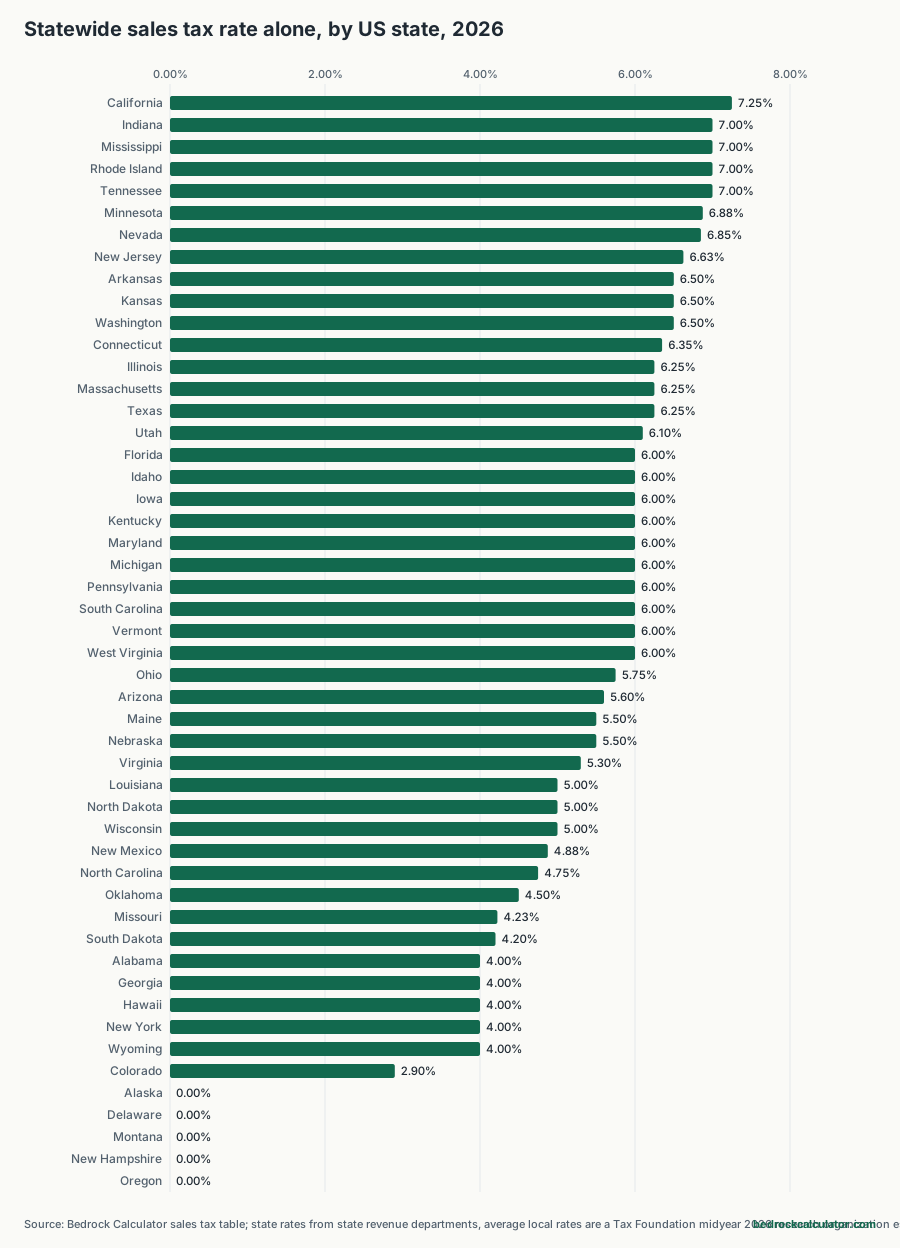
On the statewide rate alone, California is highest at 7.25%. Delaware, Montana, New Hampshire, Oregon have no general sales tax anywhere. Across all 50 states the median combined rate is 7.00%.
Where these rates come from
The rates on this page come from the sales tax table behind our sales tax calculator. That table carries, for each state, the statewide rate and the average of the local rates charged by cities, counties and special districts, weighted by population. Each statewide rate was checked against that state's own revenue department. The average local rate is different: no government agency publishes a population-weighted statewide average, so that figure comes from the Tax Foundation's midyear 2026 compilation, a research organization's estimate rather than official data. New Jersey's local rate, for example, is zero here because the state has no local sales tax. The "tax on a $1,000 purchase" column is what the sales tax calculator returns for that purchase in each state.
Three things the table can't show you:
- Your exact local rate. The local column is a statewide average. Two shops a few miles apart can charge rates more than a point apart, depending on which city, county and district lines they fall inside.
- What's taxable. States differ a lot on what the rate applies to. Groceries, clothing, prescription drugs and many services are exempt or taxed at a reduced rate in some states and fully taxed in others. Our list of states that tax groceries covers the biggest one.
- Tax holidays and caps. Some states suspend sales tax on certain items for a few days a year, and a few cap local tax on big single purchases.
Sales tax rates for every US state
Click any column to sort. The default order is by combined rate, highest first.
Sales tax rates by US state, 2026
Download CSVState rate, population-weighted average local rate and the two combined. Your own city or county rate can differ from the average.
| Louisiana | 5.00% | 5.13% | 10.13% | $101.30 | 1 |
| Tennessee | 7.00% | 2.61% | 9.61% | $96.10 | 2 |
| Washington | 6.50% | 3.07% | 9.57% | $95.70 | 3 |
| Arkansas | 6.50% | 2.98% | 9.48% | $94.80 | 4 |
| Alabama | 4.00% | 5.46% | 9.46% | $94.60 | 5 |
| Oklahoma | 4.50% | 4.56% | 9.06% | $90.60 | 6 |
| California | 7.25% | 1.78% | 9.03% | $90.30 | 7 |
| Illinois | 6.25% | 2.73% | 8.98% | $89.80 | 8 |
| Kansas | 6.50% | 2.21% | 8.71% | $87.10 | 9 |
| Arizona | 5.60% | 2.94% | 8.54% | $85.40 | 10 |
| New York | 4.00% | 4.54% | 8.54% | $85.40 | 10 |
| Missouri | 4.23% | 4.22% | 8.45% | $84.45 | 12 |
| Nevada | 6.85% | 1.39% | 8.24% | $82.40 | 13 |
| Texas | 6.25% | 1.95% | 8.20% | $82.00 | 14 |
| Minnesota | 6.88% | 1.26% | 8.13% | $81.35 | 15 |
| Colorado | 2.90% | 4.99% | 7.89% | $78.90 | 16 |
| New Mexico | 4.88% | 2.80% | 7.67% | $76.75 | 17 |
| Georgia | 4.00% | 3.56% | 7.56% | $75.60 | 18 |
| South Carolina | 6.00% | 1.49% | 7.49% | $74.90 | 19 |
| Utah | 6.10% | 1.32% | 7.42% | $74.20 | 20 |
| Ohio | 5.75% | 1.54% | 7.29% | $72.90 | 21 |
| North Carolina | 4.75% | 2.35% | 7.10% | $71.00 | 22 |
| North Dakota | 5.00% | 2.09% | 7.09% | $70.90 | 23 |
| Mississippi | 7.00% | 0.06% | 7.06% | $70.60 | 24 |
| Indiana | 7.00% | 0.00% | 7.00% | $70.00 | 25 |
| Rhode Island | 7.00% | 0.00% | 7.00% | $70.00 | 25 |
| Florida | 6.00% | 0.98% | 6.98% | $69.80 | 27 |
| Nebraska | 5.50% | 1.48% | 6.98% | $69.80 | 27 |
| Iowa | 6.00% | 0.94% | 6.94% | $69.40 | 29 |
| New Jersey | 6.63% | 0.00% | 6.63% | $66.25 | 30 |
| West Virginia | 6.00% | 0.60% | 6.60% | $66.00 | 31 |
| Vermont | 6.00% | 0.43% | 6.43% | $64.30 | 32 |
| Connecticut | 6.35% | 0.00% | 6.35% | $63.50 | 33 |
| Pennsylvania | 6.00% | 0.34% | 6.34% | $63.40 | 34 |
| Massachusetts | 6.25% | 0.00% | 6.25% | $62.50 | 35 |
| South Dakota | 4.20% | 1.91% | 6.11% | $61.10 | 36 |
| Idaho | 6.00% | 0.03% | 6.03% | $60.30 | 37 |
| Kentucky | 6.00% | 0.00% | 6.00% | $60.00 | 38 |
| Maryland | 6.00% | 0.00% | 6.00% | $60.00 | 38 |
| Michigan | 6.00% | 0.00% | 6.00% | $60.00 | 38 |
| Virginia | 5.30% | 0.47% | 5.77% | $57.70 | 41 |
| Wisconsin | 5.00% | 0.72% | 5.72% | $57.20 | 42 |
| Maine | 5.50% | 0.00% | 5.50% | $55.00 | 43 |
| Wyoming | 4.00% | 1.39% | 5.39% | $53.90 | 44 |
| Hawaii | 4.00% | 0.50% | 4.50% | $45.00 | 45 |
| Alaska | 0.00% | 1.82% | 1.82% | $18.20 | 46 |
| Delaware | 0.00% | 0.00% | 0.00% | $0.00 | 47 |
| Montana | 0.00% | 0.00% | 0.00% | $0.00 | 47 |
| New Hampshire | 0.00% | 0.00% | 0.00% | $0.00 | 47 |
| Oregon | 0.00% | 0.00% | 0.00% | $0.00 | 47 |
State rate vs local rate
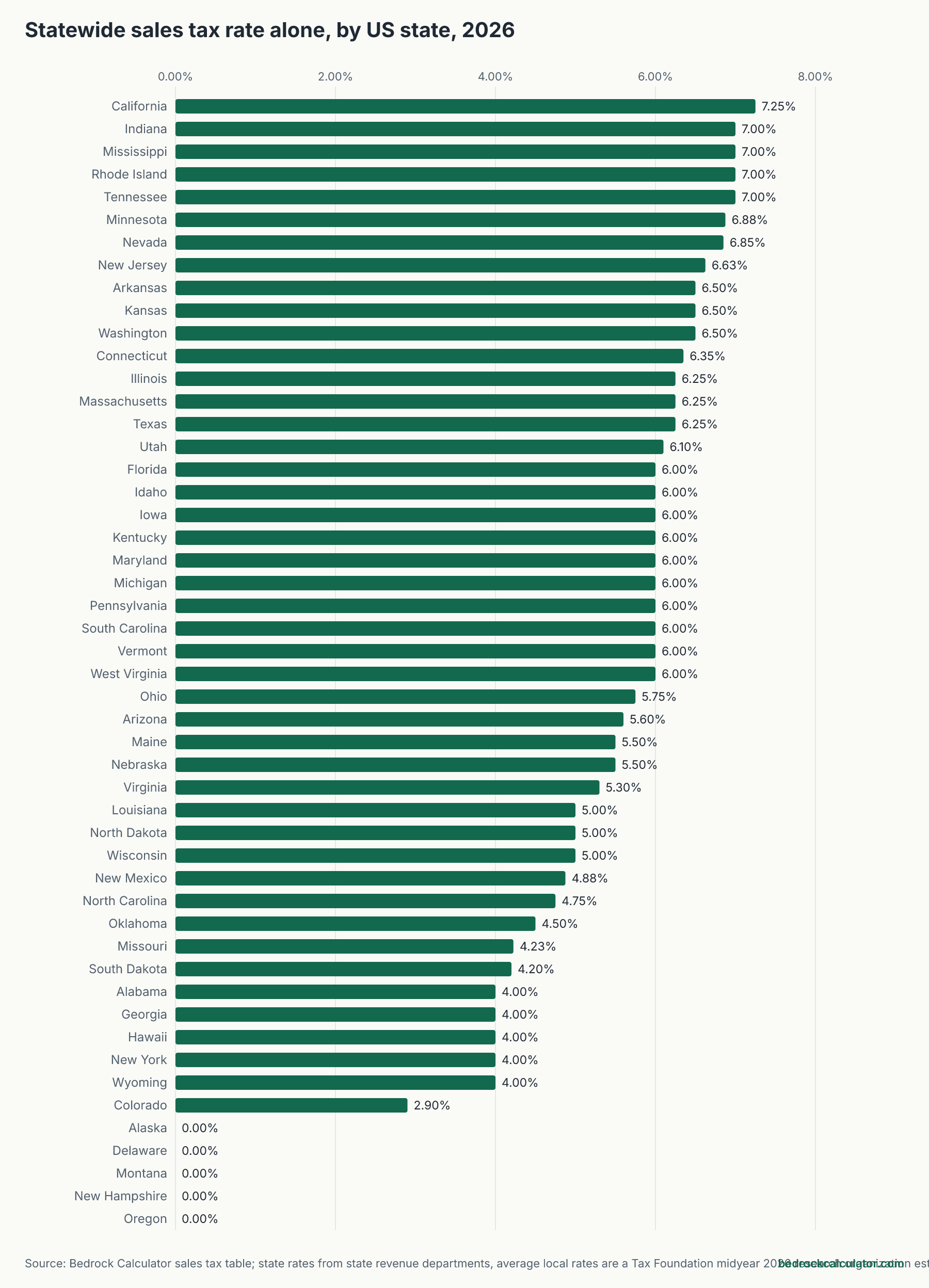
A state's rank depends heavily on local taxes. Here's the ranking on the statewide rate alone, before any city or county adds its share.
California has the highest statewide rate, 7.25%. That figure already includes a uniform local portion that applies everywhere in the state. Local district taxes average another 1.78% on top, for a combined 9.03%.
Colorado has the lowest statewide rate of any state with a sales tax, 2.90%. But its cities and counties make up for it: local rates average 4.99%, putting Colorado's combined rate at 7.89%.
Colorado isn't alone. In 5 states, the average local rate is higher than the state rate itself: Alabama, Colorado, Louisiana, New York, Oklahoma. Alabama has the highest average local rate in the country, 5.46%.
At the other end, 9 states have no local sales tax in this table, so the state rate is the rate everywhere: Connecticut, Indiana, Kentucky, Maine, Maryland, Massachusetts, Michigan, New Jersey, Rhode Island.
The states with the highest sales tax
Louisiana tops the combined ranking at 10.13%, or $101.30 on a $1,000 purchase. Close behind is Tennessee at 9.61%, which has no income tax and leans on sales tax instead; the same purchase costs $96.10 in tax there.
High combined rates cluster in the South and in states without an income tax. If you're comparing a move between a high sales tax state and a high income tax state, look at both together. Our piece on what no-income-tax states charge instead runs that comparison on one household.
The states with no sales tax
Delaware, Montana, New Hampshire, Oregon have no general sales tax at the state or local level, so they show a combined rate of zero.
Alaska is a special case. There's no state sales tax, but its boroughs and cities can levy their own. Averaged across the state, that comes to 1.82%, which also makes it the lowest combined rate of any state that has a sales tax somewhere.
What the average US sales tax rate is
There are two ways to answer this, and they give slightly different numbers. The median state has a combined rate of 7.00%. The simple average of all 50 states is 6.66%, or 7.24% if you leave out the states that charge nothing. Both count every state once, so they aren't the rate the average American pays, which would lean toward large states like California and Texas.
On a $1,000 purchase, the average tax across the 50 states is $66.61.
A note on gross receipts taxes
New Mexico and Hawaii tax businesses on gross receipts rather than charging a classic retail sales tax, though businesses usually pass the cost to buyers. The table treats those rates like a sales tax, which is how most shoppers experience them.
Working out your own sales tax
For a purchase in a particular state, the sales tax calculator applies the state rate and the average local rate, and lets you turn the local part off. State pages such as the California sales tax calculator, Texas sales tax calculator and Louisiana sales tax calculator explain how local rates work in each state. For the exact rate at an address, your state revenue department's rate lookup is the final word.