What are the 2026 US gift tax annual exclusion and lifetime exemption?
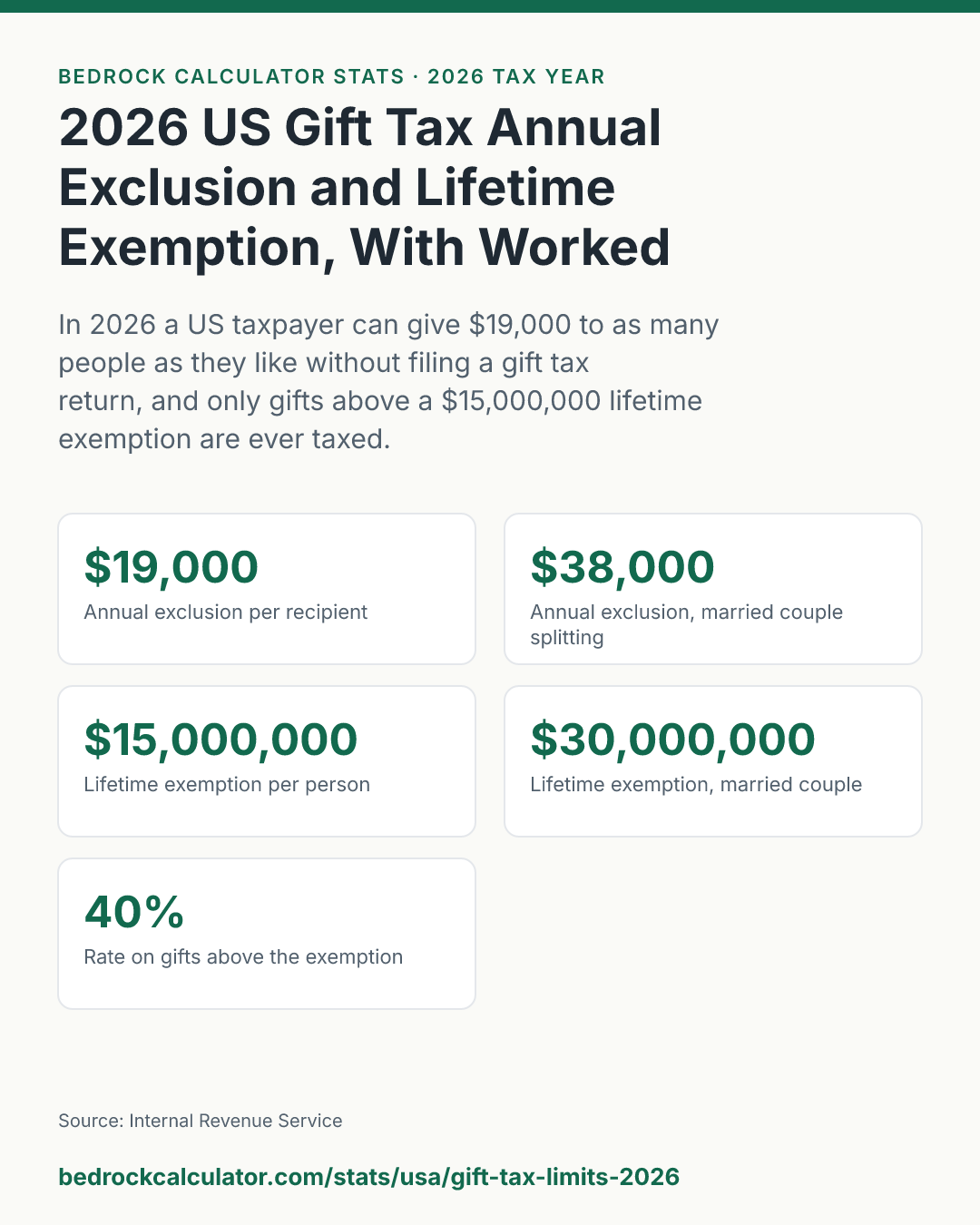
In 2026 you can give up to $19,000 to any one person in the US without it counting toward anything. That's the gift tax annual exclusion, and it applies separately to each person you give to. A married couple who split their gifts can give $38,000 per person.
Above that, gifts come off a lifetime exemption of $15,000,000 per person, $30,000,000 for a couple, which also covers your estate at death. You only pay gift tax, at 40%, on gifts beyond that. For nearly everyone, giving more than the annual exclusion means filing a form, not paying a tax.
How we worked out these examples
Every figure on this page comes from the gift tax calculator on this site, which holds the 2026 annual exclusion and lifetime exemption from IRS Revenue Procedure 2025-32. The lifetime exemption reflects the 2025 tax law that set it permanently from 2026 instead of letting it fall back by about half, as had been scheduled.
How the calculator works, and what it leaves out:
- Each recipient's gift first absorbs their own annual exclusion. Whatever is left is a taxable gift that reduces your lifetime exemption.
- If a gift goes past the remaining exemption, the calculator taxes the excess at the top rate of 40%. That's exact for anyone who gets that far, because by then every dollar is in the top bracket of the gift tax schedule.
- Gift splitting doubles both the per-recipient exclusion and the exemption available, as it does when both spouses consent on Form 709.
- It doesn't model gifts to a spouse, which are unlimited if your spouse is a US citizen, or tuition and medical bills paid directly to the school or provider, which don't count as gifts at all.
- It doesn't model the option to spread a large 529 plan contribution over five years of exclusions, or state gift taxes. Connecticut is the only state with its own gift tax.
Worked 2026 gift tax examples
Worked 2026 gift tax examples
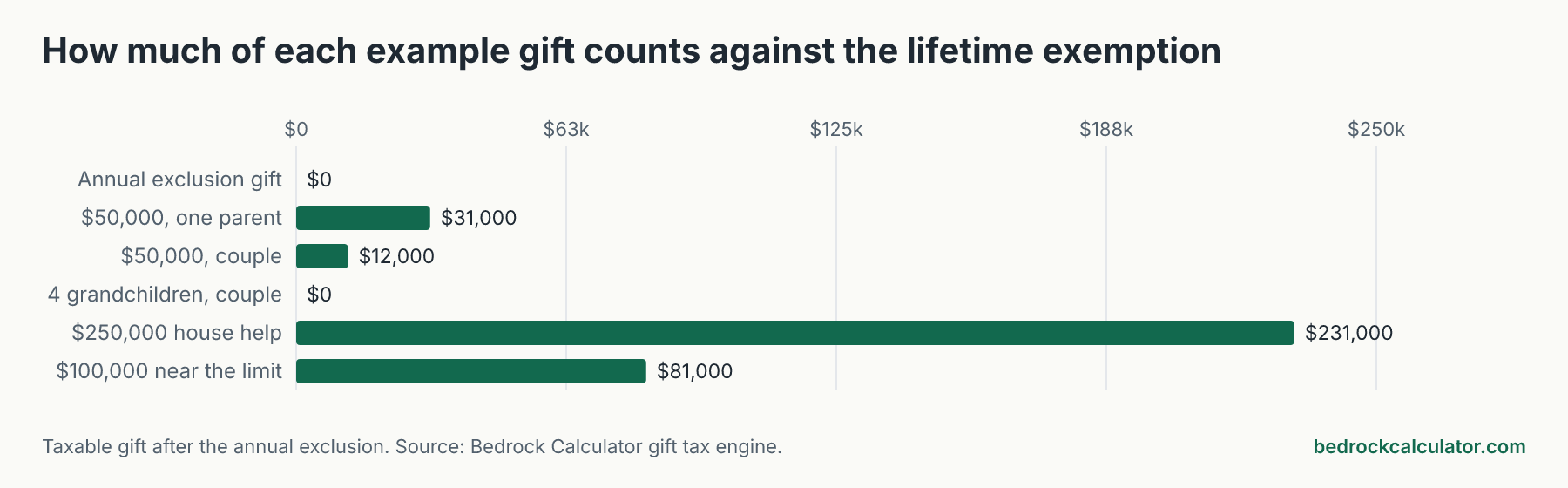
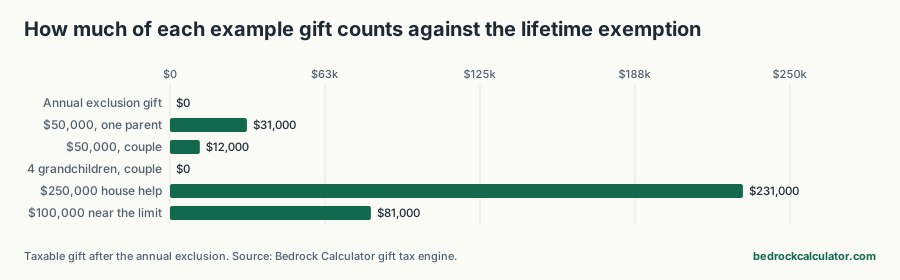
Download CSVFrom the gift tax calculator. "Exemption used" is the part of the taxable gift that comes off the lifetime exemption instead of being taxed now.
| A donor who already used $14,990,000 of exemption gives $100,000 | $100,000 | $81,000.00 | $10,000.00 | $28,400.00 | $0.00 |
| A married couple, splitting gifts, gives a child $50,000 | $50,000 | $12,000.00 | $12,000.00 | $0.00 | $29,988,000.00 |
| A married couple, splitting gifts, gives each of 4 grandchildren $38,000 | $152,000 | $0.00 | $0.00 | $0.00 | $30,000,000.00 |
| One parent gives a child $250,000 toward a house | $250,000 | $231,000.00 | $231,000.00 | $0.00 | $14,769,000.00 |
| One parent gives a child $50,000 | $50,000 | $31,000.00 | $31,000.00 | $0.00 | $14,969,000.00 |
| One parent gives a child the annual exclusion amount | $19,000 | $0.00 | $0.00 | $0.00 | $15,000,000.00 |
| One person gives $16,000,000 in a single gift | $16,000,000 | $15,981,000.00 | $15,000,000.00 | $392,400.00 | $0.00 |
Some of these are worth walking through.
A $50,000 gift to a child. The first $19,000 is excluded. The other $31,000.00 is a taxable gift, but no tax is due. It reduces your lifetime exemption to $14,969,000.00, and you report it on Form 709 by the following April.
The same $50,000 from a married couple. If both spouses agree to split the gift, it uses two exclusions, so only $12,000.00 is taxable and it comes off a combined exemption.
A couple giving to four grandchildren. Giving each grandchild $38,000 moves $152,000 out of the couple's estate in one year with nothing taxable and no exemption used. Gift splitting still has to be elected on Form 709, though.
Help with a house. A $250,000 gift toward a child's home is $231,000.00 of taxable gift and $0.00 of tax. It uses part of your exemption, leaving $14,769,000.00.
When tax is actually due. A donor who has already used $14,990,000 of their exemption and gives another $100,000 has $81,000.00 of taxable gift. Only $10,000.00 of exemption is left, so $71,000.00 goes over the line and the tax is $28,400.00. A single gift of $16,000,000 from someone with a full exemption owes $392,400.00.
How much can you give tax-free in 2026?
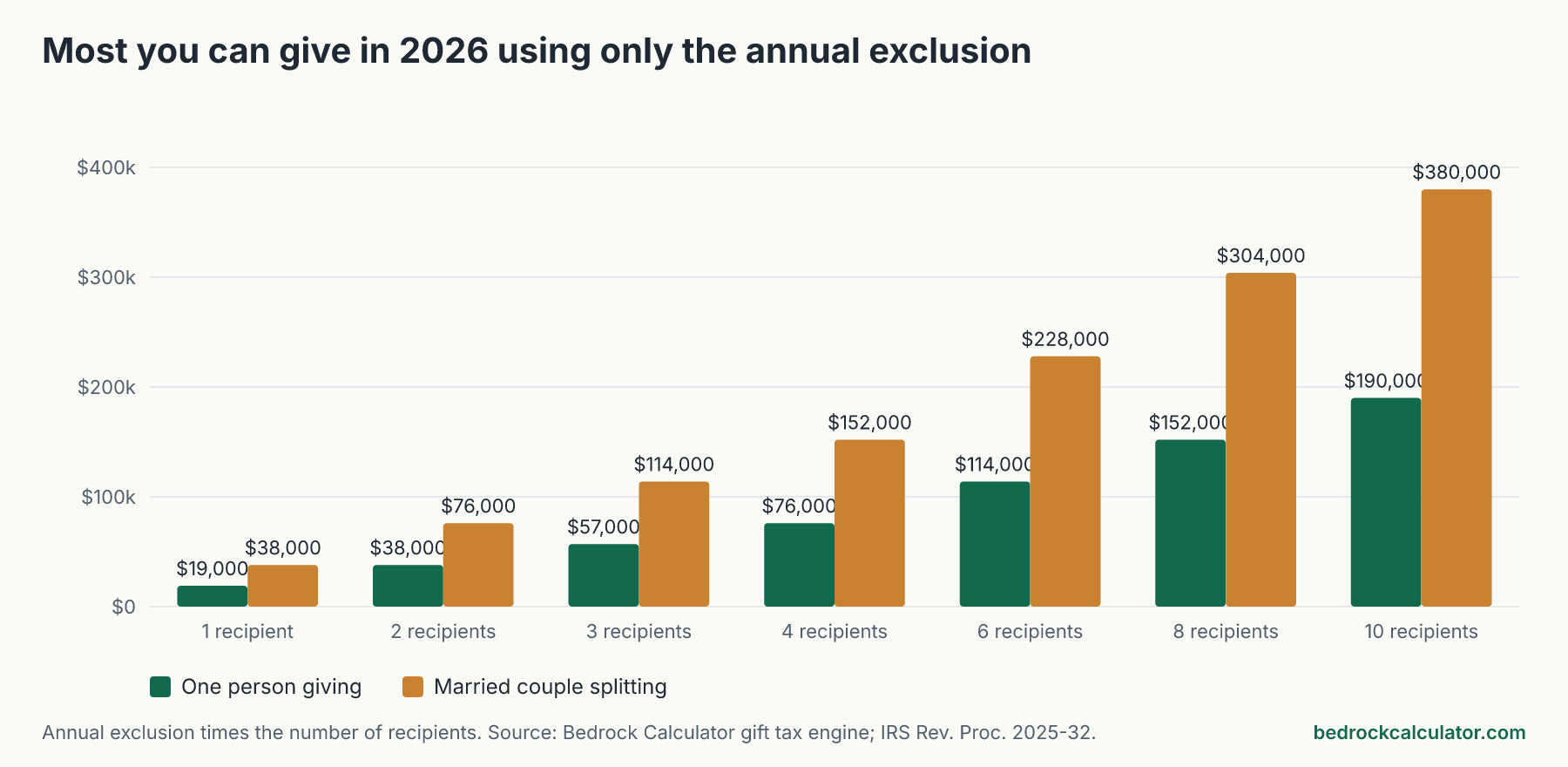
Because the exclusion is per recipient, the total grows with every person you include.
How much you can give in 2026 without touching the lifetime exemption
Download CSVThe annual exclusion multiplied by the number of recipients. A married couple who split gifts gets two exclusions per recipient.
| 1 | $19,000 | $38,000 |
| 2 | $38,000 | $76,000 |
| 3 | $57,000 | $114,000 |
| 4 | $76,000 | $152,000 |
| 6 | $114,000 | $228,000 |
| 8 | $152,000 | $304,000 |
| 10 | $190,000 | $380,000 |
One person giving to three children can move $57,000 a year with no paperwork. A couple with three children, their three spouses and four grandchildren, ten people in all, can give $380,000 a year without touching their exemption. Repeated every year, that's one of the simplest ways to reduce an estate.
Do you need to file a gift tax return?
You need to file Form 709 if, in 2026:
- you give anyone more than $19,000, or
- you and your spouse elect to split gifts, even if each half is under the exclusion.
Filing doesn't mean paying. In almost every case the return just records how much of your lifetime exemption you've used. The person who receives a gift never owes gift tax and doesn't report it as income.
Gifts and the estate tax
The lifetime exemption is shared between gifts and your estate. Every dollar of taxable gift you make now is a dollar less of exemption at death. With an exemption of $15,000,000, that only matters for large estates, and most families will never use it up.
What does matter for most people is what you give. Cash is simple. Appreciated assets carry over your original cost basis, so the recipient may owe capital gains tax when they sell. Assets inherited at death usually get a stepped-up basis instead. Our guide on how capital gains tax works explains the rates that apply.
To check your own figures, use the gift tax calculator. For larger estates, the estate tax calculator shows the federal estate tax, and the inheritance tax calculator covers the handful of states that tax heirs directly.