How much does a married couple filing jointly take home in each US state?
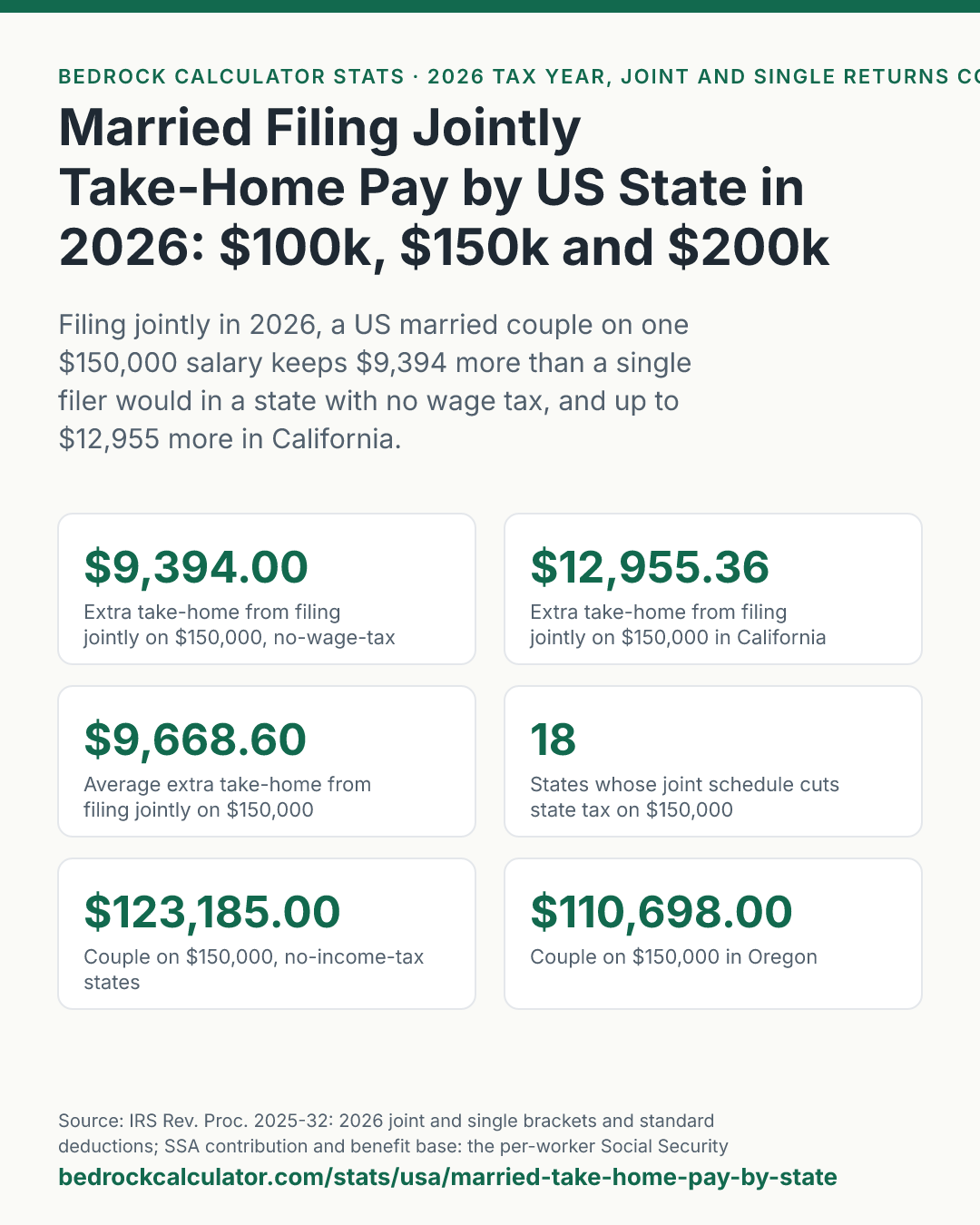
Put one $150,000 salary on a joint return instead of a single one and a US couple keeps $9,394.00 more a year in a state with no wage tax. That whole gain is federal: at these incomes the joint standard deduction and brackets are twice as wide as the single ones.
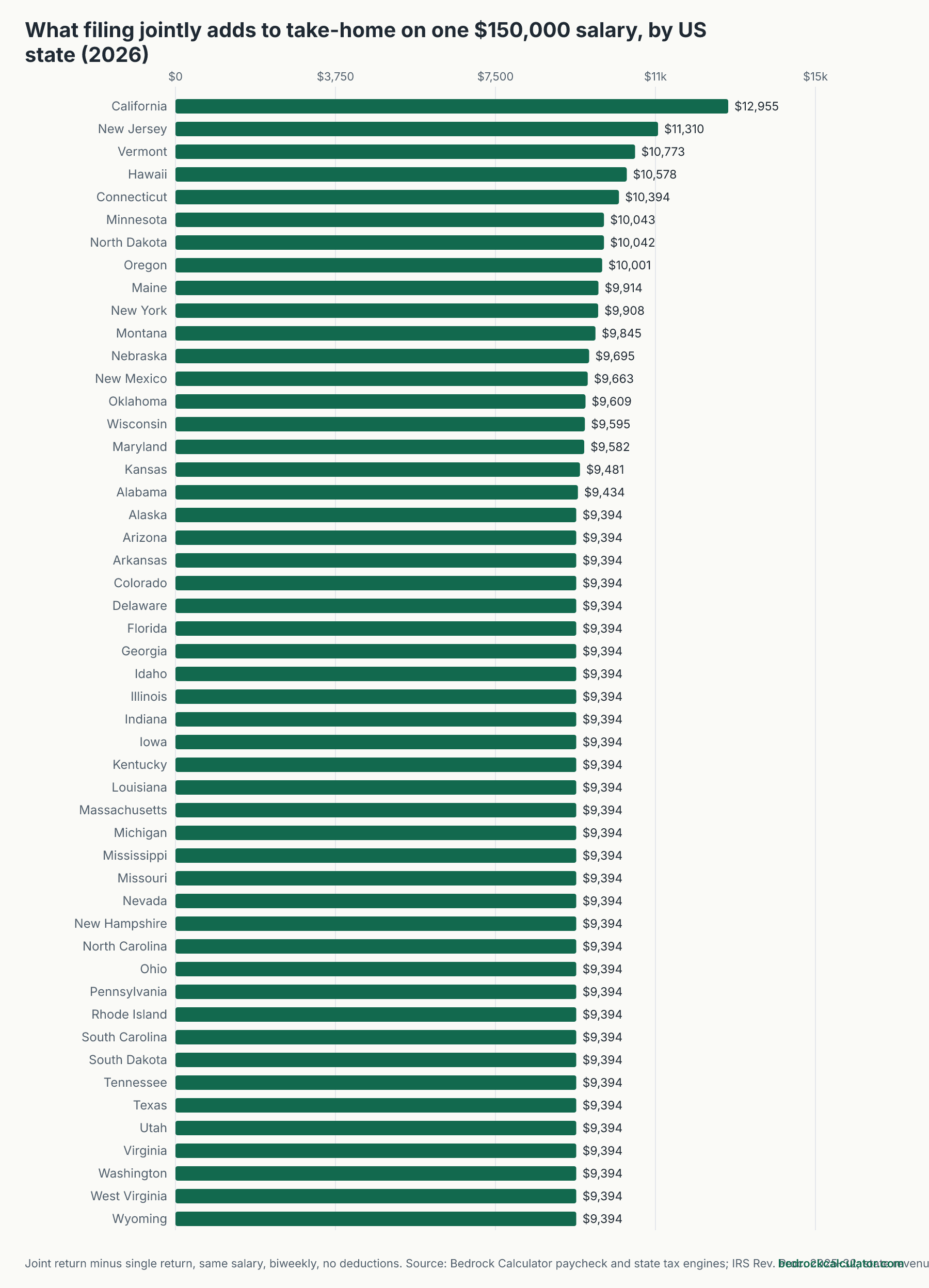
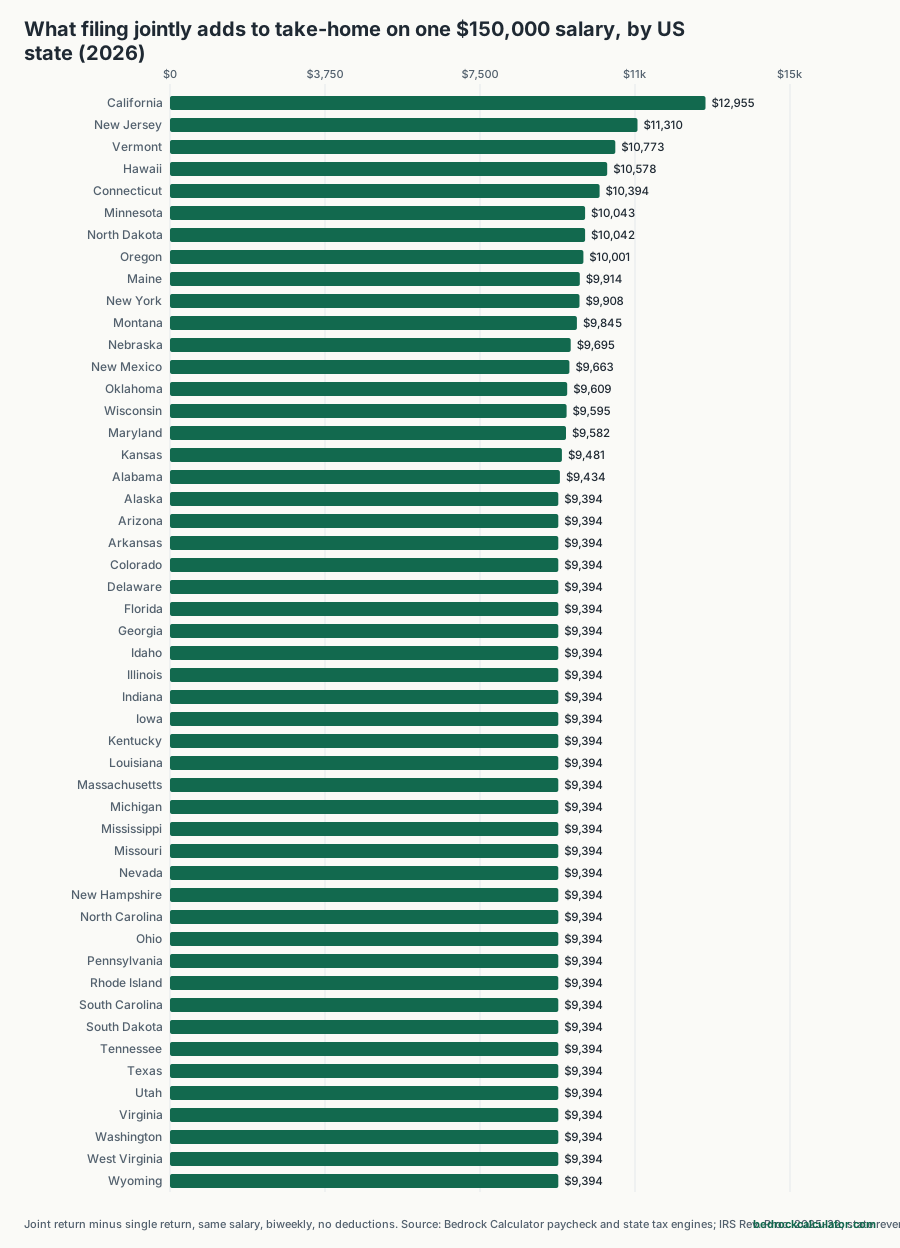
In states whose own tax code gives couples wider brackets the gain is bigger, peaking at $12,955.36 in California.
Where the couple lives still sets the final number. On $150,000 a joint return keeps $123,185.00 in the 9 states that skip wage tax and $110,698.00 in Oregon, about $1,040.58 a month apart.
What filing jointly is worth, and where it's worth more
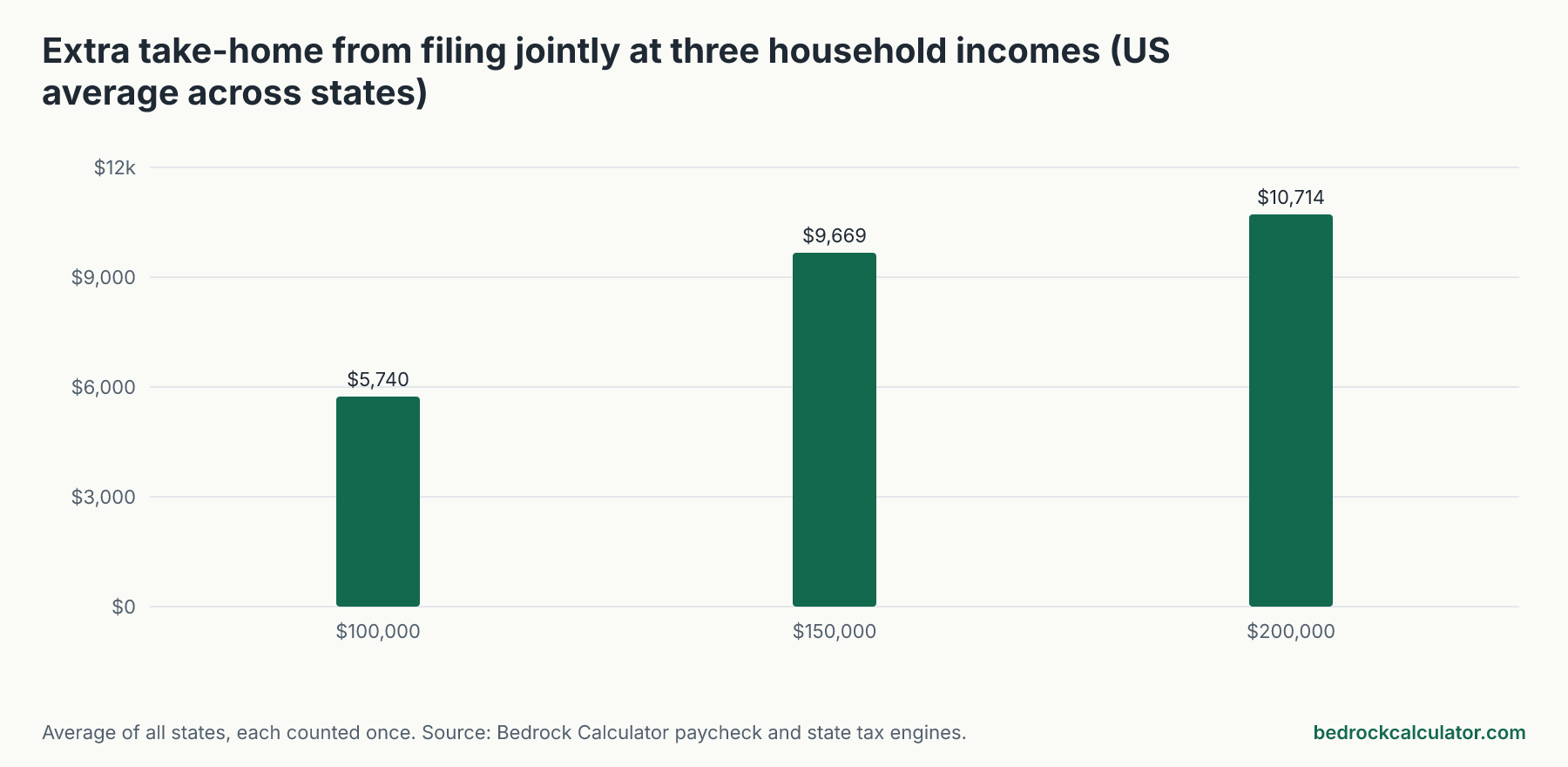
Filing status changes two layers of the bill. The federal layer is identical in every state, so it sets a floor: $5,530.00 at $100,000, $9,394.00 at $150,000 and $10,394.00 at $200,000, measured against the same salary on a single return.
The state layer is where couples see real differences. In 18 states, the state's own joint schedule takes less tax from $150,000 than its single schedule does, so the couple gains on top of the federal amount. California leads: its joint schedule alone saves $3,561.36.
In 23 states the state tax on $150,000 comes out the same on either return in our runs: Arizona, Arkansas, Colorado, Delaware, Georgia, Idaho, Illinois, Indiana, Iowa, Kentucky, Louisiana, Massachusetts, Michigan, Mississippi, Missouri, North Carolina, Ohio, Pennsylvania, Rhode Island, South Carolina, Utah, Virginia, West Virginia. Most of these tax wages at one flat rate, so wider brackets would change nothing. In the rest, the calculator applies one set of brackets to both returns, either because the state does or because the state tax table holds no separate joint schedule.
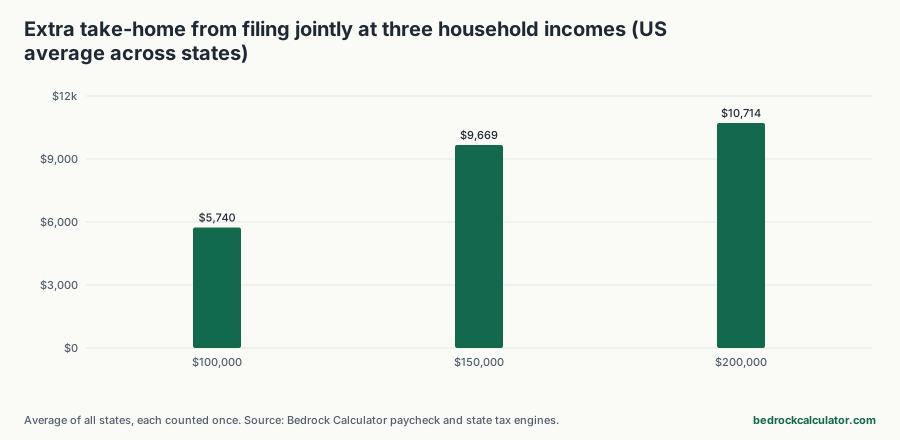
Averaged over all 50 states, joint filing adds $5,740.35 at $100,000, $9,668.60 at $150,000 and $10,713.78 at $200,000.
How we got these figures
Each state was run through the site's paycheck calculator twice for every household income, once as married filing jointly and once as single, with nothing else changed:
- One earner, salary only, paid every two weeks, no 401(k), HSA or other deductions
- 2026 federal brackets and standard deductions from IRS Revenue Procedure 2025-32
- 2026 Social Security wage base and the Additional Medicare Tax thresholds for each filing status
- The state's married-filing-jointly schedule wherever the state tax tables hold one, otherwise its single schedule
The difference between the two runs is the "joint filing adds" column. It isn't a marriage bonus estimate for two earners: if both spouses work, the joint brackets are shared between two incomes and the gain shrinks or disappears.
Limits worth knowing:
- State deductions and credits are not applied. The state figure is the rate schedule applied to wages, so it can overstate tax where a state has a large standard deduction or personal exemption.
- No local income tax. City and county wage taxes, such as New York City's or Philadelphia's, are left out. Our list of US cities with their own income tax covers them.
- No dependents. No Child Tax Credit, no itemizing.
- Annual tax, not withholding. What leaves each paycheck depends on the W-4s you file.
Married take-home pay in each state, joint versus single
The table opens sorted by what joint filing adds on $150,000. Re-sort by any column to rank states by the couple's take-home instead.
Married filing jointly versus single on the same salary, by US state (2026)
Download CSVOne salary paid biweekly, no pre-tax or post-tax deductions. Joint columns use the joint federal brackets and each state's joint schedule where one is on file; the single column runs the same salary on a single return.
| California | $12,955.36 | $3,561.36 | $103,402.36 | $81,640.22 | $116,357.72 | $147,843.72 |
| New Jersey | $11,310.25 | $1,916.25 | $106,362.25 | $81,960.00 | $117,672.50 | $150,623.50 |
| Vermont | $10,772.75 | $1,378.75 | $105,193.50 | $80,791.25 | $115,966.25 | $148,796.75 |
| Hawaii | $10,577.80 | $1,183.80 | $103,424.80 | $79,327.60 | $114,002.60 | $146,338.60 |
| Connecticut | $10,394.00 | $1,000.00 | $106,041.00 | $80,710.00 | $116,435.00 | $149,821.00 |
| Minnesota | $10,043.14 | $649.14 | $103,648.01 | $78,616.15 | $113,691.15 | $146,358.69 |
| North Dakota | $10,041.89 | $647.89 | $111,832.71 | $84,374.60 | $121,874.60 | $157,035.60 |
| Oregon | $10,000.50 | $606.50 | $100,697.50 | $76,598.00 | $110,698.00 | $142,459.00 |
| Maine | $9,914.37 | $520.37 | $103,585.70 | $78,481.07 | $113,500.07 | $146,061.07 |
| New York | $9,908.25 | $514.25 | $105,509.25 | $79,642.50 | $115,417.50 | $148,661.25 |
| Montana | $9,845.25 | $451.25 | $105,767.25 | $79,962.50 | $115,612.50 | $148,923.50 |
| Nebraska | $9,694.87 | $300.87 | $107,266.87 | $80,761.74 | $116,961.74 | $150,822.74 |
| New Mexico | $9,663.00 | $269.00 | $106,983.00 | $80,621.00 | $116,646.00 | $150,332.00 |
| Oklahoma | $9,608.75 | $214.75 | $107,255.75 | $80,639.50 | $116,864.50 | $150,750.50 |
| Wisconsin | $9,595.15 | $201.15 | $106,444.54 | $80,214.69 | $116,039.69 | $149,525.69 |
| Maryland | $9,581.50 | $187.50 | $106,531.00 | $80,012.50 | $116,112.50 | $149,686.00 |
| Kansas | $9,481.40 | $87.40 | $105,508.40 | $79,304.80 | $114,989.80 | $148,335.80 |
| Alabama | $9,434.00 | $40.00 | $106,331.00 | $79,790.00 | $115,765.00 | $149,401.00 |
| Alaska | $9,394.00 | $0.00 | $113,791.00 | $84,710.00 | $123,185.00 | $159,321.00 |
| Arizona | $9,394.00 | $0.00 | $110,041.00 | $82,210.00 | $119,435.00 | $154,321.00 |
| Arkansas | $9,394.00 | $0.00 | $108,361.00 | $81,230.00 | $117,755.00 | $151,941.00 |
| Colorado | $9,394.00 | $0.00 | $107,191.00 | $80,310.00 | $116,585.00 | $150,521.00 |
| Delaware | $9,394.00 | $0.00 | $104,907.50 | $79,126.50 | $114,301.50 | $147,137.50 |
| Florida | $9,394.00 | $0.00 | $113,791.00 | $84,710.00 | $123,185.00 | $159,321.00 |
| Georgia | $9,394.00 | $0.00 | $106,306.00 | $79,720.00 | $115,700.00 | $149,341.00 |
| Idaho | $9,394.00 | $0.00 | $105,841.00 | $79,410.00 | $115,235.00 | $148,721.00 |
| Illinois | $9,394.00 | $0.00 | $106,366.00 | $79,760.00 | $115,760.00 | $149,421.00 |
| Indiana | $9,394.00 | $0.00 | $109,366.00 | $81,760.00 | $118,760.00 | $153,421.00 |
| Iowa | $9,394.00 | $0.00 | $108,091.00 | $80,910.00 | $117,485.00 | $151,721.00 |
| Kentucky | $9,394.00 | $0.00 | $108,541.00 | $81,210.00 | $117,935.00 | $152,321.00 |
| Louisiana | $9,394.00 | $0.00 | $109,291.00 | $81,710.00 | $118,685.00 | $153,321.00 |
| Massachusetts | $9,394.00 | $0.00 | $106,291.00 | $79,710.00 | $115,685.00 | $149,321.00 |
| Michigan | $9,394.00 | $0.00 | $107,416.00 | $80,460.00 | $116,810.00 | $150,821.00 |
| Mississippi | $9,394.00 | $0.00 | $108,191.00 | $81,110.00 | $117,585.00 | $151,721.00 |
| Missouri | $9,394.00 | $0.00 | $106,921.63 | $80,190.63 | $116,315.63 | $150,101.63 |
| Nevada | $9,394.00 | $0.00 | $113,791.00 | $84,710.00 | $123,185.00 | $159,321.00 |
| New Hampshire | $9,394.00 | $0.00 | $113,791.00 | $84,710.00 | $123,185.00 | $159,321.00 |
| North Carolina | $9,394.00 | $0.00 | $107,806.00 | $80,720.00 | $117,200.00 | $151,341.00 |
| Ohio | $9,394.00 | $0.00 | $110,050.37 | $82,344.37 | $119,444.37 | $154,205.37 |
| Pennsylvania | $9,394.00 | $0.00 | $109,186.00 | $81,640.00 | $118,580.00 | $153,181.00 |
| Rhode Island | $9,394.00 | $0.00 | $107,486.50 | $80,780.50 | $116,880.50 | $150,473.48 |
| South Carolina | $9,394.00 | $0.00 | $106,942.00 | $80,466.00 | $116,336.00 | $149,867.00 |
| South Dakota | $9,394.00 | $0.00 | $113,791.00 | $84,710.00 | $123,185.00 | $159,321.00 |
| Tennessee | $9,394.00 | $0.00 | $113,791.00 | $84,710.00 | $123,185.00 | $159,321.00 |
| Texas | $9,394.00 | $0.00 | $113,791.00 | $84,710.00 | $123,185.00 | $159,321.00 |
| Utah | $9,394.00 | $0.00 | $107,116.00 | $80,260.00 | $116,510.00 | $150,421.00 |
| Virginia | $9,394.00 | $0.00 | $105,423.50 | $79,217.50 | $114,817.50 | $148,078.50 |
| Washington | $9,394.00 | $0.00 | $113,791.00 | $84,710.00 | $123,185.00 | $159,321.00 |
| West Virginia | $9,394.00 | $0.00 | $107,718.50 | $80,927.50 | $117,112.50 | $150,958.50 |
| Wyoming | $9,394.00 | $0.00 | $113,791.00 | $84,710.00 | $123,185.00 | $159,321.00 |
Two earners or one?
A joint return adds both salaries together, so federal and state income tax come out the same whether one spouse earns everything or the pay is split evenly. Social Security is where the split matters, because it's charged per worker up to a yearly wage cap.
Our figures assume one salary. On $200,000 earned by one person, the employee share of Social Security and Medicare is $14,339.00, since pay above the cap escapes Social Security. Two spouses earning $100,000 each stay under the cap and pay $15,300.00 together, which is $961.00 less take-home. Below the cap, at $100,000 and $150,000 of household income, the split makes no difference.
The states that cost couples most and least
The 9 states without a wage tax, Alaska, Florida, Nevada, New Hampshire, South Dakota, Tennessee, Texas, Washington, Wyoming, leave a couple $84,710.00 of $100,000, $123,185.00 of $150,000 and $159,321.00 of $200,000. Washington taxes large capital gains but not salaries. Our look at what no-income-tax states charge instead shows where those states collect instead.
Oregon takes the most at every income we tested: $12,487.00 of state tax on a joint $150,000 return, leaving $110,698.00. California charges $6,827.28 on the same joint return and New York State, before any city tax, $7,767.50. The best-to-worst spread runs from $8,112.00 at $100,000 to $16,862.00 at $200,000.
Single filers and couples answer different questions
This page compares a couple's joint return with the same salary filed single, state by state. If you file alone, the comparison you want is take-home pay by state for single filers, which ranks states at four salaries on a single return, starting well below the incomes used here.
Check your own household
Run your numbers in the paycheck calculator with married filing jointly selected, then again as single to see your own joint filing gain. Two-earner couples should also look at the W-4 withholding calculator, since joint brackets shared by two salaries are a common cause of a surprise bill in April. State pages such as the Oregon paycheck calculator and New York paycheck calculator explain local rules.