Which US states tax groceries in 2026?
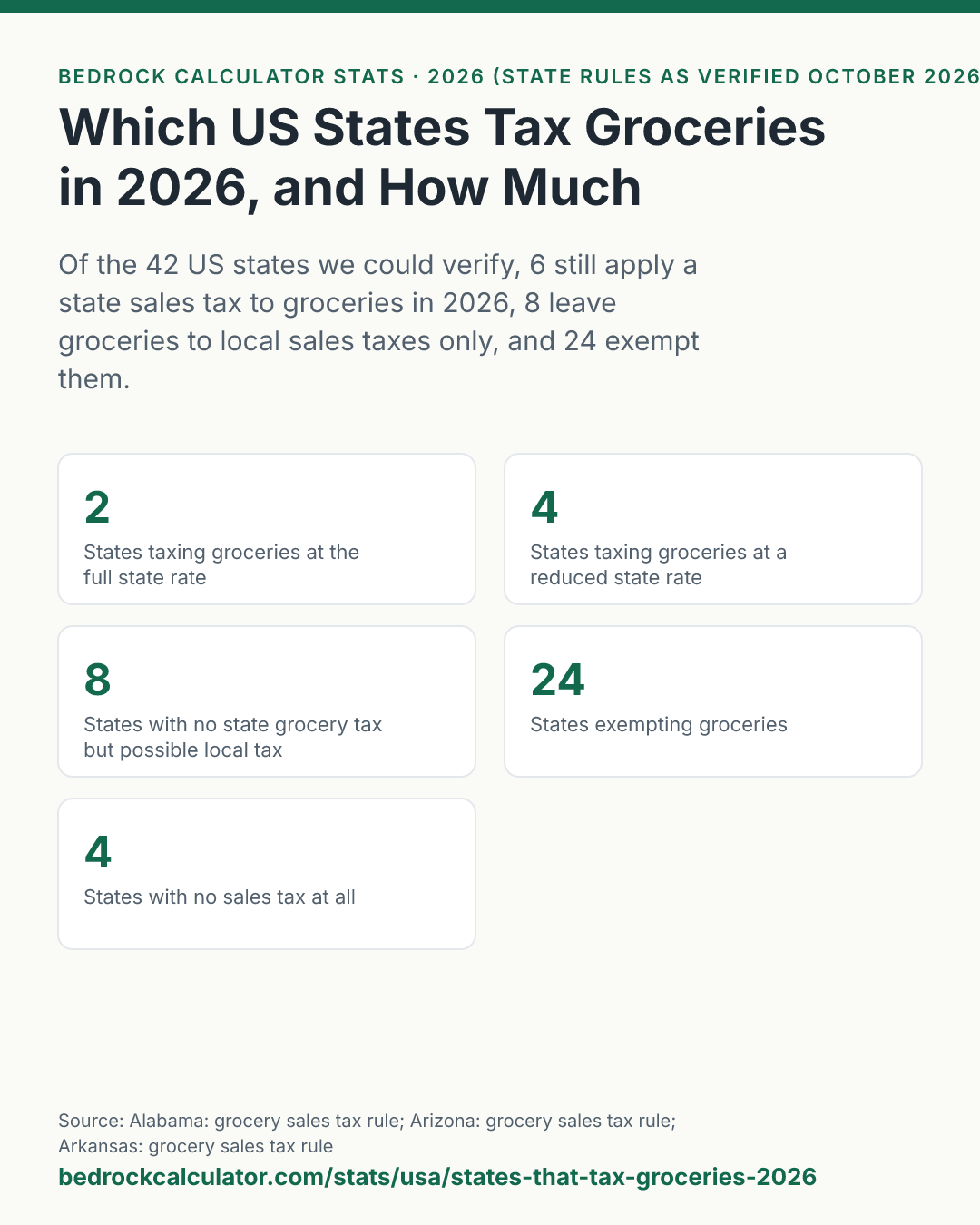
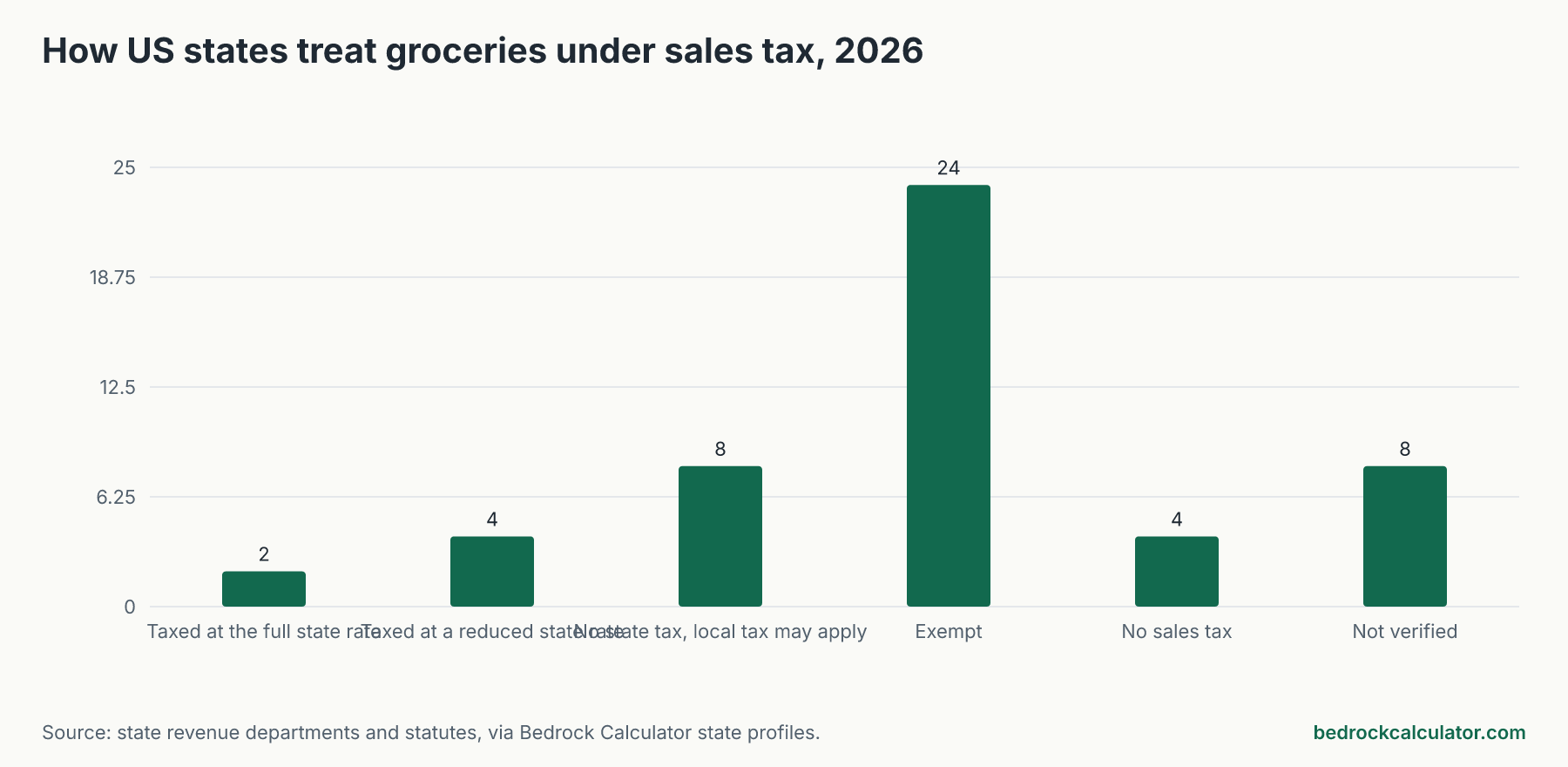
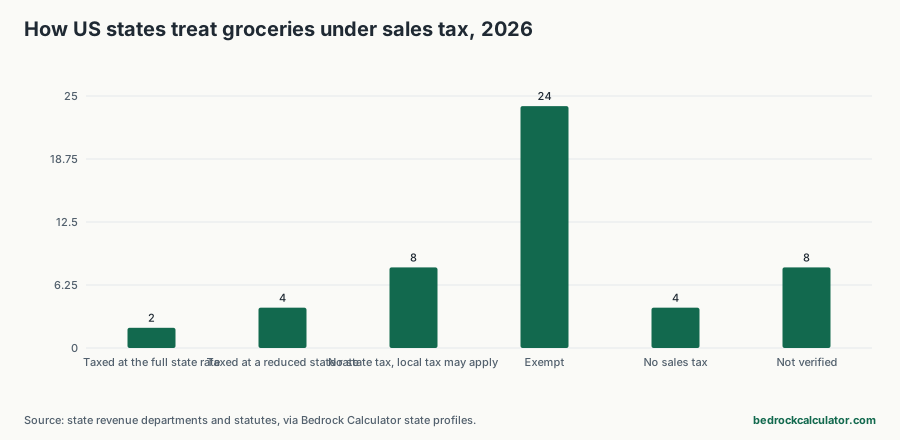
Most US states don't charge their own sales tax on groceries in 2026, but a handful still do, and in many more your city or county can. Of the 42 states we could verify against an official source:
- 2 tax groceries at the full state rate: Idaho, South Dakota.
- 4 tax them at a reduced state rate: Alabama, Mississippi, Tennessee, Virginia.
- 8 have dropped the state tax on groceries, but local sales taxes can still apply: Arizona, Arkansas, Georgia, Illinois, Kansas, North Carolina, Oklahoma, South Carolina.
- 24 exempt groceries.
- 4 have no sales tax at all: Delaware, Montana, New Hampshire, Oregon.
We couldn't confirm the current rule from an official source for 8 states, so they're left out of the counts: Alaska, Colorado, Hawaii, Indiana, Kentucky, Louisiana, Missouri, Utah.
How we put this list together
Each state's entry comes from our state profiles, where the grocery rule was read from that state's revenue department, statute or official guidance. The exact wording we recorded is quoted below for every state, and the source document for each is listed at the bottom of the page.
Sorting states into five groups takes some judgment, because the rules don't all fit neatly. Here's what each group means:
- Full state rate: groceries pay the same state rate as everything else.
- Reduced state rate: groceries carry a state tax, but at a lower rate than general goods.
- No state tax, local tax may apply: the state takes nothing on groceries, but city or county sales taxes still can.
- Exempt: groceries are exempt from the state sales tax and, as far as the state's rule says, from local tax too.
- No sales tax: the state has no general sales tax.
"Groceries" means food bought to prepare and eat at home. In nearly every state, restaurant meals, hot prepared food, candy and soft drinks are taxed at the full rate even when groceries aren't. If the difference matters to you, read the exact wording for your state below.
Every US state's grocery tax rule
How each US state taxes groceries in 2026
Download CSVFrom each state revenue department or statute, as recorded in our verified state profiles. "Not verified" states are left out of the counts. General state rate is the regular statewide sales tax rate, not the grocery rate.
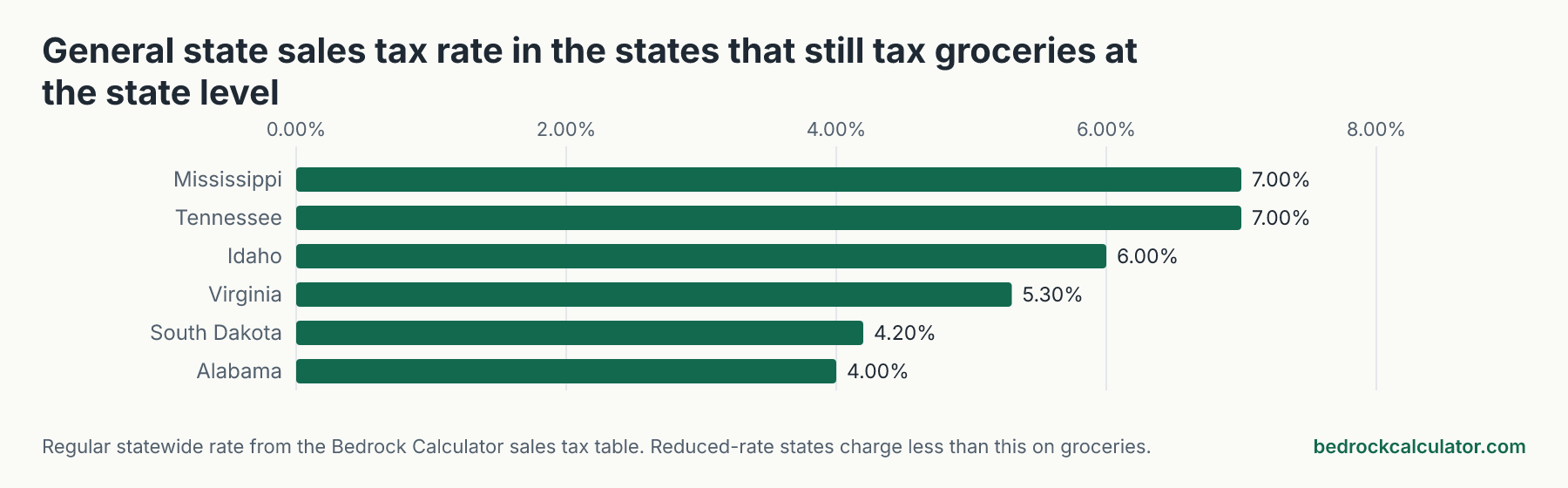
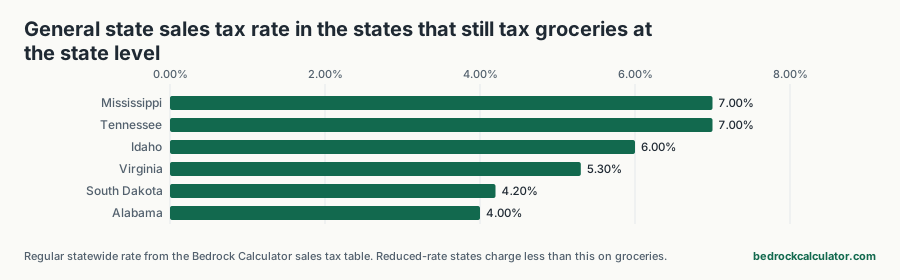
| Idaho | Taxed at the full state rate | 6.00% |
| South Dakota | Taxed at the full state rate | 4.20% |
| Alabama | Taxed at a reduced state rate | 4.00% |
| Mississippi | Taxed at a reduced state rate | 7.00% |
| Tennessee | Taxed at a reduced state rate | 7.00% |
| Virginia | Taxed at a reduced state rate | 5.30% |
| Alaska | Not verified | 0.00% |
| Colorado | Not verified | 2.90% |
| Hawaii | Not verified | 4.00% |
| Indiana | Not verified | 7.00% |
| Kentucky | Not verified | 6.00% |
| Louisiana | Not verified | 5.00% |
| Missouri | Not verified | 4.23% |
| Utah | Not verified | 6.10% |
| Arizona | No state tax, local tax may apply | 5.60% |
| Arkansas | No state tax, local tax may apply | 6.50% |
| Georgia | No state tax, local tax may apply | 4.00% |
| Illinois | No state tax, local tax may apply | 6.25% |
| Kansas | No state tax, local tax may apply | 6.50% |
| North Carolina | No state tax, local tax may apply | 4.75% |
| Oklahoma | No state tax, local tax may apply | 4.50% |
| South Carolina | No state tax, local tax may apply | 6.00% |
| Delaware | No sales tax | 0.00% |
| Montana | No sales tax | 0.00% |
| New Hampshire | No sales tax | 0.00% |
| Oregon | No sales tax | 0.00% |
| California | Exempt | 7.25% |
| Connecticut | Exempt | 6.35% |
| Florida | Exempt | 6.00% |
| Iowa | Exempt | 6.00% |
| Maine | Exempt | 5.50% |
| Maryland | Exempt | 6.00% |
| Massachusetts | Exempt | 6.25% |
| Michigan | Exempt | 6.00% |
| Minnesota | Exempt | 6.88% |
| Nebraska | Exempt | 5.50% |
| Nevada | Exempt | 6.85% |
| New Jersey | Exempt | 6.63% |
| New Mexico | Exempt | 4.88% |
| New York | Exempt | 4.00% |
| North Dakota | Exempt | 5.00% |
| Ohio | Exempt | 5.75% |
| Pennsylvania | Exempt | 6.00% |
| Rhode Island | Exempt | 7.00% |
| Texas | Exempt | 6.25% |
| Vermont | Exempt | 6.00% |
| Washington | Exempt | 6.50% |
| West Virginia | Exempt | 6.00% |
| Wisconsin | Exempt | 5.00% |
| Wyoming | Exempt | 4.00% |
The rate column is each state's general statewide sales tax rate, from the table behind our sales tax calculator. It is not the grocery rate. For the grocery rate, read the state's entry below.
States that still tax groceries at the state level
These are the states where buying groceries still costs you state sales tax. In the reduced-rate states, the grocery rate is lower than the general rate shown in the chart.
Full state rate
- Idaho: Taxed at the full 6% rate; the state offsets it with an income tax food credit of $155 per person (up to $250 with receipts).
- South Dakota: The DOR sales tax guide lists SNAP (food stamp) purchases as not subject to sales tax and lists no general exemption for grocery food.
Reduced state rate
- Alabama: Food is taxed at a reduced 2% state rate from September 1, 2025 (Act 2025-305), and the state portion was suspended entirely from May 1 through June 30, 2026 (Act 2026-604); city and county food taxes still apply.
- Mississippi: Reduced rate 5%: food and drink for human consumption that can be bought with SNAP benefits is taxed at 5% instead of the 7% general rate.
- Tennessee: Reduced rate: food and food ingredients are taxed at a 4% state rate plus the applicable local rate.
- Virginia: Reduced rate: food for home consumption and personal hygiene items are taxed at 1% statewide.
States where only local tax can apply
These states have removed their own tax on groceries, but your grocery bill can still carry city or county sales tax. Several of these changes are recent, so a receipt from a couple of years ago may not match today.
- Arizona: Food for home consumption is exempt from the state transaction privilege tax (A.R.S. 42-5061(A)(15)), but cities may still tax it; Phoenix charges 0% on retail food sales.
- Arkansas: The state's reduced food tax rate fell from 0.125% to 0% effective January 1, 2026, so groceries carry no state sales tax; city and county sales taxes still apply.
- Georgia: Food for home consumption is exempt from the 4% state sales tax but, in most jurisdictions, remains subject to all applicable local sales taxes (DOR miscellaneous rate chart effective October 1, 2026).
- Illinois: The state's 1% tax on groceries ended after December 31, 2025; since January 1, 2026 municipalities (and counties, in unincorporated areas only) may impose a local grocery tax of exactly 1% by ordinance, and the existing RTA and Metro-East grocery taxes remain; soft drinks, candy and prepared food stay taxed at the general merchandise rate.
- Kansas: The state sales tax rate on food and food ingredients fell to 4% in 2023 and 2% in 2024, and has been 0% since January 1, 2025; prepared food remains taxable, and K.S.A. 79-3603d sets only the state rate.
- North Carolina: Reduced rate of 2%: qualifying food is taxed only at a 2.00% local rate, and the state, transit and other local rates do not apply. Candy, soft drinks, prepared food, dietary supplements and vending-machine food are taxed at the full general rate.
- Oklahoma: Exempt from the 4.5% state sales tax since August 29, 2024 (HB 1955/SB 1283). All local city and county sales taxes still apply to food and food ingredients.
- South Carolina: Unprepared food that may lawfully be bought with USDA food coupons (SNAP) is exempt from the 6% state sales and use tax only, so local sales taxes still apply to groceries unless the local tax law exempts them (S.C. Code 12-36-2120(75)); the local rate on unprepared food is 0% to 2% depending on the jurisdiction.
States that exempt groceries
In these 24 states, groceries for home are exempt. The exceptions usually cover candy, soft drinks and prepared food.
- California: Food products for human consumption are exempt from sales and use tax under Revenue and Taxation Code section 6359, though hot prepared food, food eaten on the premises, carbonated drinks and alcohol are taxable.
- Connecticut: Food products for human consumption are exempt from sales and use tax under Conn. Gen. Stat. 12-412(13), while meals and certain beverages are taxed at 7.35%.
- Florida: Food products for human consumption are exempt from Florida sales tax under s. 212.08(1)(a), Florida Statutes.
- Iowa: Exempt: food and food ingredients are exempt under Iowa Code 423.3(57), except items such as candy, soft drinks, dietary supplements, prepared food, alcoholic beverages and vending-machine food.
- Maine: Exempt: sales of grocery staples are exempt from Maine sales tax under 36 M.R.S. 1760(3).
- Maryland: Exempt: food sold for consumption off the premises by a vendor operating a substantial grocery or market business is not subject to sales tax (Tax-General 11-206(c)).
- Massachusetts: Exempt: food for human consumption is exempt, except meals sold by a restaurant, which are taxed at 6.25%.
- Michigan: Exempt: the Michigan Constitution and the sales and use tax acts exempt food and food ingredients, but prepared food is taxable at 6%.
- Minnesota: Exempt: food and food ingredients are exempt under Minn. Stat. 297A.67, subd. 2, but candy, soft drinks, dietary supplements and prepared food are taxable.
- Nebraska: Exempt: sales of food and food ingredients are exempt from sales and use tax under Reg-1-087, but prepared food is taxable.
- Nevada: Exempt: food for home consumption is typically exempt from Nevada sales tax, as are prescription medications.
- New Jersey: Exempt: most food sold as grocery items is exempt, while prepared food is taxable.
- New Mexico: Exempt in effect: receipts from qualifying food sales by SNAP-authorized retail food stores are deductible from gross receipts (Section 7-9-92 NMSA 1978), but alcoholic beverages, tobacco and prepared hot foods for immediate consumption remain taxable.
- New York: Exempt: food and food products sold by food stores are generally exempt from sales tax, but candy, soft drinks, heated food, and food sold for eating on premises are taxable.
- North Dakota: Exempt: food and food ingredients are exempt from North Dakota sales tax, except alcoholic beverages, candy or gum, dietary supplements, prepared food, soft drinks with 50% or less fruit juice, and tobacco.
- Ohio: Exempt: food for human consumption off the premises where sold has been exempt since a 1936 constitutional amendment.
- Pennsylvania: Exempt: food that is not ready-to-eat is excluded from sales tax, as are candy and gum.
- Rhode Island: Exempt: food and food ingredients are exempt, but candy, soft drinks, dietary supplements, alcohol, tobacco, vending-machine food and most prepared food are taxed (R.I. Gen. Laws § 44-18-30(9)).
- Texas: Exempt: Tax Code Section 151.314(a) exempts food products for human consumption from state and local sales tax.
- Vermont: Exempt: food and food ingredients sold for ingestion or chewing by humans are exempt from sales tax.
- Washington: Exempt: RCW 82.08.0293 exempts food and food ingredients, but prepared food, soft drinks, bottled water and dietary supplements remain taxable.
- West Virginia: Exempt: food and food ingredients are not taxed, while prepared food is taxed at the regular 6% rate.
- Wisconsin: Exempt: all food and food ingredients are exempt from Wisconsin sales and use tax except candy, dietary supplements, prepared food and soft drinks.
- Wyoming: Exempt: W.S. 39-15-105 exempts sales of food for domestic home consumption from sales tax.
States with no sales tax
- Delaware: Groceries are not taxed at the register, because Delaware has no state or local sales tax.
- Montana: Not taxed: Montana does not have a general-use sales tax.
- New Hampshire: Not taxed: New Hampshire has no general sales tax on goods purchased in the state.
- Oregon: Not taxed. Oregon has no general sales tax.
The states we couldn't verify
For Alaska, Colorado, Hawaii, Indiana, Kentucky, Louisiana, Missouri, Utah, our state profiles don't yet hold a grocery rule confirmed against an official source, so we've left them out rather than guess. If you live in one of them, your state revenue department's sales tax page will have the answer.
Why this matters for your budget
Groceries are one of the biggest things most households buy, and food is bought every week, so even a small tax adds up. It also hits lower-income households hardest, because food is a larger share of what they spend. That's the main reason so many states have cut or dropped their grocery tax in the last few years, and why a few, like Idaho, give an income tax credit to make up for it.
Our sales tax calculator and state pages such as the Tennessee sales tax calculator, Alabama sales tax calculator and Illinois sales tax calculator apply the general rate to whatever you enter. They don't apply a grocery exemption or reduced food rate, so for a grocery bill, use the rule for your state above. For general rates in every state, see sales tax by state in 2026.