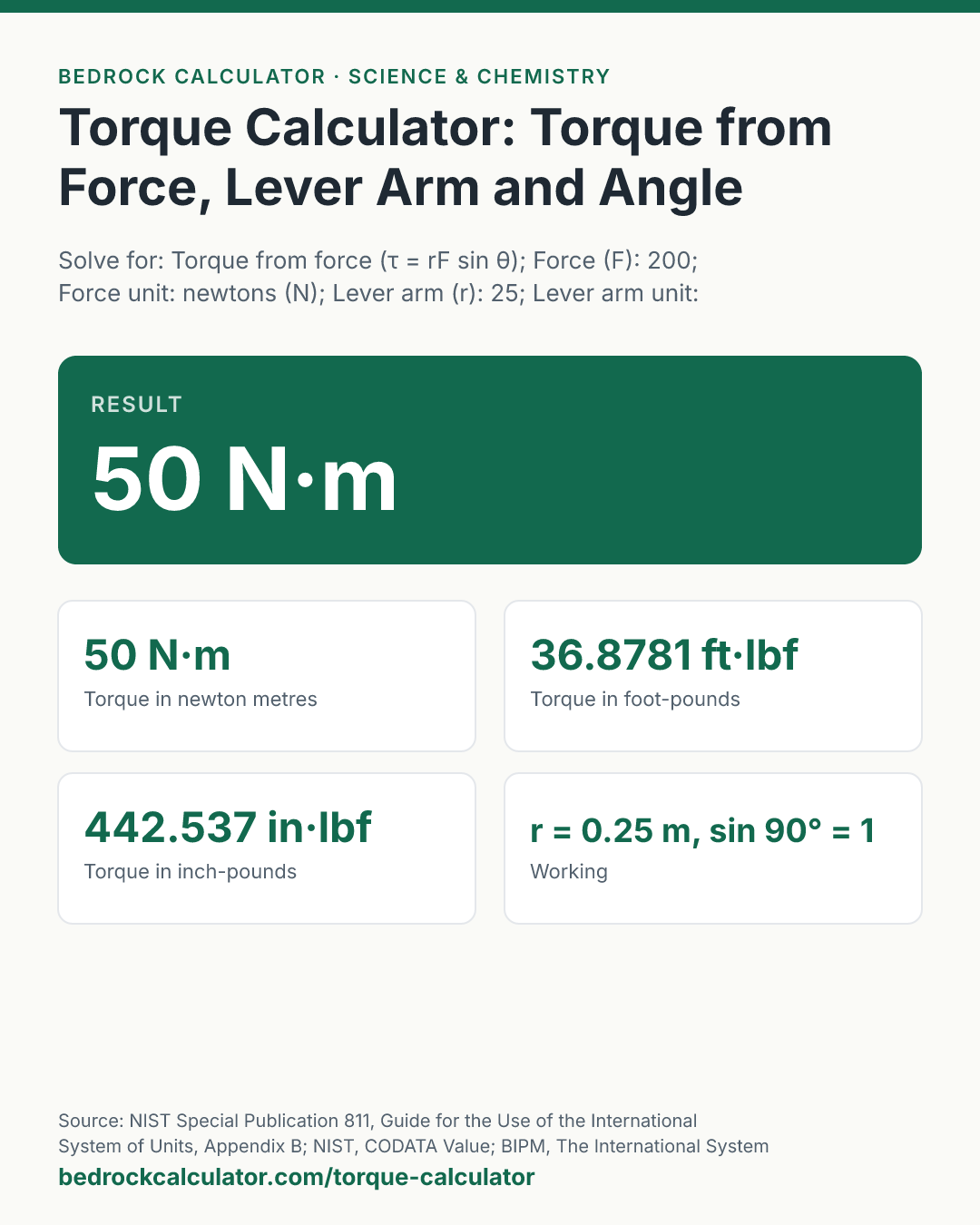
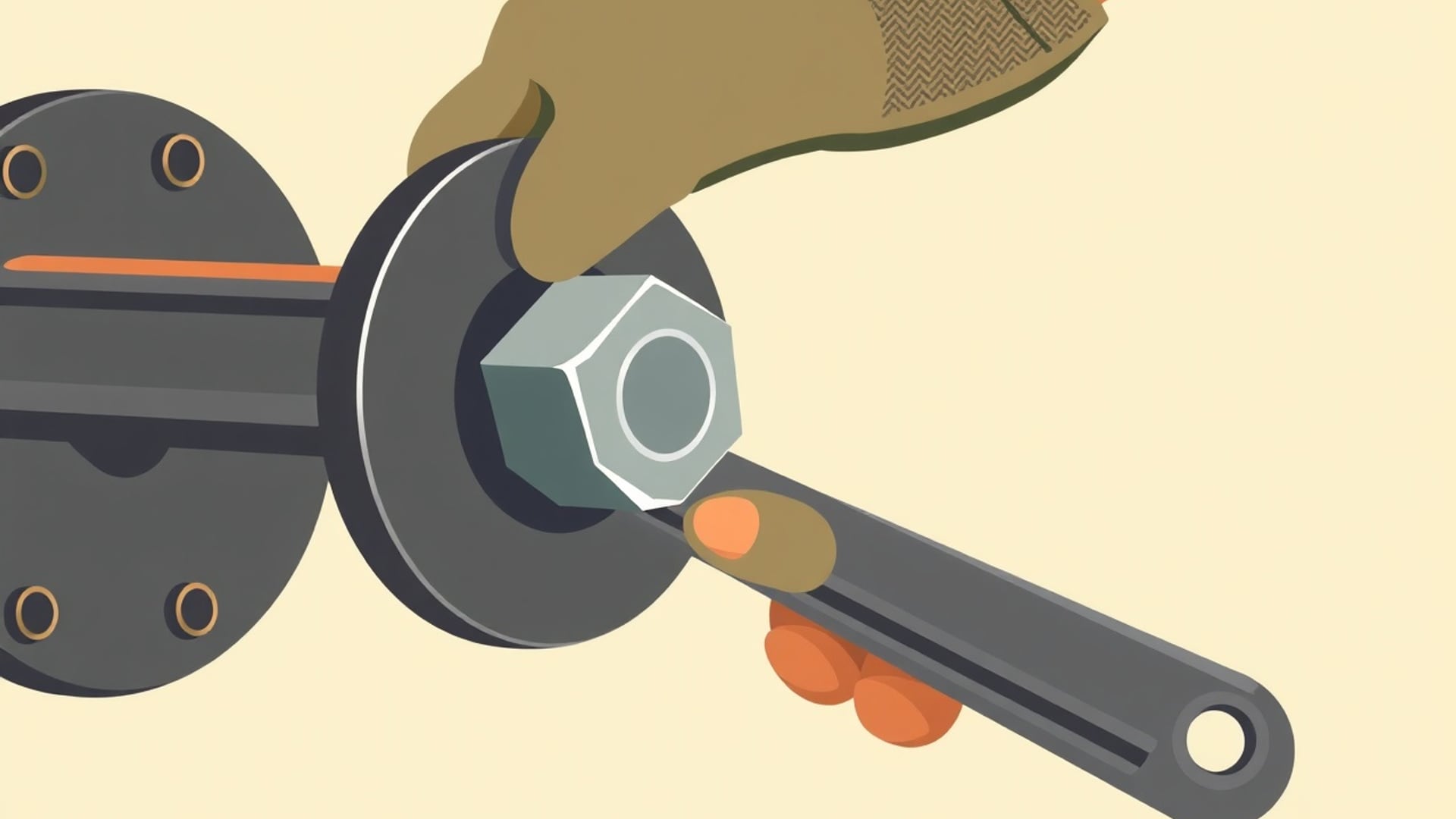
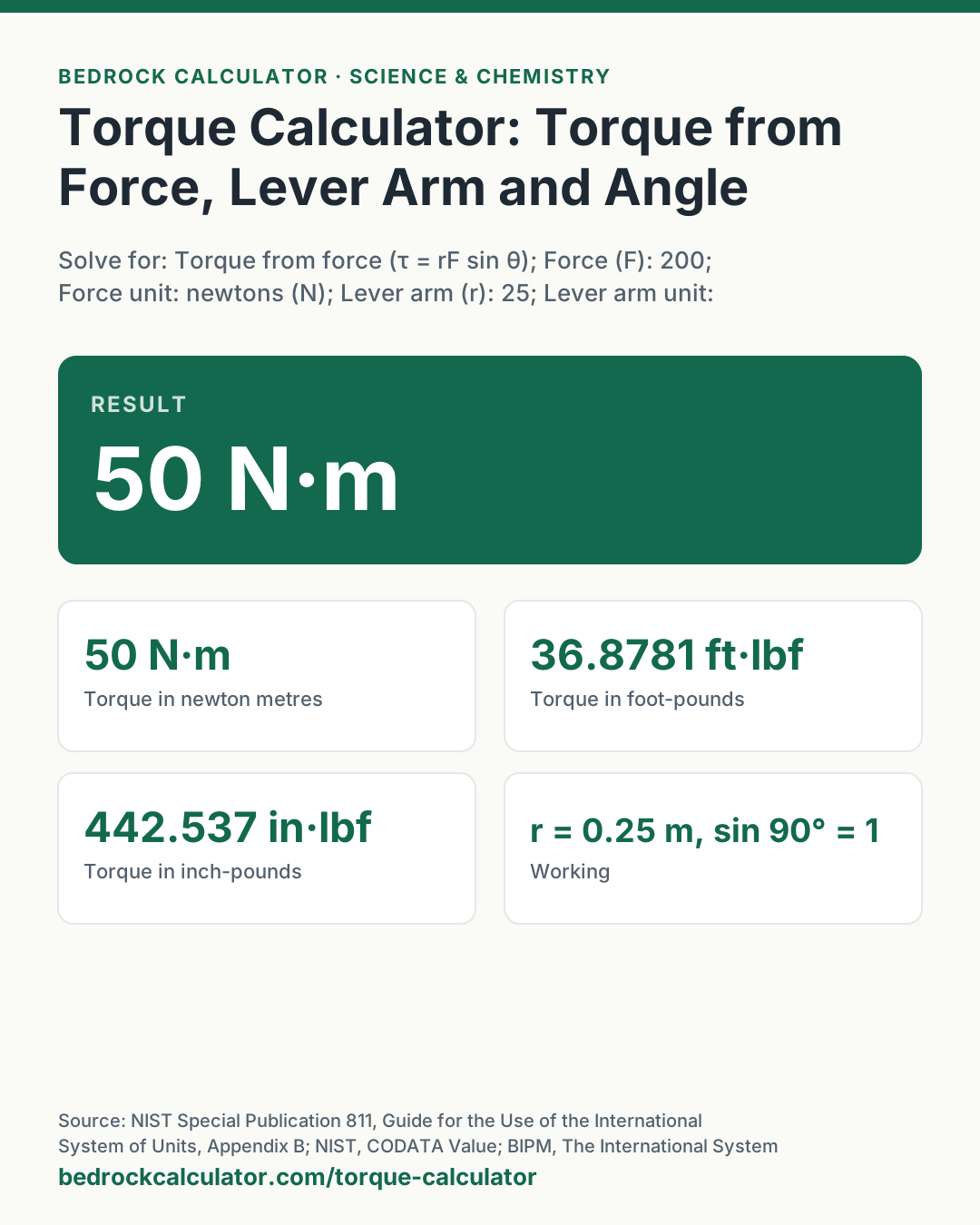
Quick Answer: A 200 N push at right angles to a wrench handle, 25 cm from the bolt, gives a torque of 50 N·m (36.8781 ft·lbf). Torque is the lever arm times the force times the sine of the angle between them.
What does this calculator do?
This torque calculator works out the turning effect of a force: how hard a wrench turns a bolt, a pedal turns a crank, or a hand turns a door on its hinges. It also runs the calculation backwards, giving the force you need to reach a target torque, which is the question a torque spec on a bolt actually asks.
Torque depends on three things. The size of the force, the distance from the pivot to where the force acts (the lever arm), and the angle between the two. A push square to the handle (90°) gives the most torque. Push along the handle and nothing turns at all. The reference table on this page shows the whole range for one push.
Inputs can be given in newtons, pounds-force or kilograms-force, with the lever arm in metres, centimetres, millimetres, feet or inches. The calculator converts to SI first and gives the torque in newton metres, foot-pounds and inch-pounds. All of the conversion factors are exact: a pound-force is the weight of a pound under standard gravity, 4.4482216152605 N, and a foot-pound is 1.3558179483314004 N·m.
Using the Torque Calculator
- Choose whether to find the torque from a force, or the force needed for a torque.
- Enter the force (or the target torque) and pick its unit.
- Enter the lever arm: the distance from the centre of the bolt or pivot to where your hand pushes.
- Enter the angle between the lever arm and the force. Leave it at 90° for a push straight across the handle.
- Read the result at the top. The cards give the torque in three units, the force in newtons and pounds-force, and the working.
How is this calculated?
- Convert to SI. The force is converted to newtons, the lever arm to metres and any target torque to newton metres.
- Take the sine of the angle. The angle in degrees is turned into radians and its sine is computed to 34 digits, then rounded to 30 decimal places so that common angles come out exact: sin 90° is 1 and sin 30° is 0.5.
- Torque mode. Lever arm times force times the sine of the angle:
τ = rF sin θ
- Force mode. The same equation solved for the force. The answer is converted to the force unit you chose.
F = τ/(r sin θ)
A force along the arm (0° or 180°) has a sine of zero and cannot produce any torque, so force mode refuses it rather than divide by zero.
- Convert and round. The torque is converted to foot-pounds and inch-pounds, and every figure is rounded half up to six significant figures.
Worked Example
The default inputs are a firm 200 N push square to a wrench, 25 cm from the bolt:
- Lever arm: 25 cm = 0.25 m.
- Angle: sin 90° = 1.
- Torque: τ = 0.25 × 200 × 1 = 50 N·m, which is 36.8781 ft·lbf or 442.537 in·lbf.
Push at 30° to the handle instead and sin 30° = 0.5, so the torque halves to 25 N·m.
Working backwards, a lug nut specified at 100 ft·lbf with an 18 inch breaker bar needs a push of 100 ÷ 1.5 = 66.6667 lbf, or 296.548 N, square to the bar.
Standing with 50 kg of weight on a horizontal bicycle pedal 17 cm from the axle (50 kgf, or 490.333 N) gives 83.3565 N·m at the crank.
How to Find the Torque
Multiply three numbers: the lever arm in metres, the force in newtons and the sine of the angle between them. If you push straight across the arm, the sine is 1 and torque is just force times distance. That is why a longer wrench makes a tight bolt easier: double the handle length and the same push gives twice the torque.
Torque Calculations at Different Angles
The angle matters more than people expect. In the reference table, 200 N on a 25 cm arm gives 50 N·m at 90°, 43.3013 N·m at 60°, 35.3553 N·m at 45° and 25 N·m at 30°. The values are symmetric about 90°, so pushing at 120° gives the same torque as 60°; only the direction of the force differs.
What does this calculator not account for?
- Friction in the thread. A torque spec is about clamping a joint. How much of the applied torque becomes clamping force depends on thread friction and lubrication, which this page does not model.
- Direction. Torque is a vector with a sense of rotation, clockwise or anticlockwise. The calculator gives its size for a single force in one plane.
- Several forces. For more than one force, work out each torque and add them with signs for direction.
- Where the hand actually is. A hand spreads its push over a few centimetres. Measure the lever arm to the middle of the grip.
- Torque wrench calibration. A torque wrench reading is only as good as its calibration; this page converts numbers, it does not check a tool.
What mistakes do people make with this?
- Measuring the whole wrench. The lever arm runs from the centre of the bolt to the hand, not the full tool length.
- Using centimetres in τ = rF. 25 cm is 0.25 m. Entering 25 with the unit left on metres gives a torque 100 times too big.
- Mixing foot-pounds and inch-pounds. There are 12 in·lbf in 1 ft·lbf. Small fasteners are usually specified in inch-pounds; wheel nuts in foot-pounds.
- Treating kgf·m as N·m. One kilogram-force metre is 9.80665 N·m.
- Forgetting the angle. An angled push gives less torque than the same force square to the arm.
Frequently Asked Questions
How do I calculate torque?
How do I convert N·m to ft·lb?
How much force do I need to reach a torque?
Why is torque greatest at 90 degrees?
Is torque the same as work?
What is a newton metre?
Sources
- NIST Special Publication 811, Guide for the Use of the International System of Units, Appendix B: the pound-force, the kilogram-force, and the foot-pound-force and inch-pound-force as units of torque. nist.gov/pml/special-publication-811
- NIST, CODATA Value: standard acceleration of gravity, g_n = 9.80665 m/s² (exact), which defines the pound-force and kilogram-force. physics.nist.gov/cgi-bin/cuu/Value
- BIPM, The International System of Units (SI Brochure, 9th edition): the newton metre as the unit of moment of force. bipm.org/en/publications/si-brochure