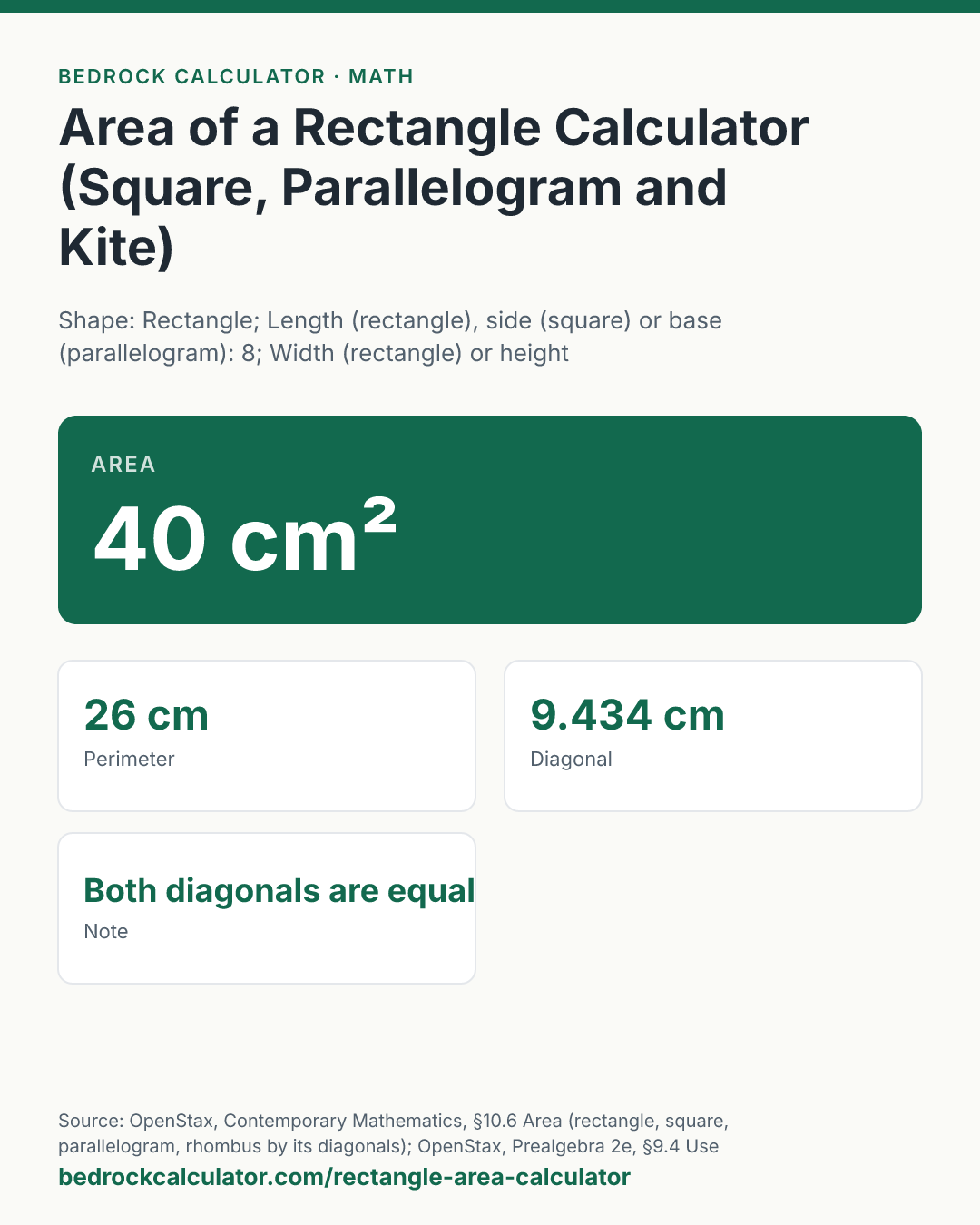
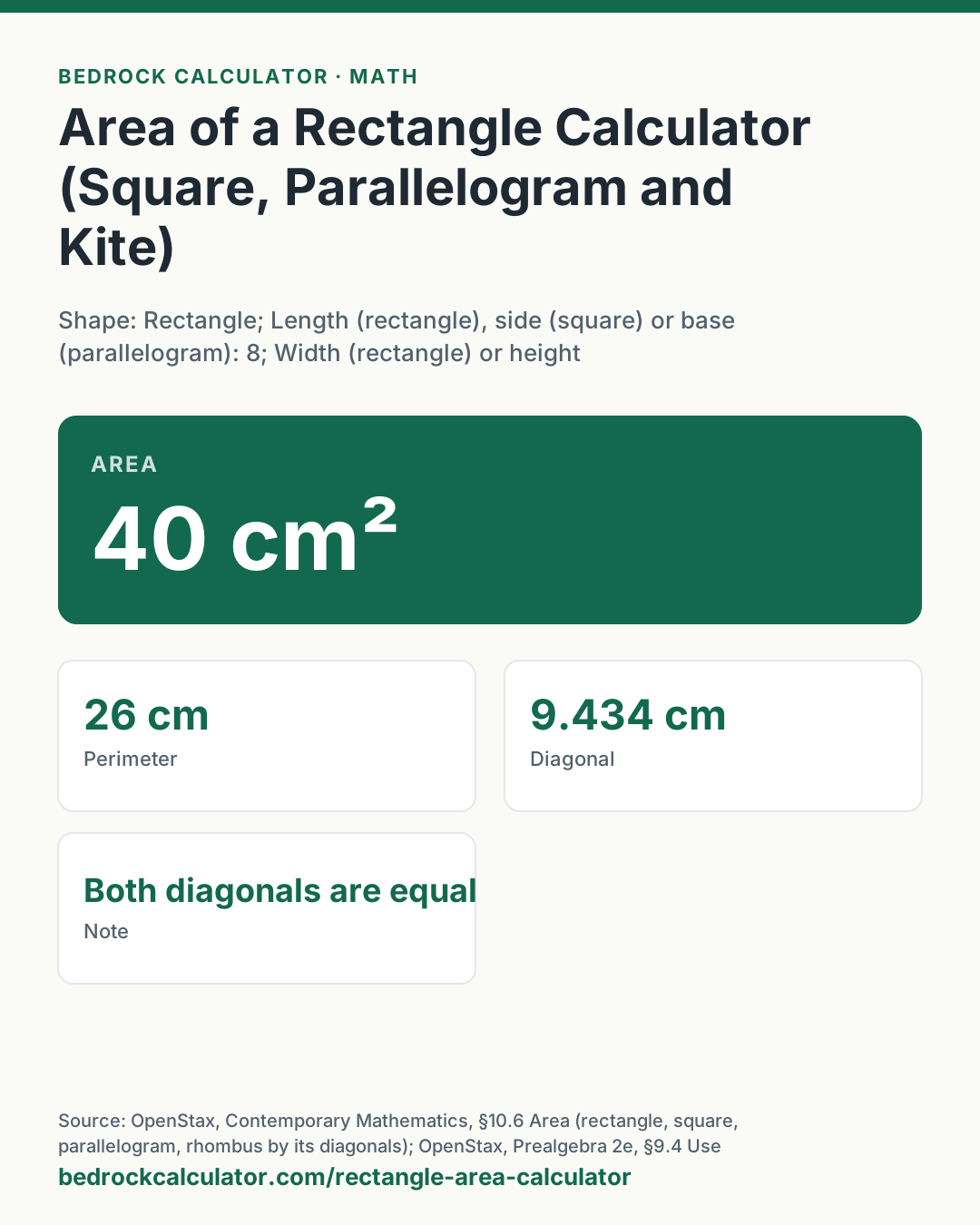
Quick Answer: The area of a rectangle is its length times its width, so a rectangle 8 cm long and 5 cm wide covers 40 cm². Its perimeter is 26 cm, twice the length plus twice the width.
What does this calculator do?
This calculator finds the area of a rectangle and of the three four-sided shapes most often taught next to it: the square, the parallelogram and the kite, which includes the rhombus. For each it gives the perimeter when the measurements allow it, and for rectangles and squares the length of the diagonal from corner to corner.
The four formulas are close relatives. A square is a rectangle with equal sides. A parallelogram is a rectangle pushed sideways: slide the triangle off one end onto the other and it becomes a rectangle with the same base and height, which is why its area is base times height and not base times slanted side. A kite or rhombus sits inside a rectangle whose sides are its two diagonals, and fills exactly half of it.
Any length unit works, provided every measurement is in the same one. The area comes back in that unit squared. The working runs at 34-digit precision and the results are rounded to four decimal places for display.
Using the Area of a Rectangle Calculator
- Choose the shape.
- Enter its measurements. The first box is the length of a rectangle, the side of a square or the base of a parallelogram. The second is the width of a rectangle or the height of a parallelogram.
- For a parallelogram, add the slanted side if you want the perimeter. For a kite, enter both diagonals, and both side lengths if you want the perimeter. Leave optional boxes at 0 when you do not have them.
- Pick the unit.
The presets load a square room 12 ft on a side, a parallelogram with a base of 10, a height of 6 and slanted sides of 7, and a rhombus with diagonals of 6 and 8. Two tables below the calculator list common room sizes in square feet and the area and diagonal of squares from 1 to 100.
How is this calculated?
- Rectangle. Area is length times width. The perimeter adds the four sides, two of each. The diagonal is the hypotenuse of the right triangle formed by a length and a width.
A = lw; P = 2(l + w); d = √(l² + w²)
- Square. The same formulas with the length and width both equal to the side s, so the area is s squared and the diagonal is s times the square root of 2.
A = s²; P = 4s; d = s√2
- Parallelogram. Area is the base times the perpendicular height. The perimeter needs the slanted side, and is twice the base plus twice that side. If the slanted side is shorter than the height, no parallelogram fits those numbers and the calculator says so.
A = bh; P = 2(b + s)
- Kite or rhombus. Area is half the product of the two diagonals. The perimeter is twice the sum of the two different side lengths; for a rhombus, the two are equal.
A = d₁d₂/2; P = 2(x + y)
- Round for display to four decimal places, half up.
Worked Example
The default is a rectangle 8 cm long and 5 cm wide.
- Area: 8 × 5 = 40 cm².
- Perimeter: 2 × (8 + 5) = 26 cm.
- Diagonal: the square root of 64 + 25, which is the square root of 89, 9.434 cm.
A square room 12 ft on a side has a floor area of 144 ft², a perimeter of 48 ft for the skirting board, and a diagonal of 16.9706 ft.
A parallelogram with a base of 10, a height of 6 and slanted sides of 7 has an area of 10 × 6 = 60 square units. The 7 plays no part in the area. It is needed only for the perimeter, 2 × (10 + 7) = 34.
A rhombus with diagonals of 6 and 8 has an area of 6 × 8 ÷ 2 = 24. Each side is 5 (half of each diagonal makes a 3-4-5 right triangle), so its perimeter is 20.
What Is the Formula for the Area of a Rectangle?
Length times width, A = lw. Count it out on squared paper and the reason is plain: a rectangle 8 squares long and 5 squares wide holds 5 rows of 8 squares, 40 in all. The answer is in square units because each of those 40 pieces is a square one unit on a side.
The first table below the calculator gives the area, perimeter and diagonal of fifteen common room sizes, from 8 by 10 feet up to 24 by 30.
What Is the Area of a Parallelogram?
The base times the perpendicular height. People often multiply the base by the slanted side instead, which gives a larger number; that would only be right for a rectangle, where the side is the height. Lean a parallelogram over further and its area shrinks, even though its sides stay the same length, because its height drops.
How Do You Find the Diagonal of a Square or Rectangle?
Use the Pythagorean theorem: the diagonal is the square root of the length squared plus the width squared. For a square this simplifies to the side times the square root of 2, about 1.4142 times the side. A square with sides of 10 has a diagonal of 14.1421.
Both diagonals of a rectangle are the same length, and in a square they also cross at right angles.
What Is the Formula for the Area of a Kite?
Half the product of the diagonals. The diagonals of a kite cross at right angles, cutting it into four right triangles that together fill half of the rectangle drawn around the diagonals. The same formula works for a rhombus, which is a kite with all four sides equal, and for a square, whose two diagonals are equal.
What does this calculator not account for?
- Rounded or cut corners. A room with a chimney breast or a bay window is not a rectangle. Split it into rectangles, find each area, and add or subtract.
- Consistency checks on kites. The kite's side lengths are used only for the perimeter. The calculator does not check that they fit the diagonals you entered.
- Parallelogram angles and diagonals. These need trigonometry and are not computed here.
- Trapezoids and other quadrilaterals. A shape with only one pair of parallel sides is a trapezoid; use the trapezoid calculator.
- Surface area of boxes. A box's surface is six rectangles. The rectangular prism calculator adds them up.
- Unit conversion. Lengths in feet and inches must be converted to one unit first.
What mistakes do people make with this?
- Adding instead of multiplying. Length plus width is half the perimeter, not the area.
- Mixing feet and inches. A room 12 ft by 9 ft 6 in is 12 by 9.5 feet, not 12 by 9.6.
- Using the slanted side as the height. For a parallelogram, measure square to the base.
- Quoting area in plain units. 40 cm² is an area; 40 cm is a length.
- Diagonal as the sum of the sides. The diagonal is always shorter than length plus width, because a straight line is the shortest path between the corners.
Frequently Asked Questions
How do I calculate the perimeter of a rectangle?
What is the area of a square with sides of 12?
How do you find the perimeter of a parallelogram?
Is a square a rectangle?
What is the area of a rectangular prism?
How many square feet is a 10 by 12 room?
Sources
- OpenStax, Contemporary Mathematics, §10.6 Area (rectangle, square, parallelogram, rhombus by its diagonals). openstax.org/books/contemporary-mathematics/pages/10-6-area
- OpenStax, Prealgebra 2e, §9.4 Use Properties of Rectangles, Triangles, and Trapezoids (A = LW, P = 2L + 2W). openstax.org/books/prealgebra-2e/pages/9-4-use-properties-of-rectangles-triangles-and-trapezoids
- Euclid's Elements, Book I, Proposition 47, ed. D. E. Joyce, Clark University: the Pythagorean theorem used for the diagonal. mathcs.clarku.edu/~djoyce/elements/bookI/propI47.html
- NIST Special Publication 811, Guide for the Use of the International System of Units: area as a derived quantity in squared length units. nist.gov/pml/special-publication-811