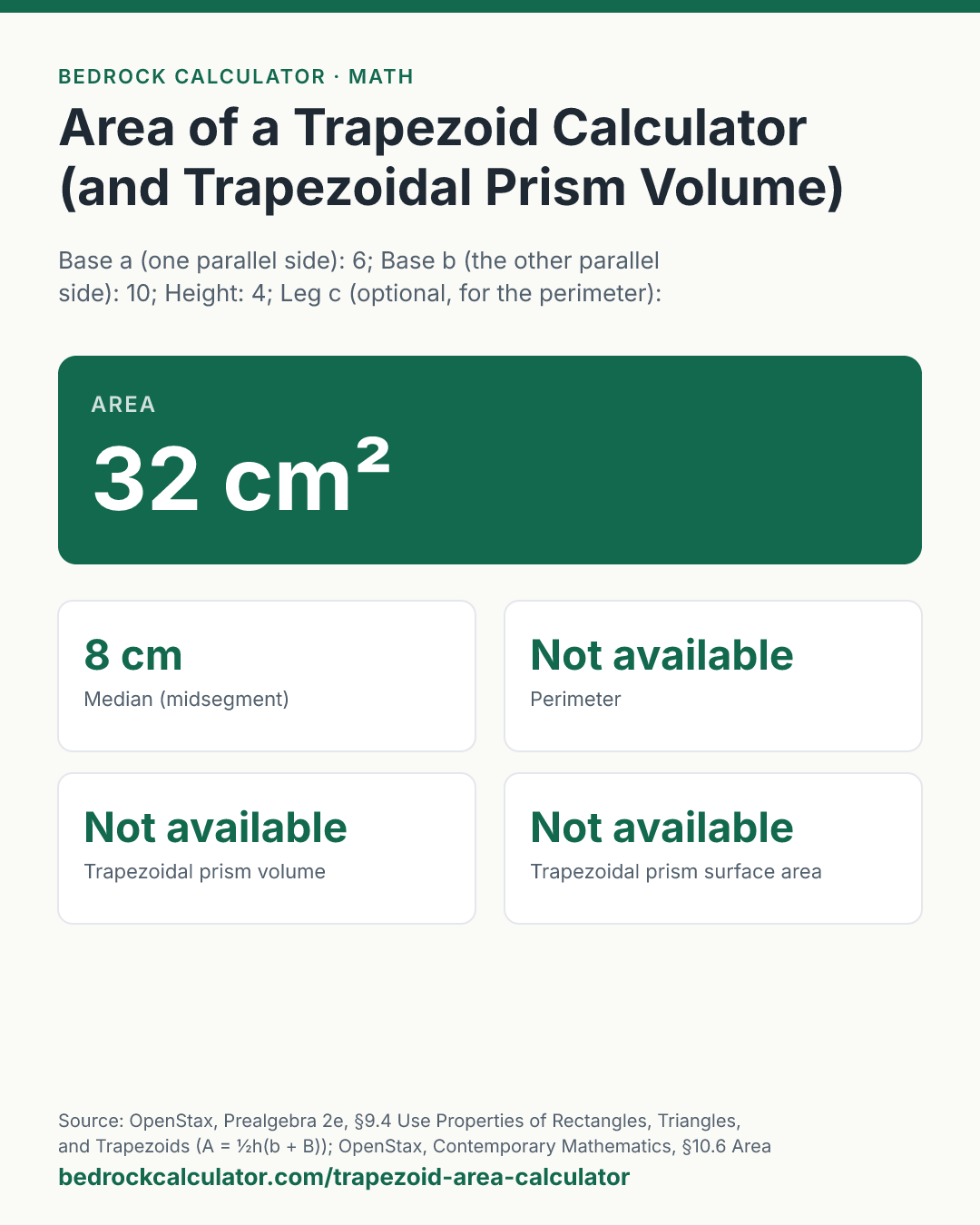
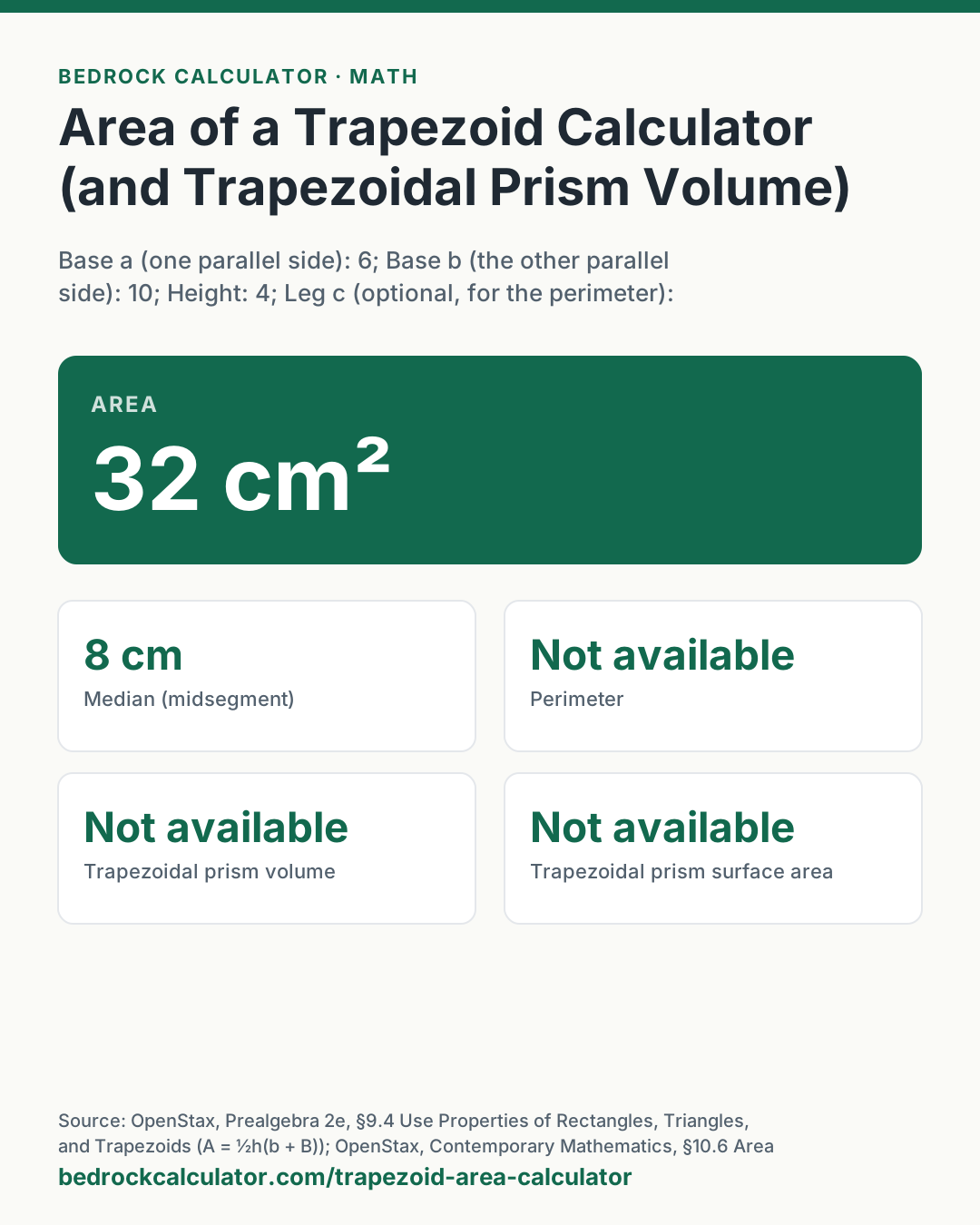
Quick Answer: The area of a trapezoid is the average of its two parallel sides times its height. Bases of 6 cm and 10 cm with a height of 4 cm give 32 cm²: the average base is 8, and 8 × 4 = 32.
What does this calculator do?
This calculator finds the area of a trapezoid from its two parallel sides and the height between them. It also gives the median, the line halfway up that runs parallel to the bases, and the perimeter if you enter the two slanted legs.
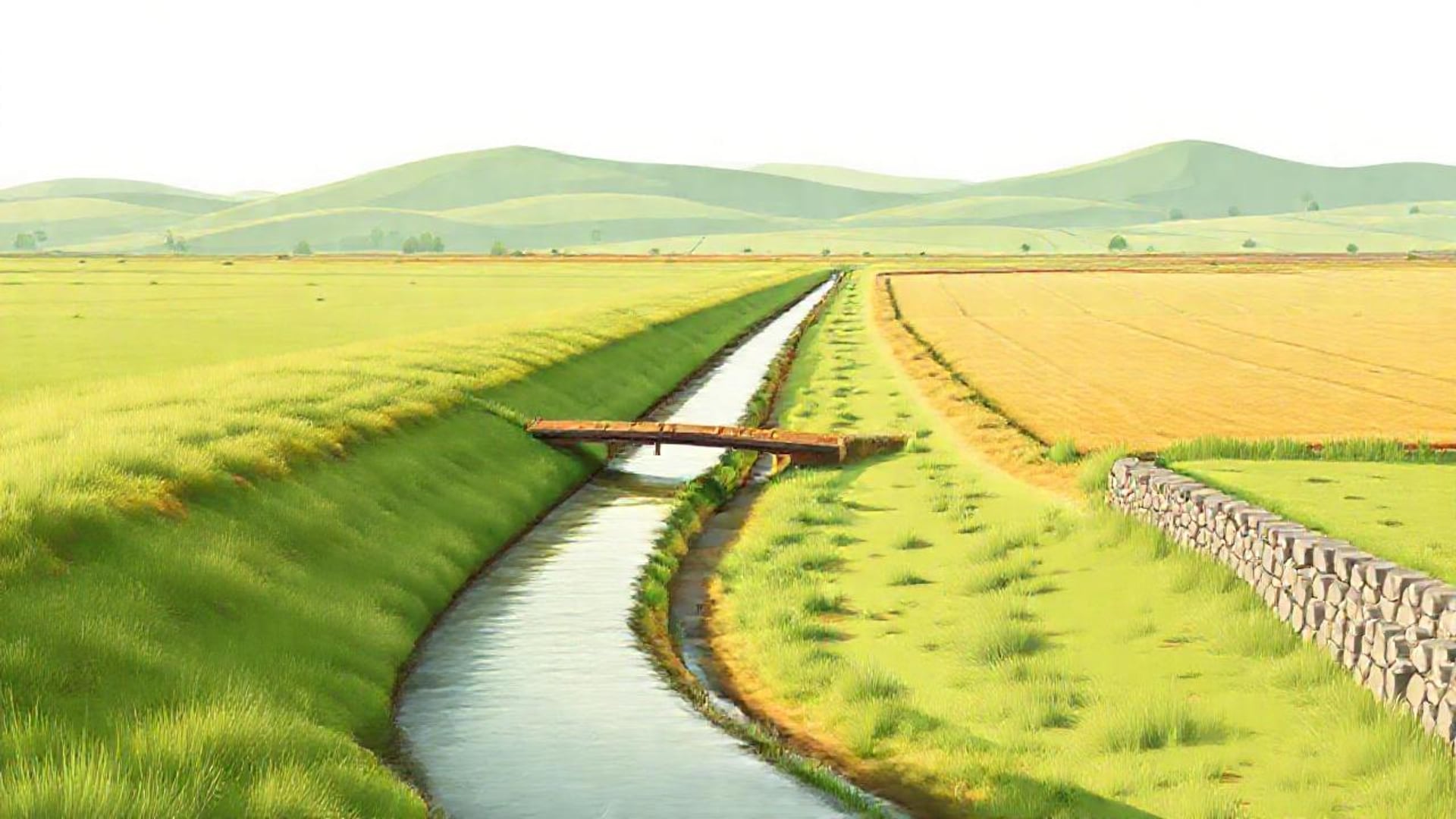
If you give a length, it returns the volume and surface area of a trapezoidal prism, the solid you get by running the trapezoid along a straight line. That last part covers ditches, channels, embankments and raised beds, which are trapezoids in cross-section.
A trapezoid (called a trapezium in British English) is a four-sided shape with at least one pair of parallel sides. The parallel sides are the bases, here a and b, and the other two are the legs. Only the bases and the height decide the area. The legs can lean in or out, together or separately, and the area stays the same as long as the height does.
Lengths can be in any unit, all in the same one. The area comes back in that unit squared and the prism volume in that unit cubed. Results are rounded to four decimal places for display.
Using the Area of a Trapezoid Calculator
- Enter the two parallel sides as base a and base b. It does not matter which is which.
- Enter the height: the perpendicular distance between the bases.
- For the perimeter, add both legs. For a prism, add its length. Leave these at 0 if you do not need them.
- Choose your unit.
The presets load an isosceles trapezoid with bases 4 and 10 and legs of 5, a channel 50 m long that is 2 m wide at the bottom, 4 m at the top and 1 m deep, and an earth berm 10 ft long. The table below the calculator lists areas for fourteen pairs of bases at a height of 10.
How is this calculated?
- Area. The sum of the bases times the height, halved. Equivalently, the median times the height.
A = ((a + b) h)/2
- Median. The average of the two bases. It is the width of the trapezoid halfway up.
m = (a + b)/2
- Perimeter. With both legs c and d entered, the four sides are added.
P = a + b + c + d
- Trapezoidal prism. With a length L, the volume is the trapezoid's area times L. With the legs as well, the surface is the two trapezoid ends plus the four rectangular faces, whose widths add up to the perimeter.
V = A L; S = 2A + P L
- Round for display to four decimal places, half up.
Worked Example
The default trapezoid has bases of 6 cm and 10 cm and a height of 4 cm.
- Sum of the bases: 6 + 10 = 16.
- Times the height and halved: 16 × 4 ÷ 2 = 32 cm².
- Median: 16 ÷ 2 = 8 cm. Check: 8 × 4 is the same 32.
An isosceles trapezoid with bases 4 and 10, height 4 and legs of 5 has an area of 28. Each leg runs 3 across and 4 up, a 3-4-5 triangle, and the perimeter is 4 + 10 + 5 + 5 = 24.
A drainage channel 2 m wide at the bottom, 4 m at the top and 1 m deep has a cross-section of 3 m². Over 50 m that is 150 m³ of earth to dig out.
An earth berm 2 ft across the top, 5 ft across the base and 2 ft high, with sloping sides of 2.5 ft and a run of 10 ft, has a cross-section of 7 ft² and holds 70 ft³ of soil. Its full surface, ends and base included, is 134 ft².
How Do You Find the Area of a Trapezoid?
Add the two parallel sides, multiply by the height, and divide by 2. The reasoning is easy to see. Put two copies of the same trapezoid together, one turned upside down, and they form a parallelogram whose base is a + b and whose height is h.
That parallelogram has area (a + b)h, and the trapezoid is half of it. Another way: the trapezoid's average width is the median, so its area is the median times the height, just as a rectangle's is its width times its height.
What Is the Volume of a Trapezoidal Prism?
The area of the trapezoid end times the length of the prism. Find the cross-section area first, then multiply. A channel with a cross-section of 3 m² running 50 m holds 150 m³. To get its surface area you also need the slanted legs, because the sloping faces are rectangles whose widths are the legs.
What does this calculator not account for?
- Finding the height from the legs. If you know all four sides but not the height, the height has to be worked out first. For an isosceles trapezoid it is the square root of a leg squared minus a quarter of the difference of the bases squared.
- Checking the legs. Legs are used only for the perimeter and prism surface. The calculator does not check that they are long enough to reach across the height.
- Open channels. The prism surface counts both ends and the top. For a ditch lining, subtract the top width times the length and the two ends.
- Uneven ground. A real channel or berm varies along its length. Measure several cross-sections and average them, or split the run into sections.
- Unit conversion and bulking. Lengths must be in one unit. Excavated soil swells once dug, so a truck load is larger than the hole's volume.
What mistakes do people make with this?
- Using a leg as the height. The legs are usually slanted. The height is measured straight across between the bases.
- Forgetting to halve. Sum of bases times height without dividing by 2 gives the parallelogram, double the trapezoid.
- Adding the legs to the bases for the area. Only the parallel sides go into the area formula.
- Mixing up top and bottom. It makes no difference which base is a and which is b; the sum is the same.
- Confusing trapezoid and trapezium. In the US a trapezoid has one pair of parallel sides; in the UK that shape is a trapezium. The formula is the same.
Frequently Asked Questions
What is the formula for trapezoidal area?
Can a trapezoid have two pairs of parallel sides?
What is the median of a trapezoid?
How do I find the height of a trapezoid from its area?
What is an isosceles trapezoid?
How much soil does a trapezoid-shaped bed hold?
Sources
- OpenStax, Prealgebra 2e, §9.4 Use Properties of Rectangles, Triangles, and Trapezoids (A = ½h(b + B)). openstax.org/books/prealgebra-2e/pages/9-4-use-properties-of-rectangles-triangles-and-trapezoids
- OpenStax, Contemporary Mathematics, §10.6 Area (trapezoid). openstax.org/books/contemporary-mathematics/pages/10-6-area
- OpenStax, Contemporary Mathematics, §10.7 Volume and Surface Area (right prisms: V = Bh, SA = 2B + ph). openstax.org/books/contemporary-mathematics/pages/10-7-volume-and-surface-area
- NIST Handbook 44, Appendix C, General Tables of Units of Measurement (27 cubic feet to the cubic yard). nist.gov/pml/owm/nist-handbook-44-current-edition