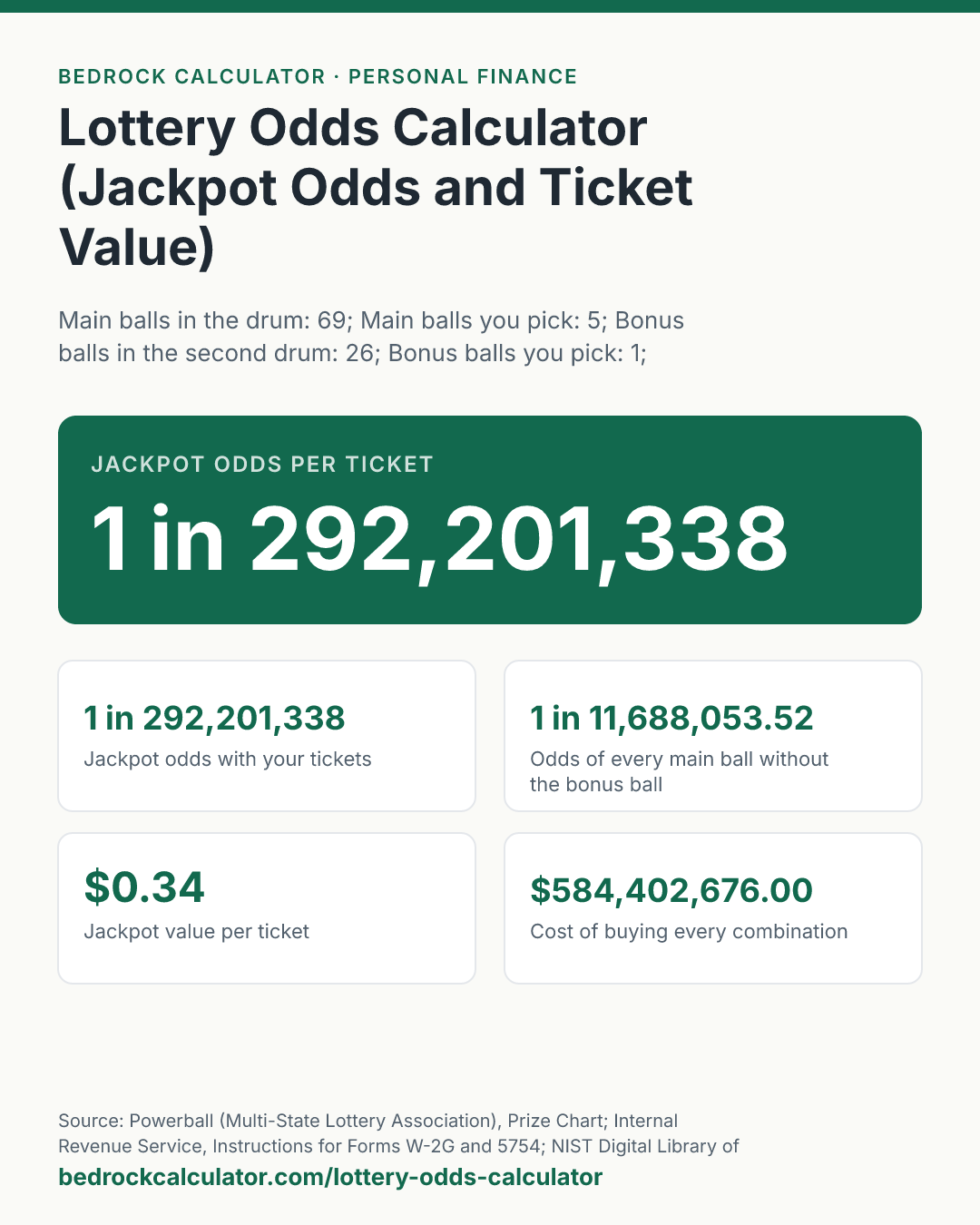

Quick Answer: A Powerball ticket, picking 5 of 69 white balls and 1 of 26 red balls, has jackpot odds of 1 in 292,201,338. Ten different tickets improve that to 1 in 29,220,133.8.
What does this calculator do?
This lottery odds calculator works out the chance of winning the jackpot in any draw game where you pick some numbers from one drum and, optionally, a bonus number from a second drum. Enter the game's shape, how many different tickets you buy, the ticket price and the advertised jackpot, and it returns the jackpot odds per ticket, the odds with all your tickets, the odds of matching every main number but missing the bonus ball, what the jackpot is worth per ticket on average, and what it would cost to buy every possible combination.
The odds are counted exactly, not estimated. The number of ways to choose 5 balls from 69, ignoring order, is 11,238,513. With 26 possible red balls, there are 26 times as many tickets, 292,201,338, and only one of them wins the jackpot. That matches the grand prize odds Powerball publishes, which is why Powerball's shape is the default.
The calculator is a tool for seeing the size of the odds plainly, not for picking numbers. Every combination has exactly the same chance of being drawn.
Using the Lottery Odds Calculator
- Enter how many main balls are in the drum and how many you pick. The game's rules or play slip give both.
- If the game has a separate bonus ball, enter how many are in that drum and how many you pick. For a game without one, enter 0.
- Enter the number of tickets you buy. The odds assume every ticket has different numbers.
- Enter the ticket price and the advertised jackpot for the value figures.
- Read the jackpot odds per ticket at the top, and the rest below.
The presets show ten Powerball tickets, a 6 of 49 game with no bonus ball, a smaller 5 of 39 game and a $1 billion jackpot. The tables below the calculator list the odds for common game shapes and for buying more Powerball tickets.
How is this calculated?
- Count the main combinations. The number of ways to choose k balls from n without regard to order is the binomial coefficient.
C(n, k) = n!/(k! (n − k)!)
For 5 of 69 this is 11,238,513.
- Count the bonus combinations. The same formula for the bonus drum: 1 of 26 is 26. With no bonus ball, this is 1.
- Multiply. Every main combination can be paired with every bonus combination, so the number of different tickets is the product. One of them is the jackpot.
jackpot odds = 1 in C(n, k) × C(m, j)
- Main numbers without the bonus. Matching every main ball but missing the bonus can happen with any of the losing bonus combinations, so its odds are the total divided by one less than the bonus combinations: 1 in 292,201,338 ÷ 25.
- Several tickets. Each different ticket covers one more combination, so t tickets give odds of 1 in (combinations ÷ t).
- Ticket value. The jackpot divided by the number of combinations is the jackpot's contribution to the expected value of one ticket. The cost of every combination is the number of combinations times the ticket price.
- Display. Odds are shown as "1 in N" and money to the cent. The counting itself is exact integer arithmetic.
Worked Example
With the default inputs, Powerball, one $2 ticket, a $100,000,000 jackpot:
- Main combinations: C(69, 5) = 11,238,513.
- Bonus combinations: 26.
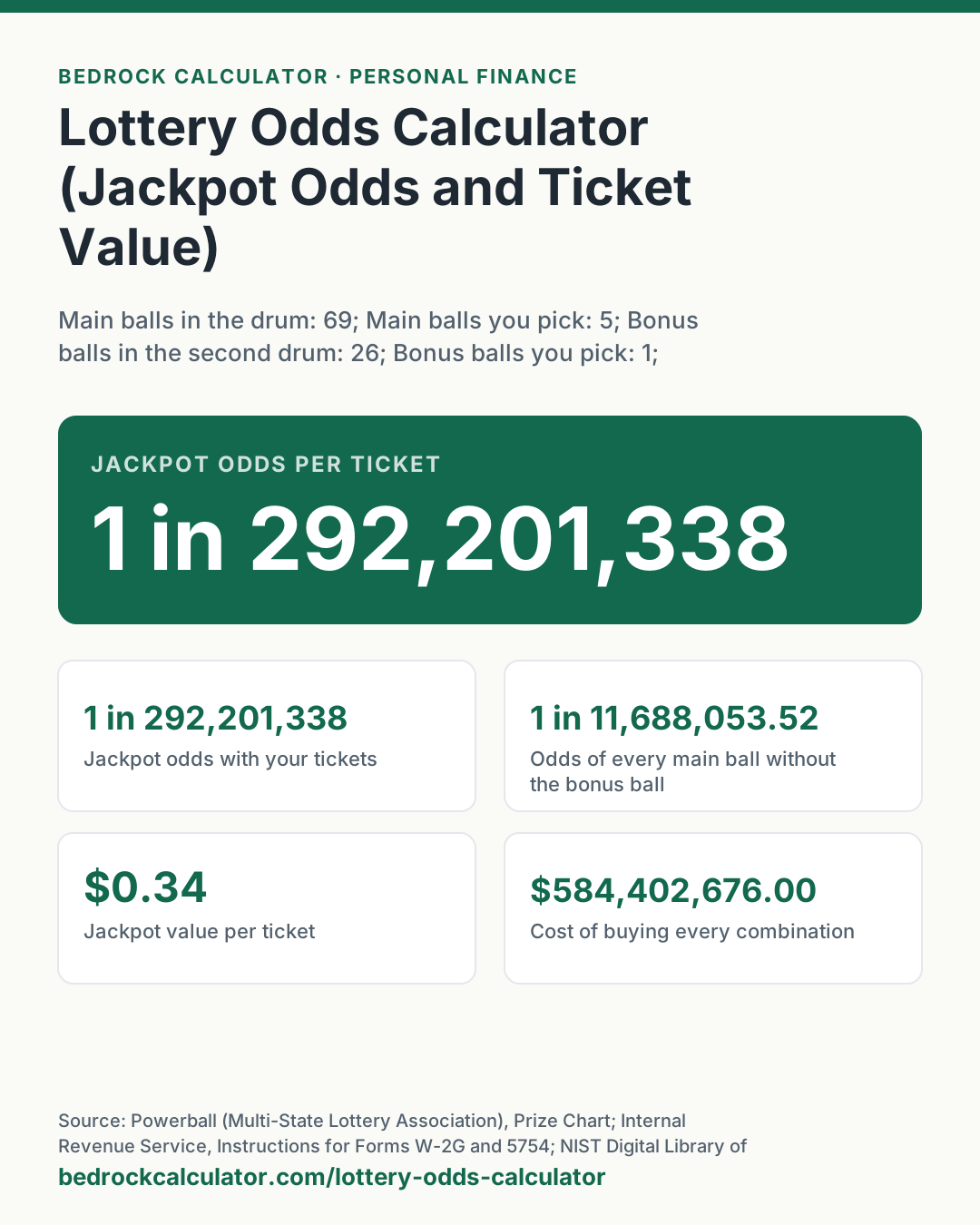
- Jackpot odds: 11,238,513 × 26 = 1 in 292,201,338.
- Five white balls without the Powerball: 292,201,338 ÷ 25 = 1 in 11,688,053.52, the odds Powerball publishes for its $1 million prize.
- Jackpot value per ticket: $100,000,000 ÷ 292,201,338 = $0.34, against a $2.00 ticket.
- Buying every combination would cost $584,402,676.00.
Ten different tickets cost $20.00 and make the odds 1 in 29,220,133.8. Even 100,000 tickets, at $200,000.00, leave the odds at 1 in 2,922.01.
A 6 of 49 game with no bonus ball has 1 in 13,983,816 odds, far better than Powerball, because there are far fewer combinations.
What Are the Best Lottery Odds?
The game with the fewest combinations. The first table below the calculator shows how quickly the count grows with the size of the drum: a 5 of 39 game is 1 in 575,757, a 6 of 49 game 1 in 13,983,816, and a 6 of 59 game 1 in 45,057,474. Adding a bonus drum multiplies the count again: 5 of 70 with 1 of 24 is 1 in 290,472,336.
Better odds usually come with smaller jackpots, since fewer tickets are sold per winner. Compare the jackpot value per ticket as well as the odds.
Is a Lottery Ticket Worth Buying?
On expected value, almost never. At the default $100 million jackpot, the jackpot is worth $0.34 of a $2 ticket. At a $1 billion advertised jackpot it rises to $3.42, but that figure is before several large reductions the calculator does not make: federal and state income tax, the lower cash value if you take a lump sum instead of the annuity the advertised figure usually describes, and the chance of sharing the jackpot when many tickets are sold. The lower prize tiers add some value back. A lottery ticket is best treated as entertainment with a known cost.
What does this calculator not account for?
- Lower prizes. Only the jackpot and the all-main-numbers case are counted. The smaller prize tiers have their own odds and add to a ticket's expected value.
- Taxes. Gambling winnings are taxable. The IRS instructions for Form W-2G call for 24% federal withholding on lottery winnings over $5,000, and the final tax can be higher. State tax varies.
- Lump sum versus annuity. Advertised jackpots are usually the total of annuity payments over many years. The cash option is lower.
- Shared jackpots. If more than one ticket wins, the jackpot is split.
- Duplicate tickets. The multi-ticket odds assume every ticket has different numbers. Two identical tickets do not improve your chance.
- Game rule changes. Lotteries change their matrices and prices. Check the current rules and enter them.
- Extra multipliers and add-ons. Optional add-ons such as prize multipliers change prize amounts, not the jackpot odds.
What mistakes do people make with this?
- Thinking some numbers are due. Every draw is independent and every combination is equally likely.
- Adding odds. Two tickets are not "1 in 292 million twice". They are 1 in 146,100,669, half the original number.
- Reading the overall odds as jackpot odds. "Odds of winning any prize" include small prizes that barely return the ticket price.
- Comparing games on jackpot size alone. A bigger jackpot with much worse odds can be worth less per ticket.
- Ignoring tax. The advertised figure is not what a winner takes home.
Frequently Asked Questions
What are the odds of winning the Powerball jackpot?
How do I calculate lottery odds?
Do more tickets improve my odds much?
How much would it cost to buy every Powerball combination?
What is the best lottery calculator for comparing games?
Are the odds the same for quick picks and chosen numbers?
Sources
- Powerball (Multi-State Lottery Association), Prize Chart: grand prize odds of 1 in 292,201,338 and $1 million prize odds of 1 in 11,688,053.52, based on a $2 play. powerball.com/powerball-prize-chart
- Internal Revenue Service, Instructions for Forms W-2G and 5754: 24% withholding on lottery winnings over $5,000. irs.gov/instructions/iw2g
- NIST Digital Library of Mathematical Functions, section 26.3, Lattice Paths: Binomial Coefficients: the definition of C(n, k). dlmf.nist.gov/26.3