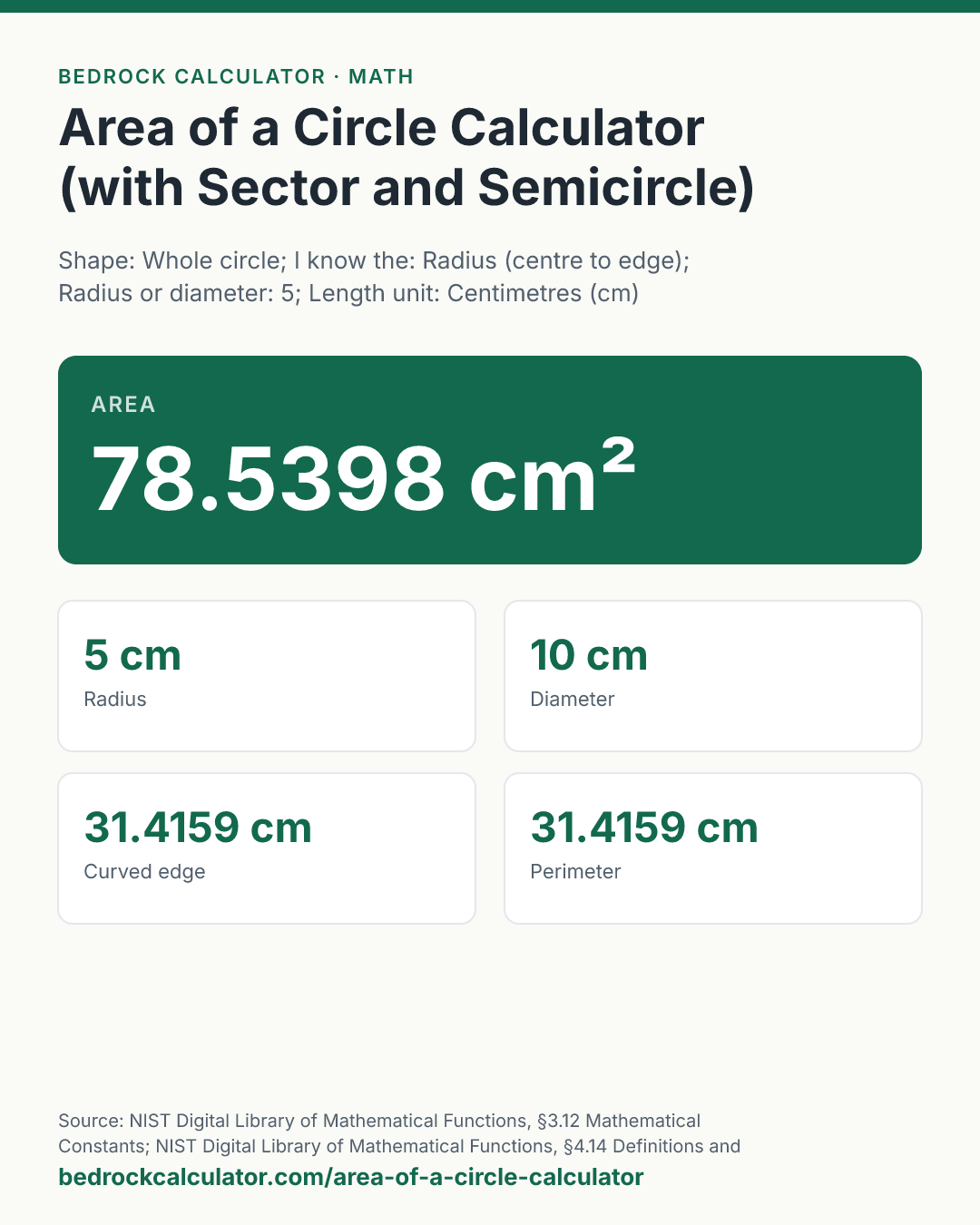
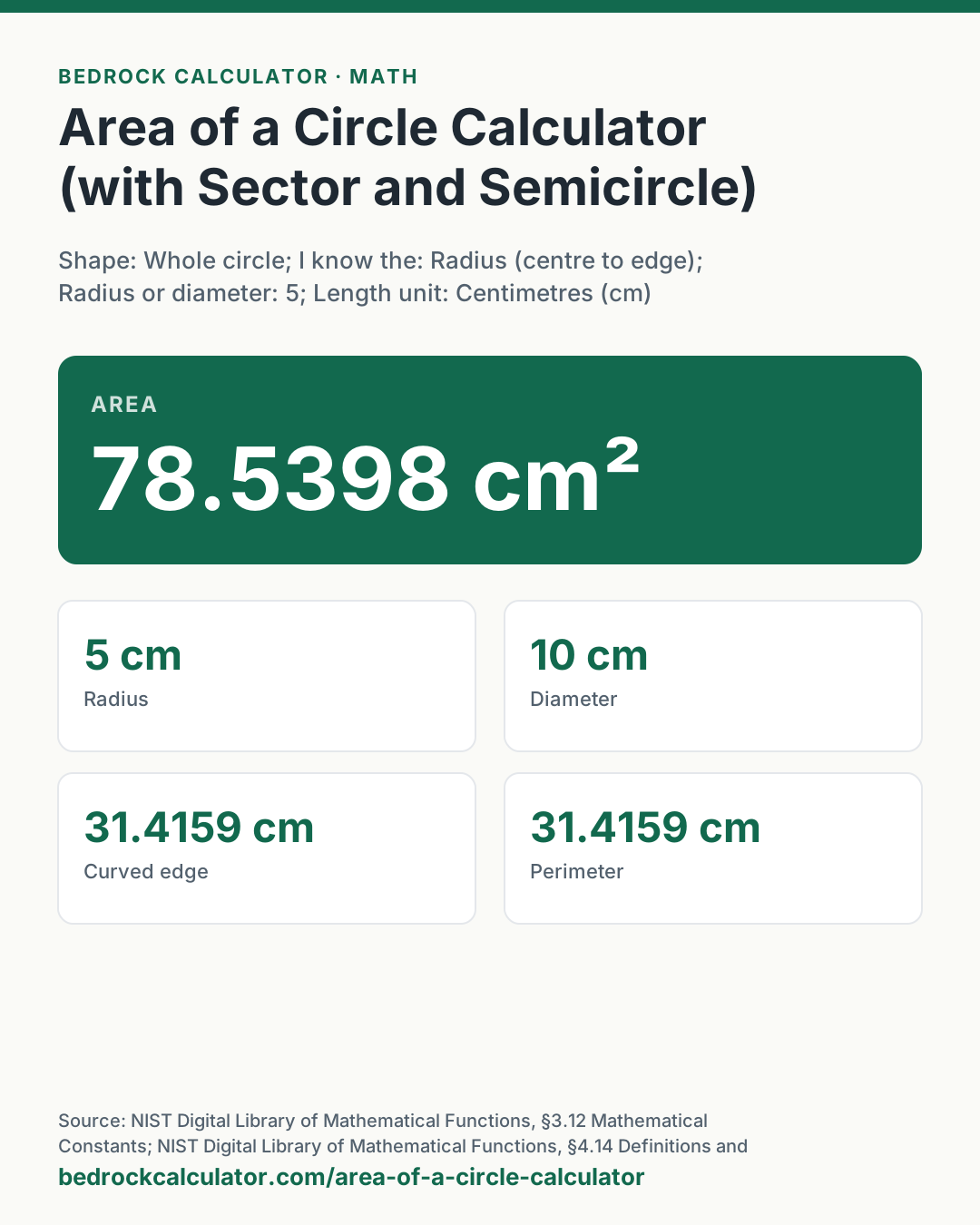
Quick Answer: The area of a circle is pi times the radius squared, so a circle with a radius of 5 cm covers 78.5398 cm². Halve the diameter first if that is what you measured: a 12 inch pizza has a 6 inch radius and an area of 113.0973 in².
What does this calculator do?
This calculator finds the area of a circle from its radius or its diameter, and it does the same for the two pieces people most often cut from a circle: a sector, which is a wedge between two radii, and a semicircle, which is exactly half.
Alongside the area it gives the curved edge (the circumference, or the arc of a sector or semicircle), the full perimeter including any straight edges, the chord across the opening, and the area of the whole circle the piece came from.
You can work in any length unit. The calculator does not convert anything: enter the radius in centimetres and the area comes back in square centimetres, enter it in feet and you get square feet. If you only have a number from a textbook problem with no unit, pick "No unit" and the answer is in square units.
Pi is carried to 34 significant digits rather than 3.14, and nothing is rounded until the figure is shown, to four decimal places. That is why the answers here can differ in the last place from a worksheet that used 3.14 or 22/7.
Using the Area of a Circle Calculator
- Choose the shape: a whole circle, a sector or a semicircle.
- Say whether the length you have is the radius or the diameter, then type it in.
- For a sector, enter the angle at the centre in degrees. A quarter circle is 90, a slice of a pizza cut into six is 60. The angle box only appears for a sector.
- Pick the unit your length is in. The results use that unit, squared for the area.
The three preset buttons load a 12 inch pizza, a 60 degree sector of a circle with radius 10 cm, and a semicircle 8 m across. Under the calculator, one table lists the area and circumference for common diameters and another lists sector areas and arc lengths for a circle of radius 10 at angles from 10 to 360 degrees. Both download as CSV files.
How is this calculated?
- Find the radius. If you entered a diameter, the calculator halves it. Everything else is built from the radius, r.
r = d/2
- Whole circle. The area is pi times the radius squared and the circumference is two pi times the radius. The perimeter of a whole circle is its circumference.
A = πr²; C = 2πr = πd
- Sector. The angle you enter, in degrees, is converted to radians (theta = angle times pi over 180). The sector is that fraction of a full turn, so its area and arc are the same fraction of the circle's. The chord comes from the right triangle formed by splitting the wedge down the middle. The perimeter adds the two straight radii to the arc, except at a full 360 degrees, where there are no straight edges and the perimeter is just the arc.
A_sector = r²θ/2; s = rθ; chord = 2r sin θ/2; P = s + 2r
- Semicircle. Half the area of the circle, an arc of half the circumference, and a perimeter that adds the diameter across the flat side.
A_semicircle = πr²/2; P = πr + 2r
- Round for display. Every figure is computed with 34 digits of precision and rounded half up to four decimal places only when shown, with trailing zeros dropped.
Worked Example
The default input is a whole circle with a radius of 5 cm.
- Area: pi times 5 squared, which is 25 pi, shown as 78.5398 cm².
- Diameter: twice the radius, 10 cm.
- Circumference: 10 pi, shown as 31.4159 cm.
A 12 inch pizza is measured across, so 12 is the diameter. The radius is 6 in, and the area is 36 pi, 113.0973 in². The crust, which is the circumference, is 37.6991 in long.
A 60 degree sector of a circle with radius 10 cm is one sixth of the circle. Its area is 52.3599 cm², one sixth of the whole circle's 314.1593 cm². The arc is 10.472 cm, the straight line across the opening is exactly 10 cm (a 60 degree wedge makes an equilateral triangle with its chord), and the perimeter round the whole wedge is 30.472 cm.
A semicircle 8 m across has a radius of 4 m. Its area is half of 50.2655 m², so 25.1327 m². The curved edge is 12.5664 m and the perimeter, adding the 8 m flat side, is 20.5664 m.
Why Is the Area of a Circle Pi r Squared?
Cut a circle into many thin wedges, like a pizza sliced very finely, and lay them side by side, alternating point up and point down. The strip that forms is close to a parallelogram. Its height is the radius, and its length is half the circumference, because half the crust runs along the top and half along the bottom.
Half the circumference is pi r, so the area is pi r times r, which is pi r squared. The thinner the slices, the closer the strip gets to a true rectangle, and in the limit the formula is exact.
The same picture explains the sector formula. A sector with angle theta in radians is theta out of a full turn of two pi, so its area is that share of pi r squared, which simplifies to r squared theta over two.
How Do You Find the Area of a Circle with the Diameter?
Halve the diameter to get the radius, then square it and multiply by pi. If you would rather skip the halving, the equation can be written with the diameter directly: the area is pi times the diameter squared, divided by four.
The common slip is to square the diameter and multiply by pi without dividing by four, which gives an answer four times too big. In the table below the calculator, a diameter of 2 gives an area of 3.1416, which is pi itself, because the radius is 1.
How Do You Find the Area of a Sector?
Multiply the area of the whole circle by the angle of the sector over 360. A 90 degree sector is a quarter of the circle; with a radius of 10 that is 78.5398, a quarter of 314.1593. If your angle is already in radians, use r squared times theta over two directly.
The calculator takes degrees, so convert radians first by multiplying by 180 and dividing by pi.
What Is the Formula for the Area of a Semicircle?
A semicircle is half a circle, so its area is pi r squared over two. People often ask how to find the area of half a circle when they have measured straight across the flat side; that measurement is the diameter, so halve it first.
The semicircle perimeter is a different question: it is the curved half of the circumference, pi r, plus the flat diameter, 2r. Forgetting the flat side is the usual mistake.
What does this calculator not account for?
- Unit conversion. The length unit is a label. If you measured the radius in inches and want square feet, convert the length to feet before entering it, or convert the area afterwards (there are 144 square inches in a square foot).
- Segments and rings. A circular segment, the area between a chord and its arc, and an annulus, the ring between two circles, are not modes here. A segment is the sector area minus the triangle formed by the two radii and the chord; a ring is the larger circle's area minus the smaller's. Run the calculator twice and subtract.
- Angles in radians. The sector angle is entered in degrees only.
- Real objects. A table top with a rounded or bevelled edge, or a pizza that is not quite round, will not match the ideal circle exactly. The result is only as good as the measurement.
- Precision of the input. The answer is shown to four decimal places, but a radius measured to the nearest centimetre does not make the area accurate to a ten-thousandth of a square centimetre. Round the answer to match your measurement.
What mistakes do people make with this?
- Using the diameter as the radius. This is the most common error, and it makes the area four times too large, because the length is squared.
- Squaring after multiplying. The formula squares the radius, then multiplies by pi. Squaring pi times r gives a different and wrong answer.
- Mixing square and linear units. The area of a circle with a radius of 5 cm is in square centimetres, not centimetres. The circumference is a length; the area is not.
- Taking a sector's perimeter as its arc. The arc is only the curved edge. The perimeter of a wedge also includes the two straight radii.
- Rounding pi early. Using 3.14 in a long calculation, such as the volume of a tank built from this area, carries the error through. The calculator keeps 34 digits until the end.
Frequently Asked Questions
What is the equation for the area of a circle?
How do I find the area of a circle from the circumference?
Is a sector the same as a segment?
What is the area of a quarter circle?
Why does my answer differ slightly from my textbook?
Can the sector angle be more than 180 degrees?
Sources
- NIST Digital Library of Mathematical Functions, §3.12 Mathematical Constants: pi as the ratio of a circle's circumference to its diameter. dlmf.nist.gov/3.12
- NIST Digital Library of Mathematical Functions, §4.14 Definitions and Periodicity of the trigonometric functions (the sine used for the chord). dlmf.nist.gov/4.14
- OpenStax, Prealgebra 2e, §9.5 Solve Geometry Applications: Circles and Irregular Figures (radius, diameter, circumference and area). openstax.org/books/prealgebra-2e/pages/9-5-solve-geometry-applications-circles-and-irregular-figures
- OpenStax, Algebra and Trigonometry 2e, §7.1 Angles: radians, arc length and the area of a sector. openstax.org/books/algebra-and-trigonometry-2e/pages/7-1-angles