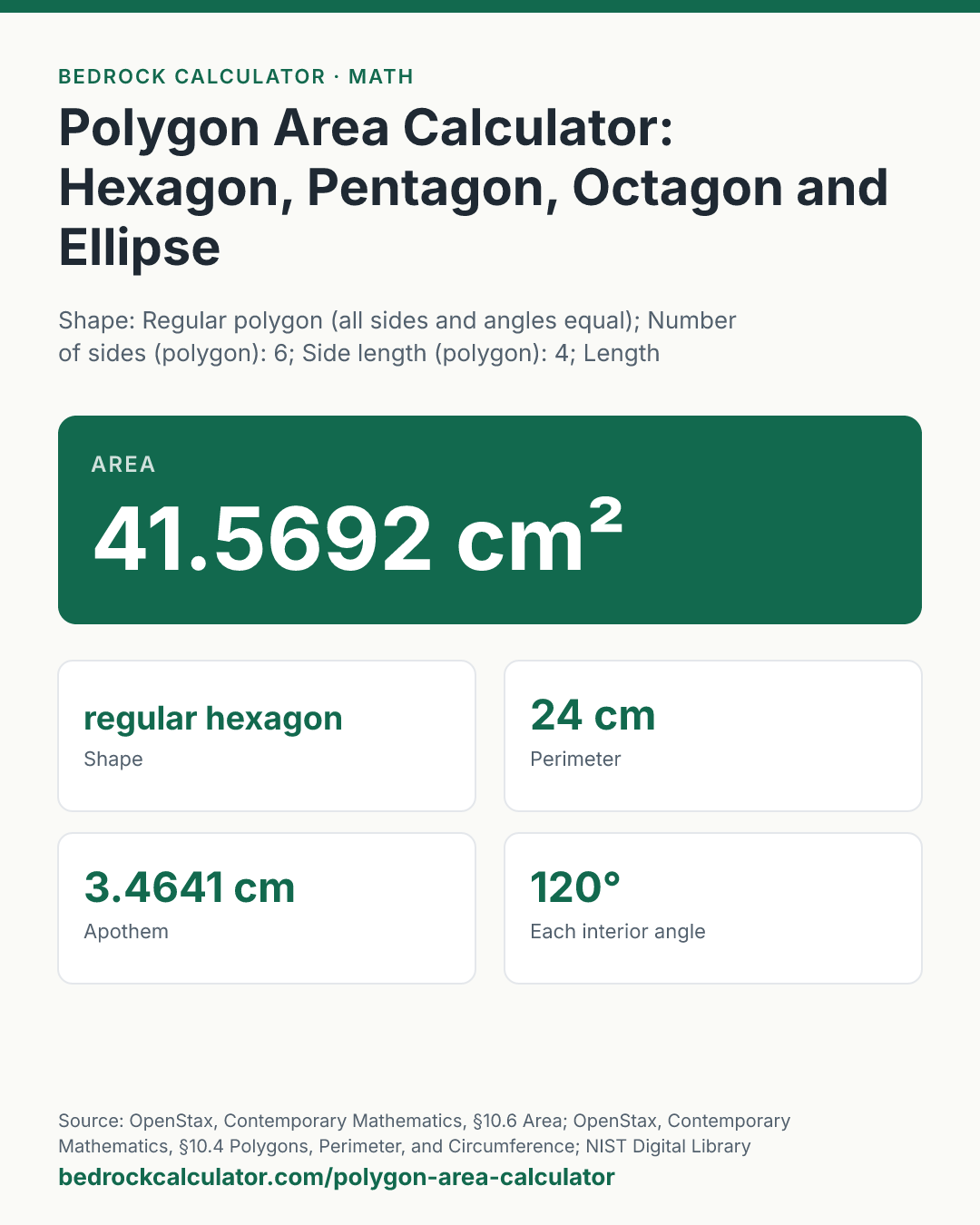
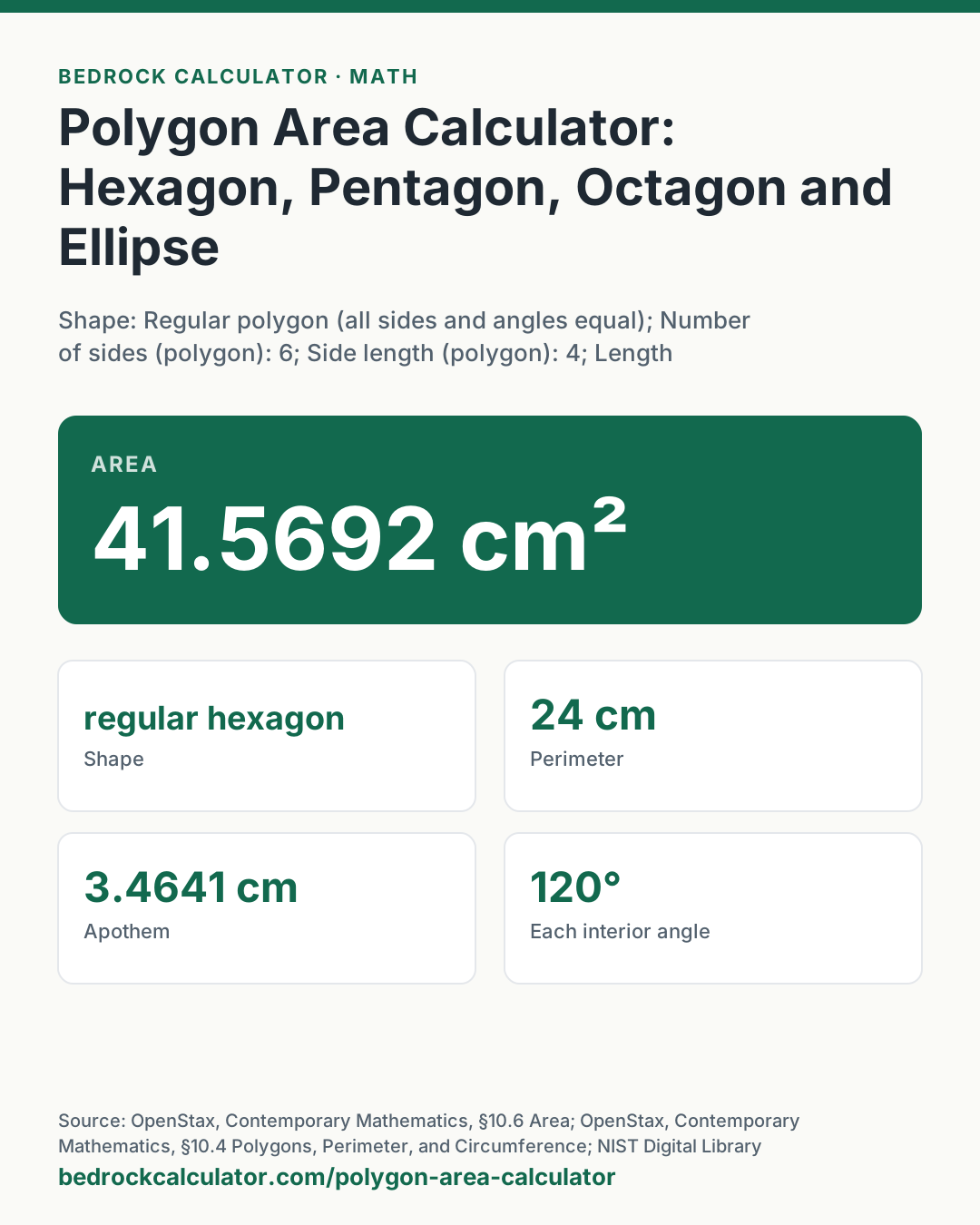
Quick Answer: A regular hexagon with 4 cm sides has an area of 41.5692 cm². For any regular polygon, the area is half the perimeter times the apothem, the distance from the centre to the middle of a side.
What does this calculator do?
This polygon area calculator works out the area of any regular polygon from the number of sides and the length of one side: a pentagon, a hexagon, an octagon, or a shape with 20 or 100 sides. Alongside the area it gives the perimeter and each interior and exterior angle.
It also gives the apothem and the circumradius, the distance from the centre to a corner.
A second mode finds the area of an ellipse, or oval, from its two semi-axes, and estimates its perimeter.
"Regular" matters here. A regular polygon has every side the same length and every angle the same size, which is what makes one side length enough to fix the whole shape. A six-sided shape with uneven sides is still a hexagon, but its area depends on more than one measurement and this calculator does not cover it.
Lengths can be in any unit. The area comes back in that unit squared. Results are rounded to four decimal places for display, and the working runs at 34-digit precision with pi to the same number of digits.
Using the Polygon Area Calculator
- Choose a regular polygon or an ellipse.
- For a polygon, enter the number of sides and the length of one side. Five sides make a pentagon, six a hexagon, eight an octagon.
- For an ellipse, enter the semi-major axis a (half the longest width) and the semi-minor axis b (half the shortest).
- Pick the unit.
The presets load a pentagon with sides of 10, an octagon with 12 inch sides, and an ellipse with semi-axes of 5 and 3. Below the calculator, one table lists polygons from 3 to 20 sides with a side of 1, and another lists hexagon areas for sides from 1 to 25.
How is this calculated?
- Split into triangles. A regular polygon with n sides is n identical isosceles triangles meeting at the centre. Each has the side s as its base and the apothem as its height. The apothem comes from the tangent of half the central angle, 180°/n.
a = s/(2 tan(180^∘/n))
- Area. n triangles of area half s times a, which is half the perimeter times the apothem.
A = 1/2 ns a = 1/2P a
- Circumradius and angles. The circumradius uses the sine of the same half angle. Each interior angle is the total, (n − 2) × 180°, shared equally; each exterior angle is 360° shared equally.
R = s/(2 sin(180^∘/n)); θ_interior = ((n − 2) 180^∘)/n; θ_exterior = 360^∘/n
- Ellipse area. Pi times the two semi-axes, exactly. A circle is the case a = b.
A = πab
- Ellipse perimeter. There is no exact formula in elementary terms; the true value is an elliptic integral. The calculator uses Ramanujan's approximation, which is exact for a circle and very close for ordinary ovals, and labels the result as an approximation.
P ≈ π(a + b)(1 + 3h/(10 + √(4 − 3h))), h = ((a − b)²)/((a + b)²)
- Round for display to four decimal places, half up.
Worked Example
The default is a regular hexagon with 4 cm sides.
- Apothem: 4 ÷ (2 × tan 30°), 3.4641 cm.
- Perimeter: 6 × 4 = 24 cm.
- Area: half of 24 × 3.4641, carried at full precision, 41.5692 cm².
- Circumradius: 4 cm, the same as the side, which is special to the hexagon. Interior angles 120°, exterior angles 60°.
A regular pentagon with sides of 10 has an apothem of 6.8819, a perimeter of 50 and an area of 172.0477. Its interior angles are 108°.
A regular octagon with 12 inch sides covers 695.2935 in², with a perimeter of 96 in and interior angles of 135°.
An ellipse with semi-axes of 5 and 3 has an area of 15 pi, 47.1239, and a perimeter of about 25.527.
How Do You Find the Area of a Hexagon?
For a regular hexagon, multiply the side squared by three times the square root of 3, over 2, which is about 2.5981 times the side squared. The formula comes from the hexagon splitting into six equilateral triangles, each with the hexagon's side as its own side.
That is also why a hexagon's corners are exactly one side length from its centre. The hexagon table below the calculator gives areas for sides from 1 to 25; a side of 10 gives 259.8076.
How Do You Find the Area of a Pentagon?
Use half the perimeter times the apothem, as for any regular polygon, with the apothem equal to the side divided by twice the tangent of 36°. With a side of 1 the area is 1.7205, so for any regular pentagon, multiply 1.7205 by the side squared. The first table below the calculator lists that factor for every common polygon.
What Is the Area of an Octagon?
For a regular octagon, the area is twice (1 + √2) times the side squared, about 4.8284 times the side squared. An octagon with 12 inch sides covers 695.2935 square inches. A regular octagon can also be seen as a square with its four corners cut off at 45 degrees.
How Do You Find the Area of an Ellipse?
Multiply pi by the two semi-axes, A = πab. The semi-axes are half the full widths, measured across the longest and shortest directions through the centre. An ellipse 10 wide and 6 tall has semi-axes of 5 and 3 and an area of 47.1239.
What does this calculator not account for?
- Irregular polygons. Unequal sides or angles need more measurements. Split the shape into triangles, find each with the triangle area calculator, and add them up, or use the coordinates of the corners.
- Other starting measurements. The calculator starts from the side length. If you know the apothem or the distance across, work back to the side first.
- Exact ellipse perimeter. The perimeter is an approximation, correct to many digits for ordinary ellipses but not exact for very long, thin ones.
- Unit conversion. Lengths are not converted between units.
What mistakes do people make with this?
- Using a full width as a semi-axis. For an ellipse, halve the width and the height before entering them.
- Treating the apothem and the circumradius as the same. The apothem goes to the middle of a side; the circumradius goes to a corner and is longer.
- Measuring across a hexagon wrongly. Across the flats is twice the apothem; across the corners is twice the side, which is noticeably longer.
- Assuming a shape is regular. A stop-sign octagon is regular; a room with eight walls usually is not.
- Angles in radians. The angles here are in degrees.
Frequently Asked Questions
What is a 6 sided shape called?
What is the formula for the area of a regular polygon?
What is the sum of the interior angles of a polygon?
Why does a hexagon have an apothem of 3.4641 when the side is 4?
Is a circle a polygon?
Can an ellipse have equal axes?
Sources
- OpenStax, Contemporary Mathematics, §10.6 Area: the area of a regular polygon, ½ap. openstax.org/books/contemporary-mathematics/pages/10-6-area
- OpenStax, Contemporary Mathematics, §10.4 Polygons, Perimeter, and Circumference: interior angle sum (n − 2) × 180°. openstax.org/books/contemporary-mathematics/pages/10-4-polygons-perimeter-and-circumference
- NIST Digital Library of Mathematical Functions, §19.9(i) Inequalities: Ramanujan's approximation to the perimeter of an ellipse (19.9.10). dlmf.nist.gov/19.9
- NIST Digital Library of Mathematical Functions, §4.14 Definitions and Periodicity of the trigonometric functions (tangent and sine). dlmf.nist.gov/4.14