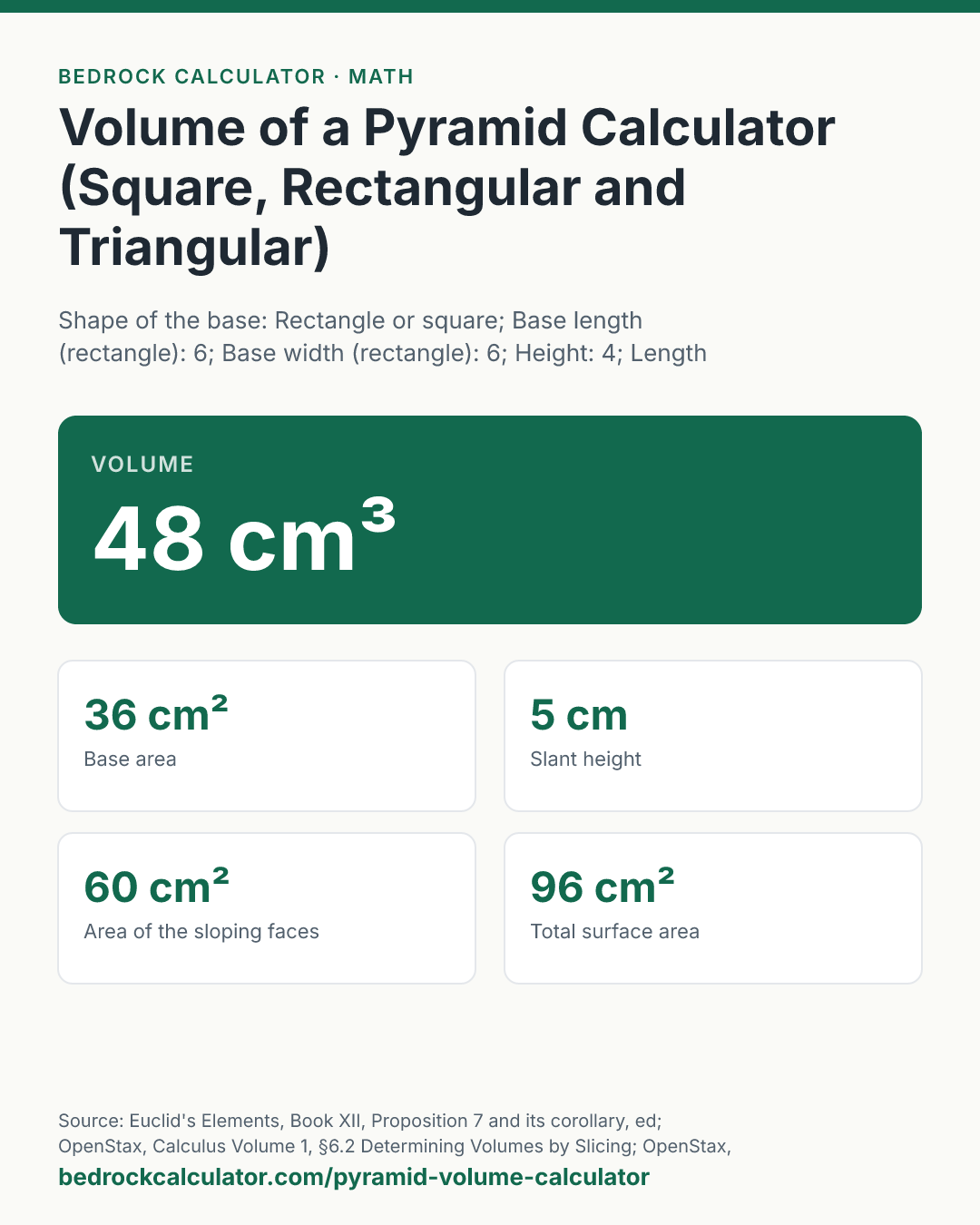
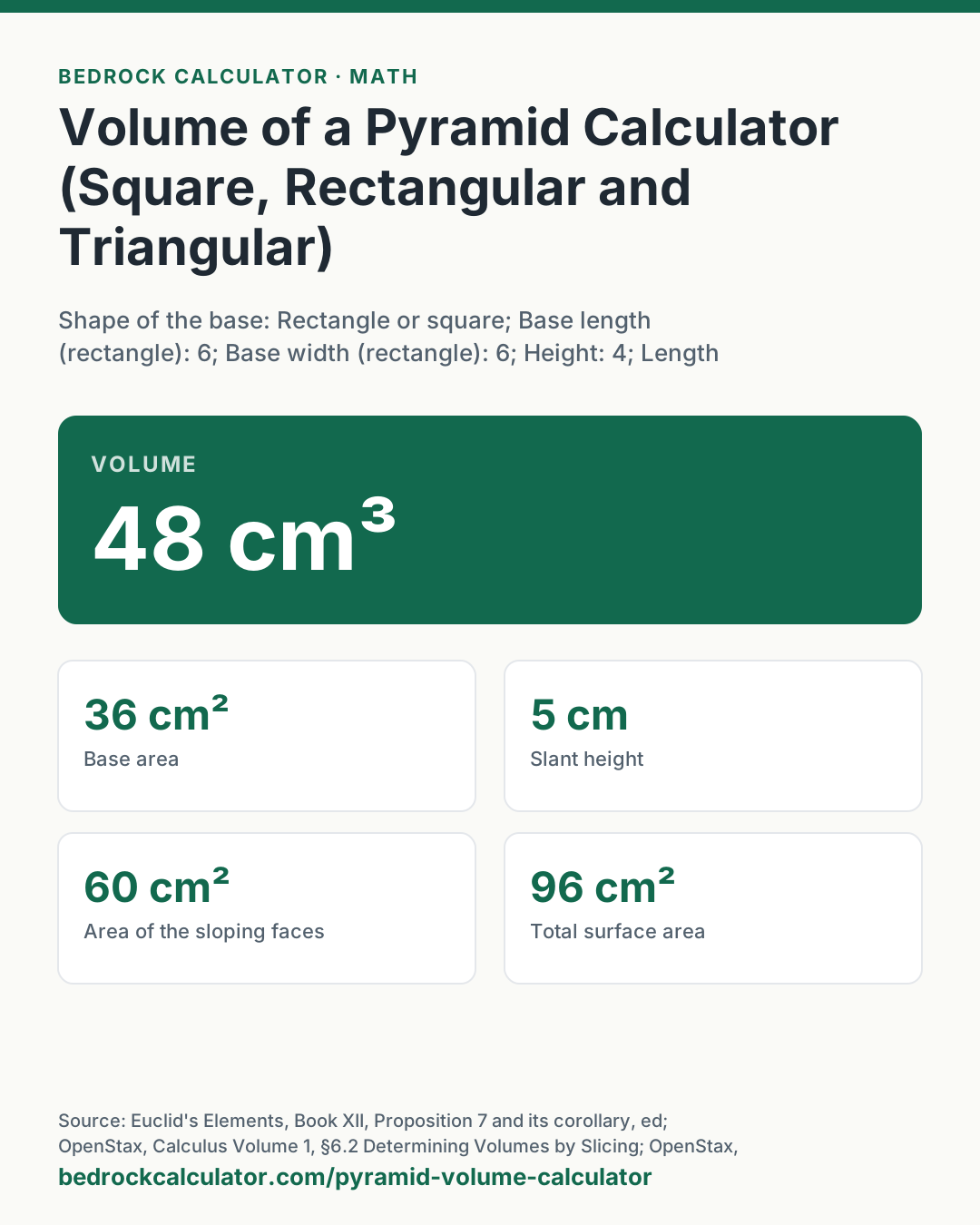
Quick Answer: The volume of a pyramid is one third of its base area times its height. A square pyramid with a 6 cm base and a height of 4 cm holds 48 cm³: the base is 36 cm², and a third of 36 × 4 is 48.
What does this calculator do?
This calculator finds the volume of a pyramid, and its surface area where the shape allows it. It handles a rectangular or square base, a regular polygon base from its number of sides and side length, and any other base whose area you already know.
A regular polygon base can be an equilateral triangle, a square, a pentagon, a hexagon and so on. Alongside the volume it gives the slant height, the edge from a base corner to the tip, the area of the sloping faces and the total surface area.
The one-third in the volume formula is the surprising part. A pyramid takes up exactly a third of the box, or prism, that would just enclose it: same base, same height. Euclid proved it for a triangular base by cutting a triangular prism into three pyramids of equal volume, and the result carries over to any base. The same rule makes a cone a third of a cylinder.
Lengths can be in any unit, all in the same one. Volume comes back in that unit cubed and surfaces in that unit squared. The calculator assumes a right pyramid, with its tip directly above the centre of the base, and rounds results to four decimal places for display.
Using the Volume of a Pyramid Calculator
- Choose the shape of the base.
- For a rectangle or square, enter its length and width. For a regular polygon, enter the number of sides (3 for a triangular pyramid, 4 for a square one) and the side length. For any other base, enter its area.
- Enter the height: the perpendicular distance from the base to the tip, not the length up a sloping face.
- Pick the unit.
The presets load a rectangular pyramid on an 8 by 6 base, a triangular pyramid on an equilateral base of side 6, and a pyramid with a known base area of 50 and a height of 12. The table below the calculator lists square pyramids of height 10 with bases from 2 to 30.
How is this calculated?
- Volume. In every mode the volume is the base area B times the height h, divided by 3.
V = 1/3Bh
- Rectangular base, l by w. The base area is l times w. Each triangular face has its own slant height, from the middle of its base edge up to the tip. Over a length edge that is the square root of h² plus half the width squared; over a width edge, h² plus half the length squared. The sloping faces add up to l times the first slant plus w times the second.
sₗ = √(h² + (w/2)²); s_w = √(h² + (l/2)²); A_faces = l sₗ + w s_w
- Regular polygon base, n sides of length a. The base area comes from its apothem, the distance from the centre to the middle of a side, which is a divided by twice the tangent of 180°/n. All the faces are identical, with slant height the square root of h² plus the apothem squared, so their total area is half the base perimeter times the slant height. The edge from a base corner to the tip uses the circumradius, the distance from the centre to a corner.
r_apothem = a/(2 tan(180^∘/n)); s = √(h² + r_apothem²); A_faces = nas/2
- Total surface adds the base to the sloping faces. In base-area mode only the volume is given, because the faces depend on the base's shape.
- Round for display to four decimal places, half up.
Worked Example
The default is a square pyramid with a 6 cm base and a height of 4 cm.
- Base area: 6 × 6 = 36 cm².
- Volume: 36 × 4 ÷ 3 = 48 cm³.
- Slant height: the square root of 4² + 3², which is 5 cm.
- Sloping faces: four triangles, each 6 wide and 5 tall, so 4 × 6 × 5 ÷ 2 = 60 cm². Adding the base gives a total surface of 96 cm².
A rectangular pyramid on an 8 by 6 base, 4 high has a volume of 48 × 4 ÷ 3 = 64. Its faces lean differently: the slant height is 5 on the long faces and 5.6569 on the short ones, and the sloping area comes to 73.9411.
A triangular pyramid on an equilateral base with sides of 6 and a height of 4 has a base area of 15.5885 and a volume of 20.7846. The slant height of each face is 4.3589, and each edge from a base corner to the tip is 5.2915 long.
What Is the Volume Formula for a Pyramid?
V = ⅓Bh, where B is the area of the base and h is the perpendicular height. It works for any base shape: square, rectangular, triangular, hexagonal or irregular. Only the base area changes.
For a square pyramid the formula becomes V = ⅓a²h, for a rectangular pyramid V = ⅓lwh, and for a triangular pyramid it is a third of the triangle's area times the height.
How Do You Find the Volume of a Triangular Pyramid?
Find the area of the triangular base, multiply by the height of the pyramid and divide by 3. If the base is an equilateral triangle, choose a regular polygon base with 3 sides and the calculator works out its area for you.
If it is some other triangle, find its area first (the triangle area calculator does this from the three sides) and enter it in base-area mode.
How Do You Find the Surface Area of a Regular Pyramid?
Add the base area to the area of the sloping faces. For a regular pyramid all the faces are identical triangles, so their combined area is half the base's perimeter times the slant height. The slant height is not the pyramid's height: it runs up the middle of a face and is always longer.
Get it from the height and the apothem with the Pythagorean theorem.
What does this calculator not account for?
- Oblique pyramids. If the tip is not above the centre of the base, the volume formula still holds, but the faces are no longer congruent and the surface figures here do not apply.
- Frustums. A pyramid with its top cut off is a frustum. Its volume is the full pyramid's minus the small one removed from the top; run the calculator twice and subtract.
- Surface area in base-area mode. With only the base area known, the shape of the faces is unknown.
- Irregular polygon bases. The regular-polygon mode assumes equal sides and angles.
- Unit conversion. All lengths must be in one unit.
What mistakes do people make with this?
- Forgetting the third. Base area times height is the prism's volume, three times the pyramid's.
- Using the slant height as the height. The volume needs the vertical height. Using the slant height overstates it.
- Using the height for the face area. The faces need the slant height, not the vertical height.
- Using a base edge instead of the base area. For a square base 6 on a side, B is 36, not 6.
- Assuming all faces are the same on a rectangular pyramid. They come in two pairs with different slant heights.
Frequently Asked Questions
What is the volume of a square pyramid formula?
How do you find the volume of a rectangular pyramid?
Why is a pyramid one third of a prism?
What is the slant height of a pyramid?
What is a tetrahedron?
Is a cone a pyramid?
Sources
- Euclid's Elements, Book XII, Proposition 7 and its corollary, ed. D. E. Joyce, Clark University: any pyramid is a third of the prism with the same base and height. mathcs.clarku.edu/~djoyce/elements/bookXII/propXII7.html
- OpenStax, Calculus Volume 1, §6.2 Determining Volumes by Slicing: V = ⅓a²h for a square pyramid derived by integration. openstax.org/books/calculus-volume-1/pages/6-2-determining-volumes-by-slicing
- OpenStax, Contemporary Mathematics, §10.6 Area: the area of a regular polygon from its apothem and perimeter. openstax.org/books/contemporary-mathematics/pages/10-6-area
- NIST Digital Library of Mathematical Functions, §4.14 Definitions and Periodicity of the trigonometric functions (the tangent in the apothem). dlmf.nist.gov/4.14