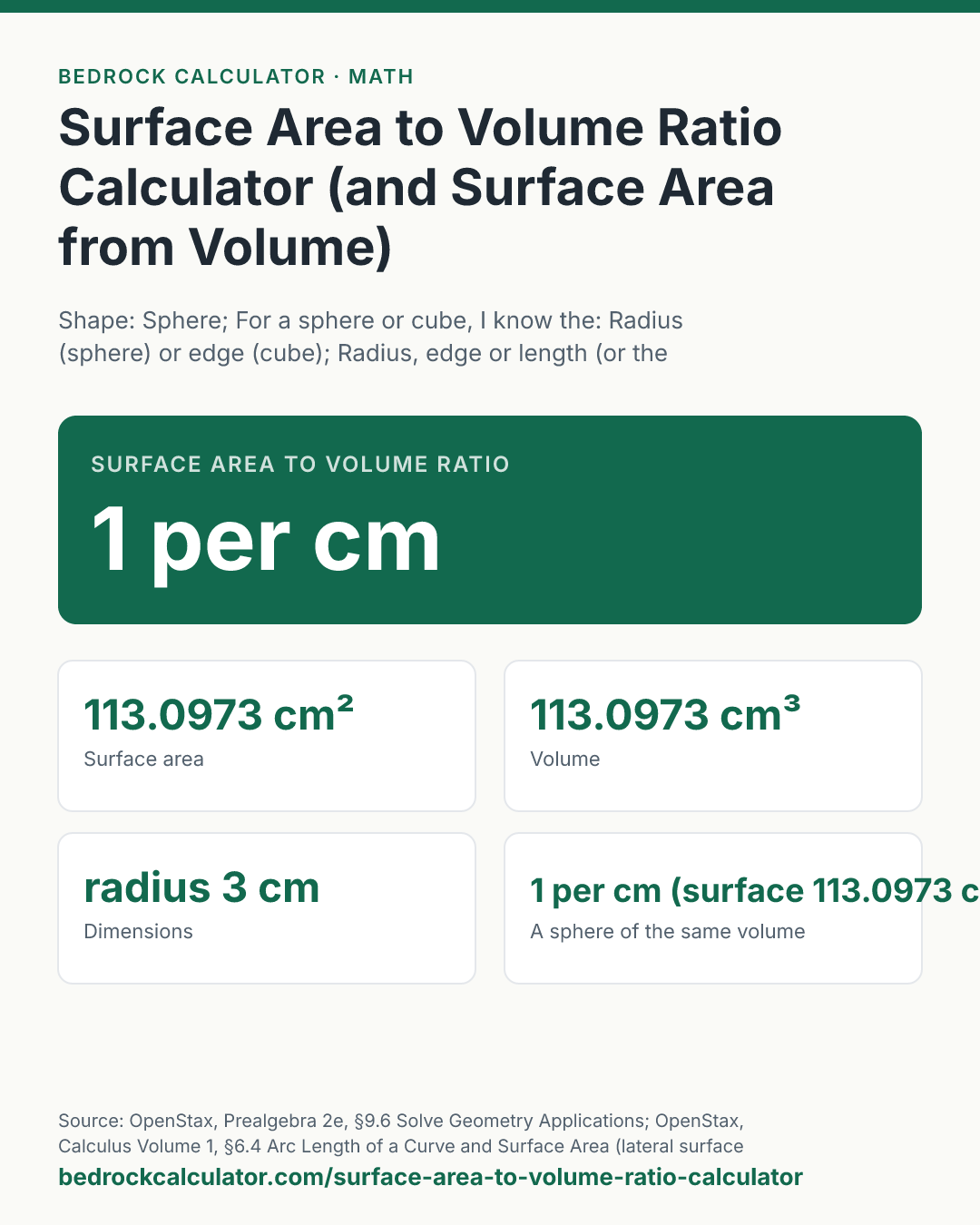
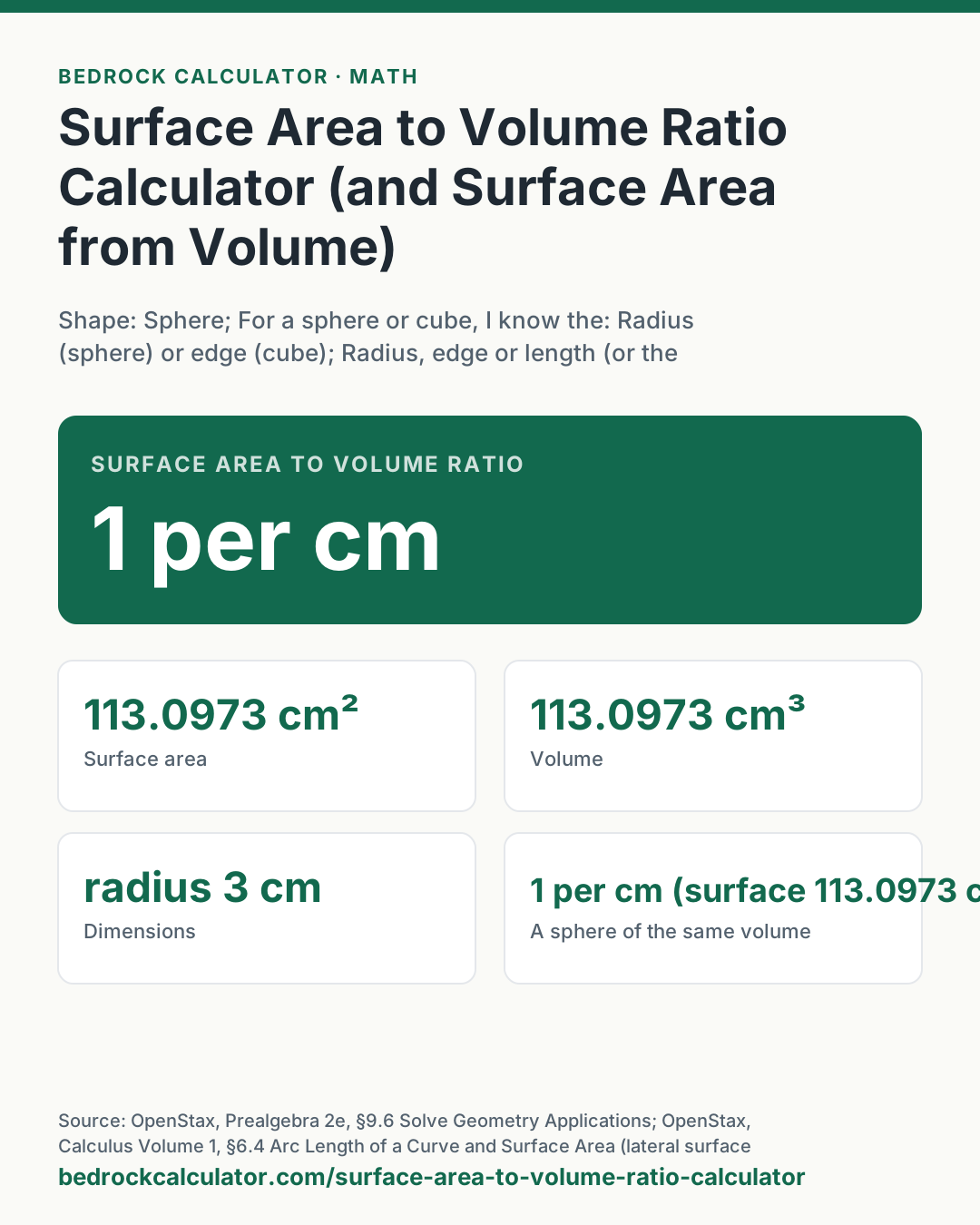
Quick Answer: The surface area to volume ratio is the surface area divided by the volume. A sphere with a radius of 3 cm has a ratio of exactly 1 per cm: its surface, 113.0973 cm², and its volume, 113.0973 cm³, are the same number.
What does this calculator do?
This calculator works out the surface area to volume ratio of a sphere, a cube, a rectangular box, a cylinder or a cone. It also answers the two related questions people ask about spheres and cubes: what surface area a given volume has, and what volume a given surface area encloses.
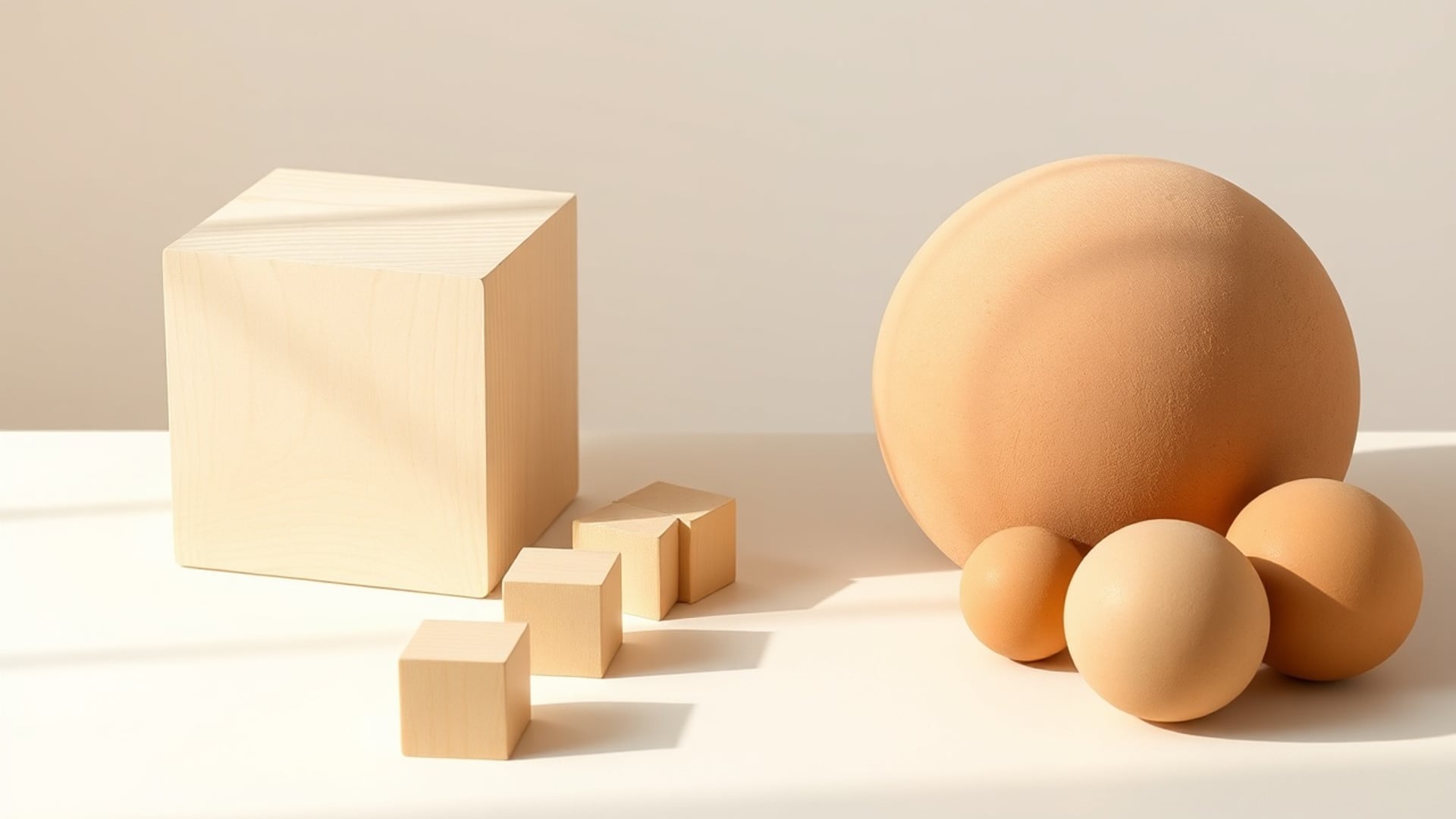
For every shape it adds the ratio of a sphere with the same volume, which is the smallest ratio any solid of that volume can have, so you can see how far your shape is from the most compact one.
The ratio matters wherever exchange happens across a surface. A small cell has plenty of membrane for its contents, which is why cells divide rather than growing large. Crushed ice cools a drink faster than one big cube. A large animal loses heat more slowly for its size than a small one. In each case the important fact is that surface grows with the square of size while volume grows with the cube, so the ratio falls as things get bigger.
Unlike most geometric figures, this ratio has units: area over volume is one over length. A ratio of 1 per cm is 0.1 per mm and 100 per m, so always quote the unit. Lengths can be in any unit, and results are rounded to four decimal places for display.
Using the Surface Area to Volume Ratio Calculator
- Choose the shape.
- For a sphere or cube, say whether you know its radius or edge, its volume, or its surface area, and enter it.
- For a box, enter its length in the first box with the width and height. For a cylinder or cone, enter the radius in the first box and the height.
- Pick the unit.
The cards show the surface area, the volume, the dimensions (including the radius or edge worked out from a volume or surface area) and the same-volume sphere. The presets load a cube holding 1,000 cm³, a sphere with 100 cm² of surface, a cell of radius 10 micrometres and a cylinder of radius 1 and height 10. The table below the calculator compares spheres and cubes from 0.5 to 100 units across.
How is this calculated?
- Build the solid. A sphere from its radius, or from its volume by r = cube root of 3V over 4 pi, or from its surface area by r = square root of A over 4 pi. A cube from its edge, or from its volume by the cube root, or from its surface area by the square root of A over 6. A box, cylinder or cone from its dimensions.
- Surface and volume. The standard formulas, with every face included: the ends of a cylinder, the base of a cone, all six faces of a box.
sphere: A = 4πr², V = 4/3πr³; cube: A = 6s², V = s³
cylinder: A = 2πrh + 2πr², V = πr²h; cone: A = πrℓ + πr², V = 1/3πr²h
- Ratio. The total surface divided by the volume. For a sphere it simplifies to 3 over the radius, for a cube to 6 over the edge.
A/V; sphere: 3/r; cube: 6/s
- Same-volume sphere. The calculator finds the sphere with your shape's volume and reports its ratio and surface. No solid of that volume has less surface.
- Round for display to four decimal places, half up.
Worked Example
The default is a sphere with a radius of 3 cm.
- Surface: 4 × pi × 9 = 36 pi, 113.0973 cm².
- Volume: four thirds × pi × 27 = 36 pi, 113.0973 cm³.
- Ratio: 3 ÷ 3 = 1 per cm.
A cube that holds 1,000 cm³ has an edge of 10 cm, a surface of 600 cm² and a ratio of 0.6 per cm. A sphere of the same volume needs only 483.5976 cm² of surface, a ratio of 0.4836 per cm.
A sphere with 100 cm² of surface has a radius of 2.8209 cm and holds 94.0316 cm³, a ratio of 1.0635 per cm.
A cylinder of radius 1 cm and height 10 cm has a ratio of 2.2 per cm. Packed into a ball of the same volume it would have a ratio of only 1.5326 per cm, which is why long thin shapes such as roots, gills and radiator fins are good at exchange.
A spherical cell of radius 10 micrometres has a ratio of 0.3 per µm. Enter it in plain units and read the answer as per micrometre.
How Do You Find the Surface Area from the Volume?
For a sphere, find the radius first by taking the cube root of three times the volume over four pi, then use 4πr². For a cube, take the cube root of the volume to get the edge and multiply its square by 6. Choose "Volume" in the calculator and it does both steps.
A volume alone does not fix the surface of other shapes: a box of 1,000 cm³ could be a cube or a thin slab, with very different surfaces.
How Do You Find the Volume from the Surface Area?
Reverse the same steps. For a sphere, the radius is the square root of the area over 4π, and the volume follows. For a cube, the edge is the square root of the area over 6. A sphere with 100 cm² of surface encloses 94.0316 cm³.
Why Does the Surface Area Ratio Fall as Size Grows?
Double every length of a shape and its surface becomes four times larger while its volume becomes eight times larger, so the ratio halves. The table below the calculator shows it directly: a sphere of radius 1 has a ratio of 3, radius 10 has 0.3, and radius 100 has 0.03.
A cube is always twice its matching sphere's ratio at the same radius or edge, 6 over s against 3 over r.
What does this calculator not account for?
- Open shapes. The surface includes every face. For an open-topped box or a tube open at both ends, subtract the missing faces yourself.
- Real surfaces. Folds, pores and roughness add surface that a smooth geometric shape does not have. A real cell, lung or catalyst grain has a much higher ratio than its outline suggests.
- Other shapes from volume. Only spheres and cubes can be rebuilt from a volume or surface area alone.
- Units. The ratio depends on the unit: convert all lengths to one unit and quote the ratio per that unit.
What mistakes do people make with this?
- Quoting the ratio without a unit. 1 per cm and 1 per m are a hundredfold apart.
- Comparing shapes in different units. Convert first.
- Leaving out ends or bases. A cylinder's ratio includes its two circular ends; a cone's includes its base.
- Thinking a bigger object has a bigger ratio. It is the other way round: smaller objects have more surface per unit of volume.
- Using a diameter for the radius. For a sphere the ratio is 3 over the radius, not over the diameter.
Frequently Asked Questions
What is the surface area to volume ratio of a sphere?
What is the surface area to volume ratio of a cube?
Which shape has the smallest surface area for its volume?
Why do cells stay small?
Does the ratio have units?
How do I compare two different shapes fairly?
Sources
- OpenStax, Prealgebra 2e, §9.6 Solve Geometry Applications: Volume and Surface Area (rectangular solid, sphere, cylinder and cone). openstax.org/books/prealgebra-2e/pages/9-6-solve-geometry-applications-volume-and-surface-area
- OpenStax, Calculus Volume 1, §6.4 Arc Length of a Curve and Surface Area (lateral surface of a cone). openstax.org/books/calculus-volume-1/pages/6-4-arc-length-of-a-curve-and-surface-area
- NIST Digital Library of Mathematical Functions, §3.12 Mathematical Constants: the value of pi. dlmf.nist.gov/3.12
- NIST Special Publication 811, Guide for the Use of the International System of Units: units formed as quotients, such as reciprocal metres. nist.gov/pml/special-publication-811