How much is real estate transfer tax in each US state?
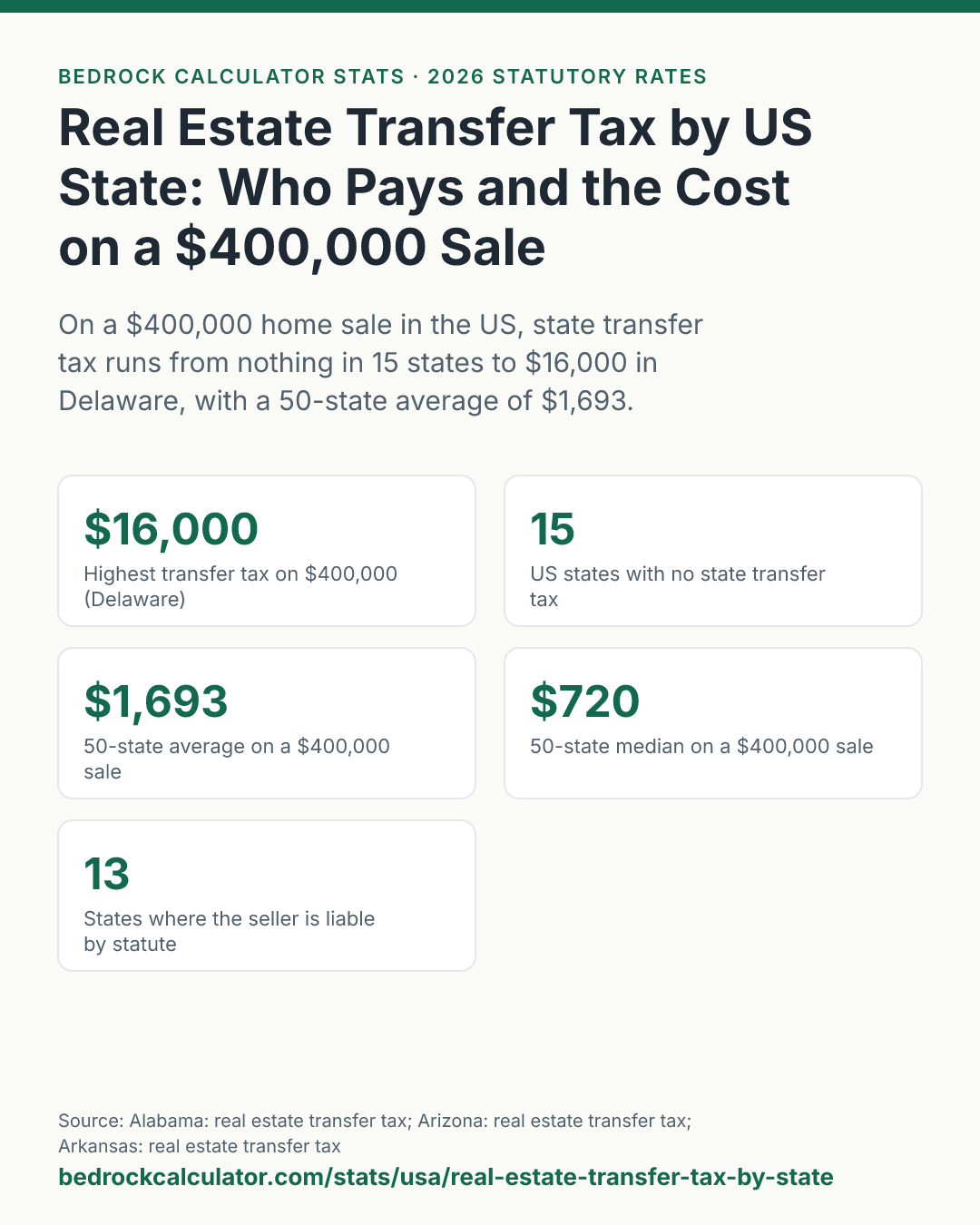
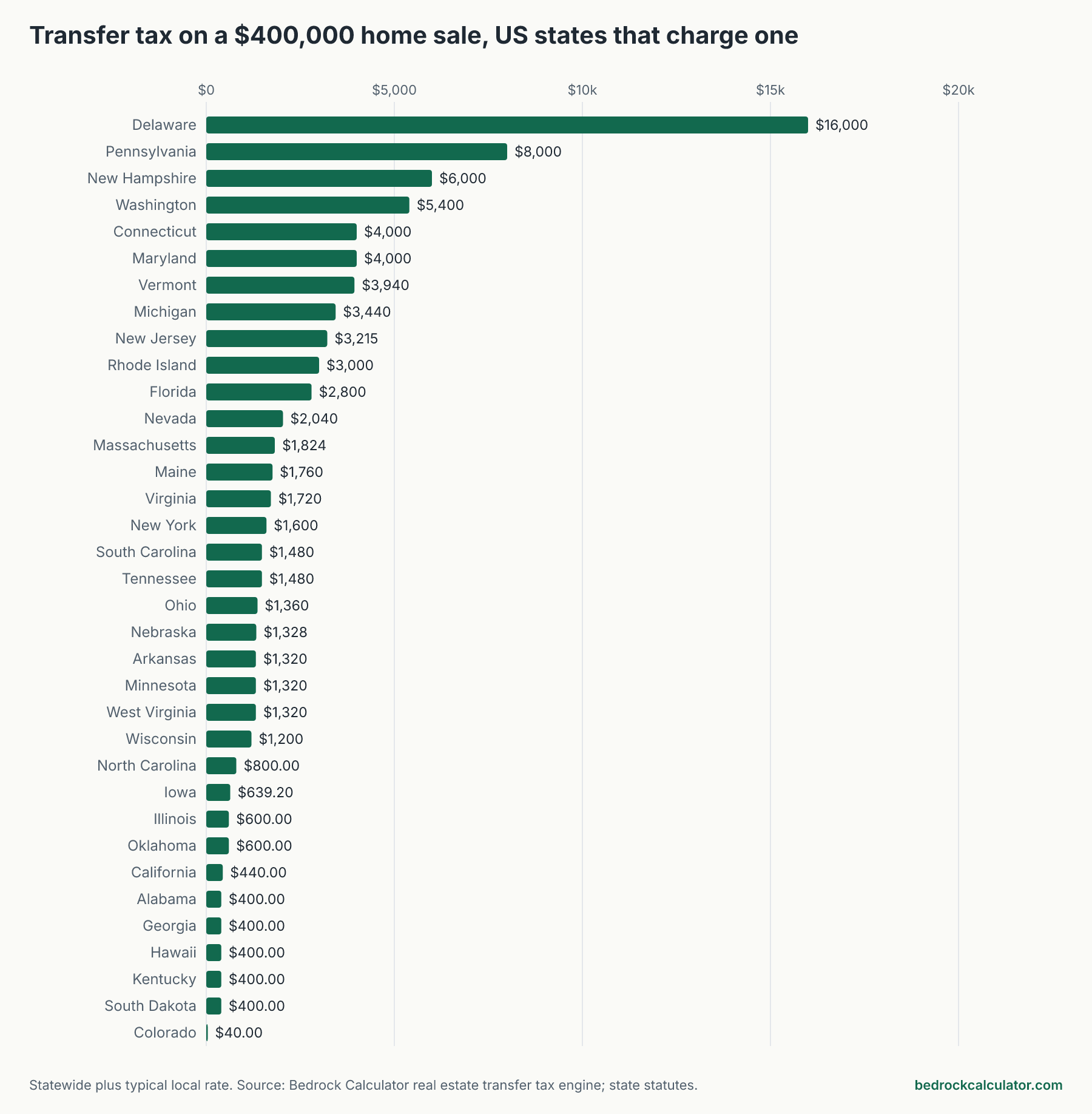
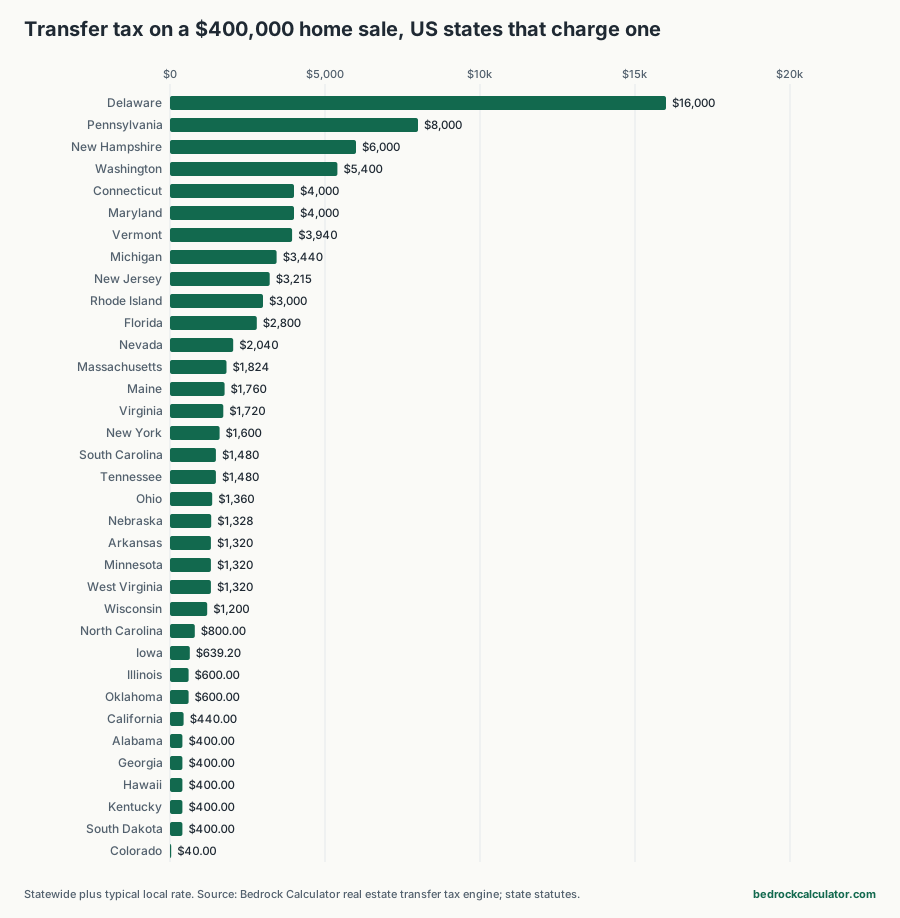
When a home changes hands in the US, most states charge a tax on the deed. On a $400,000 sale it ranges from nothing at all in 15 states to $16,000 in Delaware. Pennsylvania ($8,000) and New Hampshire ($6,000) are next.
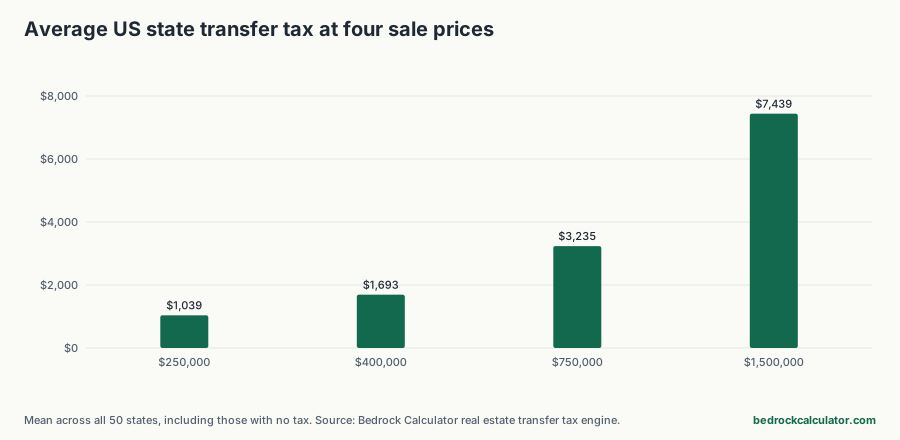
Across all 50 states the average is $1,693, but that's pulled up by a few expensive states. The state in the middle charges $720.
Who pays depends on the state. By statute or state guidance the seller is liable in 13 states, the buyer in a couple, and the cost is split in a few more. In every state, the purchase contract can move it.
How we worked out these numbers
We ran the real estate transfer tax calculator once for every state with a sale price of $400,000 and recorded the tax due. The calculator applies each state's statutory rate or bracket schedule. Where a state's local add-on is close to uniform, it includes a typical local rate too: Pennsylvania's matching local tax, Delaware's local share, and county add-ons in states like Michigan, Maryland and Washington.
It assumes an ordinary arm's-length sale of an owner-occupied home with no exemption. What it leaves out matters:
- City transfer taxes. San Francisco, Los Angeles, Chicago, Philadelphia and New York City all charge well above the statewide figure. California's number here is only the county documentary tax of $440.
- Resort-town and county taxes. Colorado's statewide fee is just $40.00 here, but several mountain towns levy their own transfer taxes of a percent or more.
- Exemptions and first-time buyer breaks. Some states, Delaware and Maryland among them, cut the tax for first-time buyers or exempt transfers between family members or into trusts.
- Mortgage recording taxes, recording fees and title costs, which are separate charges and often larger.
The "who pays" column is our plain reading of the statute or state guidance in our verified state profiles, linked in the sources. "Not stated in source" means the cited rule sets the rate but doesn't say which party pays, so local custom decides. Hawaii, Wisconsin have no verified profile entry on this yet.
Transfer tax on a $400,000 sale in every state
Click a column heading to sort. Rank 1 is the most expensive state, and the states with no tax share the bottom rank.
Real estate transfer tax on a $400,000 sale, by US state
Download CSVStatewide and typical local rate in the engine, owner-occupied residential sale, no exemptions. Who pays reflects the statute or state guidance cited on this page; contracts can reallocate it.
| Delaware | $16,000 | 4.00% | 1 | Buyer and seller, typically split |
| Pennsylvania | $8,000 | 2.00% | 2 | Both jointly liable |
| New Hampshire | $6,000 | 1.50% | 3 | Split half and half |
| Washington | $5,400 | 1.35% | 4 | Seller |
| Connecticut | $4,000 | 1.00% | 5 | Not stated in source |
| Maryland | $4,000 | 1.00% | 5 | Not stated in source |
| Vermont | $3,940 | 0.98% | 7 | Buyer |
| Michigan | $3,440 | 0.86% | 8 | Seller |
| New Jersey | $3,215 | 0.80% | 9 | Seller |
| Rhode Island | $3,000 | 0.75% | 10 | Seller unless agreed otherwise |
| Florida | $2,800 | 0.70% | 11 | All parties liable |
| Nevada | $2,040 | 0.51% | 12 | Not stated in source |
| Massachusetts | $1,824 | 0.46% | 13 | Not stated in source |
| Maine | $1,760 | 0.44% | 14 | Split half and half |
| Virginia | $1,720 | 0.43% | 15 | Seller pays grantor tax |
| New York | $1,600 | 0.40% | 16 | Seller (buyer pays mansion tax) |
| South Carolina | $1,480 | 0.37% | 17 | Seller (buyer secondarily) |
| Tennessee | $1,480 | 0.37% | 17 | Buyer |
| Ohio | $1,360 | 0.34% | 19 | Seller |
| Nebraska | $1,328 | 0.33% | 20 | Seller |
| Arkansas | $1,320 | 0.33% | 21 | Not stated in source |
| Minnesota | $1,320 | 0.33% | 21 | Not stated in source |
| West Virginia | $1,320 | 0.33% | 21 | Either party |
| Wisconsin | $1,200 | 0.30% | 24 | Not verified |
| North Carolina | $800 | 0.20% | 25 | Seller |
| Iowa | $639 | 0.16% | 26 | Not stated in source |
| Illinois | $600 | 0.15% | 27 | Not stated in source |
| Oklahoma | $600 | 0.15% | 27 | Either party |
| California | $440 | 0.11% | 29 | Not stated in source |
| Alabama | $400 | 0.10% | 30 | Not stated in source |
| Georgia | $400 | 0.10% | 30 | Seller (contract can shift it) |
| Hawaii | $400 | 0.10% | 30 | Not verified |
| Kentucky | $400 | 0.10% | 30 | Seller |
| South Dakota | $400 | 0.10% | 30 | Seller |
| Colorado | $40 | 0.01% | 35 | Not stated in source |
| Alaska | $0 | 0.00% | 36 | No state transfer tax |
| Arizona | $0 | 0.00% | 36 | No state transfer tax |
| Idaho | $0 | 0.00% | 36 | No state transfer tax |
| Indiana | $0 | 0.00% | 36 | No state transfer tax |
| Kansas | $0 | 0.00% | 36 | No state transfer tax |
| Louisiana | $0 | 0.00% | 36 | No state transfer tax |
| Mississippi | $0 | 0.00% | 36 | No state transfer tax |
| Missouri | $0 | 0.00% | 36 | No state transfer tax |
| Montana | $0 | 0.00% | 36 | No state transfer tax |
| New Mexico | $0 | 0.00% | 36 | No state transfer tax |
| North Dakota | $0 | 0.00% | 36 | No state transfer tax |
| Oregon | $0 | 0.00% | 36 | No state transfer tax |
| Texas | $0 | 0.00% | 36 | No state transfer tax |
| Utah | $0 | 0.00% | 36 | No state transfer tax |
| Wyoming | $0 | 0.00% | 36 | No state transfer tax |
The most expensive states to sell a home
Delaware stands alone at $16,000, an effective rate of 4.00%. Its state realty transfer tax is high on its own, and most towns and counties add a local share on top. By state guidance the cost is usually split between buyer and seller, and first-time buyers get a partial break.
Pennsylvania comes second at $8,000 because the state's tax is matched by a local tax almost everywhere. New Hampshire charges buyer and seller half each, $6,000 combined. Washington's graduated real estate excise tax, paid by the seller, comes to $5,400 at this price.
New York is lower than people expect at this price, $1,600, because its well-known mansion tax only starts at a million dollars. Our mansion tax study covers what happens above that line.
The 15 states with no transfer tax
Alaska, Arizona, Idaho, Indiana, Kansas, Louisiana, Mississippi, Missouri, Montana, New Mexico, North Dakota, Oregon, Texas, Utah, Wyoming don't charge a statewide tax on the deed. Some, like Texas, bar one in the state constitution. Buyers and sellers there still pay recording fees, title insurance and other closing costs, but no tax on the price itself.
Who pays the transfer tax: buyer or seller?
There's no national rule. In our verified records:
- The seller is liable in Georgia, Kentucky, Michigan, Nebraska, New Jersey, New York, North Carolina, Ohio, Rhode Island, South Carolina, South Dakota, Virginia, Washington. In Georgia and Rhode Island the cited rule notes that the parties can agree otherwise, and in New York the buyer pays the separate mansion tax.
- The buyer is liable in Tennessee, Vermont.
- It's split in Delaware, Maine, New Hampshire.
- Either or both parties can be held liable in Florida, Oklahoma, Pennsylvania and West Virginia.
Even where the law names one side, the purchase contract can shift the cost, and in a hot market buyers sometimes agree to cover it. Read the closing cost section of your contract before you sign.
How the tax grows with the sale price
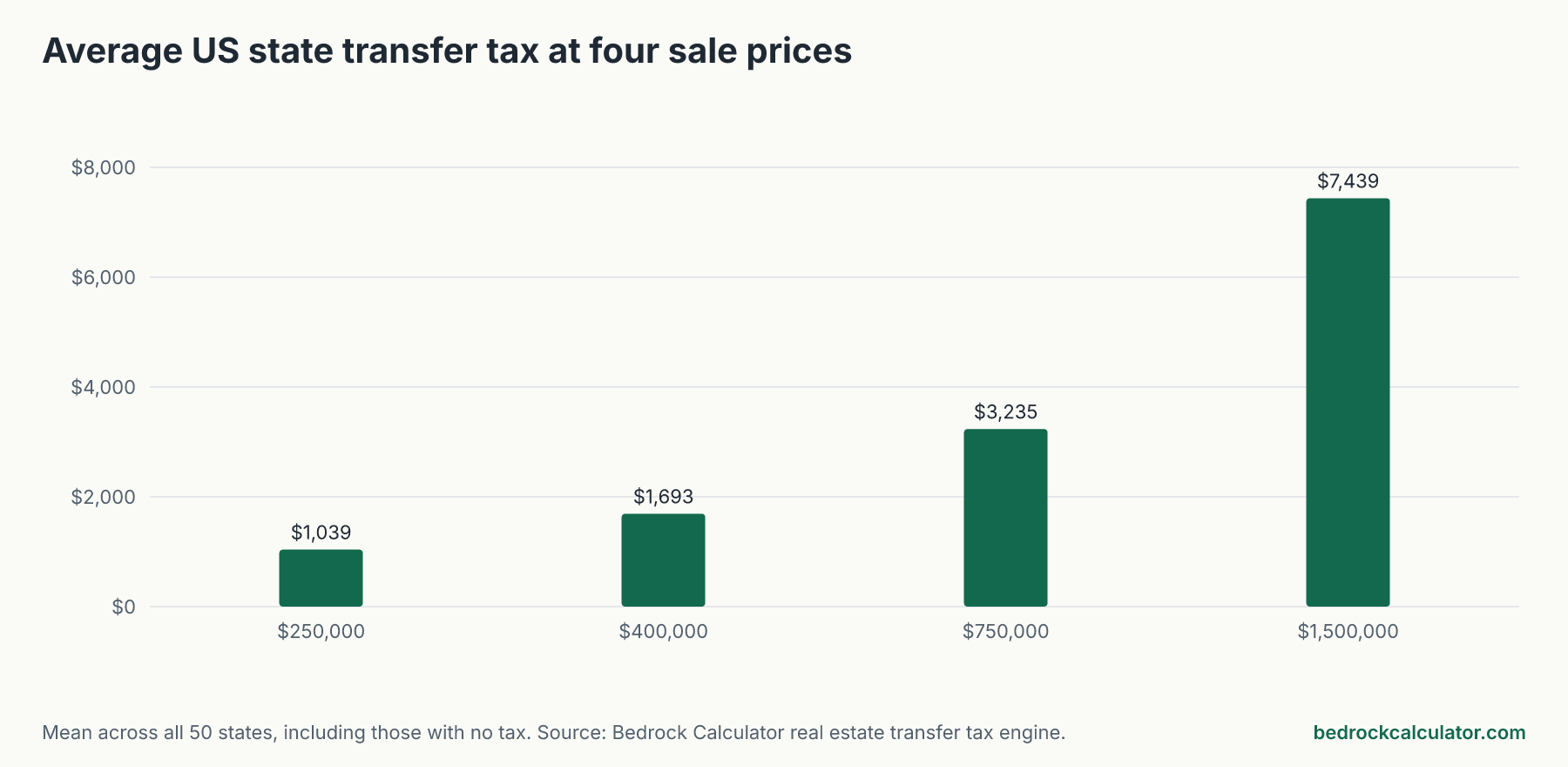
Most states charge a flat percentage, so the tax rises in step with the price. A handful use brackets that climb as the price goes up. Averaged across all 50 states, the tax is $1,039 on a $250,000 sale, $1,693 on $400,000 and $7,439 on $1,500,000.
Getting your own figure
Enter your state and price in the real estate transfer tax calculator, then add the local tax if your city or county charges one. The closing costs calculator puts the transfer tax alongside lender and title fees, and the mortgage calculator shows the monthly side of the purchase.