Which US states charge a mansion tax, and how much is it?
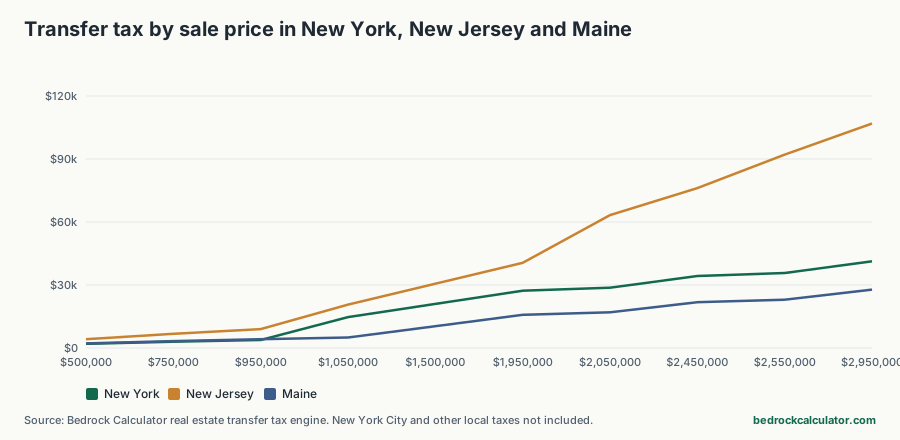
A "mansion tax" is a higher transfer tax on expensive homes, and in the US three states charge one that starts at $1 million: New York, New Jersey and Maine. The first two work as a cliff. Once the price reaches the threshold, the extra rate applies to the entire price, not just the part above it.
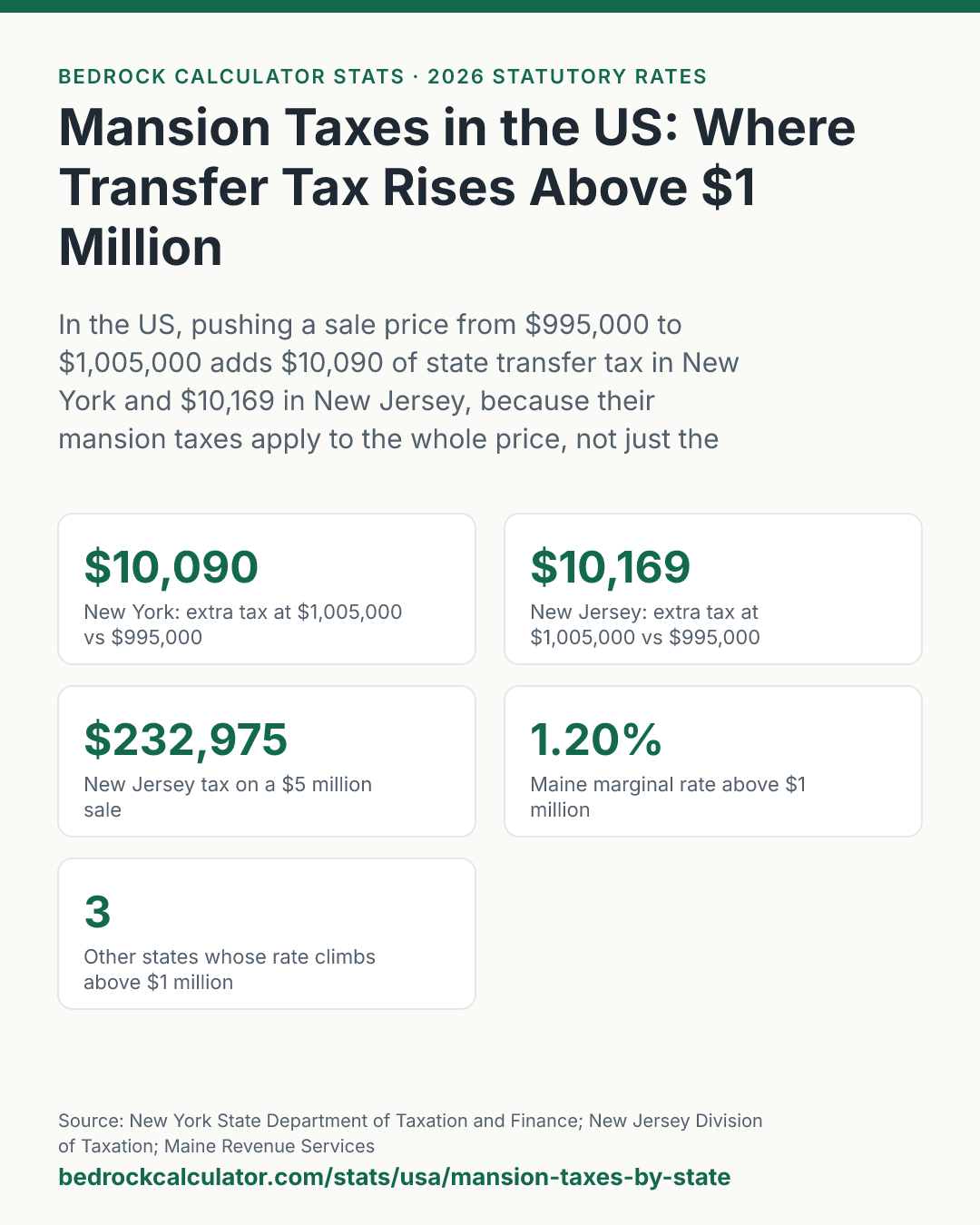
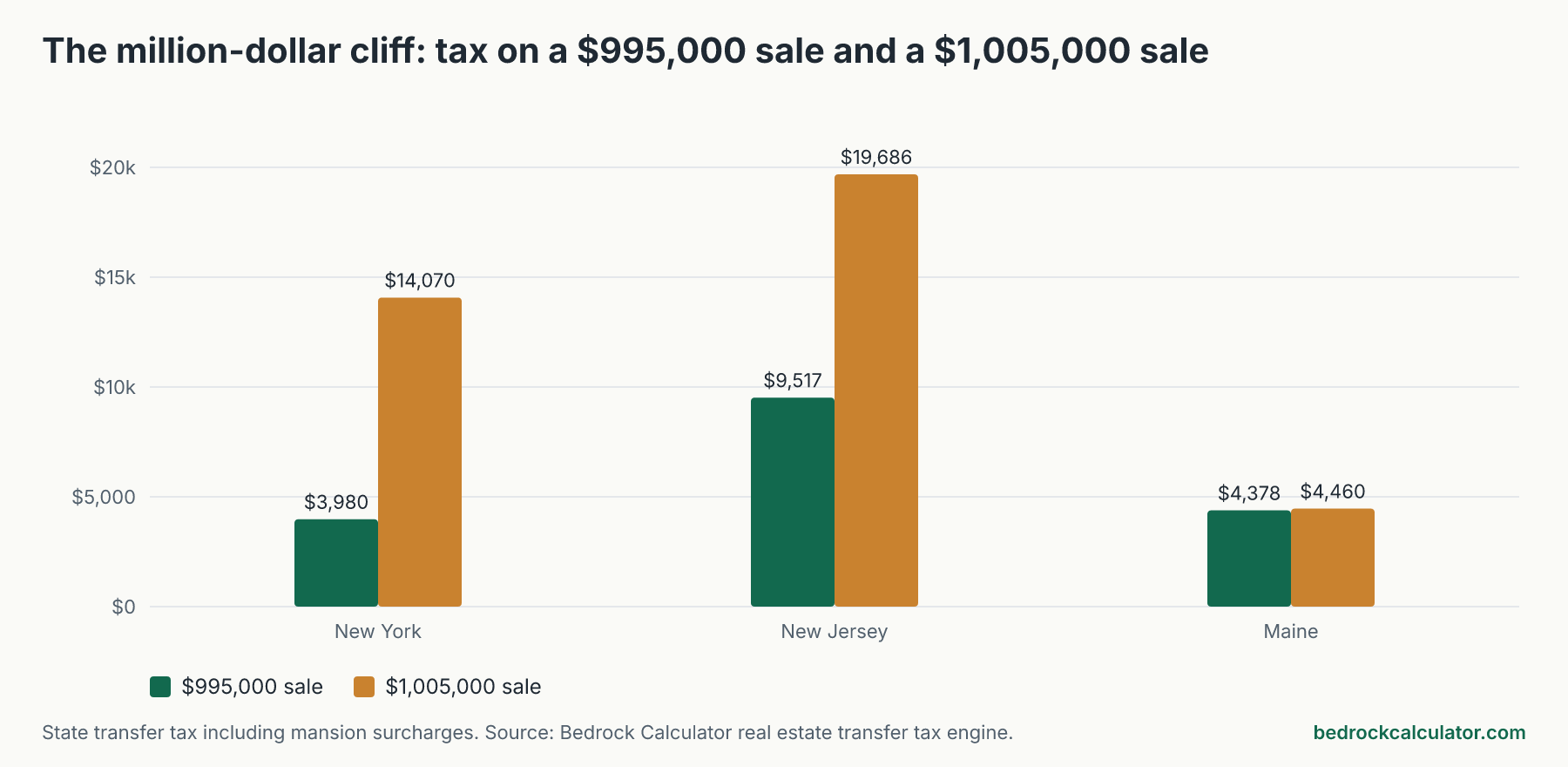
That makes the line expensive to cross. Moving a sale from $995,000 to $1,005,000 adds $10,090 of state transfer tax in New York and $10,169 in New Jersey. In Maine the same move adds only a little, because Maine's higher rate applies only to value above $1 million.
How we worked out these numbers
Every figure comes from the real estate transfer tax calculator, run at each price shown. It includes each state's base transfer tax, its mansion surcharge, and the typical local rate the engine applies for that state. It assumes a residential sale of an owner-occupied home with no exemption.
We picked prices that sit a little away from each threshold, like $995,000 and $1,005,000, so no figure depends on whether a statute says "$1 million or more" or "over $1 million". If your price lands right on a threshold, check the statute or ask your closing attorney.
The other states in the table weren't picked by hand. We had the engine find every state whose rate on the next dollar is higher just under three million dollars than just under one million. That turned up 3 more: Connecticut, Hawaii, Washington.
What we leave out:
- New York City's own taxes. The city adds a supplemental mansion tax paid by the buyer on residential sales of two million dollars or more, and a higher base tax on sales of three million or more. None of that is in the New York figures here.
- Los Angeles's Measure ULA and other city transfer taxes. Our engine covers statewide rates, so California's figure is only the county documentary tax.
- The District of Columbia. DC charges a deed recordation tax and a deed transfer tax at a higher rate once the price reaches a set threshold, but DC isn't in our transfer tax table, so we don't compute it.
New York's mansion tax: the buyer's cliff
New York charges a base transfer tax of 0.40% of the price, usually paid by the seller. On top of that, the buyer pays a mansion tax of 1.00% of the whole price once a home sells for $1 million or more.
On a $1,005,000 sale the mansion tax is $10,050, which takes the state total from $3,980 at $995,000 to $14,070. Above the line it grows in step with the price: $30,800 at $2,200,000 and $70,000 at $5,000,000.
New Jersey's mansion tax: a ladder of cliffs
New Jersey's version is steeper. Since July 2025 the seller pays a graduated fee on the entire price of a sale over $1 million, and the rate on the whole price steps up at two million, two and a half million, three million and three and a half million. That's on top of the regular realty transfer fee, which already reaches 1.16% on the slice of the price just under $1 million.
The result: $30,625 on a $1,500,000 sale, $68,095 at $2,200,000 (of which $44,000 is the graduated fee), and $232,975 at $5,000,000. New Jersey has the highest state transfer tax of any state at five million dollars.
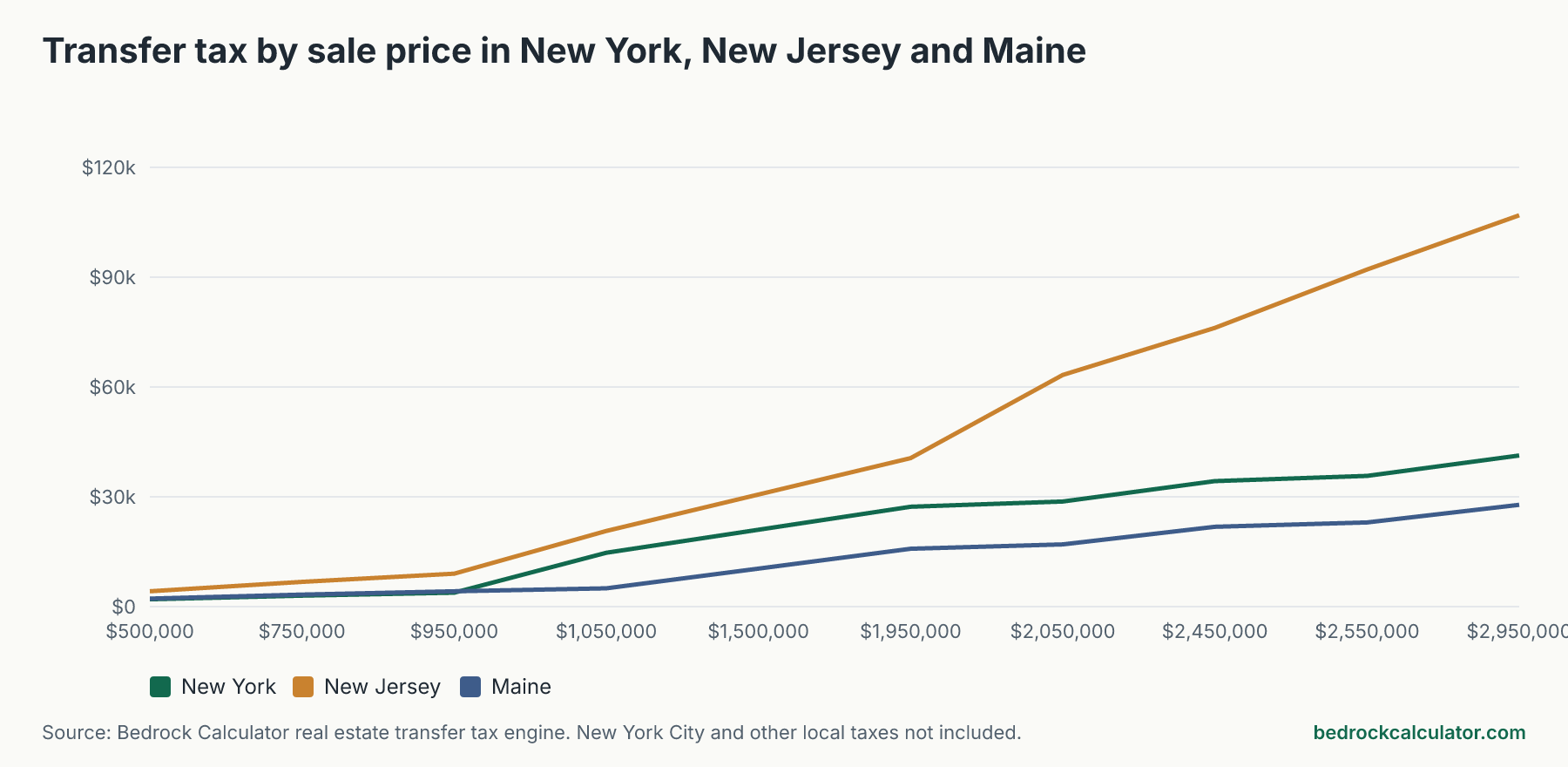
The line chart shows the shape. New York jumps once and then climbs steadily. New Jersey jumps at the first threshold and again at each later one.
Maine's higher rate above $1 million
Maine took a different route. From November 2025, the part of a home's value above $1 million is taxed at 1.20% combined, against 0.44% below it. The tax is split equally between buyer and seller.
Because the higher rate applies only to the excess, there's no cliff. A $1,005,000 sale owes $4,460, barely more than $4,378 at $995,000. A $1,500,000 sale owes $10,400.
Other states that charge more on expensive homes
Connecticut, Hawaii, Washington don't call it a mansion tax, but their bracket schedules work the same way in spirit: the rate on each extra dollar goes up as the price rises. These are marginal brackets, so there's no cliff, only a steeper slope.
State transfer tax on high-value US home sales
Download CSVTotal state transfer tax including any mansion surcharge, plus the typical local rate the engine applies. Owner-occupied residential sale; city taxes not included.
| New Jersey | $9,517 | $8,415 | $21,785 | $30,625 | $68,095 | $101,355 | $232,975 |
| Washington | $14,279 | $12,825 | $15,885 | $22,005 | $42,638 | $60,638 | $131,575 |
| Connecticut | $10,925 | $9,500 | $12,500 | $18,500 | $29,000 | $41,000 | $96,000 |
| New York | $3,980 | $3,600 | $15,400 | $21,000 | $30,800 | $39,200 | $70,000 |
| Maine | $4,378 | $3,960 | $5,600 | $10,400 | $18,800 | $26,000 | $52,400 |
| Hawaii | $1,390 | $1,200 | $1,700 | $2,900 | $5,400 | $8,400 | $21,400 |
Who pays, and how to plan for it
In New York, the mansion tax is the buyer's bill. In New Jersey the graduated fee falls on the seller. In Maine the tax is split. A contract can shift any of these. Near a threshold, a few thousand dollars of price can mean ten thousand or more in tax, so it's worth running both sides of the line before you make or accept an offer.
To run a specific price, open the real estate transfer tax calculator. The closing costs calculator adds the other costs of closing, and the mortgage calculator handles the monthly side. Our transfer tax study for every state covers ordinary sales below the mansion thresholds.