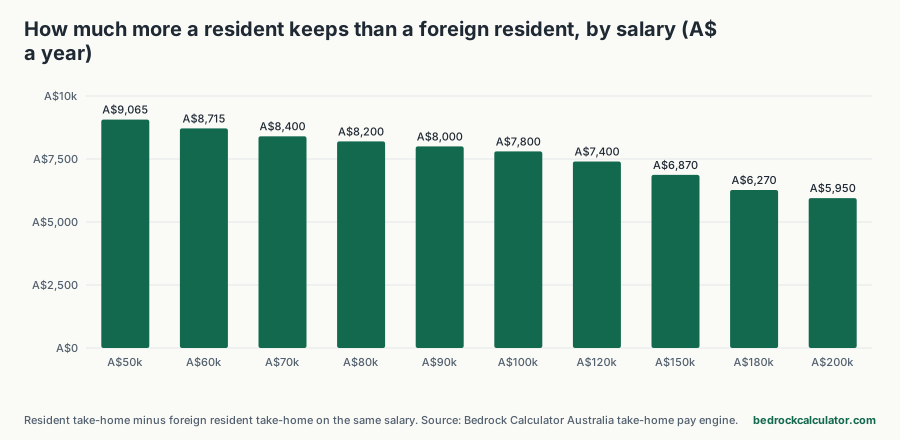
How much less does a foreign resident take home in Australia?
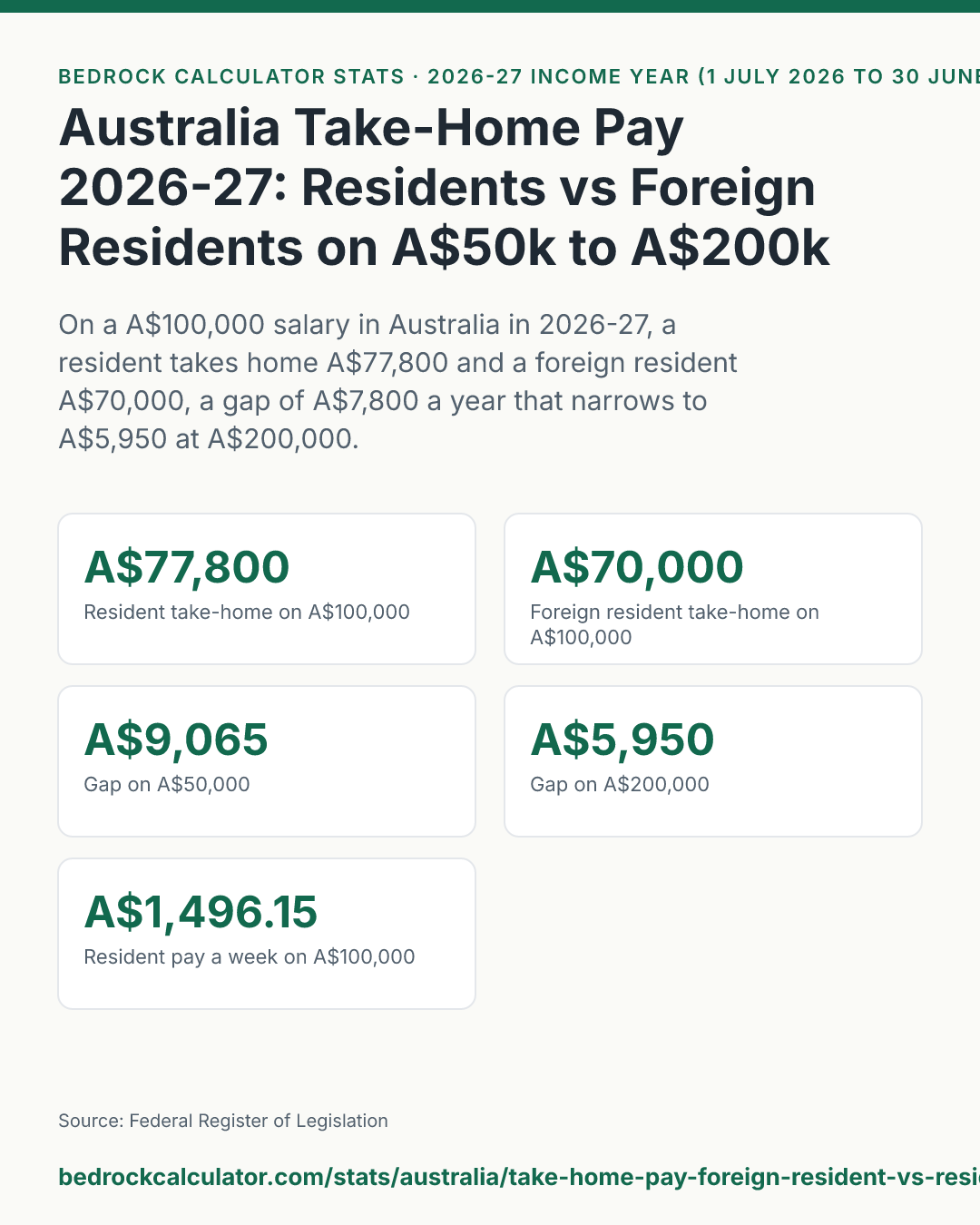
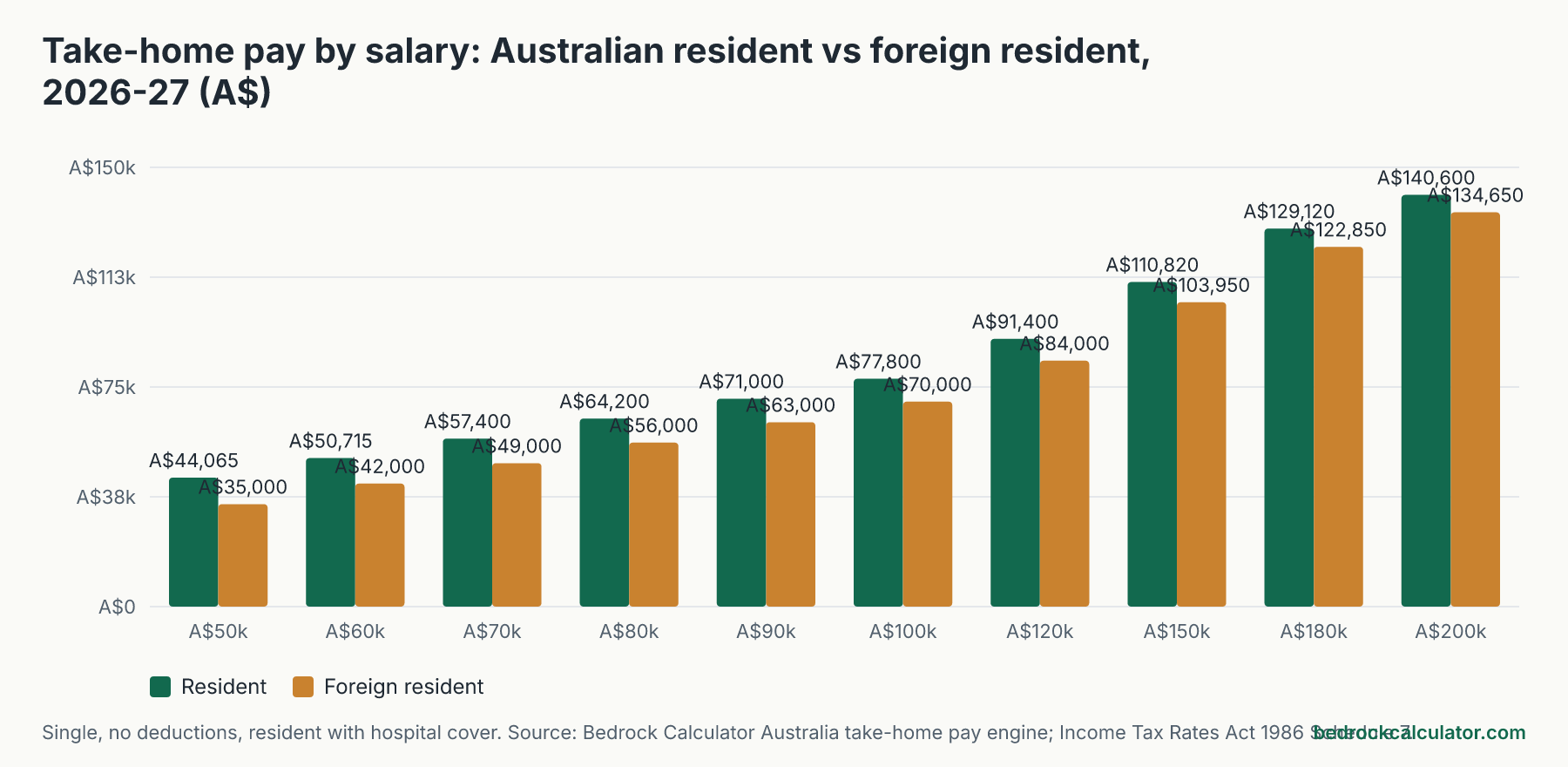
Two people in Australia earn the same A$100,000 salary in the 2026-27 income year. The one who is an Australian resident for tax purposes takes home A$77,800. The one who is a foreign resident takes home A$70,000. That's A$7,800 a year, or about A$300.00 every fortnight, and it comes down to residency alone.
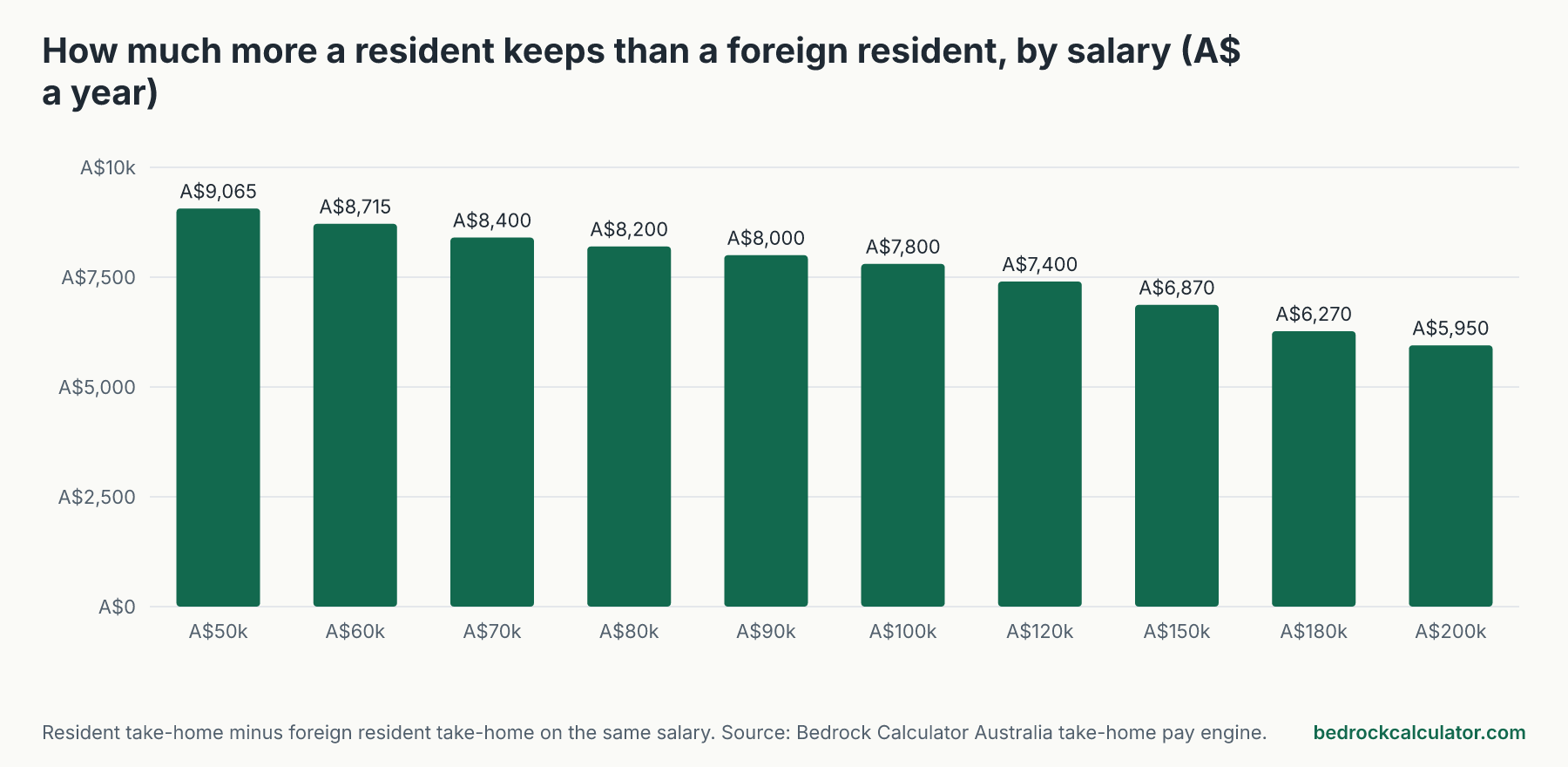
The gap is widest on smaller salaries and narrows as pay rises: A$9,065 at A$50,000, A$6,870 at A$150,000 and A$5,950 at A$200,000.
Why residency changes your pay so much
Australia taxes residents and foreign residents on different schedules, and nearly every difference runs in the resident's favour.
A resident pays nothing on the first A$18,200 of taxable income, then 15% up to A$45,000. A foreign resident has no tax-free threshold at all. Their first dollar is taxed at 30%, and that rate holds all the way to A$135,000. Above that the two schedules line up, so the difference is a head start on the bottom part of the salary that every resident gets and no foreign resident does.
Two smaller items widen it. Residents get the low income tax offset, worth A$265 on A$50,000 and nothing once salary is high enough for it to phase out. And from 1 July 2026 residents with labour income get a A$1,000 standard deduction for work expenses, which the law limits to Australian residents. A foreign resident gets neither.
The one thing that runs the other way is the Medicare levy. Foreign residents don't pay the 2% levy, while a resident does: A$1,980 on A$100,000 and A$3,980 on A$200,000. That's why the gap shrinks as salary goes up. The resident's head start on the bottom of the salary is a fixed amount, the low income tax offset fades away, and the levy keeps growing with pay.
How we worked out these numbers
Every figure here comes from running the Australia take-home pay calculator on this site, once for each salary as a resident and once as a foreign resident. Nothing is estimated by hand.
The setup is the same for every run:
- 2026-27 income year, single, no dependants
- Salary only, no work-related deductions claimed, no salary sacrifice to super
- The resident holds private hospital cover, so no Medicare levy surcharge applies
- Income tax after the low income tax offset, plus the Medicare levy for the resident
The calculator applies the resident rates in Schedule 7 Part I of the Income Tax Rates Act 1986 and the foreign resident rates in Part II, both as compiled at 1 July 2026. It gives a foreign resident no tax-free threshold, no low income tax offset, no standard deduction and no Medicare levy.
Every salary from A$50,000 to A$200,000
Click a column heading to sort. The last column is how much more a resident keeps each year on the same salary.
Australia take-home pay for residents and foreign residents, 2026-27 (A$ a year)
Download CSVSingle, no dependants, no work-related deductions claimed, no salary sacrifice. The resident holds private hospital cover, so no Medicare levy surcharge. Foreign residents pay no Medicare levy and get no tax-free threshold, low income tax offset or standard deduction.
| A$50,000 | A$5,935 | A$44,065 | A$15,000 | A$35,000 | A$9,065 |
| A$60,000 | A$9,285 | A$50,715 | A$18,000 | A$42,000 | A$8,715 |
| A$70,000 | A$12,600 | A$57,400 | A$21,000 | A$49,000 | A$8,400 |
| A$80,000 | A$15,800 | A$64,200 | A$24,000 | A$56,000 | A$8,200 |
| A$90,000 | A$19,000 | A$71,000 | A$27,000 | A$63,000 | A$8,000 |
| A$100,000 | A$22,200 | A$77,800 | A$30,000 | A$70,000 | A$7,800 |
| A$120,000 | A$28,600 | A$91,400 | A$36,000 | A$84,000 | A$7,400 |
| A$150,000 | A$39,180 | A$110,820 | A$46,050 | A$103,950 | A$6,870 |
| A$180,000 | A$50,880 | A$129,120 | A$57,150 | A$122,850 | A$6,270 |
| A$200,000 | A$59,400 | A$140,600 | A$65,350 | A$134,650 | A$5,950 |
On A$100,000 the resident's taxable income is A$99,000, because the standard deduction comes off first. The resident pays A$20,220 of income tax plus the levy, an average of 22.2% of salary. The foreign resident pays A$30,000, an average of 30.0%. On A$50,000 the averages are 11.9% and 30.0%, which is where residency matters most.
What a resident's pay looks like each week, fortnight and month
Most people think about pay in the amount that lands in the bank, not the yearly total. Here are the same resident figures divided the way the calculator divides them: by 52 weeks, 26 fortnights or 12 months.
Resident take-home pay per week, fortnight and month, Australia 2026-27 (A$)
Download CSVThe same resident runs as the table above, divided by 52 weeks, 26 fortnights or 12 months by the calculator.
| A$50,000 | A$847.40 | A$1,694.81 | A$3,672.08 |
| A$60,000 | A$975.29 | A$1,950.58 | A$4,226.25 |
| A$70,000 | A$1,103.85 | A$2,207.69 | A$4,783.33 |
| A$80,000 | A$1,234.62 | A$2,469.23 | A$5,350 |
| A$90,000 | A$1,365.38 | A$2,730.77 | A$5,916.67 |
| A$100,000 | A$1,496.15 | A$2,992.31 | A$6,483.33 |
| A$120,000 | A$1,757.69 | A$3,515.38 | A$7,616.67 |
| A$150,000 | A$2,131.15 | A$4,262.31 | A$9,235 |
| A$180,000 | A$2,483.08 | A$4,966.15 | A$10,760 |
| A$200,000 | A$2,703.85 | A$5,407.69 | A$11,716.67 |
A resident on A$50,000 takes home A$847.40 a week or A$3,672.08 a month. On A$100,000 it's A$1,496.15 a week or A$6,483.33 a month. On A$150,000 it's A$2,131.15 a week or A$9,235.00 a month, and on A$200,000 it's A$11,716.67 a month.
Your actual payslip can differ by a few dollars. Employers withhold using the ATO's withholding schedules, which round in their own way, and the difference is settled when you lodge your return. The figures here are the tax you end up owing for the year, spread evenly.
Who counts as a foreign resident
Residency for tax purposes isn't the same as citizenship or visa status. Someone living and working in Australia on a long visa is usually a resident for tax. Someone who lives overseas and earns Australian income, or who is here only briefly, is often a foreign resident. The tests turn on where you live, your intentions and how long you stay, and this page doesn't try to apply them. If you aren't sure which side you fall on, the ATO's residency guidance is the place to check before relying on either column.
Working holiday makers are left out. They have their own tax table, and whether they pay the Medicare levy depends on their residency, which this page can't know. The calculator offers a working holiday option if you want a rough figure.
What these numbers leave out
These figures compare residency and nothing else, so a few things that change real pay are switched off:
- HECS-HELP and other study loans. No study loan repayment is deducted in either column.
- Super. Salary is shown before compulsory employer super, which is paid on top.
- The Medicare levy surcharge. The resident holds hospital cover. Without it, a resident above the surcharge threshold pays more.
- Part-year residency. If you became or stopped being a resident during the year, your tax-free threshold is pro-rated, which this calculator doesn't model.
- Other income, deductions and tax treaties. Investment income, deductions above the standard amount and any double tax agreement relief are not included.
Run your own numbers
The Australia take-home pay calculator takes your salary, residency, pay frequency, deductions and salary sacrifice, and shows each deduction line by line. The Australia income tax calculator works on taxable income directly, and the Medicare levy calculator shows how the levy behaves on low incomes and for families. For residents comparing this year with last, our 2026-27 take-home pay article shows how much the tax cuts added at each salary.