How much tax is due on the same capital gain in each Canadian province?
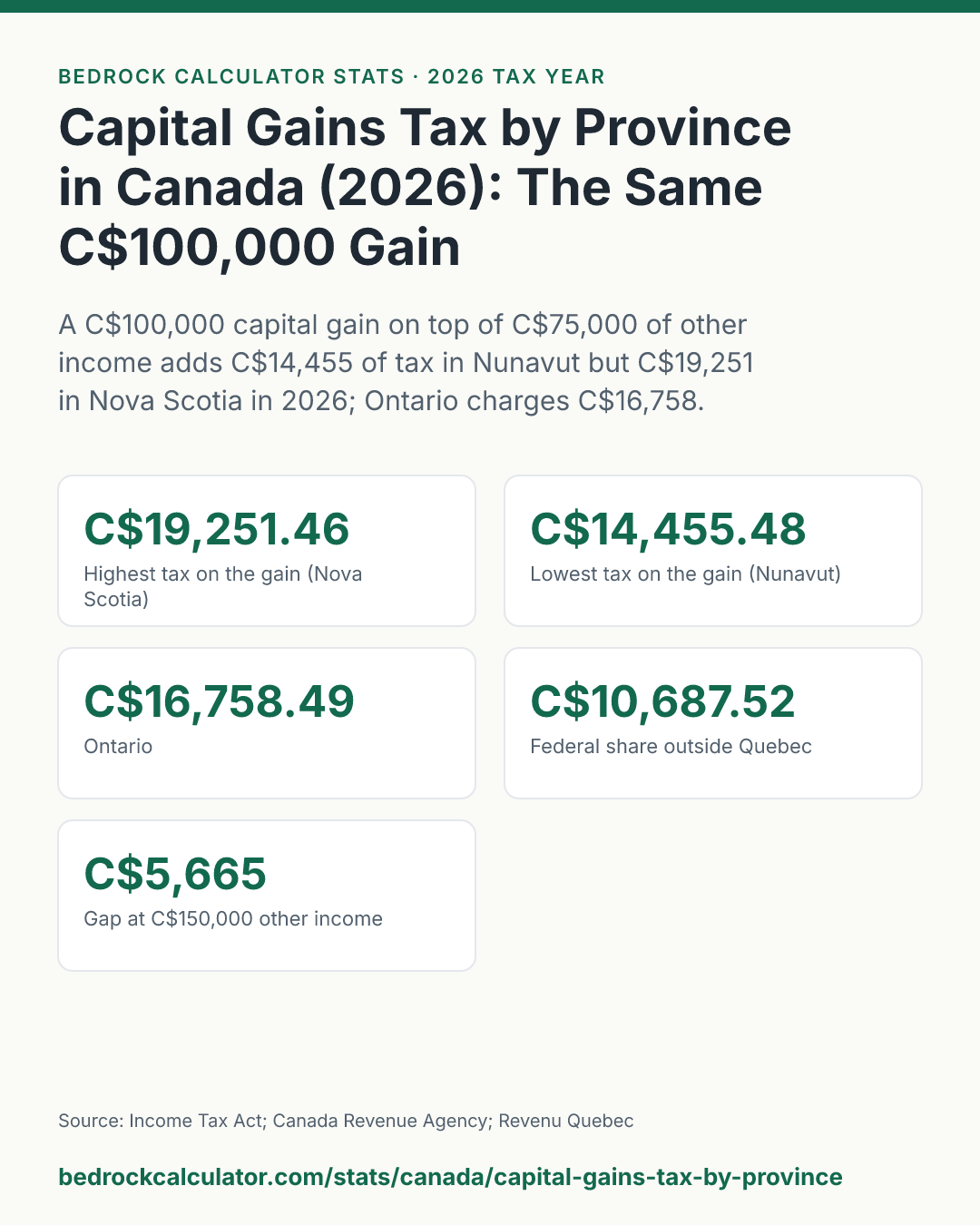
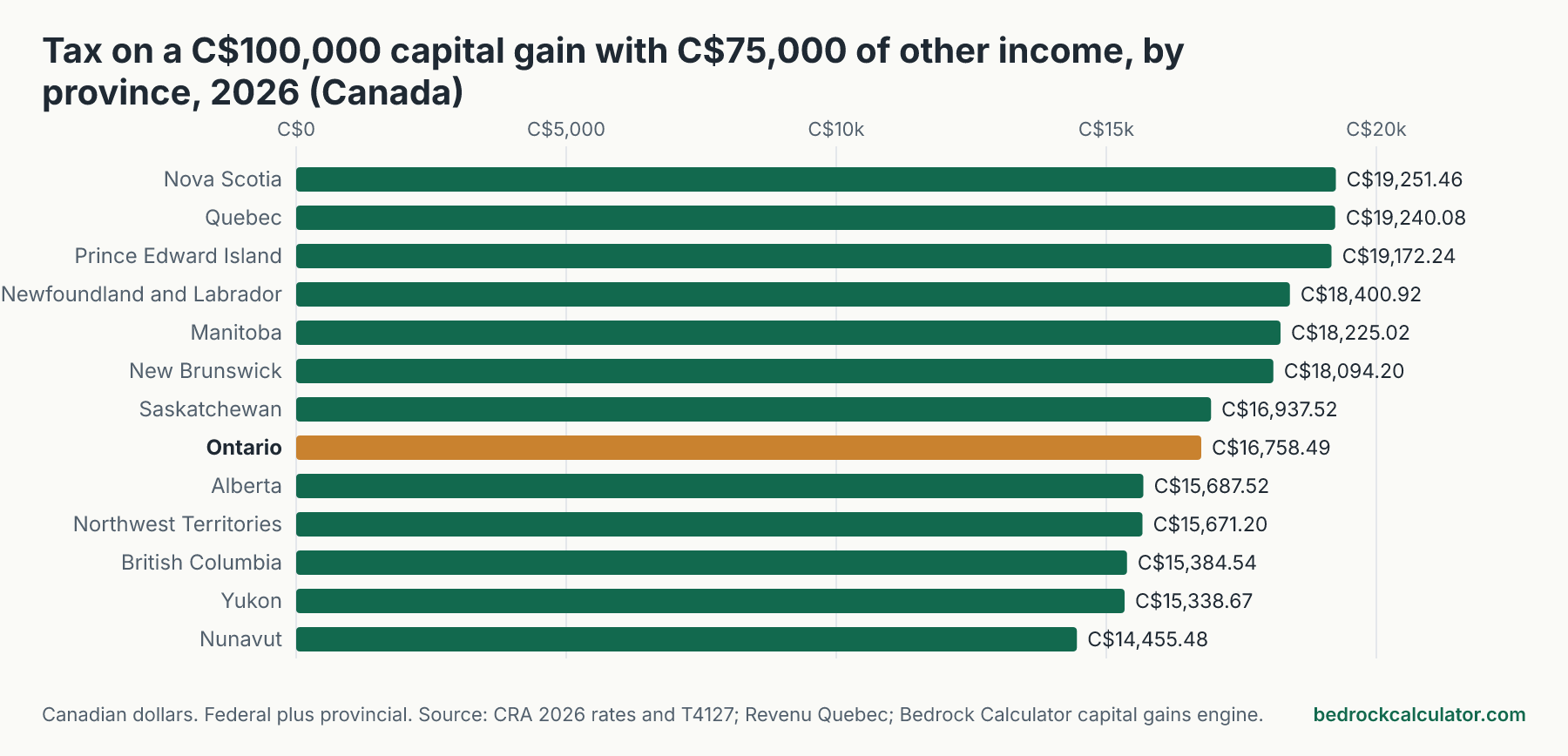
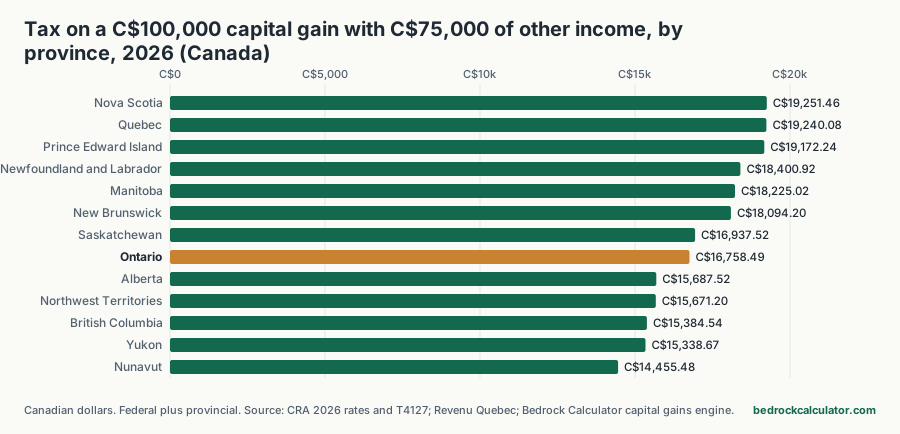
Sell an investment for a C$100,000 profit in 2026 and the tax you owe depends heavily on where in Canada you live. With C$75,000 of other income, the gain adds C$14,455.48 of tax in Nunavut and C$19,251.46 in Nova Scotia, a gap of C$4,796. Ontario sits in the middle at C$16,758.49.
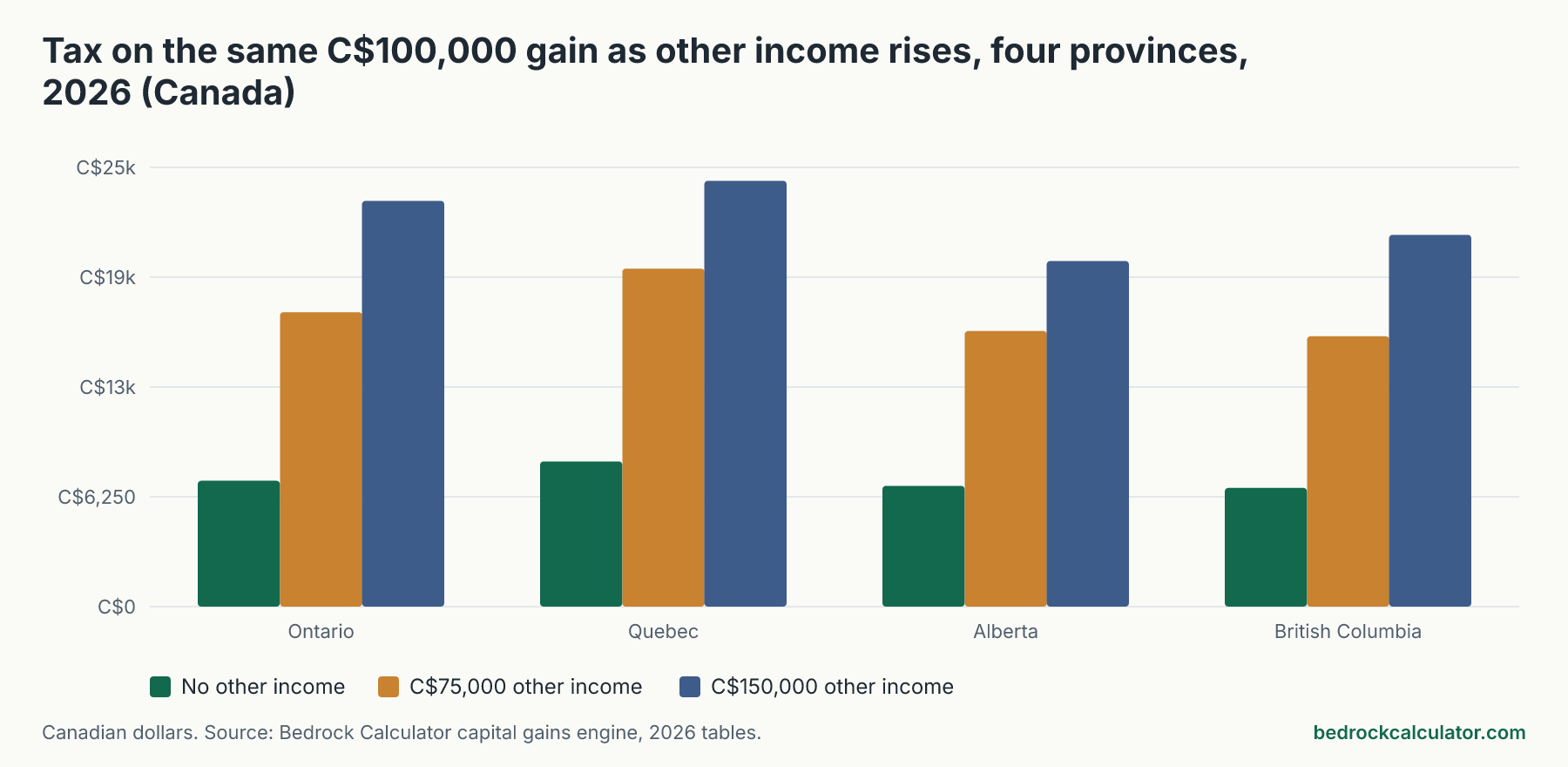
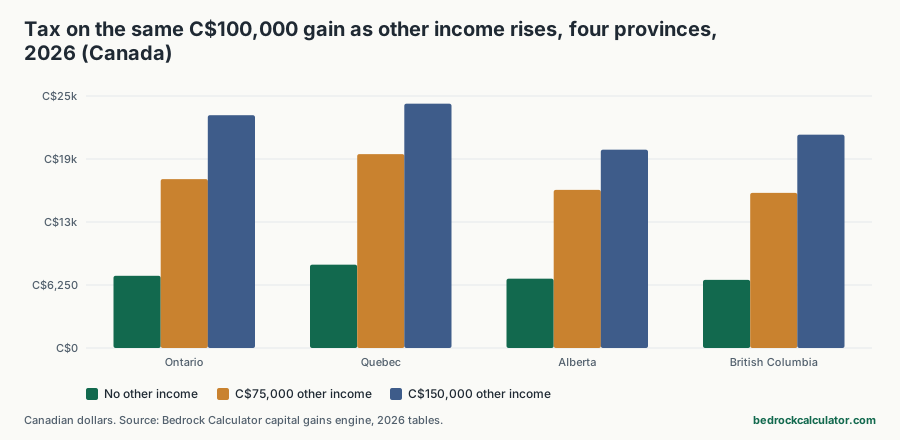
It also depends on what else you earned that year. In Ontario the same gain costs C$7,165.78 with no other income and C$23,096.34 with C$150,000 of other income.
How Canada taxes a capital gain
Canada doesn't have a separate capital gains tax rate. Under section 38 of the Income Tax Act, half of a capital gain is taxable. So on a C$100,000 gain, C$50,000 is added to your income for the year, and that half is taxed at your ordinary federal and provincial rates, the same as salary.
That's why the province matters. Federal tax on the gain is the same everywhere except Quebec: with C$75,000 of other income it's C$10,687.52. Quebec residents pay C$8,924.08 federally, because federal tax there is cut by the Quebec abatement, but then pay C$10,316.00 to Quebec. Everything else in the gap between provinces is provincial or territorial tax.
How we worked out these numbers
Every figure comes from the Canada capital gains tax calculator on this site. For each province and territory we entered a C$100,000 gain with no selling costs, no principal residence exemption and no carried-forward losses, at three levels of other taxable income: none, C$75,000 and C$150,000.
The calculator adds the taxable half of the gain on top of your other income, works out 2026 federal and provincial tax with the gain and without it, and reports the difference. That means a gain that pushes you into a higher bracket, into the Ontario surtax, or into the range where a basic personal amount starts shrinking is taxed exactly as the 2026 schedules say, not at one flat rate.
The brackets and basic personal amounts come from the Canada Revenue Agency's 2026 rate table and T4127 payroll formulas, and from Revenu Quebec for Quebec. Only the basic personal amount credits are applied. Other credits, provincial low-income reductions and the alternative minimum tax aren't modelled, and AMT in particular can matter for a very large gain.
The same gain in every province and territory
Click a column to sort. The effective rate is the tax divided by the whole C$100,000 gain, not just the taxable half.
Tax on a C$100,000 capital gain by province and territory, 2026 (Canadian dollars)
Download CSVHalf the gain is taxable, added on top of the other taxable income shown. Tax is the extra federal plus provincial tax the gain causes.
| Nova Scotia | C$9,213.61 | C$19,251.46 | C$23,862.20 | 19.25% | 23.86% |
| Quebec | C$8,268.48 | C$19,240.08 | C$24,240.64 | 19.24% | 24.24% |
| Prince Edward Island | C$8,659.78 | C$19,172.24 | C$23,111.54 | 19.17% | 23.11% |
| Newfoundland and Labrador | C$8,216.22 | C$18,400.92 | C$22,320.98 | 18.40% | 22.32% |
| Manitoba | C$8,450.98 | C$18,225.02 | C$22,311.54 | 18.23% | 22.31% |
| New Brunswick | C$8,112.30 | C$18,094.20 | C$21,826.41 | 18.09% | 21.83% |
| Saskatchewan | C$7,806.71 | C$16,937.52 | C$20,745.45 | 16.94% | 20.75% |
| Ontario | C$7,165.78 | C$16,758.49 | C$23,096.34 | 16.76% | 23.10% |
| Alberta | C$6,875.20 | C$15,687.52 | C$19,675.25 | 15.69% | 19.68% |
| Northwest Territories | C$6,573.04 | C$15,671.20 | C$20,223.14 | 15.67% | 20.22% |
| British Columbia | C$6,756.62 | C$15,384.54 | C$21,163.04 | 15.38% | 21.16% |
| Yukon | C$6,843.79 | C$15,338.67 | C$19,439.21 | 15.34% | 19.44% |
| Nunavut | C$5,910.36 | C$14,455.48 | C$18,575.57 | 14.46% | 18.58% |
Why your other income changes the answer so much
Because the taxable half stacks on top of everything else you earned, the gain lands in whatever brackets are left above your other income. With no other income, the first part of the gain is sheltered by the federal and provincial basic personal amounts and the rest falls in the lowest brackets. That's why the tax with no other income runs from just C$5,910.36 in Nunavut to C$9,213.61 in Nova Scotia.
With C$150,000 of other income, the whole taxable half sits in the upper brackets. The highest is now Quebec at C$24,240.64, and the lowest Nunavut at C$18,575.57, an effective rate of 18.58% on the gain against 24.24%.
Ontario shows the effect most sharply. Its effective rate on the gain climbs from 16.76% at C$75,000 of other income to 23.10% at C$150,000, because at the higher income the whole taxable half lands in Ontario's upper brackets, where both tiers of the Ontario surtax apply on top.
The provinces that charge the most and least
Nunavut charges the least at every income level we tested. Its territorial rates are the lowest in the country and its basic personal amount is large.
At the top, it depends on income. With no other income or C$75,000, Nova Scotia charges the most, because its middle brackets are high and start early. Quebec is a whisker behind at C$75,000, at C$19,240.08. With C$150,000 of other income Quebec moves to the top, because its upper provincial rates are the highest in the country.
In the West, the same gain with C$75,000 of other income costs C$15,687.52 in Alberta and C$15,384.54 in British Columbia.
What the half inclusion is worth
The half inclusion rate is the biggest tax break on a capital gain. In Ontario, with C$75,000 of other income, taxing the whole C$100,000 gain like salary would cost C$38,853.29. Including only half brings it to C$16,758.49, a saving of C$22,094.80.
Ways to reduce the tax on a gain
A few things change the numbers above, and the calculator handles most of them:
- Selling costs. Commissions and legal fees come off the gain before the half is taken. Enter them in the calculator.
- Carried-forward capital losses. Net capital losses from earlier years reduce the taxable half of this year's gain.
- Timing. Because the gain stacks on other income, selling in a lower-income year, such as early retirement or a sabbatical, can cut the tax a lot.
- Your home. A gain on a property designated as your principal residence for every year you owned it is fully sheltered.
- Donating shares. Giving publicly listed shares directly to a registered charity makes the taxable gain nil.
- Holding investments in a TFSA. Gains inside a TFSA are never taxed at all.
To run your own sale, use the capital gains tax calculator with your province and your other income. For the brackets behind these numbers, see our 2026 tax brackets by province, and for salary rather than gains, take-home pay by province. The Canada income tax calculator shows your marginal rate for any income.