How much wealth tax is due on the same net worth across Europe?
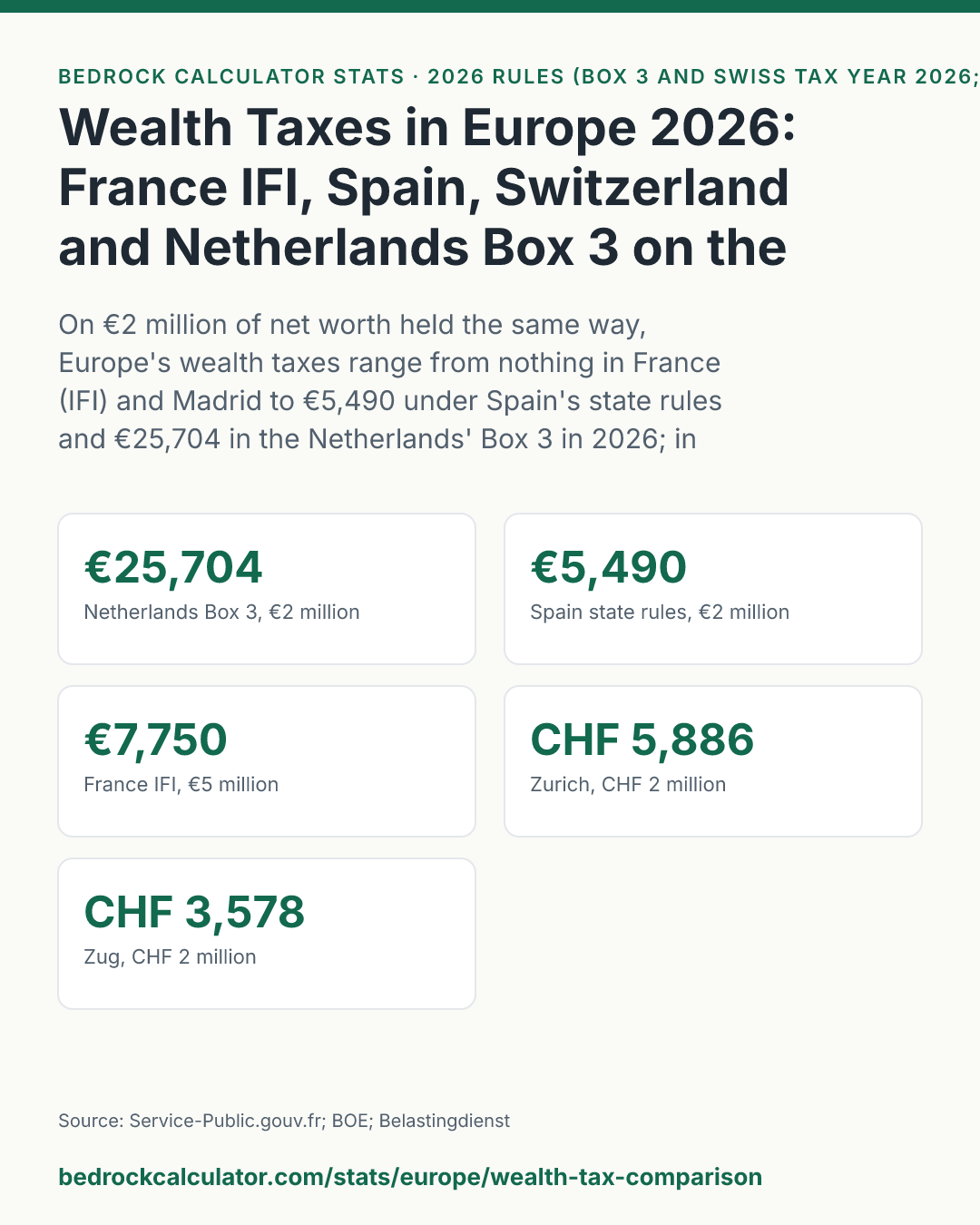
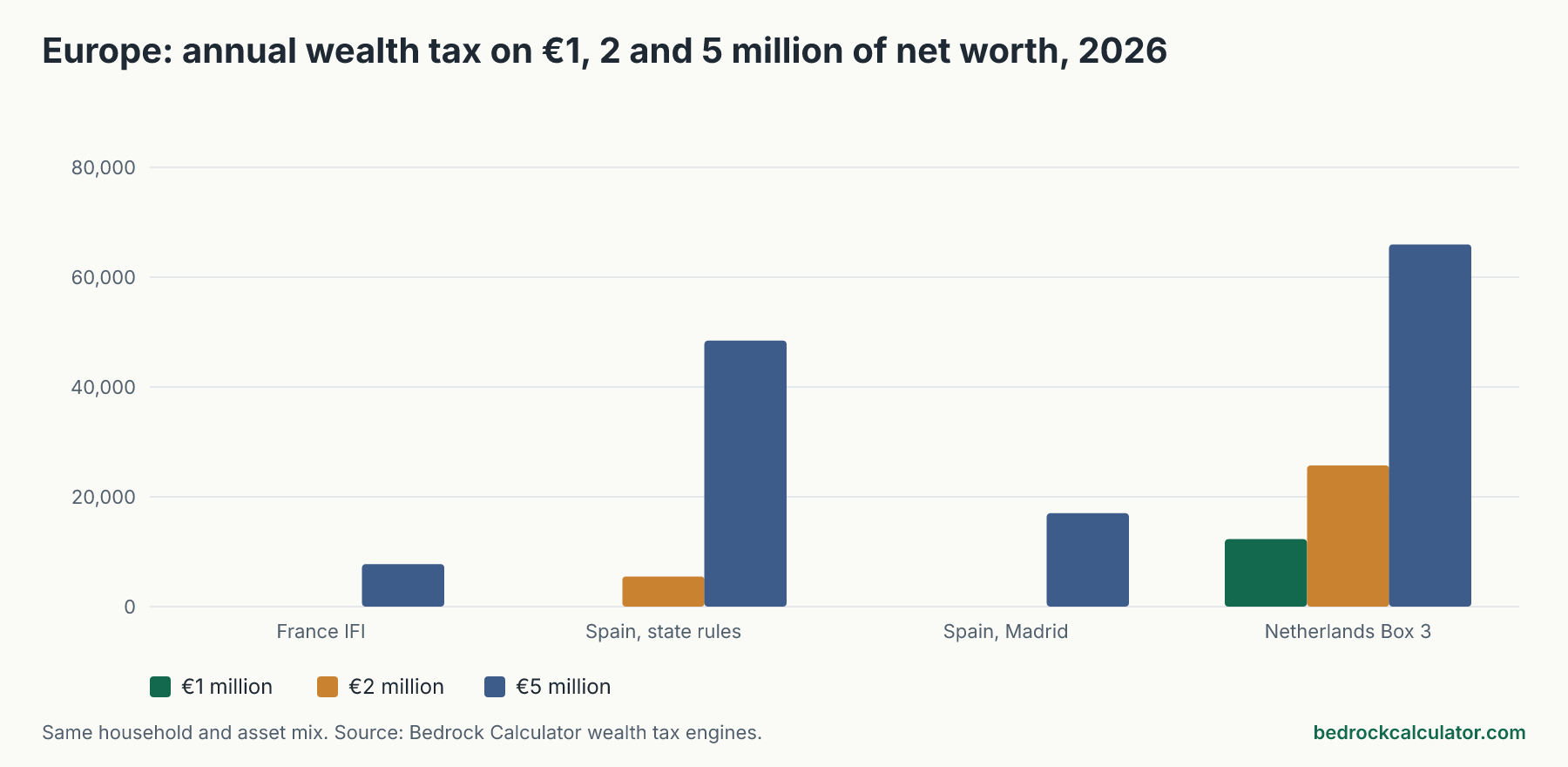
Europe's wealth taxes look similar on paper and behave very differently in practice. We took one household and priced its yearly wealth tax in four systems. On €2 million of net worth, France's IFI charges nothing, and neither does Madrid. Spain's state rules charge €5,490. The Netherlands' Box 3 charges €25,704.
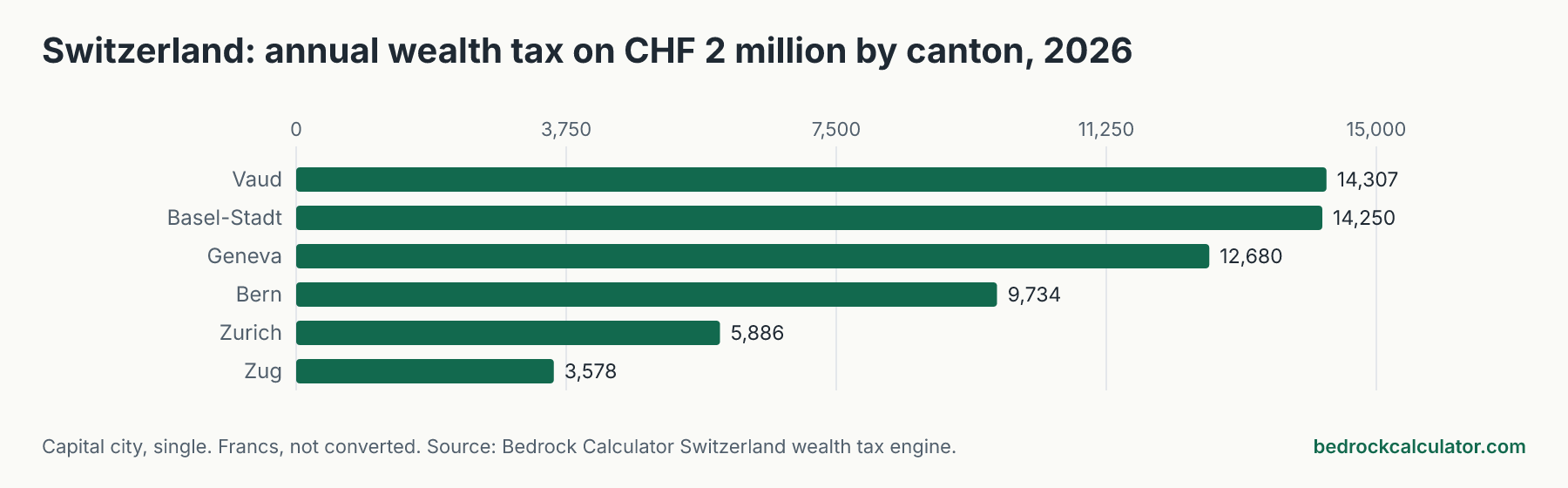
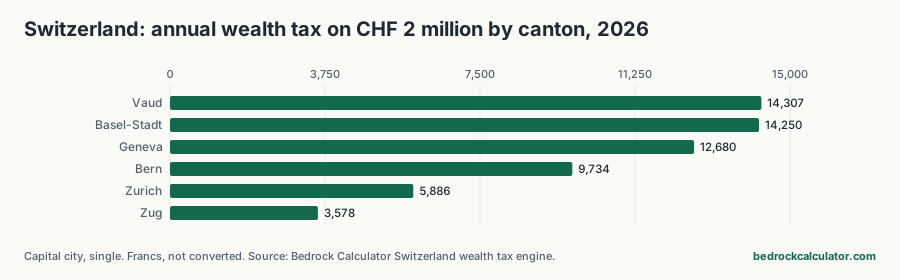
Switzerland taxes wealth in every canton, and the canton matters as much as the amount. On the same figure in francs, CHF 2 million, Zug charges CHF 3,578 and Vaud charges CHF 14,307.
The household we priced
Each tax counts different things, so we used one realistic mix and let each system see what it taxes. The household is a single person whose net worth is 30% their main home, 20% a second property they rent out, 40% shares and funds and 10% cash in the bank, with no debt. We ran it at €1 million, €2 million and €5 million.
Here's what each tax picks up from that:
- France, IFI. Real estate only. The main home gets a 30% reduction. Shares and cash are ignored.
- Spain, Impuesto sobre el Patrimonio. Everything, with the main home exempt up to a cap and a general exemption on top. Above a higher threshold, the state's solidarity tax on large fortunes also applies.
- Netherlands, Box 3. Savings, investments and the second property. The main home sits in Box 1 and isn't counted.
- Switzerland, Vermögenssteuer. Total net wealth, taxed by the canton and commune.
Wealth tax on €1, 2 and 5 million
Switzerland is shown in francs at the same nominal amounts. We didn't convert anything, so compare the Swiss rows with each other rather than with the euro rows. Sort by any column.
Annual wealth tax in Europe on the same net worth, 2026
Download CSVPer year. Net worth split 30% main home, 20% second property, 40% investments, 10% savings, no debt, single person. Euro countries in euros; Swiss cantons in francs at the same nominal net worth, not converted. Source: Bedrock Calculator wealth tax engines.
| Netherlands: Box 3 | EUR | 12,282.78 | 25,703.58 | 65,965.98 |
| Switzerland: Vaud | CHF | 6,391 | 14,307 | 38,053 |
| Switzerland: Basel-Stadt | CHF | 6,350 | 14,250 | 37,950 |
| Switzerland: Geneva (provisional) | CHF | 5,116 | 12,680 | 38,114 |
| Switzerland: Bern | CHF | 4,027 | 9,734 | 27,630 |
| Switzerland: Zurich | CHF | 2,002 | 5,886 | 23,387 |
| Spain: Patrimonio, state rules | EUR | 0 | 5,490.36 | 48,446.37 |
| Switzerland: Zug | CHF | 1,368 | 3,578 | 10,208 |
| France: IFI (real estate only) | EUR | 0 | 0 | 7,750 |
| Spain: Madrid (100% rebate, solidarity tax applies) | EUR | 0 | 0 | 17,000 |
Why Box 3 costs the most here
Box 3 isn't called a wealth tax, but it works like one. It assumes your savings and investments earned a fixed return, then taxes that assumed return. Because the assumed return on investments is high and there's only a small tax-free allowance, the bill is large and grows almost in step with wealth: €12,283 at €1 million, €25,704 at €2 million and €65,966 at €5 million. That's about 1.29% of total net worth every year, even though the main home is excluded.
There is a way out for some. Since 2024 you can ask to be taxed on your actual return if it was lower. Our Box 3 study goes through the details.
Spain: the region decides
Spain's wealth tax is a state tax handed to the regions, and they've gone in opposite directions. Under the state rules, with the standard exemption and no regional rebate, our household pays nothing at €1 million, €5,490 at €2 million and €48,446 at €5 million.
Madrid and Andalucía rebate the whole tax. That used to mean no wealth tax at all, which is why the state added a solidarity tax on large fortunes in 2022. It applies only above a high threshold, and the regional wealth tax paid counts against it. So in Madrid our household pays nothing at €2 million but €17,000 at €5 million, all of it solidarity tax.
Regions with their own scales and exemptions, such as Catalonia and Valencia, aren't modelled, so their bills could differ from the state figure.
France: only property counts
France replaced its old wealth tax with the IFI in 2018, and it now taxes real estate only. Our household's shares and cash are invisible to it. Net taxable real estate at €2 million of net worth is €820,000, below the threshold, so the bill is zero. At €5 million it's €2,050,000 and the IFI is €7,750.
The flip side: a French household with most of its wealth in property would pay much more than ours. The same €5 million all in real estate would be a very different bill.
Switzerland: every canton, very different rates
Every Swiss canton taxes net wealth each year, and the rates vary a lot. On CHF 2 million, Zug charges CHF 3,578, Zurich CHF 5,886, Bern CHF 9,734 and Geneva CHF 12,680.
At CHF 5 million the range runs from CHF 10,208 in Zug to CHF 38,114 in Geneva, or from 0.20% to 0.76% of net worth a year. Swiss wealth tax isn't a small line on the bill, but Switzerland has no general capital gains tax on private investments, which offsets some of it.
How we worked out these numbers
Every figure comes from one of this site's calculators: the France wealth tax (IFI) calculator, the Spain wealth tax calculator, the Netherlands Box 3 calculator and the Switzerland wealth tax calculator. We split each net worth into the mix above and gave each calculator the parts it asks for.
Norway also has a wealth tax and a calculator on this site, but it works in kroner, and the same nominal figure would be a much smaller fortune. Rather than convert, we left it out.
What these numbers leave out
Swiss property values. Swiss cantons tax real estate at an official tax value that's usually well below market value. We passed the full net worth to the calculator, so the Swiss figures are higher than our household would really pay.
Caps tied to income. Spain limits income tax plus wealth tax to 60% of the income tax base, cutting the wealth tax by up to 80%. France caps income tax, IFI and social charges at a share of income. Some cantons have similar brakes. None are applied, so a wealthy household with a low income could pay less.
Couples. Everything is for a single person. Couples get a double allowance in Box 3 and larger exemptions in most cantons, and Spanish and French rules apply per person or per household in their own ways.
Exemptions for businesses. Family business and business property exemptions in Spain and France can remove large amounts from the base. They're not modelled.
Run your own numbers
Use the Box 3 calculator, the Spain wealth tax calculator with your region's exemption and rebate, the IFI calculator or the Switzerland wealth tax calculator with your own figures. If you're also buying property, our comparison of property transfer tax across Europe shows the one-off tax when you buy.